

Fundamental Analysis | Trading Course

How Economic Events, Central Bank Decisions, and Market Expectations Affect Currencies
Fundamental analysis is a method of evaluating the financial market based on economic, political, and social factors. Its goal is not simply to find out whether the economy is doing well or poorly, but to understand how new data can change investor expectations and impact the value of a currency.
In the foreign exchange market, two economies are always being compared. For example, when analyzing the EURUSD ... pair, a trader must evaluate not only the state of the Eurozone economy but also the situation in the US. The euro might decline even amidst positive European data if American statistics turn out to be even stronger.
The Core Question of Fundamental Analysis
The main question of fundamental analysis is: Which of the two currencies will be in higher demand in the near term?
1. What Determines the Value of a Currency
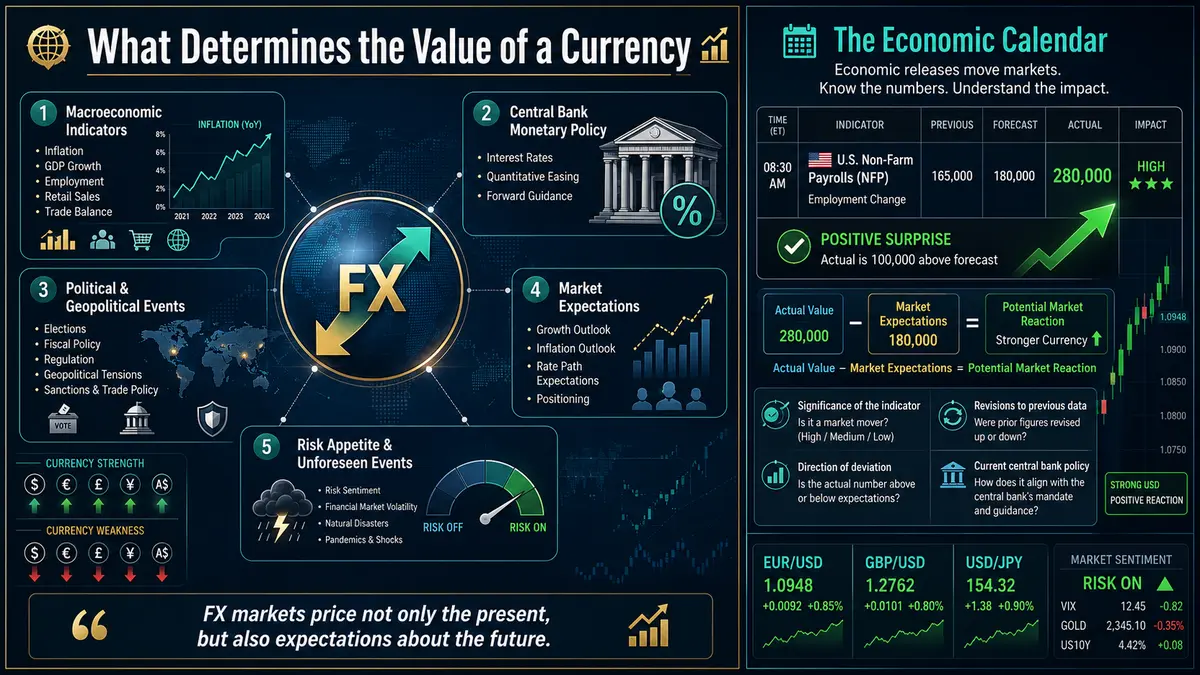
A national currency reflects the state of a country’s economy; however, its exchange rate depends on more than just current economic performance.
Five Main Groups of Factors
The value of a currency is influenced by five key elements:
-
Macroeconomic indicators.
-
Monetary policy of the central bank.
-
Political and geopolitical events.
-
Market participants’ expectations.
-
Unforeseen events and shifts in global risk appetite.
It is important to understand that the foreign exchange market prices in not only the present but also the future. Investors try to anticipate how interest rates, inflation, economic growth, and international capital flows will change. Because of this, the market often starts moving even before an indicator is officially published.
2. The Economic Calendar
The economic calendar is one of the primary tools for a fundamental trader. It lists the dates and times for the release of statistical data, central bank meetings, speeches by their representatives, and other significant events.
Reading the Calendar Data
For each indicator, three values are typically provided:
-
Previous value: The result from the last reporting period.
-
Forecast: The expected value calculated by analysts.
-
Actual value: The result published by a government agency or statistical bureau.
The market usually reacts not to the indicator itself, but to the difference between the actual value and the forecast.
Example of Market Reaction
For instance:
-
Employment growth forecast: 180,000 jobs.
-
Actual result: 280,000 jobs.
This result significantly exceeded expectations. If the other components of the report are also strong, participants might start buying the national currency. But if the market had already anticipated very good data and priced it in beforehand, the reaction might be weak or even the opposite.
The Market Reaction Formula
Actual value − Market expectations = Potential strength of the reaction.
When evaluating this potential reaction, a trader must consider the following:
-
The significance of the indicator.
-
The direction of the deviation from the forecast.
-
Revisions to previous data.
-
The current policy of the central bank.
-
The currency
3. Gross Domestic Product (GDP)
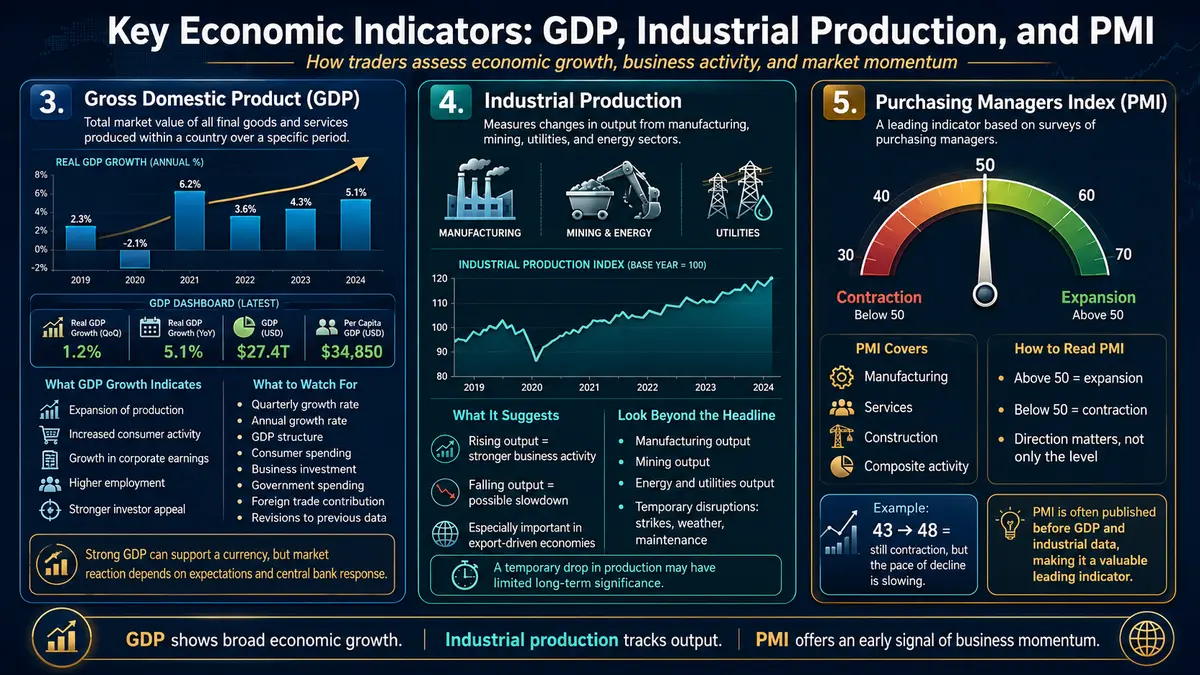
Gross Domestic Product is the total market value of all final goods and services produced within a country’s borders over a specific period.
GDP is considered one of the primary indicators of a state’s economic health. Typically, the quarterly change and annual growth rate are published.
What GDP Growth Indicates
An increase in GDP can be a sign of:
-
Expansion of production
-
Increased consumer activity
-
Growth in corporate earnings
-
Higher employment
-
The economy’s attractiveness to investors
Strong GDP figures usually support the national currency because they increase the likelihood of capital inflows and a tighter central bank policy.
However, this connection is not automatic. If economic growth was already anticipated, positive data might have little to no impact on the market. Furthermore, overly rapid growth can accelerate inflation, forcing investors to assess the central bank’s potential response.
What to Watch For
When evaluating GDP, you should analyze:
-
The quarterly growth rate
-
The annual growth rate
-
The structure of the GDP
-
Consumer spending
-
Business investments
-
Government spending
-
The contribution of foreign trade
-
Revisions to previous data
Revisions can be just as important as the new release. If a previous figure is significantly revised downward, an initially positive market reaction can quickly disappear.
4. Industrial Production
Industrial production measures the change in the output volume of the manufacturing, mining, energy, and utility sectors.
Growth in production generally indicates an increase in business activity and demand, while a decline may point to an economic slowdown. This indicator is particularly crucial for countries where industry and exports make up a significant portion of the economy.
Looking Beyond the Headline Number
A trader must consider not only the final number but also the reasons driving the change. For example, a temporary reduction in production caused by a strike, severe weather conditions, or facility maintenance might only have a limited impact on the long-term assessment of the economy.
5. Purchasing Managers Index (PMI)
Business activity indices were not covered in detail in the source material, even though they are among the most closely monitored leading indicators.
PMI is calculated based on surveys of purchasing managers and reflects the health of:
-
The manufacturing sector
-
The services sector
-
The construction sector
-
Composite business activity
Interpreting PMI Data
A reading above 50 points generally indicates an expansion in business activity, while a level below 50 indicates contraction.
It is important to analyze not just where the index stands relative to the 50-point mark, but also its direction of movement. For instance, if the index rises from 43 to 48, it means the sector is still contracting, but the pace of deterioration is slowing down. The market may interpret this dynamic as a positive sign.
Because PMI is often published earlier than official production and GDP data, it serves as a valuable tool for assessing the state of the economy in advance.
6. The Labor Market
The state of the labor market is of immense importance because employment is directly linked to household income, consumption, and inflation.
A strong labor market usually means that people are earning an income, actively purchasing goods and services, and companies maintain a strong demand for workers.
Unemployment Rate
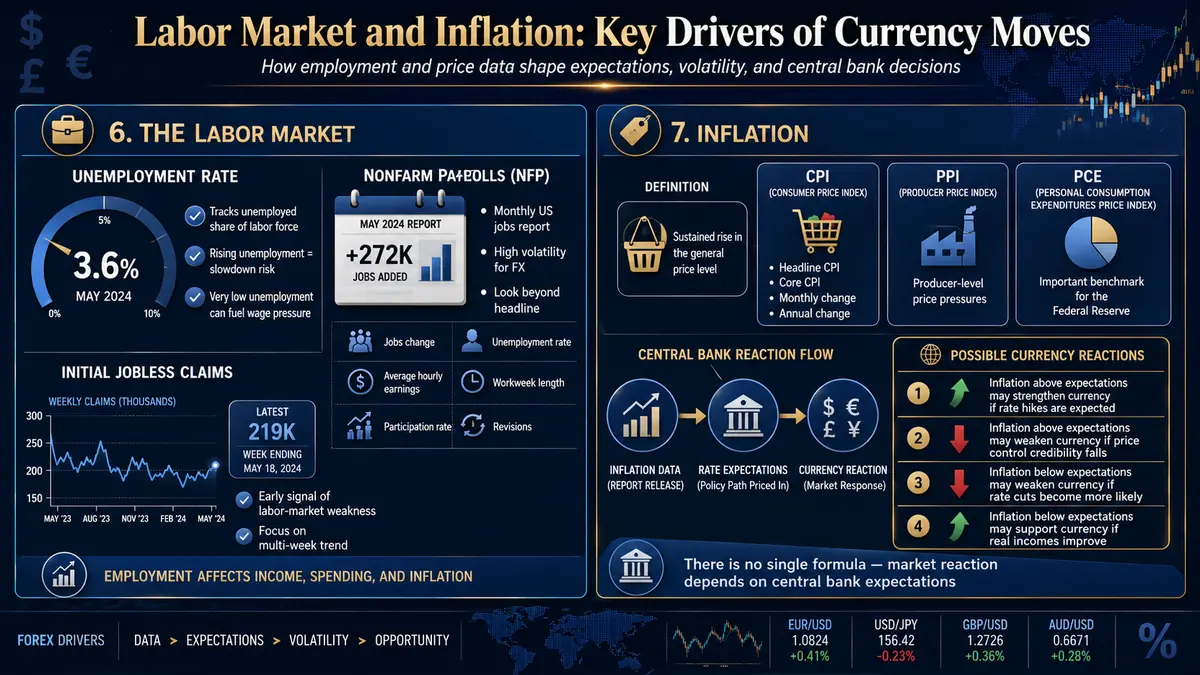
The unemployment rate shows the percentage of unemployed individuals among the economically active population (the labor force).
An increase in unemployment is generally a negative signal, as it can indicate:
-
A contraction in business activity
-
A decrease in household income
-
A decline in consumer demand
-
An economic slowdown
A decrease in unemployment is usually perceived positively. However, extremely low unemployment can create a labor shortage and accelerate wage growth. This can increase inflationary pressure and heavily influence the central bank’s decisions.
Nonfarm Payrolls
The Nonfarm Payrolls report shows the change in the number of jobs in the non-agricultural sectors of the US economy.
It is published monthly and traditionally causes elevated volatility in the foreign exchange market. To fully analyze the report, looking solely at the headline number of new jobs is insufficient. It is necessary to simultaneously evaluate:
-
The change in overall employment
-
The unemployment rate
-
Average hourly earnings growth
-
The length of the average workweek
-
The labor force participation rate
-
Revisions to the previous months’ results
For example, a high number of new jobs might initially seem positive. But if the unemployment rate sharply increases and wage growth slows down at the same time, the currency’s final reaction may be mixed.
Initial Jobless Claims
This indicator reflects the number of people filing for unemployment benefits for the first time.
It is released weekly and helps to promptly assess short-term changes in the labor market. A continuous rise in claims can be an early signal of deteriorating employment. However, a single week rarely forms a long-term trend, so it is better to analyze the moving average over several weeks.
7. Inflation
Inflation is the sustained increase in the general price level of goods and services.
Basic educational materials often use a simplified rule: rising inflation means a falling currency. In practice, the market’s reaction is significantly more complex.
High inflation does indeed reduce the purchasing power of money. However, at the same time, it can force the central bank to raise interest rates. The expectation of higher rates can attract capital and temporarily strengthen the currency. Therefore, a trader must evaluate not only the inflation data itself but also the probable reaction of the central bank.
Consumer Price Index (CPI)
The CPI measures the change in the cost of a consumer basket of goods and services.
Typically, the following are analyzed:
-
Headline CPI (the overall index)
-
Core CPI
-
The monthly change
-
The annual change
The core index excludes the most volatile categories, primarily food and energy. It helps to assess the persistent component of underlying inflationary pressure.
Producer Price Index (PPI)
The PPI measures price changes at the producer level.
Rising production costs can eventually pass through to consumer prices if companies shift the additional expenses onto buyers. However, PPI does not always directly determine future CPI. Companies may temporarily accept lower profit margins without raising their retail prices.
The Preferred Inflation Indicator
Some central banks do not focus solely on the CPI. For example, when evaluating US monetary policy, the Federal Reserve pays significant attention to the Personal Consumption Expenditures (PCE) price index.
Therefore, before analyzing a currency, it is necessary to determine which inflation indicator serves as the primary benchmark for the respective central bank.
Possible Currency Reactions
-
Inflation above expectations can strengthen a currency if the market anticipates an interest rate hike.
-
Inflation above expectations can weaken a currency if investors believe the central bank has lost control over prices.
-
Inflation below expectations can weaken a currency if the probability of an interest rate cut increases.
-
Inflation below expectations can support a currency if falling prices boost real consumer incomes without threatening economic growth.
Consequently, there is no single formula that applies to all situations.
8. Retail Sales and Consumer Activity
Retail sales measure the change in the total volume of goods purchased by consumers.
Consumer spending accounts for a significant portion of the economy in many countries. Consequently, growth in retail sales indicates resilient domestic demand. Strong figures can support the national currency by boosting economic growth and inflation forecasts. However, excessively rapid growth in consumption can heighten expectations of interest rate hikes.
Key Aspects of Retail Sales Data
In addition to the headline figure, it is useful to consider:
-
Sales ex-autos (excluding automobiles)
-
Sales ex-fuel (excluding fuel)
-
The impact of inflation
-
Seasonal adjustment factors
-
Changes in consumer credit levels
9. Construction and the Housing Market
Housing Starts
Housing starts indicate how many new residential building projects began construction during the reporting period. The real estate market is closely connected to many other economic sectors, including:
-
Bank lending
-
Construction materials
-
Employment
-
Consumer spending
-
Household income
An increase in housing starts is generally a positive economic signal. However, it should always be evaluated alongside mortgage rates, existing home sales, and the number of building permits issued.
Building Permits
Building permits are considered a key leading indicator because they are issued before actual construction work can begin. A rise in the number of permits signals potential growth in future construction activity.
10. Trade Balance
The trade balance represents the difference between the monetary value of a country’s exports and imports of goods over a given period.
When exports exceed imports, a country records a trade surplus. When imports exceed exports, it results in a trade deficit. A trade surplus can support the national currency, as foreign buyers must acquire the local currency to pay for exported goods.
Key Factors Influencing Market Impact
In practice, the actual impact on the market depends on a variety of factors:
-
The structural composition of exports
-
Commodity price fluctuations
-
The volume of capital equipment imports
-
Foreign capital flows
-
Fiscal policy
-
The country’s broader position in international trade
For instance, an increase in imports is not inherently negative. If businesses are actively importing machinery and technology to expand production, higher imports signal future investment and economic growth.
To gain a complete financial picture, traders should evaluate both the trade balance and the broader current account of the balance of payments.

11. Central Banks and Interest Rates
Central bank decisions are among the most critical drivers in the foreign exchange market. The benchmark interest rate serves as a primary focal point for evaluating a national currency.
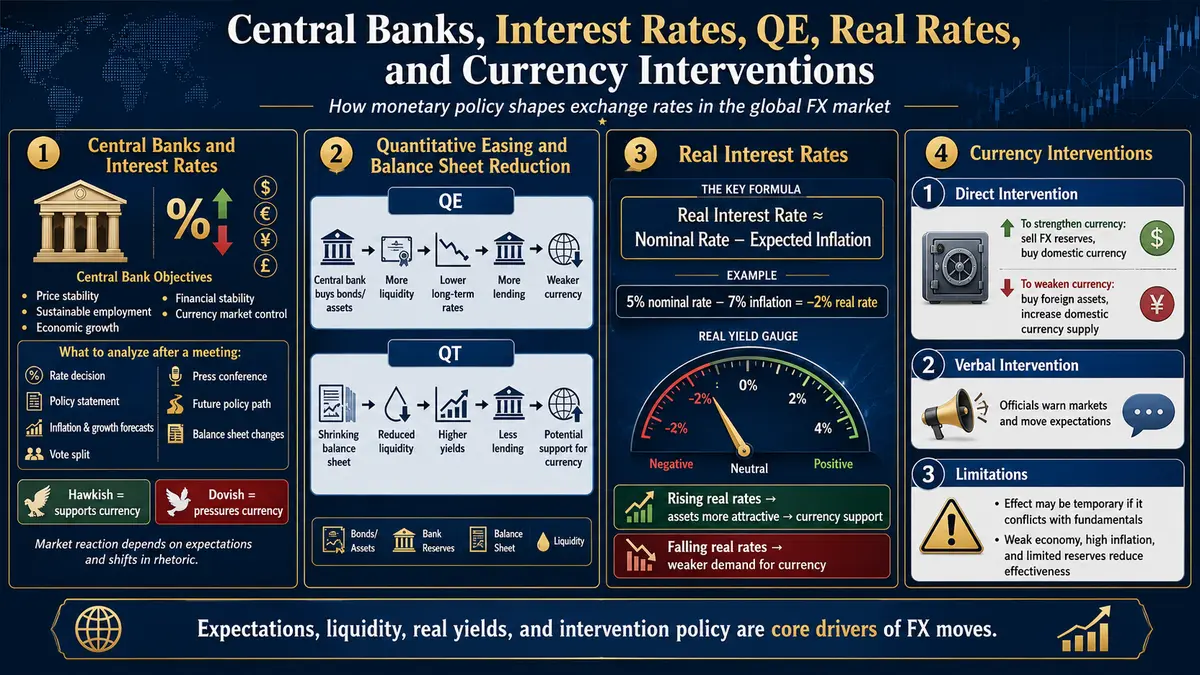
Central banks typically pursue several key objectives:
-
Maintaining price stability
-
Ensuring sustainable employment
-
Supporting economic growth
-
Safeguarding financial system stability
-
Controlling the currency market
Key Interest Rate
The key interest rate directly impacts borrowing costs, yields on financial instruments, and international capital flows.
A higher interest rate makes assets denominated in the national currency potentially more attractive to investors. Consequently, expectations of a rate hike often provide support to the currency. Conversely, a rate cut makes borrowing cheaper and stimulates economic activity, but it can simultaneously reduce the currency’s appeal to international capital.
However, the market reaction always depends on expectations. If the market was already confident in a rate hike, the decision itself may not trigger a currency rally. If a central bank raises rates but signals that the tightening cycle is drawing to a close, the currency may even decline.
What to Analyze After a Central Bank Meeting
Following a rate announcement, a trader should evaluate:
-
The interest rate decision itself
-
The wording of the accompanying policy statement
-
Updated inflation and economic growth forecasts
-
The vote breakdown among monetary policy committee members
-
The central bank governor’s press conference
-
The anticipated path of future monetary policy
-
Changes in the central bank’s balance sheet
Hawkish Policy
Monetary policy is described as hawkish when the central bank signals a readiness to combat inflation by raising interest rates or reducing monetary stimulus. Hawkish statements typically support the currency.
Dovish Policy
Dovish policy implies lower interest rates, credit stimulation, and economic support. Dovish statements generally put downside pressure on the currency.
However, what matters most is not just the absolute stance, but a shift in rhetoric. If a central bank remains dovish but becomes less dovish, the market may still interpret this shift as a positive signal for the currency.
12. Quantitative Easing and Balance Sheet Reduction
Central banks influence financial conditions through mechanisms beyond just benchmark interest rates.
Quantitative Easing (QE)
Quantitative Easing involves a central bank purchasing government bonds and other financial assets from the open market. This policy:
-
Increases liquidity in the banking system
-
Lowers long-term interest rates
-
Stimulates commercial lending
-
Tends to weaken the national currency
Quantitative Tightening (QT)
Quantitative Tightening refers to reducing the assets on the central bank’s balance sheet or halting the reinvestment of maturing bonds. QT drains excess liquidity and can drive up bond yields. Under certain conditions, this policy provides support to the national currency.
13. Real Interest Rates
The nominal interest rate alone does not provide a complete picture of asset attractiveness. Investors care primarily about real yields:
Real Interest Rate ≈ Nominal Interest Rate − Expected Inflation
For example, a nominal rate of 5% alongside 7% inflation results in a negative real rate of roughly −2%.
If real interest rates rise, a country’s financial assets tend to become more attractive to capital. If real rates fall, demand for the currency can drop. This explains why a currency sometimes fails to strengthen after a key rate hike: inflation may simply be accelerating at a faster pace than the nominal rate increase.
14. Currency Interventions
A currency intervention is an official action taken by a central bank or government to directly influence the exchange rate of its national currency. Interventions are generally divided into direct (actual) and verbal interventions.
Direct Intervention
In a direct intervention, the central bank actively buys or sells currency in the foreign exchange market.
-
To strengthen the currency: The central bank sells foreign currency reserves and buys its own national currency.
-
To weaken the currency: The central bank buys foreign assets, increasing the supply of its own currency in circulation.
Verbal Intervention
In a verbal intervention, central bank officials publicly express dissatisfaction with the current exchange rate or warn of potential future actions. Even without physical transactions, such statements can trigger significant market volatility as traders adjust their positions in anticipation of real intervention.
Limitations of Interventions
The impact of an intervention is often temporary if the central bank’s actions run counter to fundamental market forces. For example, defending a currency is exceptionally difficult if the underlying economy is weakening, inflation remains persistently high, and foreign exchange reserves are limited.
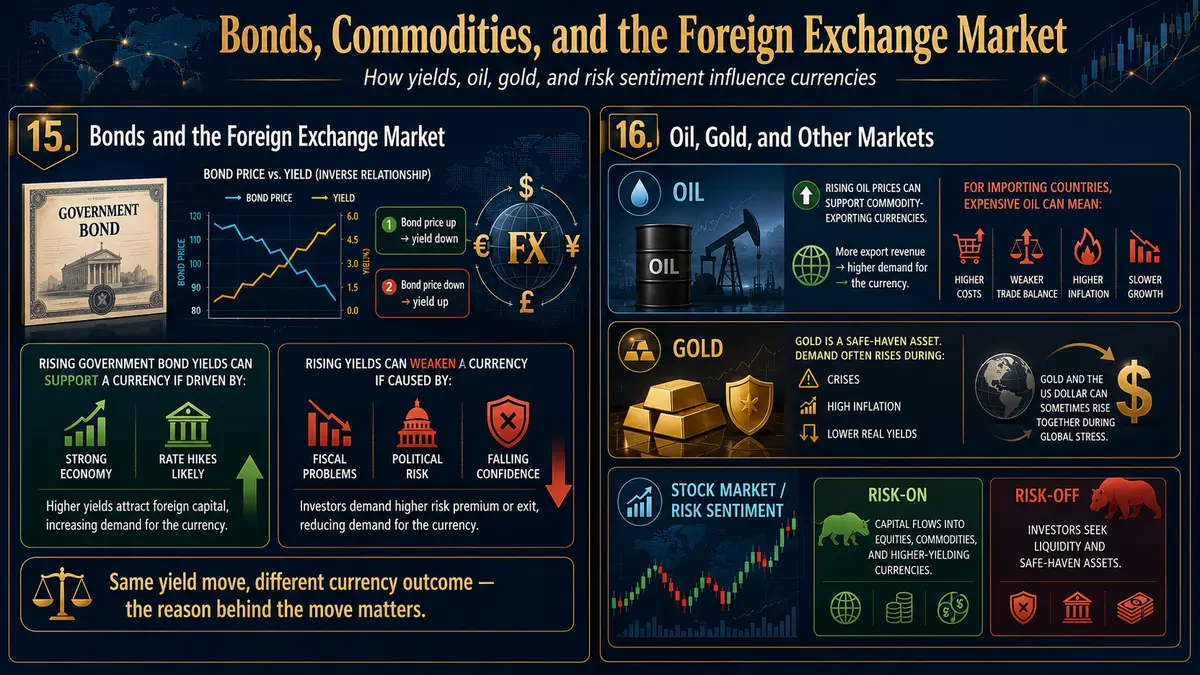
15. Bonds and the Foreign Exchange Market
For currency analysis, it is crucial to track not just the price of bonds, but their yields.
Bond prices and yields move in opposite directions:
-
When the bond price rises, the yield falls.
-
When the bond price falls, the yield rises.
An increase in government bond yields can enhance the attractiveness of a country’s assets and support its currency. However, you must identify the reason behind the rising yield.
If yields are rising due to expectations of a strong economy and interest rate hikes, this is generally a positive signal for the currency. If yields are increasing because of fiscal problems, a political crisis, or a lack of confidence in government finances, the national currency may weaken. Consequently, identical movements in bond yields can have entirely different outcomes.
16. Oil, Gold, and Other Markets
Basic educational materials often rely on a simplified correlation: a rise in oil or gold prices is accompanied by a falling US dollar. While this correlation can indeed be observed, it is not a permanent rule.
Oil
Rising oil prices often support the currencies of commodity-exporting countries by increasing their export revenues. For importing countries, expensive oil can mean:
-
Increased costs
-
A deteriorating trade balance
-
Higher inflation
-
Downward pressure on economic growth
However, the final outcome depends heavily on the structure of the economy and central bank policy.
Gold
Gold is widely regarded as a safe-haven asset. Demand for it typically increases during crises, periods of high inflation, or when real bond yields decline.
At the same time, the US dollar can also strengthen during periods of global stress. Therefore, gold and the dollar sometimes rise simultaneously.
The Stock Market
A rising stock market is usually associated with an increased investor appetite for risk. During these periods, capital often flows into equities, commodities, and higher-yielding currencies.
During market panics, investors seek liquidity and safe-haven instruments. This behavior is known as a risk-off environment.
17. Market Risk Appetite
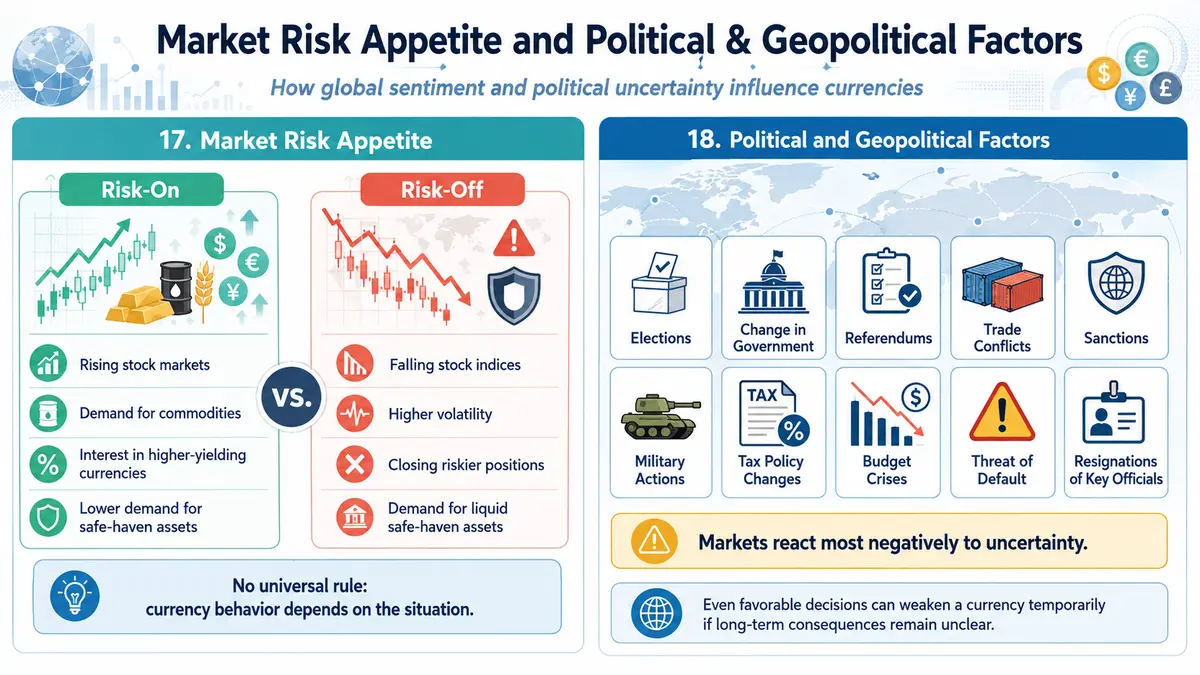
Fundamental analysis of a currency cannot be limited to the economy of a single country.
During calm periods, investors are generally more willing to buy riskier assets. During crises, they reduce their exposure, hold cash, and move into safe-haven instruments.
Risk-On
Market participants are optimistic about the global economic outlook and are willing to take on risk. This environment typically features:
-
Rising stock markets
-
Demand for commodities
-
Increased interest in higher-yielding currencies
-
Reduced demand for safe-haven assets
Risk-Off
Investors fear a crisis, war, recession, or financial instability. This environment can lead to:
-
Falling stock indices
-
Increased volatility
-
The closing of riskier positions
-
Surging demand for highly liquid and safe-haven assets
The behavior of any given currency depends on the specific situation; therefore, predetermined universal rules do not exist.
18. Political and Geopolitical Factors
Politics influence currencies through expectations regarding the economy, government spending, taxes, foreign trade, and financial stability.
Important political and geopolitical events include:
-
Elections
-
Changes in government
-
Referendums
-
Trade conflicts
-
Sanctions
-
Military actions
-
Changes in tax policy
-
Budget crises
-
The threat of default
-
Resignations of key officials
The market reacts particularly negatively to uncertainty. Even a potentially favorable decision can temporarily weaken a currency if its long-term consequences are difficult to assess.
19. Rumors, Expectations, and the “Buy the Rumor” Principle
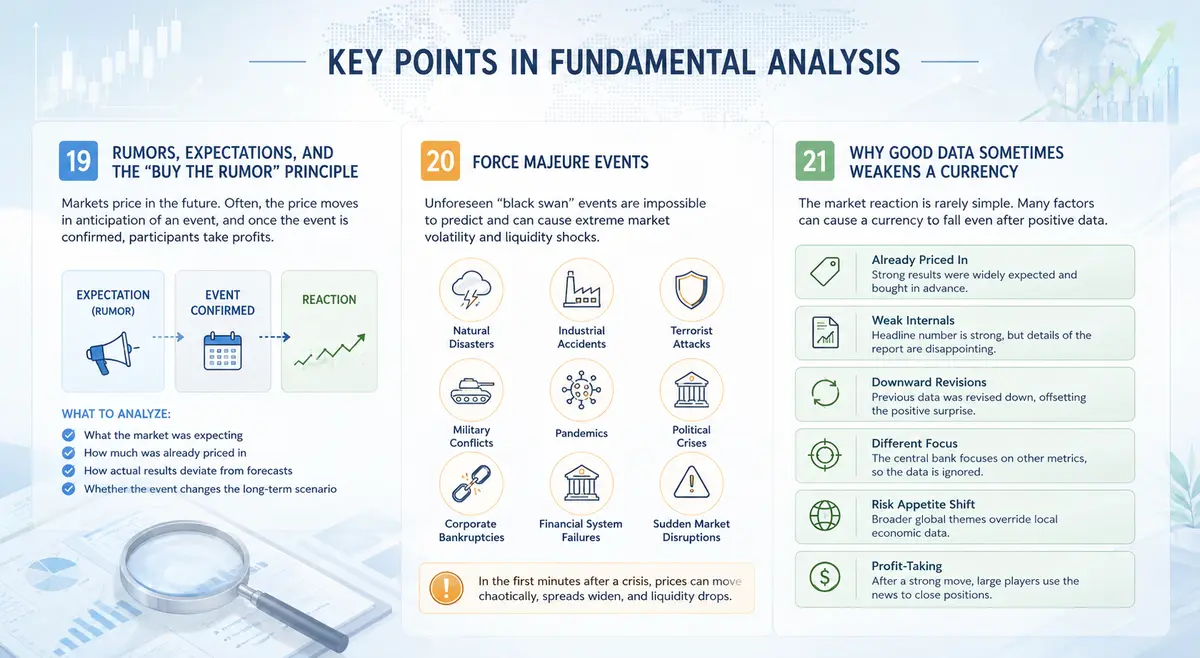
Market participants are constantly trying to predict future events. If the majority of investors expect positive news, they may start buying the currency in advance. By the time the official data is published, a significant portion of the price movement has already occurred.
This has given rise to the famous market adage: “Buy the rumor, sell the fact.”
It means that the price moves in anticipation of an event, and once the event is confirmed, participants lock in their profits by closing their positions. However, this is not a universal law.
If the actual result significantly exceeds expectations, the trend may continue. If the rumor is not confirmed, the market can reverse sharply. Therefore, you must analyze:
-
What exactly the market was expecting
-
How much of that expectation was already priced in
-
How much the actual result deviates from the forecast
-
Whether the event alters the long-term fundamental scenario
20. Force Majeure Events
Unforeseen “black swan” events include:
-
Natural disasters
-
Major industrial accidents
-
Terrorist attacks
-
Military conflicts
-
Pandemics
-
Sudden political crises
-
Bankruptcies of systemically important organizations
-
Failures in financial infrastructure
Such events are impossible to forecast accurately. They can trigger massive spikes in volatility, severely widened spreads, and a sudden drop in liquidity. In the first few minutes after an emergency, prices can move chaotically. Attempting to open a position immediately is heavily accompanied by elevated risk.
21. Why Good Data Sometimes Weakens a Currency
One of the biggest mistakes a beginner trader makes is expecting a simple, binary reaction: good statistics = currency rises; bad statistics = currency falls. The market often behaves differently for several reasons:
-
The data is already priced in: If a strong result was widely anticipated, investors may have bought the currency well before the release.
-
Other components of the report are weak: The headline number might beat the forecast, but the underlying details (the internals) may have deteriorated.
-
Previous data was revised downward: A strong current result might just be compensating for a significant negative revision to the previous month’s data.
-
The central bank is looking at a different metric: Investors may ignore a strong report if they know it won’t influence the regulator’s policy decisions.
-
Risk appetite has shifted: A broader global macro theme or crisis can easily override local economic data.
-
Profit-taking: After a strong run-up, large players may use the liquidity generated by the news release to exit their positions.
22. How to Conduct Fundamental Analysis of a Currency Pair
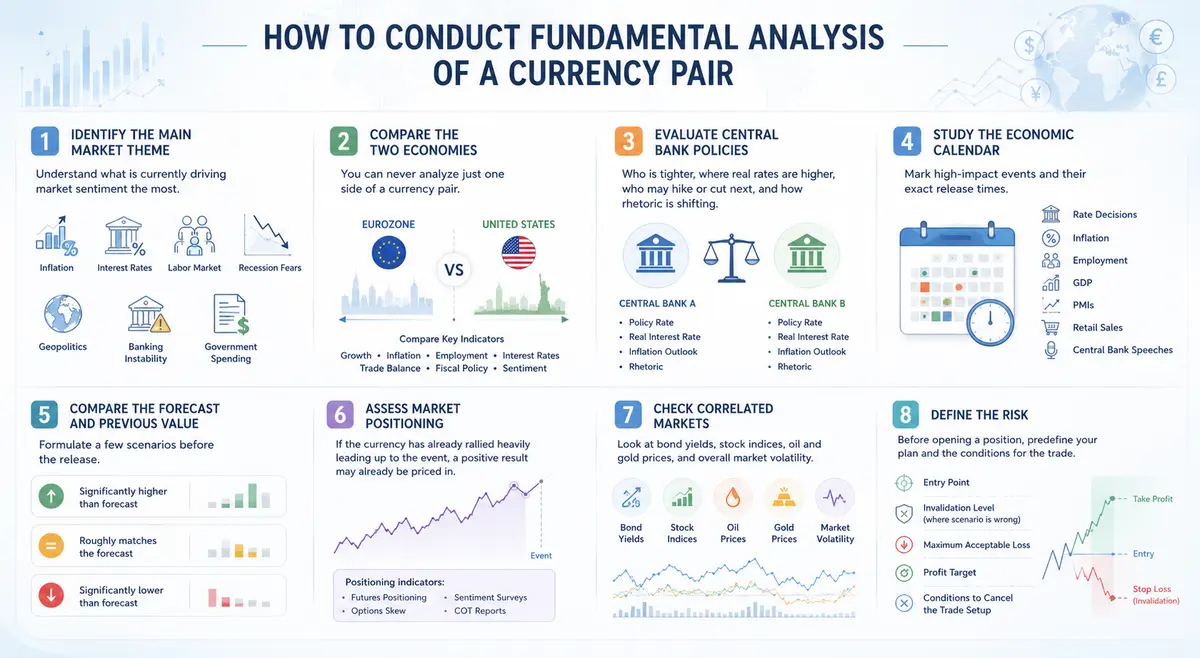
Step 1. Identify the Main Market Theme
Understand what is currently driving market sentiment the most: inflation, interest rates, the labor market, recession fears, geopolitics, banking instability, or government spending.
Step 2. Compare the Two Economies
For EUR/USD, compare the Eurozone and the US. For GBPJPY ... , compare the UK and Japan. You can never analyze just one side of a currency pair.
Step 3. Evaluate Central Bank Policies
Determine which central bank is running a tighter policy, where real interest rates are higher, who is likely to hike or cut rates next, and how the regulators’ rhetoric is shifting.
Step 4. Study the Economic Calendar
Mark high-impact events and their exact release times. Pay special attention to rate decisions, inflation, employment, GDP, PMIs, retail sales, and speeches by central bank officials.
Step 5. Compare the Forecast and Previous Value
Formulate a few scenarios before the release:
-
The result is significantly higher than the forecast.
-
The result roughly matches the forecast.
-
The result is significantly lower than the forecast.
Step 6. Assess Market Positioning
If the currency has already rallied heavily leading up to the event, a positive result may already be priced in.
Step 7. Check Correlated Markets
Look at bond yields, stock indices, oil and gold prices, and overall market volatility.
Step 8. Define the Risk
Before opening a position, predefine your entry point, your invalidation level (where your scenario is proven wrong), your maximum acceptable loss, your profit target, and the conditions under which you will cancel the trade setup altogether.
23. Example of a Fundamental Scenario
Assume the market is analyzing the EUR/USD pair ahead of a US employment data release. Expectations: Job numbers should increase, wage growth should slow down, and the Federal Reserve is not currently planning to raise rates.
Scenario 1: A Very Strong Report
Employment vastly exceeds forecasts, unemployment drops, and wage growth accelerates. The market increases its expectations for a tighter Federal Reserve policy.
-
Possible Outcome: The US dollar strengthens, and EUR/USD falls.
Scenario 2: A Mixed Report
Job creation is high, but unemployment ticks up and wage growth slows down.
-
Possible Outcome: The initial reaction for the dollar might be positive, but the move could quickly reverse.
Scenario 3: A Weak Report
Employment is significantly below forecasts, previous data is revised downward, and unemployment rises. The market increases bets on interest rate cuts.
-
Possible Outcome: The US dollar weakens, and EUR/USD rises. (Note: Even here, the final reaction depends on how much of this weakness was already priced in.)
24. Trading Directly During News Releases
Publishing high-impact data is frequently accompanied by:
-
Drastic spread widening
-
Severe slippage
-
A lack of liquidity
-
Rapid price whipsaws in both directions
-
False breakouts
-
Order execution delays
Because of this, beginner traders are strongly advised against opening large positions right before a major news event. A more cautious approach is to:
-
Wait for the data to be published.
-
Evaluate all components of the report.
-
Monitor the reaction in bond yields.
-
Wait for the spread to stabilize.
-
Compare the price action against your prepared scenarios.
-
Open a position only if the risk-to-reward ratio makes sense.
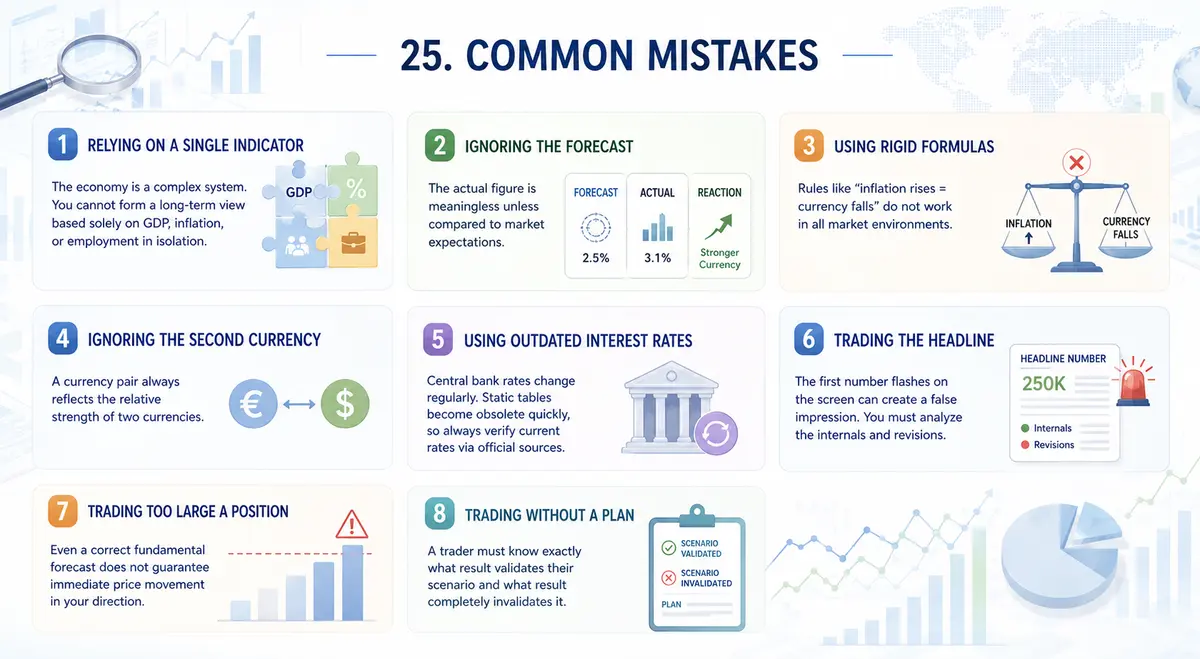
25. Common Mistakes
-
Relying on a single indicator: The economy is a complex system. You cannot form a long-term view based solely on GDP, inflation, or employment in isolation.
-
Ignoring the forecast: The actual figure is meaningless unless compared to market expectations.
-
Using rigid formulas: Rules like “inflation rises = currency falls” do not work in all market environments.
-
Ignoring the second currency: A currency pair always reflects the relative strength of two currencies.
-
Using outdated interest rates: Central bank rates change regularly. Static tables become obsolete quickly, so always verify current rates via official sources.
-
Trading the headline: The first number flashes on the screen can create a false impression. You must analyze the internals and revisions.
-
Trading too large a position: Even a correct fundamental forecast does not guarantee immediate price movement in your direction.
-
Trading without a plan: A trader must know exactly what result validates their scenario and what result completely invalidates it.
26. Information Sources
For fundamental analysis, it is best to use multiple types of sources:
-
Central bank websites
-
Official statistical agencies
-
Economic calendars
-
Government financial institutions
-
International economic organizations (IMF, World Bank, etc.)
-
Major financial news agencies (Bloomberg, Reuters)
-
Reports from major banks and analytical firms
It is always best to verify critical metrics at the primary source. Secondary news sites may publish truncated information without mentioning revisions, underlying components, or methodological notes.
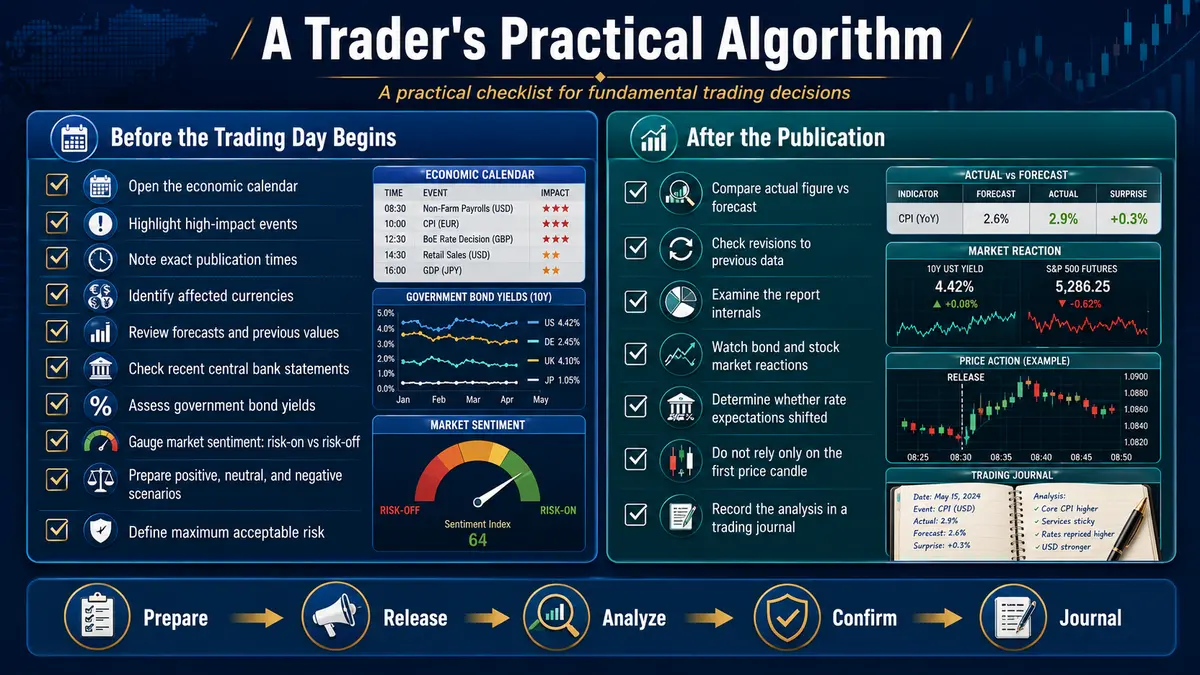
27. A Trader’s Practical Algorithm
Before the Trading Day Begins:
-
Open the economic calendar.
-
Highlight high-impact events.
-
Note the exact publication times.
-
Identify which currencies will likely be affected.
-
Review the forecasts and previous values.
-
Check recent statements from central banks.
-
Assess government bond yields.
-
Gauge overall market sentiment (risk-on vs. risk-off).
-
Prepare positive, neutral, and negative scenarios.
-
Define your maximum acceptable risk.
After the Publication:
-
Compare the actual figure to the forecast.
-
Check for revisions to previous data.
-
Examine the underlying details of the report.
-
Watch the reaction in the bond and stock markets.
-
Determine if interest rate expectations have shifted.
-
Do not make a decision based solely on the very first price candle.
-
Log the results of your analysis in a trading journal.
28. Conclusion
Fundamental analysis helps you understand the reasons behind financial market movements and identify the driving forces that can influence prices in the future.
Core Principles:
-
A currency is always evaluated relative to another currency.
-
The market reacts to deviations between actual results and expectations.
-
Central bank decisions often carry more weight than individual economic indicators.
-
Inflation impacts currencies primarily by shaping interest rate expectations.
-
You must always analyze report internals and data revisions.
-
Correlations between currencies, oil, gold, and bonds are dynamic, not static.
-
Good news does not guarantee a currency will rally.
-
A fundamental forecast must always be paired with strict risk management.
-
A trader’s job is not to guess the exact number, but to be prepared for multiple possible scenarios.
Fundamental analysis does not provide absolute certainty. However, it significantly improves the quality of your decision-making, helps you decode the current market logic, and prevents trades driven purely by emotion.

Comments
No comments yet. Be the first to share your thoughts!
Authentication Required
You must be logged in to post a comment.