

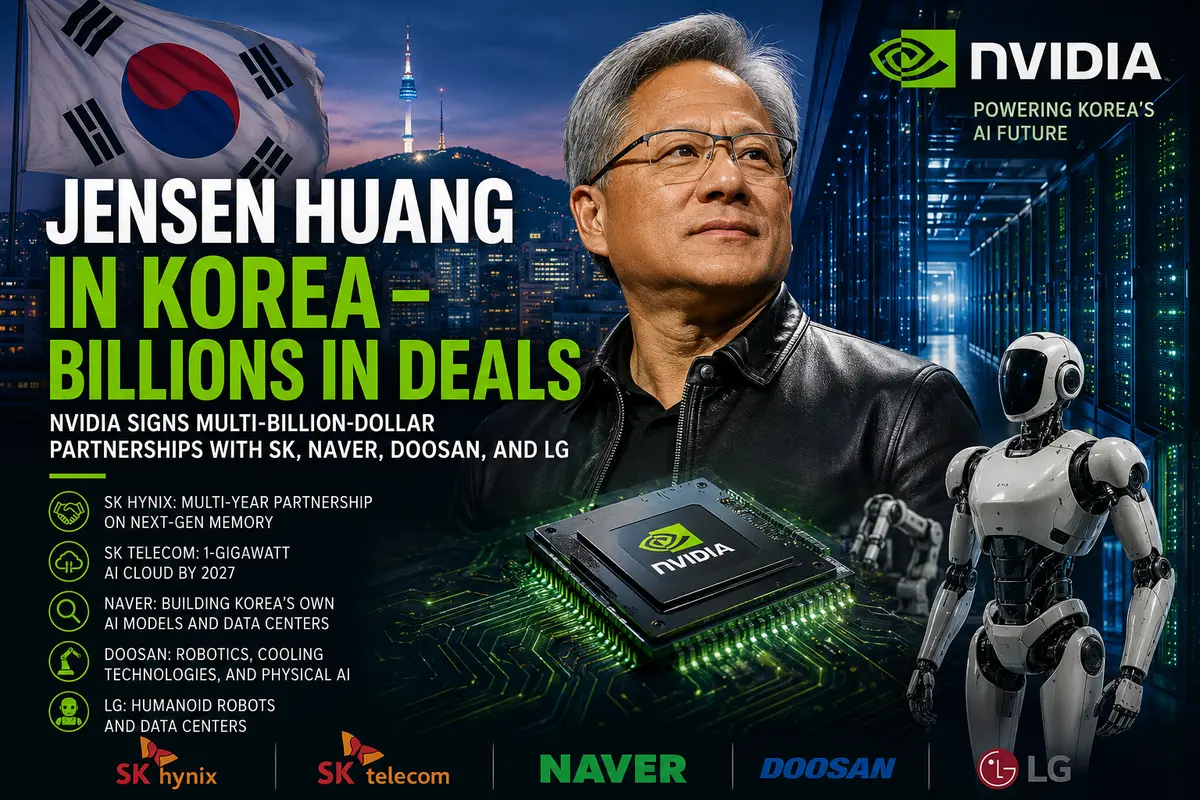
Jensen Huang Arrived in Korea — and for Good Reason: Nvidia Signs Multi-Billion-Dollar Deals with SK, Naver, Doosan, and LG
A Visit Six Months in the Making
When Nvidia CEO Jensen Huang lands in a country, local technology companies line up to meet him. Not because he’s handing out gifts, but because in today’s AI world, almost no major decision gets made without Nvidia. Huang arrived in South Korea on Friday, and by Monday, announcements of new partnerships were pouring in one after another.
These are not the typical memorandum-of-understanding photo opportunities that often accompany executive visits. These are real technology partnerships, multi-year agreements, and strategic alliances that could reshape the global AI infrastructure landscape.
Nvidia needs Korea because the country produces some of the world’s most advanced memory chips. Korea needs Nvidia because without its AI accelerators, even the most sophisticated data center is just an expensive room full of servers.
The main players in this Korean tour are SK Group, Naver, Doosan, and, as it became clear later, LG. Each company received its own dose of Nvidia’s influence. And each is now building its AI strategy around technologies from the American giant.
SK Hynix: A Multi-Year Partnership That Has Competitors Nervous
Let’s start with the most obvious—and arguably the most important—announcement.
SK Hynix is the world’s second-largest memory chip manufacturer after Samsung. More importantly, it has become one of the biggest beneficiaries of the AI boom thanks to its leadership in HBM (High Bandwidth Memory), the advanced memory technology essential for AI workloads.
HBM is not the kind of memory found in your laptop. It enables data transfers measured in terabytes per second between processors and memory, making it indispensable for training and running modern AI models.
Now SK Hynix and Nvidia have entered into a multi-year technology partnership. This is more than a supply agreement—it involves joint development of future generations of memory and AI accelerators.
In practical terms, engineers from both companies will work together from the earliest design stages. Instead of adapting memory after a chip architecture is finalized, SK Hynix will help design memory specifically for Nvidia’s future products.
That gives SK Hynix a major advantage over rivals such as Samsung and Micron.
In semiconductors, the winner is often the company that gains access to next-generation specifications first. If Nvidia tells SK Hynix, “We’ll need memory with these characteristics 18 months from now,” SK Hynix can begin development immediately. Competitors may not learn those details until Nvidia publicly unveils them months later.
The companies said the partnership will support Nvidia’s expansion into robotics, AI supercomputers, and AI-powered personal computers. This isn’t just about data centers anymore. Nvidia envisions a future where its chips power robots, developer workstations, scientific research labs, and autonomous systems everywhere. All of them will need advanced memory.
SK Hynix wants to be the primary supplier.
SK Telecom: Building a Gigawatt-Scale AI Cloud Empire
SK Group’s ambitions extend far beyond memory chips.
SK Telecom, South Korea’s largest mobile operator, also secured a major partnership with Nvidia.
The plan is extraordinarily ambitious: build a one-gigawatt AI cloud infrastructure in South Korea powered by Nvidia technologies.
One gigawatt is an enormous amount of power. It’s roughly equivalent to the electricity consumption of a small city or a large industrial facility. For comparison, today’s most powerful supercomputers consume around 30 megawatts. This AI cloud would operate at more than 30 times that scale.
The goal is to create a national AI platform—not merely another cloud provider, but a foundational AI infrastructure connecting everything from household devices to industrial robots, all supported by centralized AI systems processing data in real time.
The first facility is expected to become operational in 2027.
That’s an aggressive timeline. Projects of this scale often require five to seven years from planning to deployment. SK Telecom clearly has no intention of waiting while regional competitors race ahead.
China is building AI infrastructure. Japan is building AI infrastructure. Singapore is building AI infrastructure.
South Korea doesn’t want to fall behind.
Nvidia will contribute not only hardware but also its entire software ecosystem: CUDA, machine-learning libraries, optimization tools, and AI development frameworks.
The chips matter. But without software, even the most powerful processors are simply expensive pieces of silicon.
Naver and Doosan: Korea’s Google and an Industrial Robotics Giant
Naver is often described as Korea’s equivalent of Google, though in South Korea its local dominance is arguably even stronger.
Search, maps, e-commerce, content platforms—Naver is deeply embedded in daily digital life.
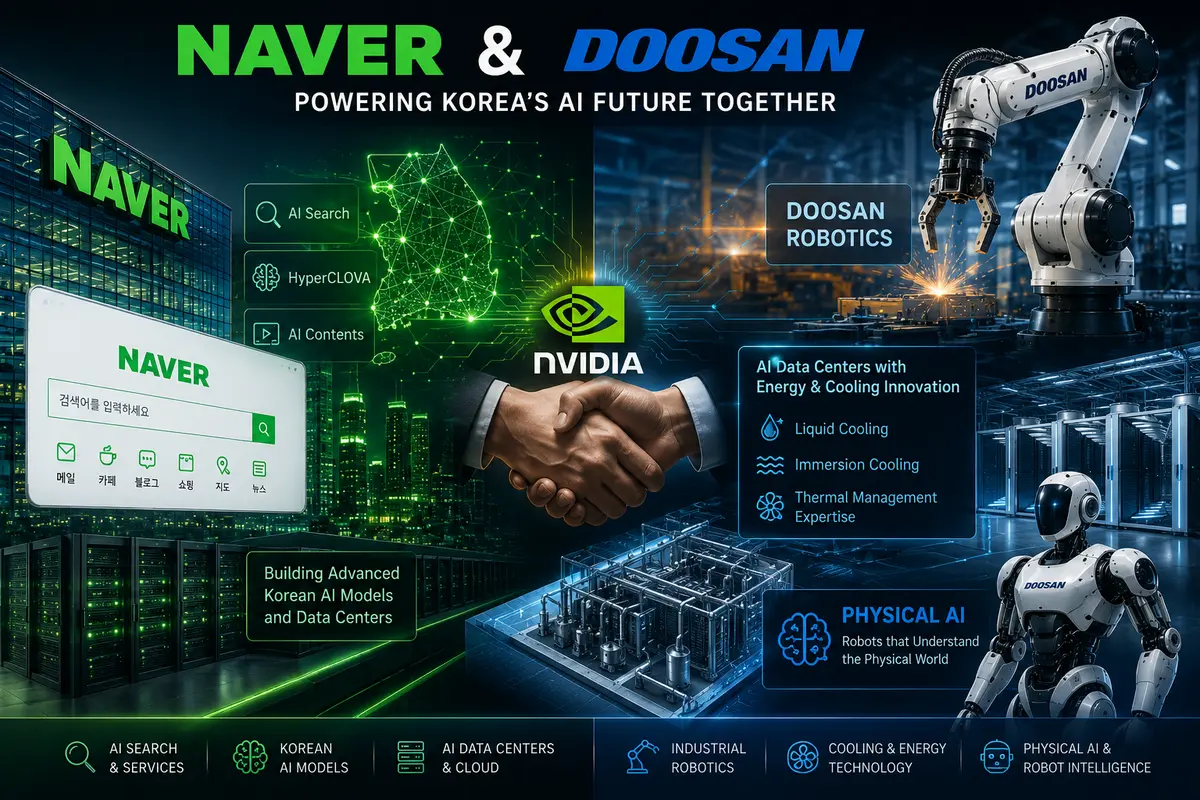
The company has now signed an agreement with Nvidia to expand AI data center capabilities.
Modern search is no longer just about displaying links. It involves conversational AI, content generation, image creation, personalization, and real-time knowledge processing. All of this requires immense computational resources.
Naver also has broader ambitions.
The company wants to build advanced Korean-language AI models capable of understanding linguistic subtleties, dialects, and cultural nuances more effectively than global models.
That requires enormous quantities of Nvidia hardware.
A lot of hardware.
Doosan’s AI Vision
Doosan presents a different story.
Most people associate the company with construction equipment and heavy industry. But Doosan has been aggressively expanding into advanced technology sectors.
Doosan Robotics manufactures industrial robots. The company also produces materials critical to advanced semiconductor manufacturing.
Now it plans to deploy Nvidia technologies in AI data centers as well.
What makes the partnership particularly interesting is Doosan’s intention to integrate its energy and cooling technologies into Nvidia-based infrastructure.
Data centers consume massive amounts of electricity.
They consume even more cooling capacity.
Modern AI accelerators generate so much heat that traditional air cooling is increasingly inadequate. The industry is moving toward liquid cooling and, eventually, immersion cooling systems.
Doosan has decades of experience managing thermal systems for large industrial machinery. The company sees an opportunity to bring that expertise into next-generation AI facilities.
The partnership also includes development around “physical AI,” one of Nvidia’s most heavily promoted strategic initiatives.
Physical AI is not about generating text or images.
It’s about enabling robots to operate intelligently in the real world.
These systems understand concepts such as friction, gravity, inertia, and force. They allow robots to perform complex physical tasks safely and autonomously.
Doosan Robotics is an ideal partner for this effort.
Combined with Nvidia’s Isaac Sim platform, the companies could help create robots that learn through simulation and natural-language instruction rather than traditional programming.
LG: Humanoid Robots and an Unexpected Development
Another notable event was Jensen Huang’s meeting with LG Group Chairman Koo Kwang-mo.
While no formal deal was initially announced, the outcome quickly became apparent.
Nvidia and LG are now collaborating on humanoid robots and data center technologies.
Humanoid robotics is increasingly viewed as the next major frontier after large language models.
Tesla has Optimus.
Boston Dynamics continues to push robotics forward.
Chinese manufacturers are accelerating their efforts.
And LG wants to be part of the race.
Why?
Because humanoid robots can operate in environments designed for humans. They can open doors, use tools, move boxes, assist workers, and eventually help people at home.
Imagine warehouse robots, factory assistants, elder-care companions, childcare assistants, and household helpers.
But all of that requires intelligence.
Nvidia provides the AI brains through its Jetson robotics platform, computer vision technologies, and simulation environments.
LG contributes consumer electronics expertise, manufacturing capabilities, and global distribution channels.
Together, they hope to build the next generation of intelligent machines.
LG is also expanding its data center footprint and will rely heavily on Nvidia technologies for those efforts.
At this point, nearly every major AI initiative in Korea appears to involve Nvidia in some capacity.
The comparison to Microsoft’s Windows dominance in the 1990s is difficult to ignore.
Why Is All of This Happening Now?
Some may ask why these announcements are being made during Huang’s visit rather than through ordinary business channels.
The answer is signaling.
Huang’s presence sends a message to investors, competitors, governments, and industry partners.
It signals that Nvidia views South Korea as a strategic AI partner in Asia.
China has become increasingly difficult for Nvidia because of U.S. export restrictions.
Japan has a strong semiconductor ecosystem but is less focused on memory.
Taiwan remains indispensable thanks to TSMC, but it carries significant geopolitical risks.
South Korea offers advanced technology, political stability, world-class semiconductor expertise, and strong government support for AI.
It’s an attractive partner.
At the same time, the AI boom has created shortages everywhere: chips, memory, packaging capacity, electricity, and infrastructure.
Companies that fail to secure supply chains years in advance risk being left behind.
And demand is expected to keep growing.
Industry forecasts suggest the AI chip market could expand from roughly $50 billion today to $400 billion by 2030.
What It Means for the Memory Market
One of the most significant consequences of these agreements concerns memory chips.
Signs of constrained supply have already driven memory prices sharply higher since mid-2025.
The new SK Hynix-Nvidia partnership could push them even higher.
The market now recognizes that SK Hynix is no longer merely a supplier.
It is becoming a preferred supplier.
If Nvidia dedicates a significant share of future HBM demand to SK Hynix, competitors may struggle to secure comparable growth opportunities.
Samsung will not stand still.
The company continues developing advanced HBM products and pursuing its own Nvidia agreements.
Yet for now, Nvidia appears to favor SK Hynix.
Whether that advantage stems from technology, execution, flexibility, or relationships, the result is the same.
Investors have noticed.
SK Hynix shares have already surged dramatically over the past two years, but many analysts believe further upside remains because Nvidia-related demand is not a one-time event.
Every new AI data center, supercomputer, and robot deployment translates into additional demand for advanced memory.
Korea’s Dream of AI Sovereignty
These partnerships also have a geopolitical dimension.
Like many countries, South Korea is concerned that global AI infrastructure depends heavily on a single company—Nvidia—and a single manufacturing hub—Taiwan.
That concentration creates vulnerabilities.
If geopolitical tensions escalate, export controls tighten, or supply chains are disrupted, the entire AI economy could feel the impact.
South Korea wants to build a national AI ecosystem that is not fully independent—an unrealistic goal in a globalized world—but resilient enough to withstand regional disruptions.
The Nvidia agreements fit directly into that strategy.
SK Telecom’s AI cloud.
Naver’s AI data centers.
Doosan’s robotics ecosystem.
LG’s humanoid ambitions.
Together they form pieces of a broader national AI infrastructure.
By 2027, when SK Telecom’s first major AI facility comes online, South Korea could become one of the world’s most advanced AI nations—not just a chip manufacturer, but a leading adopter and deployer of AI technologies.
What Comes Next?
The Korean visit may only be the beginning.
Industry rumors suggest potential future collaboration with Hyundai on autonomous vehicles, deeper semiconductor cooperation with Samsung, and even the possibility of a joint AI research center in Seoul.
Nvidia, once viewed primarily as an American technology company, is rapidly becoming a truly global institution.
The company already maintains major operations in Tel Aviv, Munich, Shanghai, and Taipei.
Seoul could be next on that list.
For South Korea, this moment represents an opportunity similar to the semiconductor and mobile technology boom that transformed the country in the 1990s.
Back then, Korea was catching up.
In AI, it has a chance to help lead.
The biggest risk remains geopolitics.
The United States and China are increasingly dividing the world into competing technology blocs.
South Korea sits between them.
Any escalation could complicate these ambitious plans.
For now, however, the mood is optimistic.
SK Hynix is growing.
Nvidia is strengthening its position.
And Jensen Huang is likely already planning his next visit.
Because in the AI era, there may be no greater risk than being left behind while everyone else builds the future.
And Nvidia seems determined to ensure that future is built on its technology—whether in Silicon Valley, Beijing, Taipei, or now, increasingly, Seoul.

Comments
No comments yet. Be the first to share your thoughts!
Comments only for logged-in users.