Bar Pipa
We pay for a post of 10$

ETF

Tom Maffin

Bitcoin: What the Capitulation of the Coin’s Top Holders Is Telling Us

Bitcoin: What the Capitulation of the Coin’s Top Holders Is Telling Us
The Strongest Hands Have Finally Given Up

The world of Bitcoin has its own hierarchy of resilience. Newcomers buy at the top and sell at the bottom. Experienced traders try to time the market but often get it wrong. And then there is a special class of investors: long-term holders. These are the people who buy coins and leave them untouched in their wallets for months or years. They do not react to the news. They do not stare at charts every hour. They simply believe.

They believe that Bitcoin is the future of money, that the current price is irrelevant, and that sooner or later everything will pay off.

These people form the backbone of the Bitcoin community. They are often called “diamond hands.” As long as they hold, the market has a floor. As long as they are not selling, a decline does not turn into a collapse.

But in recent weeks, something has broken. Long-term holders—those who have held their coins for at least 155 days—have become sellers. And they are selling a lot. A very large amount.

According to analysts at Compass Point, they sold roughly $2.4 billion worth of Bitcoin over the past two days. Two and a half billion dollars in just 48 hours. This is not profit-taking. This is an exodus. This is capitulation.

Ed Engel, a Compass Point analyst who tracks long-term holder behavior, notes that these investors were largely inactive from February through April. They sat on their coins, watched Bitcoin fall from its October highs above $126,000, and did not budge. They endured. They hoped for a reversal.

But hope has faded. The price has fallen below $64,000. The conflict in the Middle East is not ending—it is escalating. Institutional investors have withdrawn money from Bitcoin ETFs for twelve consecutive...

Continue reading...
0
0

Ether at the Bottom: Why Standard Chartered Believes Ethereum Can Return to Its 2021 Glory

Ether at the Bottom: Why Standard Chartered Believes Ethereum Can Return to Its 2021 Glory

Fifty-seven percent. That’s how much Ethereum has fallen from its August 2025 peak. Today, the world’s second-largest cryptocurrency trades at around $2,100, and looking at the chart, it’s hard to imagine that it once climbed to heights that seemed unreachable. Over the same period, the ETH/BTC ratio has dropped by 37%. Bears are celebrating, bulls are licking their wounds, and retail investors are asking the same question in panic: Is this the end for Ethereum?

Jeff Kendrick of Standard Chartered answers that question with a confidence that may seem provocative. No, it’s not the end. It’s a temporary disconnect between fundamentals and price. And if history teaches us anything, it’s that such gaps eventually close. The only question is when—and how high Ether can rise when it does.

The Dot-Com Parallel: What Ethereum Can Learn from Amazon

Standard Chartered draws a comparison that is both encouraging and sobering.

The year is 2001. The dot-com bubble bursts. Technology stocks plunge. Amazon—now worth trillions of dollars—loses 90% of its market value. Yet inside the company, something important is happening that stock charts fail to capture. Business processes are improving. The customer base is growing. Infrastructure is becoming more reliable.

At the time, Jeff Bezos made a statement that would later become famous: “While the stock price was moving in the wrong direction, everything inside the company was moving in the right direction.”

Kendrick believes the same logic applies to ETH today.

On the surface, everything looks terrible. The price chart resembles a falling knife. Sentiment across the crypto market is bleak. Bitcoin ETFs are seeing outflows, macroeconomic conditions are weighing on risk assets, and geopolitical uncertainty is adding another layer of fear.

Yet beneath the surface, activity on the Ethereum blockchain remains strong. Transaction volumes are hovering near historic highs. Total value...

Continue reading...
0
0

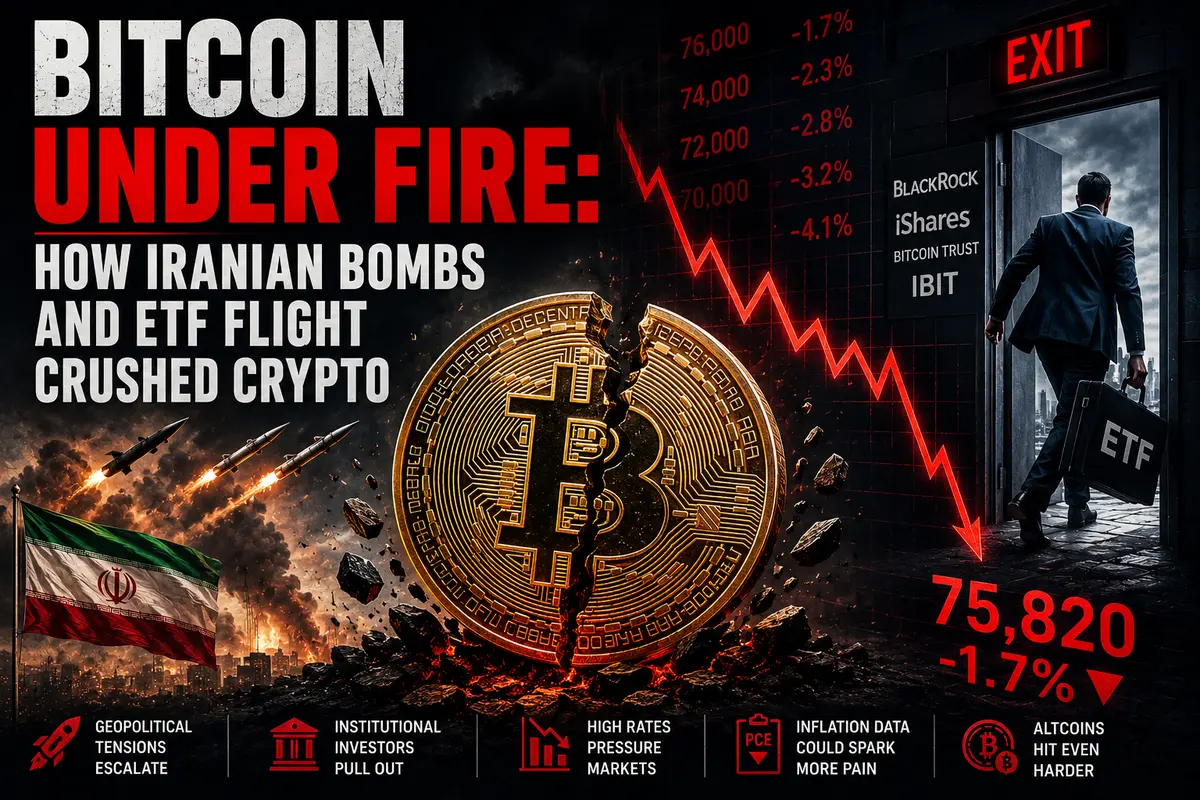
Bitcoin Under Fire: How Iranian Bombs and ETF Flight Crushed Crypto

Bitcoin Under Fire: How Iranian Bombs and ETF Flight Crushed Crypto

Wednesday became the kind of day Bitcoin investors would rather forget as quickly as possible. The world’s leading cryptocurrency plunged below seventy-six thousand dollars, touching 75,820 dollars and losing one point seven percent during the session. But the percentages are not even the main story. The real issue is the context.

While tech stocks on Wall Street and across Asia were climbing to fresh highs, Bitcoin moved sharply in the opposite direction. This divergence — with the NASDAQ and S&P 500 hitting record levels while crypto trades in the red — suggests something specific is happening inside the crypto market, unrelated to the broader appetite for risk. And the name of that “something” is a combination of geopolitical fear and institutional flight.

The Iranian Front: Bombs That Hit Bitcoin

New U.S. strikes on Iranian targets earlier this week continue to poison sentiment across the crypto market. Iran called the attacks a violation of the ceasefire agreement. U.S. officials responded by describing the strikes as defensive in nature. But for traders, the legal wording means little. What matters is that the conflict is not cooling down — it is escalating again.

Moreover, the geopolitical fire has begun spreading beyond the direct U.S.-Iran confrontation. Reports emerged of Israeli strikes in southern Lebanon. This is no longer merely a bilateral conflict; it is beginning to resemble the expansion of a regional war. And for cryptocurrencies, which are still widely viewed as risk assets, such escalation is a direct hit.

The logic here, however, is more complicated than it first appears. Normally, periods of geopolitical tension should support Bitcoin as a defensive asset — digital gold. But what we are witnessing is the opposite. Why? Because the current conflict hurts Bitcoin indirectly through the monetary channel.

War drives oil prices higher. Higher oil prices...

Continue reading...
0
0

Silence on the Airwaves: Why Bitcoin Fell Asleep While the AI Sector Went Crazy

Silence on the Airwaves: Why Bitcoin Fell Asleep While the AI Sector Went Crazy

Nine months. That’s how long it has been since Bitcoin was last this boring. The Bitcoin Volmex implied volatility index — the market’s thermometer of excitement — has dropped to 36.11, its lowest level since last September. The price is stuck around seventy-seven thousand dollars, nearly forty percent below the all-time high above one hundred twenty-six thousand reached in October. And while traders in the worlds of equities and semiconductors are losing their minds over massive rallies, the crypto market has sunk into a lethargic sleep. This is not a crash, not a collapse, not capitulation. It is something more insidious — a slow fading of interest.

Hot Money Moved Into AI

To understand where the speculative capital went, you only need to look at the headlines of recent weeks. South Korea’s KOSPI is hitting record highs. Japan’s Nikkei is storming historical peaks. SK Hynix has just entered the trillion-dollar company club. Samsung is celebrating the resolution of its labor dispute and climbing higher as well. This entire fireworks show is happening in one sector — manufacturers of memory chips, AI accelerators, and related hardware. That is where the “hot money” has gone: into AI and semiconductor stocks, absorbing the same speculative capital that once fueled crypto rallies.

Orbit Markets co-founder Caroline Mauron puts it with brutal clarity: “Retail interest is flowing into other sectors in search of new trading opportunities, as confirmed by ETF outflows.” And the numbers do not lie. In May, around one billion dollars was withdrawn from U.S. spot Bitcoin ETFs, breaking a two-month streak of inflows. Institutional investors who had enthusiastically entered crypto through regulated products are now taking profits or cutting positions.

The logic behind this exodus is simple and ruthless. Bitcoin is trapped in a range. It cannot break resistance and move to...

Continue reading...
0
0
Navigation menu