Bar Pipa
We pay for a post of 10$
Luis Silva

The Forex Gold Standard: Analysis and Forecast for XAU/USD on May 19, 2026
The Forex Gold Standard: Analysis and Forecast for XAU/USD on May 19, 2026

Trading gold (XAU/USD) on the Forex market has always been considered the "major league" of trading. In 2026, this asset has not lost its status as the ultimate safe-haven mechanism; however, the nature of its movements has become even more dependent on a complex web of geopolitics and the new monetary reality.

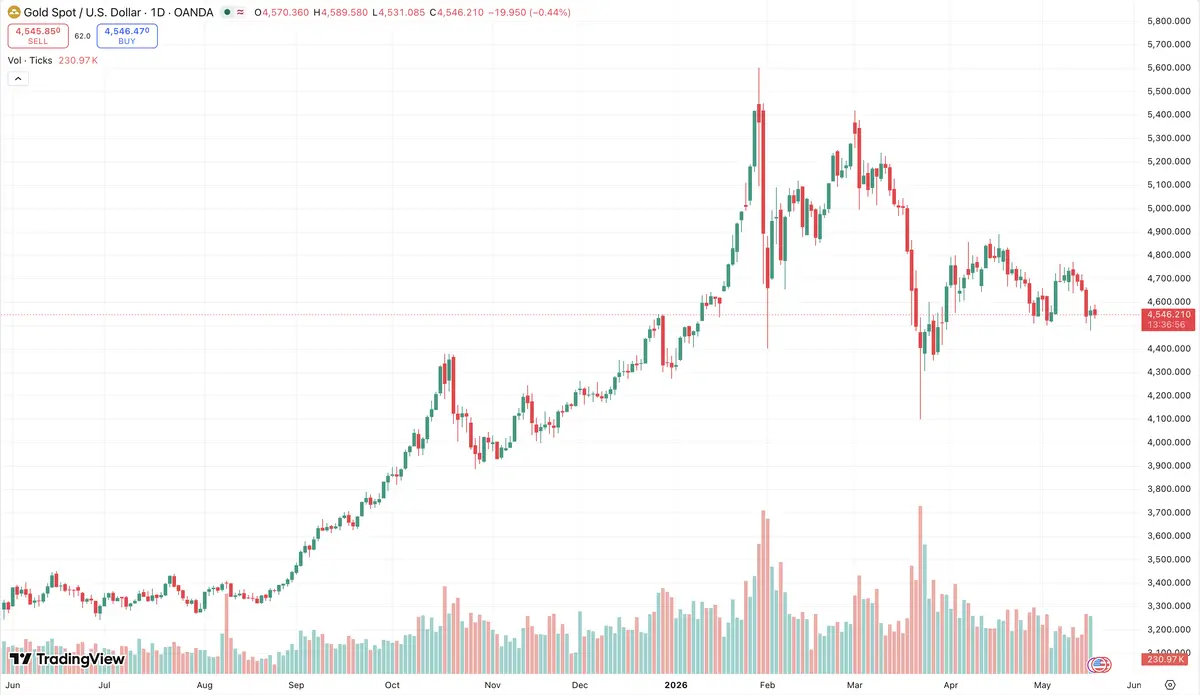
Today, May 19, 2026, the gold market is in a phase of sharp correction following a tumultuous rally in the first quarter. Let’s break down the forces driving the quotes of the "sunny metal" right now.

Fundamental Background: Oil, the Dollar, and the Shadow of Conflict

The fundamental picture today is defined by a paradoxical link between energy resources and US monetary policy.

1. The Oil and Inflation Factor

The situation surrounding Iran and potential sanctions remains the main driver. High oil prices (holding around $96–$100 per barrel) are creating sticky inflationary pressure in the US. For gold, this is a double-edged sword: on one hand, gold is a hedge against inflation; on the other hand, high inflation forces the Fed to keep interest rates at a restrictive level (3.50–3.75%).

2. A Hawkish Fed and the Dollar Index (DXY)

At the moment, the market is reassessing expectations: instead of rate cuts, investors are beginning to price in a "high for longer" scenario. This supports US Treasury yields and makes non-yielding assets (like gold), which do not bear coupon income, less attractive. The Dollar Index (DXY) is trading around 97.80, exerting moderate pressure on gold.

Technical Analysis: The Battle for the $4500 Level

The technical picture for May 19 points to the dominance of bears in the short term. After gold lost about 3.7% of its value last week, the price has approached a psychologically vital milestone.

Key Levels for Today:

Support at $4500: This is the main bastion...

Continue reading...
0
0
Lin Brings

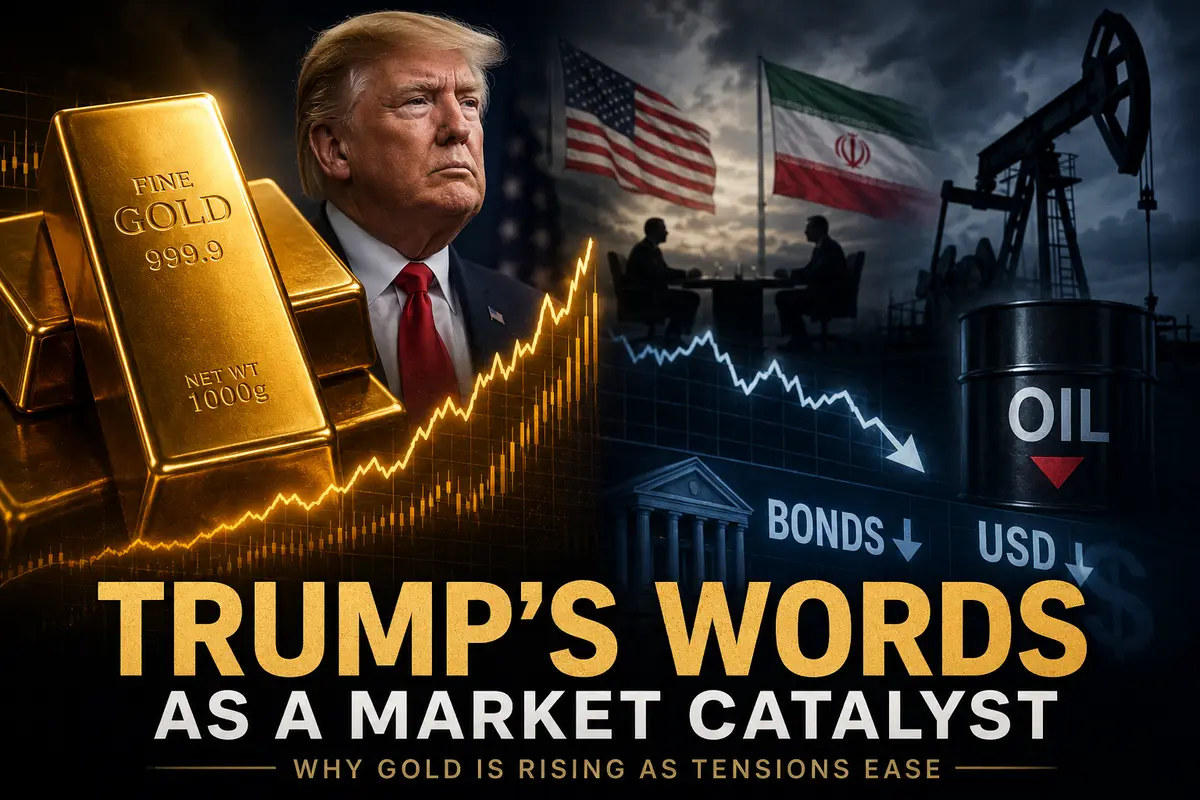
Trump’s Words as a Market Catalyst

Trump’s Words as a Market Catalyst

Tuesday began with a cautious but confident rise in the precious metals market. Spot gold gained one tenth of a percent and settled around $4,570 per ounce, while futures climbed three tenths of a percent to $4,574. At first glance, the move looked modest. But behind these numbers stood an event that changed the mood of the entire financial world the previous evening: Donald Trump announced a postponement of the planned strike on Iran and confirmed that negotiations were ongoing.

Markets, which for weeks had been pricing in the possibility of a major war in the Middle East, interpreted these remarks as the first real signal of de-escalation in a long time. The reaction was multifaceted: oil moved lower, bonds stopped falling, the dollar weakened, and gold — contrary to the usual logic linking its rise to heightened geopolitical fears — also moved higher. To understand this apparent paradox, it is necessary to look at the mechanics currently driving the precious metals market.

Oil Down, Gold Up: Breaking the Pattern

Normally, gold and oil move in the same direction when geopolitics is the main driver. War sends oil higher and gold higher. Peace pushes both lower. But Tuesday morning broke this familiar pattern. Oil prices fell sharply after Trump’s comments, while gold rose.

The explanation lies in the fact that gold is currently far more sensitive to the bond market than to geopolitical risk itself. Recent weeks have shown that the metal’s main enemy was not hope for peace, but rising yields. When investors sold bonds on fears that a war with Iran would fuel inflation and force central banks to tighten policy further, yields surged and gold declined. Now that dynamic is beginning to reverse.

Trump’s announcement that the strike was postponed and that serious negotiations were underway sparked...

Continue reading...
0
0

Morning Momentum in Asian Trading

Morning Momentum in Asian Trading

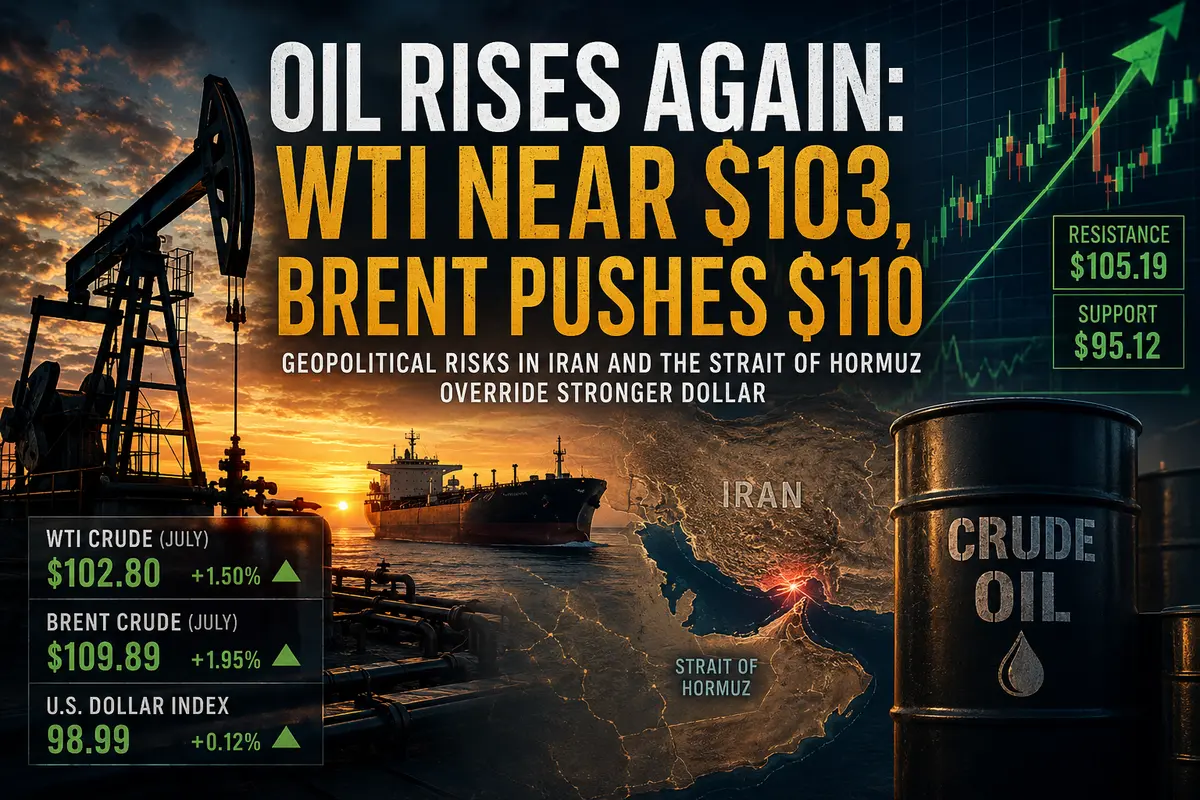
Tuesday began with a confident rise in the oil market. On the New York Mercantile Exchange, July WTI crude oil futures climbed by one and a half percent, settling near $102.80 per barrel. This is not an explosive surge or a panic-driven rally, but rather a steady, methodical move higher that suggests bullish sentiment in the oil market has not disappeared. It merely paused briefly the day before and is now returning with renewed strength.

The session high moved above $103 — territory where oil has not traded since early May. Intraday support formed around $95, a level where buyers appear willing to enter the market without waiting for a deeper pullback. On the upside, resistance is located near $105, a key zone whose breakout could open the path to new highs.

But before examining why oil is rising today specifically, it is worth paying attention to one critically important detail: oil is gaining alongside the U.S. dollar. This is an unusual combination under normal market conditions and deserves separate analysis.

The Dollar and Oil: An Unusual Duo

The U.S. Dollar Index, which measures the strength of the American currency against a basket of six major peers, gained 0.12% and is trading near 98.99. Normally, a stronger dollar puts pressure on oil prices: when the U.S. currency appreciates, dollar-denominated commodities become more expensive for foreign buyers, reducing demand. This inverse relationship is a classic principle taught in introductory finance courses.

But today, that relationship is not working. Oil and the dollar are rising simultaneously, which says a great deal about the nature of the current move. When commodities rally despite a strengthening dollar, it means a powerful market-specific factor is outweighing the currency effect. And that factor is well known — geopolitical tensions surrounding Iran and ongoing supply concerns in...

Continue reading...
0
0
Anton Algo

Momentum Hunting: How Trading Bots Exploit the European Morning Breakout

Momentum Hunting: How Trading Bots Exploit the European Morning Breakout

The Forex market operates 24 hours a day, but its activity is distributed highly unevenly. The most powerful, directional, and profitable movements (momentum) occur when the trading hours of the world's largest financial hubs overlap. Traditionally, the opening of the European session—when exchanges in London, Frankfurt, and Paris come into play—is considered the main daily trigger.

For a retail trader, the morning chaos of Europe’s first hours is a high-risk zone. For trading bots, however, it is the perfect time for "momentum hunting." The Opening Range Breakout (ORB) strategy has existed for decades, but automation has transformed it from an exhausting routine into a highly efficient algorithmic business.

Strategy Philosophy: Why Does It Work?

The logic behind the morning breakout is rooted in how market phases transition. The Asian session (Tokyo, Sydney, Singapore) winds down just before Europe opens. For most currency pairs (excluding the JPY and AUD), Asian trading is characterized by low volume and narrow price amplitude. The price is essentially compressed like a spring, forming a consolidation or a flat market.

When European exchanges open, institutional liquidity floods the market in an avalanche: large banks, funds, and market makers begin placing their orders. The energy accumulated during the Asian flat is released. The price sharply breaks through the boundaries of the overnight range, triggering a powerful directional movement—momentum.

The robot's task is to mathematically pin down the boundaries of the overnight channel, wait for its breakout, and instantly enter a trade in the direction of the emerging trend, capturing the bulk of the morning move.

How the Algorithm Works: Step-by-Step Bot Logic

t is difficult for a human to objectively assess flat boundaries, especially in the rush of the morning open. A robot, however, operates on a rigid mathematical algorithm that can be divided into four key...

Continue reading...
0
0

Monday’s Statement That Turns the Page

Monday’s Statement That Turns the Page

On Monday, Hungarian Prime Minister Peter Magyar said something Budapest had long been expected to say — but which the previous leadership stubbornly refused to utter. Hungary intends to adopt the euro. Not tomorrow, not the day after tomorrow, and not in emergency mode — but gradually, step by step, meeting the criteria in a way that does not harm the national economy. The wording itself says a great deal: the country is no longer debating whether it should join the eurozone, but rather discussing how exactly to do it.

This marks a tectonic shift in rhetoric. Under the previous government of Viktor Orbán, the euro was practically a taboo subject. The forint was presented as a symbol of national sovereignty, and abandoning it was portrayed as surrender to Brussels. Magyar, who replaced Orbán, is turning that logic upside down. In his view, adopting the euro is not a loss of sovereignty, but the acquisition of new opportunities for public finances and ordinary citizens alike.

Behind these words lies not just a rhetorical shift, but a fundamental reassessment of how Hungary sees its place in Europe. For three decades after the collapse of the socialist bloc, the country balanced between the West and its own sense of exceptionalism. Now the pendulum appears to have swung toward deeper integration — and that movement will have consequences far beyond currency markets.

The Criteria That Must Be Met: What “Gradually” Really Means

Magyar emphasizes gradualism for a reason. Adopting the euro is not merely about replacing banknotes in people’s wallets. It is an extraordinarily complex process requiring compliance with the Maastricht criteria, and Hungary currently fails to meet at least several of them. Inflation must be kept under control, the budget deficit must remain within three percent of GDP, public debt must be...

Continue reading...
0
0
Tom Maffin

The Dollar Catches Its Breath After the Bond Storm

The Dollar Catches Its Breath After the Bond Storm

Tuesday morning on the currency market began in relative calm. The U.S. dollar index and dollar futures stabilized during Asian trading, offering a long-awaited pause after several days of relentless selling in the bond market that had dragged virtually every other asset down with it. Investors, exhausted by surging yields and constant repricing of interest-rate expectations, stepped back to reassess the situation and consider what might come next.

Two factors helped trigger this temporary relief.

The first was a technical correction in the Treasury market. Yields on 10-year U.S. government bonds fell by half a percentage point from levels that had hovered near yearly highs just a day earlier. Thirty-year yields dropped by two-tenths of a percentage point after coming within arm’s reach of their highest levels in nineteen years. Nineteen years ago is so far back that many traders sitting at their terminals today were still in school — or had not even considered a career in finance.

The second factor was oil. The bond selloff eased alongside declining energy prices. The reason for that decline has a name: Donald Trump. The American president stated that he had postponed a planned military operation against Iran and that negotiations were progressing successfully. Markets, which had spent recent weeks bracing for the possibility of another Middle East war, interpreted the statement as a cautiously optimistic signal. Oil moved lower, and bonds calmed down with it.

Still, this calm remains highly conditional. Oil prices continue to hold onto much of their recent gains, and the inflationary consequences of the Iranian conflict have not disappeared. Markets remain tense — just slightly less tense today than yesterday.

The Japanese Paradox: The Economy Grows, the Yen Falls

The most intriguing story of Tuesday revolves around the Japanese yen. The dollar-yen pair rose by one-tenth of...

Continue reading...
0
0
NorthRay

Gold Said “Yes.” My First XAU/USD Trade Made Me $42.70. And Now — Apple and an Index.

Gold Said “Yes.” My First XAU/USD Trade Made Me $42.70. And Now — Apple and an Index.

Hi, this is NorthRay.

Remember how last time I said I wanted to try commodities and stocks?

Well, I didn’t waste any time.

I opened my very first gold trade (XAU/USD).

And you know what? It didn’t bite me. Quite the opposite — it gave me the biggest profit of my entire demo trading journey so far.

$42.70.

From a single trade.

For someone who was celebrating 24 cents not long ago — this feels like a holiday.


How It Happened

I spent a long time staring at the gold chart.

Honestly? At first, it scared me.

The price moves like crazy. Long candles. Swings of $10–20 within an hour.

I kept thinking:
“This isn’t for beginners. You could lose everything in five minutes here.”

But then I remembered my rule: small steps.

I didn’t use 1 lot. Not even 0.50.

I opened just 0.10 lot.

Ten times smaller than my last EUR/USD trade.

Why?

Because gold is a different beast. You don’t dive headfirst into an unfamiliar river. First, you test the water with your finger.


The Numbers That Surprised Me

Lot size: 0.10 XAU/USD
Take-profit: set at a reasonable distance
Stop-loss: mandatory (I no longer trade without one)

A few hours later, I checked the terminal.

The trade was closed.

Take-profit hit.

Profit: $42.70.

I rubbed my eyes.

Sure, it’s demo money. But the number still looks serious.

For comparison:
My best EUR/USD trade on a 1-lot position made me $23.50.

Here?
0.10 lot — and $42.70.

Gold is incredibly volatile. It covers huge distances in a short amount of time.

That’s both good and bad.

The good:
You can make more money.

The bad:
You can lose money much faster too.

But this time, I was in profit. And it felt good.


What I...
Continue reading...
0
0
Lin Brings

Industry Loses Momentum

Industry Loses Momentum

When China’s April industrial production figures were released on Monday morning, analysts had to quietly put away their forecasts. Growth came in at 4.1% year-over-year. That is not just below March’s 5.7% — it is dramatically below the consensus forecast, which had expected an acceleration to 6%. A gap of nearly two percentage points between expectations and reality is not a statistical error; it is a full-scale miss that forces a reassessment of the picture of the Chinese economy.

What is behind this slowdown? Analysts at ING offered a fairly accurate assessment in their review: industrial activity is being supported by strong external demand, while virtually all indicators of domestic demand remain weak. In other words, Chinese factories are still operating because Americans and Europeans continue buying Chinese goods, but Chinese consumers themselves have largely stopped spending. Exports have been masking the weakness of the domestic market, and the April data ripped that mask away.

This model — relying on exports while domestic consumption remains weak — is not new for China. But in the past, it worked: rapid global economic growth pulled Chinese factories forward, and those factories, in turn, created jobs and incomes that gradually supported domestic demand. Now, however, the global economy itself is balancing on the edge, trade wars have not disappeared, and geopolitical tensions surrounding Iran have pushed energy prices higher, hurting Chinese manufacturers that import oil and gas. In such an environment, relying solely on exports is becoming increasingly risky.

Retail Sales: A Consumer Unwilling to Spend

If industrial production is at least still growing, albeit slowly, retail sales have practically stalled. Growth of just 0.2% year-over-year is a statistical figure barely distinguishable from zero. For comparison, analysts had expected 2%, while March recorded 1.7%. A drop from nearly 2% to nearly zero in...

Continue reading...
0
0

Three and a Half Million in Just a Few Weeks

Three and a Half Million in Just a Few Weeks

Tap Global, a company whose shares are traded on London’s AIM market, has released a short but highly revealing statement. Its new product, called Tap Earn, managed to attract $3.5 million in assets under management since launching in early May. For giants like Coinbase or Binance, that amount would barely register as statistical noise. But for Tap Global, whose audience is still measured in hundreds of thousands rather than tens of millions of users, it is a significant signal.

The product was officially announced on May 7, and within just a couple of weeks clients had already deposited $3.5 million into it. If that pace were extrapolated over a quarter or a year, the numbers could materially reshape the company’s financial profile. More importantly, however, customers are voting with their feet — or rather, with their wallets — for a model fundamentally different from what cryptocurrency platforms have traditionally offered.

Tap Earn provides variable yield on crypto assets and stablecoins. In practice, this means users can open the mobile app, deposit their Bitcoin, Ether, or dollar-pegged tokens, and begin earning interest on them. There is no need to trade, monitor charts, or stress over volatility — users simply deposit assets and earn passive income. The idea itself is as old as finance, but in the crypto world it has long been associated with risky decentralized finance protocols and infamous yield platforms that promised high returns before disappearing along with users’ funds. Tap Global is attempting to offer a similar product, but within a regulated framework and through a publicly traded company.

A Strategic Shift: From Transactions to Passive Income

The most interesting aspect of Tap Global’s announcement is not the $3.5 million figure itself, but what it represents. CEO Arsen Torosian described the launch of Tap Earn as the beginning...

Continue reading...
0
0
Tom Maffin

Seventy-Seven Thousand: The Psychological Threshold Is Gone

Seventy-Seven Thousand: The Psychological Threshold Is Gone

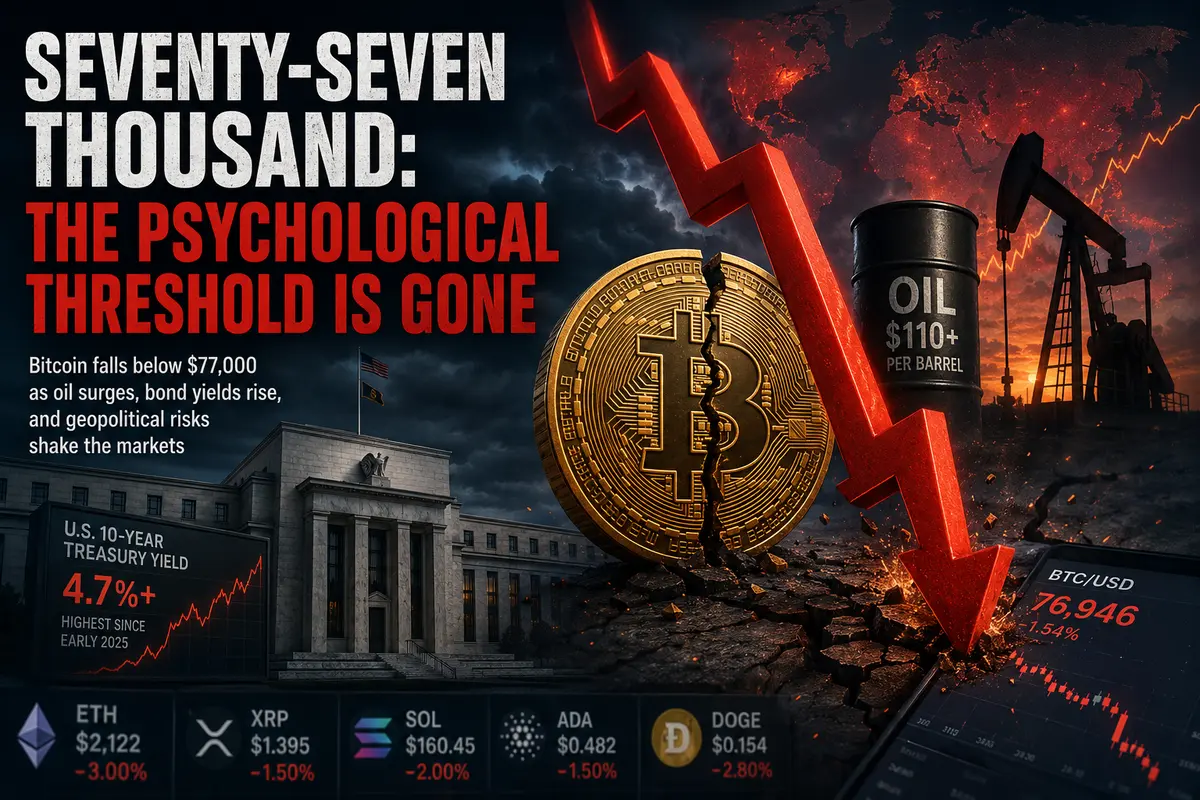
Monday began with an unpleasant milestone for Bitcoin. The leading cryptocurrency broke below the seventy-seven-thousand-dollar level and continued sliding lower, trading around $76,946. A one-and-a-half percent daily loss is not particularly dramatic for an asset accustomed to swinging five to ten percent in a single session. But more important than the percentage itself is the fact that this marked Bitcoin’s lowest level since May 1. Nearly three weeks of gains and consolidation were erased in just a few trading sessions.

Just last week, Bitcoin looked promising. It briefly climbed above the eighty-thousand-dollar mark, and bulls had already begun speculating about when the next major psychological level would fall. But the breakout turned out to be false, and the market failed to hold the higher ground. Looking back now, it’s becoming clear that the move above eighty thousand was not the beginning of a new rally, but rather a final burst before a prolonged correction. The crypto market, which only recently was fueled by hopes of imminent monetary easing, has collided with a harsh reality where oil prices are rising, bond yields are climbing, and risk assets are getting crushed.

Oil as the Killer of Risk Appetite

The main trigger behind today’s Bitcoin decline lies far outside the crypto world — in the Middle East and the bond market. On Monday, Brent crude oil surged above $110 per barrel, setting off a chain reaction that rippled across the entire financial universe.

Expensive oil means inflation. Inflation means higher interest rates. Higher rates are deadly for risk assets — and Bitcoin, whether people like it or not, still belongs in that category. Investors are looking at oil prices, headlines about drones over the UAE, and failed diplomatic negotiations with Iran, and drawing a simple conclusion: cheap energy is not coming back anytime...

Continue reading...
0
0
Navigation menu
instaforex banner