

Seventy-Seven Thousand: The Psychological Threshold Is Gone
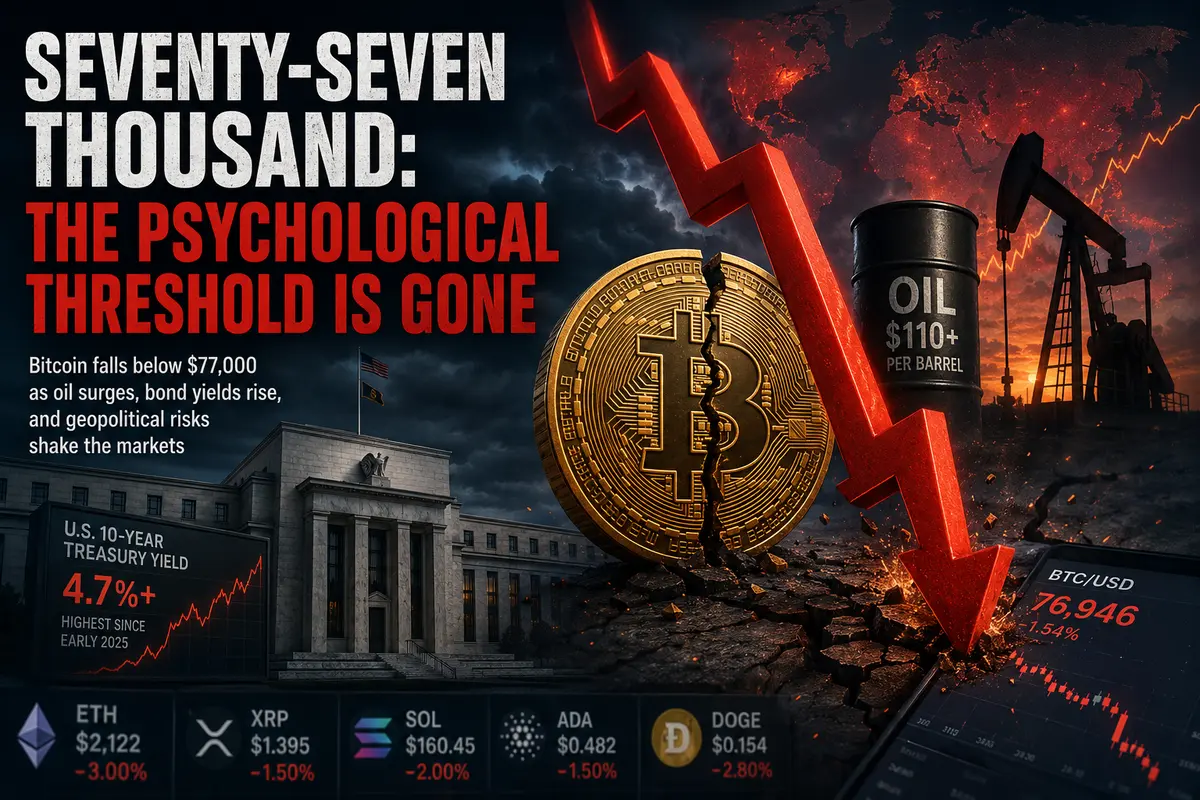
Monday began with an unpleasant milestone for Bitcoin. The leading cryptocurrency broke below the seventy-seven-thousand-dollar level and continued sliding lower, trading around $76,946. A one-and-a-half percent daily loss is not particularly dramatic for an asset accustomed to swinging five to ten percent in a single session. But more important than the percentage itself is the fact that this marked Bitcoin’s lowest level since May 1. Nearly three weeks of gains and consolidation were erased in just a few trading sessions.
Just last week, Bitcoin looked promising. It briefly climbed above the eighty-thousand-dollar mark, and bulls had already begun speculating about when the next major psychological level would fall. But the breakout turned out to be false, and the market failed to hold the higher ground. Looking back now, it’s becoming clear that the move above eighty thousand was not the beginning of a new rally, but rather a final burst before a prolonged correction. The crypto market, which only recently was fueled by hopes of imminent monetary easing, has collided with a harsh reality where oil prices are rising, bond yields are climbing, and risk assets are getting crushed.
Oil as the Killer of Risk Appetite
The main trigger behind today’s Bitcoin decline lies far outside the crypto world — in the Middle East and the bond market. On Monday, Brent crude oil surged above $110 per barrel, setting off a chain reaction that rippled across the entire financial universe.
Expensive oil means inflation. Inflation means higher interest rates. Higher rates are deadly for risk assets — and Bitcoin, whether people like it or not, still belongs in that category. Investors are looking at oil prices, headlines about drones over the UAE, and failed diplomatic negotiations with Iran, and drawing a simple conclusion: cheap energy is not coming back anytime soon, central banks will be forced to keep rates elevated, and speculative assets are no longer attractive compared to safer alternatives.
Reports of drone incidents in the Emirates and the deadlock in U.S.–Iran negotiations became the catalyst that turned simmering anxiety into an outright flight from risk. When drones are crashing near nuclear facilities, when the president of the world’s most powerful nation says that “time is running out,” and diplomats throw up their hands in frustration, even the most committed crypto optimists begin to feel nervous.
Bonds Are Stealing the Spotlight
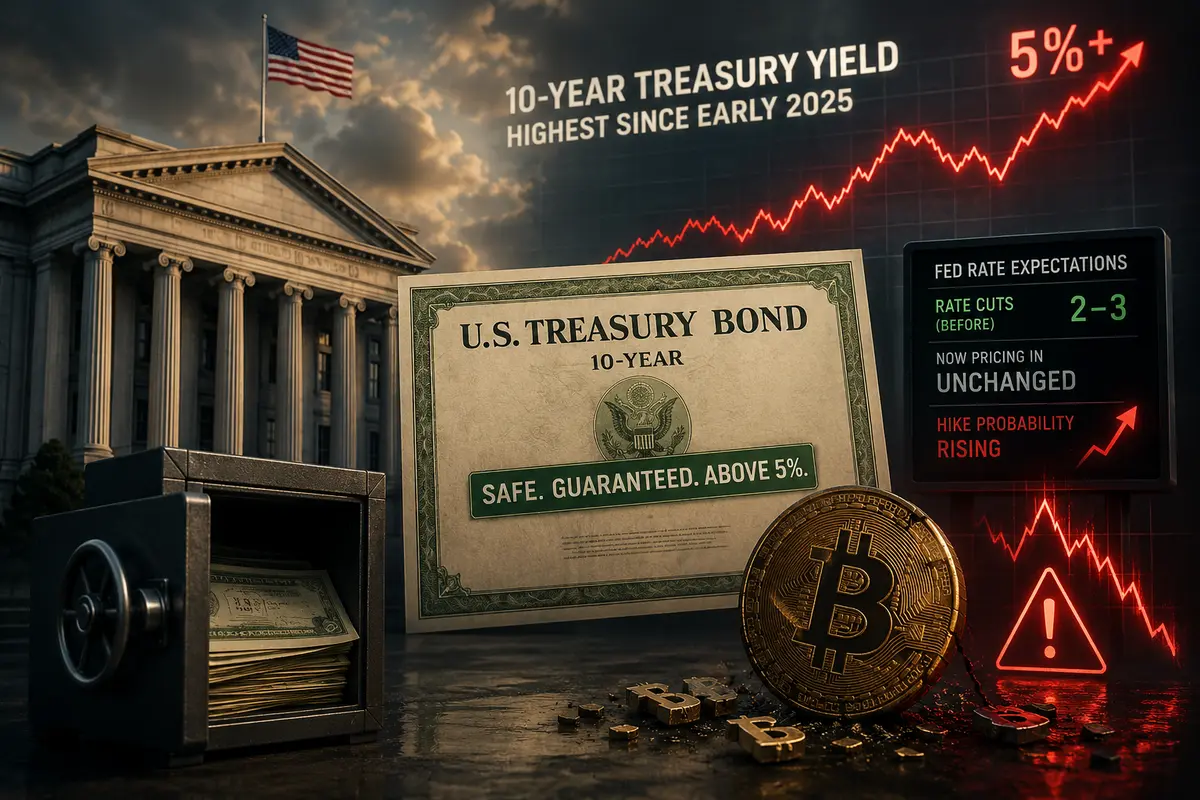
Rising oil prices triggered a broad sell-off in the government bond market. Yields on benchmark U.S. 10-year Treasuries climbed to their highest levels since the beginning of 2025. For financial markets, a year and a half is practically an eternity — several entire expectation cycles have come and gone during that time.
The higher bond yields rise, the more attractive they become to conservative investors. Why risk money in Bitcoin, which can lose ten percent in a single day, when U.S. Treasuries offer guaranteed annual returns above five percent on what is considered a virtually risk-free asset? That is the question pension fund managers, insurance companies, and family offices around the world are now asking themselves. Judging by market behavior, the answer is not favorable for cryptocurrencies.
Traders have sharply revised their expectations for Federal Reserve policy. Previously, markets were hoping for two or even three rounds of rate cuts before the end of 2026. Those hopes have now evaporated. Futures markets are pricing in rates staying largely unchanged for most of the year. More importantly, the probability of another rate hike has begun to rise — the very tightening scenario everyone feared but considered unlikely just a few months ago. For Bitcoin and the broader crypto market, this is an unmistakably bearish signal.
Trump and “Time Is Running Out”: Geopolitics Versus Crypto
President Donald Trump issued another warning to Tehran on Sunday. His statement that “time is running out” for Iran to reach an agreement with Washington sounded less like diplomacy and more like a political ultimatum that could lead to anything from new sanctions to direct military action.
For the crypto market, this is bad news for several reasons. First, a deeper regional conflict means continued disruptions to global oil supply routes, which in turn keeps energy prices high and inflationary pressure elevated. Second, rising geopolitical tensions usually push investors out of risky assets and into the dollar and government bonds. Third, uncertainty itself is the enemy of speculation: when nobody knows what tomorrow may bring, the appetite for volatile assets drops sharply.
Interestingly, Bitcoin has often been called “digital gold” and promoted as a hedge against geopolitical instability. But the current episode demonstrates that this analogy does not always hold true. When a geopolitical crisis simultaneously fuels inflation and drives bond yields higher, cryptocurrencies suffer alongside other risk assets instead of benefiting as defensive instruments. Gold, by the way, is also declining — which suggests the issue is not Bitcoin specifically, but rather a broad reassessment of market risk.
Eighty Thousand Looks Like an Impossible Dream
Bitcoin continues to slam against the eighty-thousand-dollar level like a fish against ice. Every attempt to break through ends in another pullback. Institutional interest has not disappeared, inflows into spot Bitcoin ETFs continue, but all of that still proves insufficient to overcome the macroeconomic headwinds.
This is a classic market setup where fundamental drivers — institutional adoption and ETF inflows — collide with monetary conditions. When rates are rising and bond yields are luring conservative investors with guaranteed returns, even massive institutional enthusiasm cannot push prices beyond a certain ceiling. The money simply is not flowing into crypto markets in sufficient volume to offset the outflow of speculative capital.
At the same time, investors are acting cautiously ahead of Nvidia’s earnings report. At first glance, that may seem unrelated — what does a chipmaker have to do with Bitcoin? But in today’s interconnected markets, everything is linked. NVIDIA has become the symbol of the artificial intelligence boom that has driven technology stocks and risk assets more broadly. If Nvidia disappoints investors, the shockwave could hit all speculative assets, including cryptocurrencies. On the other hand, a strong report could revive overall risk appetite and indirectly support Bitcoin.
Altcoins: The Younger Brothers Suffer More
As usually happens during risk-off periods, altcoins are suffering far more than Bitcoin itself. Ether, the second-largest cryptocurrency by market capitalization, lost three percent during the day and fell toward $2,122. That decline is roughly double Bitcoin’s losses and perfectly illustrates how the crypto market behaves during stress: capital first rotates out of riskier altcoins into relatively safer Bitcoin, and only later, if pressure intensifies, exits Bitcoin as well.
XRP lost one and a half percent and hovered around $1.395. Solana dropped two percent. Cardano and Polygon both fell by one and a half percent. Among meme tokens, Dogecoin plunged 2.8 percent — more than many serious projects — reinforcing the old market truth that jokes are the first thing investors abandon when fear takes over.
Interestingly, while the declines in altcoins are significant, they are not catastrophic. The market is not panicking, there is no mass exodus or cascade of liquidations like during previous crypto winters. Instead, what we are seeing is a methodical and relatively orderly reduction of exposure. Investors are not fleeing in terror — they are gradually trimming risk positions and reallocating toward safer instruments.
What Comes Next: Macroeconomics Versus Crypto Optimism
Bitcoin now finds itself trapped between two opposing forces. On one side, institutional adoption continues to advance: ETFs are attracting capital, major banks are expanding crypto services, and regulators are gradually building clearer rules for the industry. These are long-term structural factors that should support higher prices over the coming years.
On the other side, the immediate macroeconomic backdrop looks openly hostile. Oil prices are rising, bond yields are climbing, interest rates are not coming down, and geopolitical tensions show no sign of easing.
For now, the second set of factors outweighs the first. But markets move in cycles, and today’s sell-off is not a death sentence for Bitcoin — it is merely another chapter in its endless struggle against macroeconomic gravity. If oil prices stabilize, if diplomatic progress with Iran emerges, if bond yields stop rising, Bitcoin could quickly recover its losses. But until then, cryptocurrencies are forced to operate in a world where U.S. Treasuries have once again become investors’ preferred safe haven. And in that competition, despite all its strengths, Bitcoin is still losing.

Comments
No comments yet. Be the first to share your thoughts!
Authentication Required
You must be logged in to post a comment.