
Monday’s Statement That Turns the Page
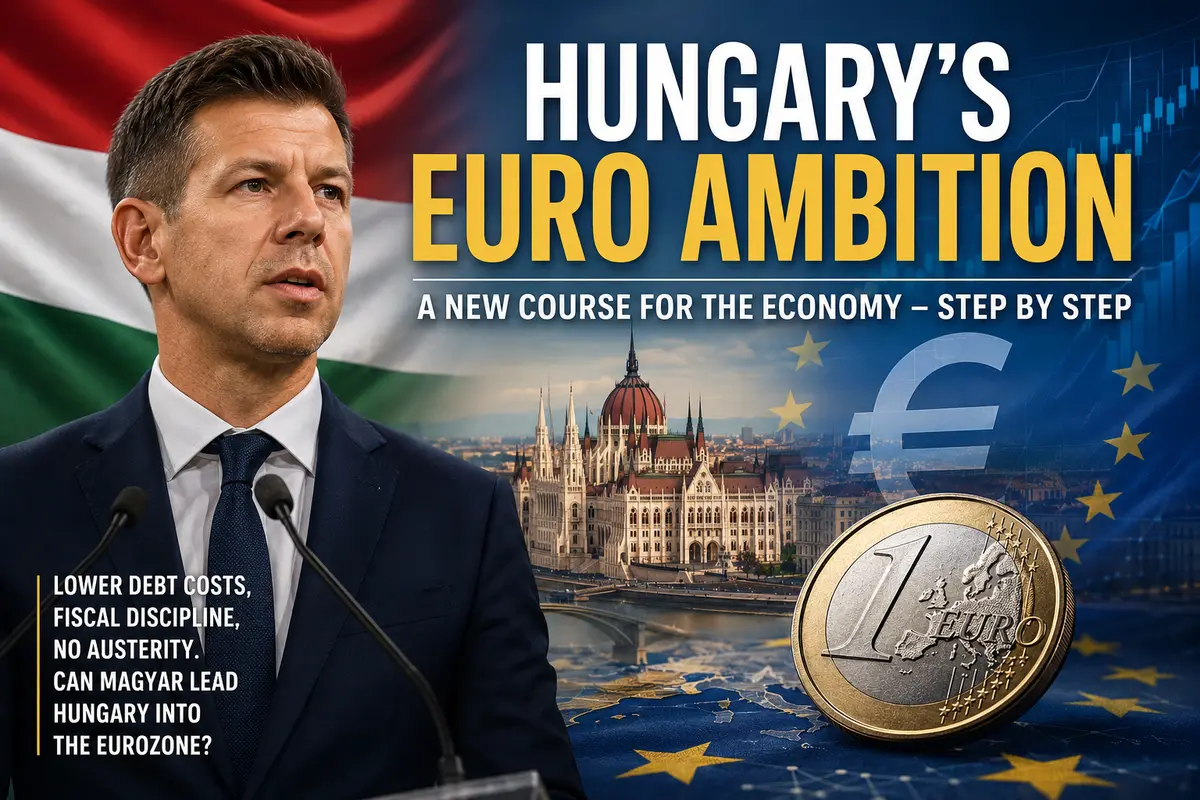
On Monday, Hungarian Prime Minister Peter Magyar said something Budapest had long been expected to say — but which the previous leadership stubbornly refused to utter. Hungary intends to adopt the euro. Not tomorrow, not the day after tomorrow, and not in emergency mode — but gradually, step by step, meeting the criteria in a way that does not harm the national economy. The wording itself says a great deal: the country is no longer debating whether it should join the eurozone, but rather discussing how exactly to do it.
This marks a tectonic shift in rhetoric. Under the previous government of Viktor Orbán, the euro was practically a taboo subject. The forint was presented as a symbol of national sovereignty, and abandoning it was portrayed as surrender to Brussels. Magyar, who replaced Orbán, is turning that logic upside down. In his view, adopting the euro is not a loss of sovereignty, but the acquisition of new opportunities for public finances and ordinary citizens alike.
Behind these words lies not just a rhetorical shift, but a fundamental reassessment of how Hungary sees its place in Europe. For three decades after the collapse of the socialist bloc, the country balanced between the West and its own sense of exceptionalism. Now the pendulum appears to have swung toward deeper integration — and that movement will have consequences far beyond currency markets.
The Criteria That Must Be Met: What “Gradually” Really Means
Magyar emphasizes gradualism for a reason. Adopting the euro is not merely about replacing banknotes in people’s wallets. It is an extraordinarily complex process requiring compliance with the Maastricht criteria, and Hungary currently fails to meet at least several of them. Inflation must be kept under control, the budget deficit must remain within three percent of GDP, public debt must be on a sustainable downward path, and the national currency must spend at least two years inside the European exchange rate mechanism without major turbulence.
That last requirement is especially sensitive. The ERM II mechanism, through which every eurozone entrant has passed, is a kind of purgatory in which a currency must prove its stability. Despite its recent successes, the forint remains an emerging-market currency, with all the risks that entails. Keeping it within a narrow fluctuation band against the euro for two years would require either iron macroeconomic discipline or considerable luck — preferably both.
The prime minister clearly understands that abrupt moves would be dangerous. Entering the eurozone too quickly is like jumping into icy water: the resulting shock can leave an economy recovering for years. Greece remains the classic example — it entered the eurozone with an overvalued exchange rate and spent the next decade paying for it through a debt crisis. Every Eastern European politician has that lesson firmly in mind. Magyar is clearly determined to avoid the same trap.
Public Debt: A Bet on Trust
One of the key arguments Magyar offered in favor of adopting the euro was the reduction in the cost of servicing public debt. This is not merely a strong argument — for a country whose debt burden requires constant attention, it is critically important.
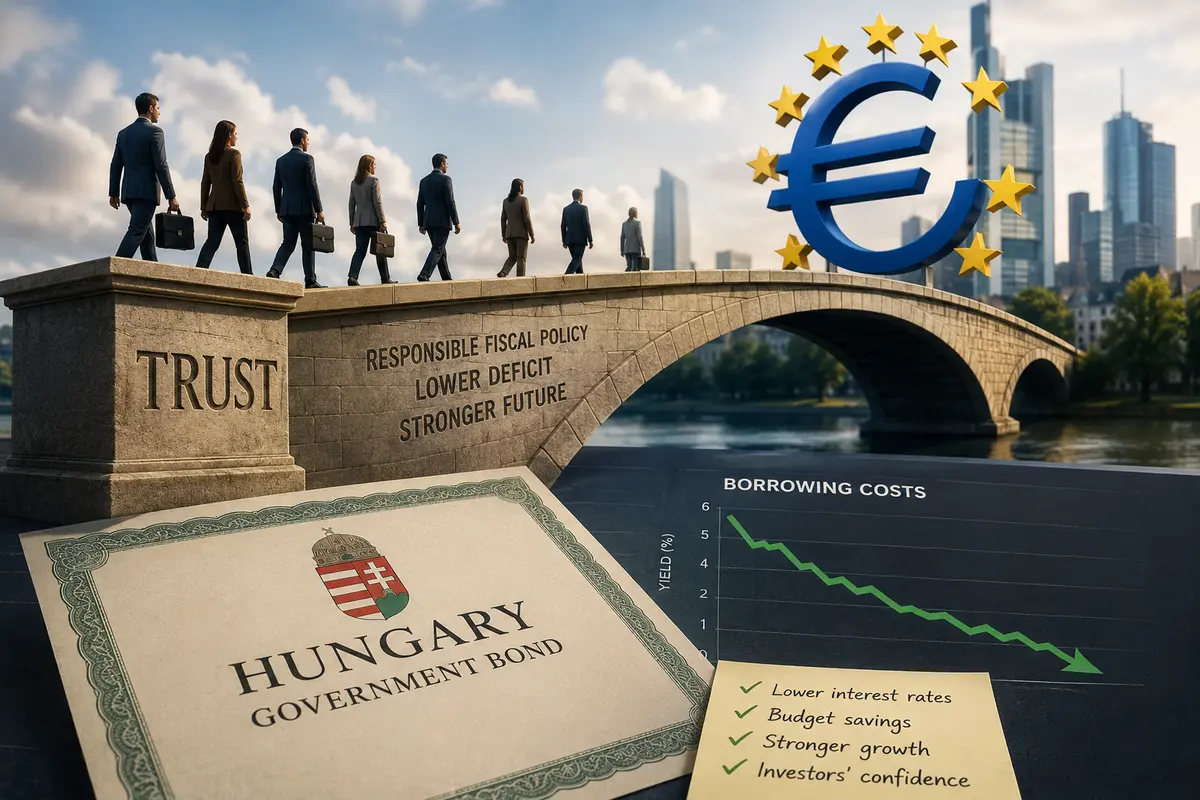
The mechanism is simple and has been tested repeatedly by countries that joined the eurozone. Once investors see that a country is committed to entering the monetary union, they begin to view its bonds as less risky. Currency risk disappears from the horizon, and with it the premium investors demand for bearing that risk. Government bond yields fall, borrowing costs decline, and the state budget gains substantial savings on debt servicing.
Magyar linked this improvement directly to growing investor confidence in the government’s commitment to reducing the budget deficit. This is no longer just rhetoric about the euro; it is a concrete signal to financial markets: we will pursue responsible fiscal policy, we will reduce the deficit, and we will do so without extreme measures that could undermine economic growth. To holders of Hungarian bonds — major international funds, pension systems, and insurance companies — such a statement sounds like music.
Austerity? No Thanks
And here we arrive at perhaps the most interesting part of Magyar’s statement. The prime minister stressed that the government intends to avoid austerity measures. In the European context, this is almost a revolutionary declaration. Countries that underwent fiscal consolidation before joining the eurozone — from Greece to Portugal, from Latvia to Ireland — almost always resorted to belt-tightening: cutting public-sector wages, slashing social programs, raising taxes. Magyar claims Hungary can take a different path.
According to him, there are significant opportunities to cut spending in sectors where the previous administration spent excessively. This is a direct attack on the Orbán government, which became known for large-scale and often opaque spending. The Orbán system was built around a sprawling network of state contracts, subsidies for politically connected businesses, and massive infrastructure projects whose efficiency was often questioned. Magyar is effectively promising to audit these expenditures and redirect the savings toward deficit reduction — without tax hikes and without cutting social programs.
If he succeeds, it would be a brilliant political move. Fiscal consolidation achieved through reducing inefficient spending rather than burdening the population is exactly what voters exhausted by years of “tighten your belts” rhetoric want to hear. But, as always, the devil is in the details. Which sectors will actually be optimized? Who will lose state contracts? How will businesses accustomed to generous government financing react? The answers to those questions will determine how smooth Hungary’s path to the euro will be.
The Finance Minister and the Real Deficit: An Unpleasant Surprise or a Sober Assessment?
One intriguing detail: Magyar said the finance minister is currently calculating the actual size of the budget deficit based on available data. It may sound technical, but it could conceal something far more serious. Orbán’s previous government was repeatedly accused of masking the true condition of public finances. Off-budget funds, state-owned companies with questionable reporting practices, hidden liabilities — all of this may surface during a thorough audit.
If the finance minister discovers that the real deficit significantly exceeds the official figures, this will place additional strain on the consolidation process. On the other hand, an honest audit is exactly what both Brussels and financial markets want to see. Transparency in public finances is the first — and perhaps the most important — step toward adopting the euro. Without it, every other promise and plan will remain mere words.
Magyar appears to understand this well. His statement that the finance minister is now calculating the real deficit signals that the government intends to begin with an honest assessment of the situation, however unpleasant it may turn out to be. For markets, that is a positive sign. For political opponents, a cause for concern. And for Hungarian citizens, perhaps the first step toward a currency that will not go into convulsions during every global crisis.
A Road That Will Take Years
Hungary’s transition to the euro will not happen this year, nor next year, nor probably even in two years. This is a marathon, not a sprint. But every marathon begins with a first step, and Magyar’s statement is precisely that step. The country has officially declared its intention to join the eurozone, and now every budget decision, every reform, every quarterly report will be viewed through that lens.
For Hungary, this is a historic choice. More than thirty years ago, the country emerged from the Soviet bloc and began the painful transition toward a market economy. Twenty years ago, it joined the European Union. Now another milestone has appeared on the horizon — the common European currency. If Magyar succeeds in guiding the country along this path without social upheaval or economic shocks, he will go down in history as the leader who completed Hungary’s European integration. If not — well, his predecessors failed too. But at least now the game is being played openly, with a clearly declared goal and understandable rules. And that alone is no small thing.

Comments
No comments yet. Be the first to share your thoughts!
Authentication Required
You must be logged in to post a comment.