

Morning Momentum in Asian Trading
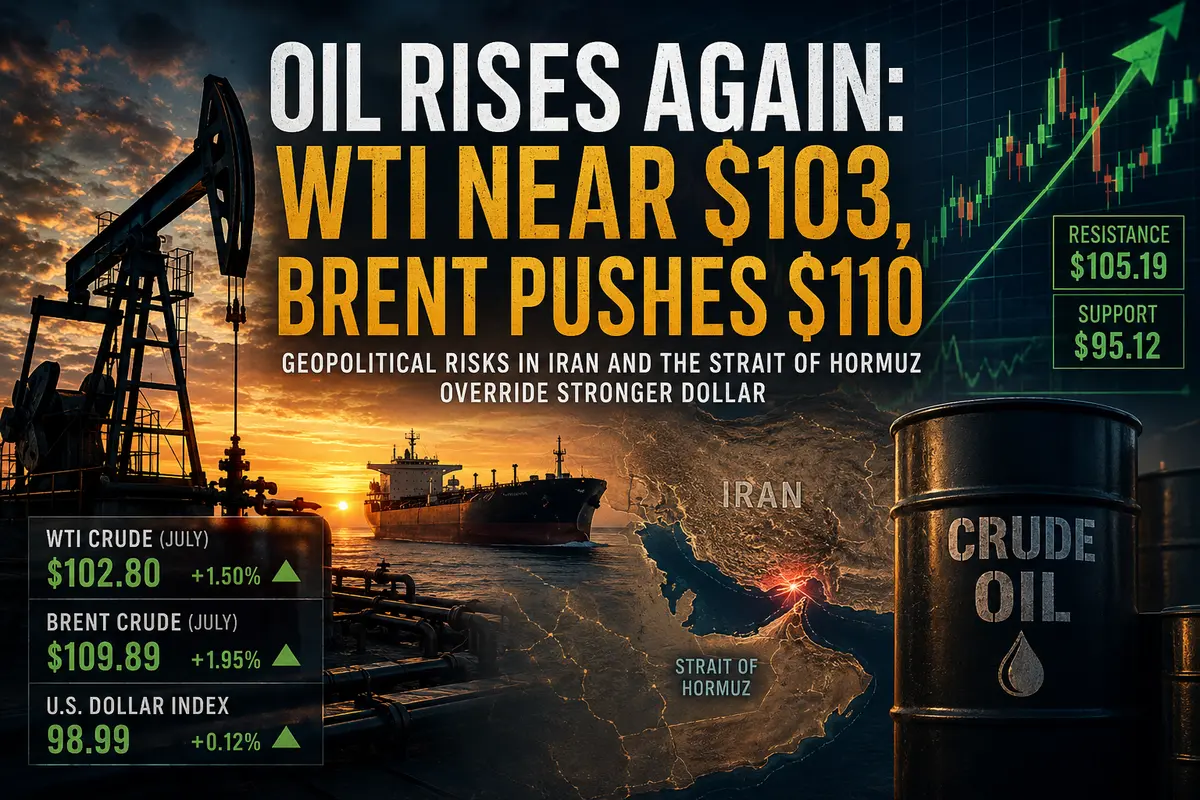
Tuesday began with a confident rise in the oil market. On the New York Mercantile Exchange, July WTI crude oil futures climbed by one and a half percent, settling near $102.80 per barrel. This is not an explosive surge or a panic-driven rally, but rather a steady, methodical move higher that suggests bullish sentiment in the oil market has not disappeared. It merely paused briefly the day before and is now returning with renewed strength.
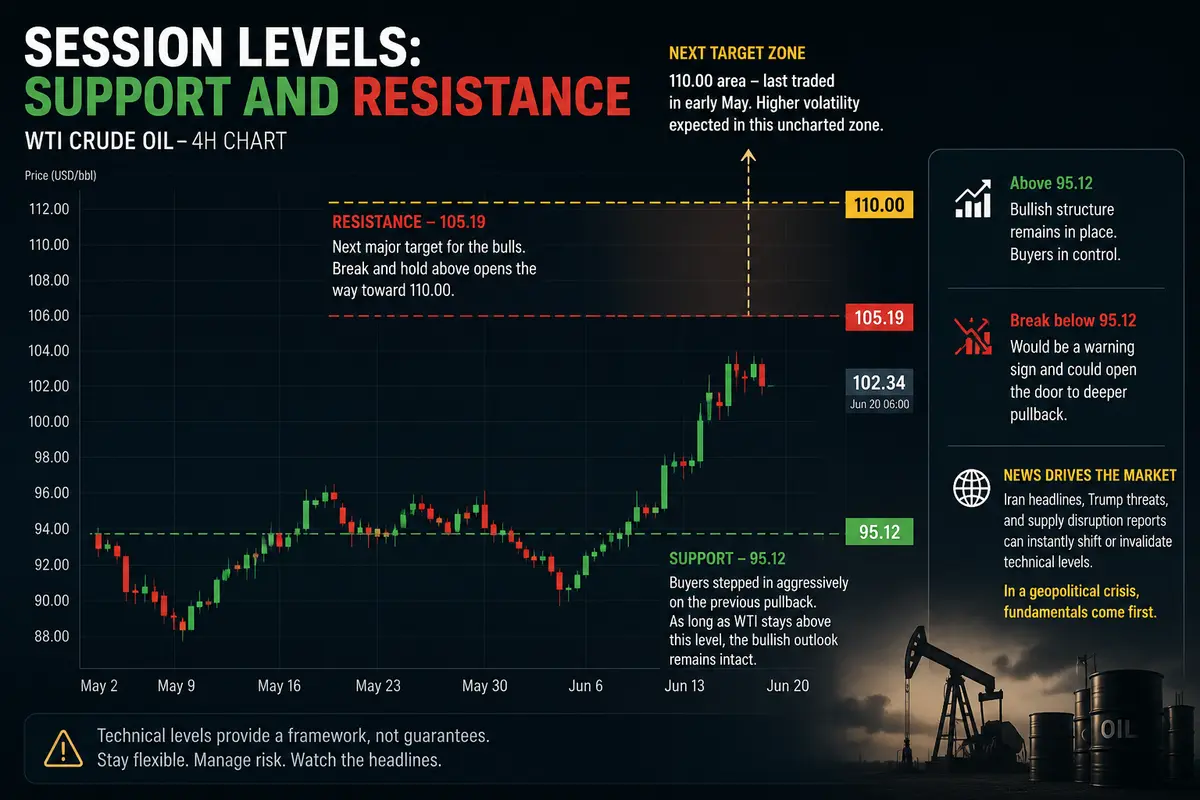
The session high moved above $103 — territory where oil has not traded since early May. Intraday support formed around $95, a level where buyers appear willing to enter the market without waiting for a deeper pullback. On the upside, resistance is located near $105, a key zone whose breakout could open the path to new highs.
But before examining why oil is rising today specifically, it is worth paying attention to one critically important detail: oil is gaining alongside the U.S. dollar. This is an unusual combination under normal market conditions and deserves separate analysis.
The Dollar and Oil: An Unusual Duo
The U.S. Dollar Index, which measures the strength of the American currency against a basket of six major peers, gained 0.12% and is trading near 98.99. Normally, a stronger dollar puts pressure on oil prices: when the U.S. currency appreciates, dollar-denominated commodities become more expensive for foreign buyers, reducing demand. This inverse relationship is a classic principle taught in introductory finance courses.
But today, that relationship is not working. Oil and the dollar are rising simultaneously, which says a great deal about the nature of the current move. When commodities rally despite a strengthening dollar, it means a powerful market-specific factor is outweighing the currency effect. And that factor is well known — geopolitical tensions surrounding Iran and ongoing supply concerns in the Strait of Hormuz.
In other words, the oil market is currently so concerned about physical supply disruptions that it is willing to ignore currency fluctuations. This is an exceptionally bullish signal: when the market stops reacting negatively to a stronger dollar, it means fear of supply shortages has become the dominant force.
Brent Keeps Pace: The North Sea Benchmark Pushes Toward $110
While WTI is testing the $103 level, North Sea Brent crude is showing even stronger momentum. July Brent futures rose nearly 2% to reach $109.89 per barrel. The psychologically important $110 mark is now just a few cents away — a distance that, under current volatility conditions, could easily be covered within a single trading session.
The price spread between Brent and WTI widened to $7.09 per barrel. This spread is itself an important indicator. Brent traditionally trades at a premium to WTI due to differences in crude quality, delivery geography, and transportation costs. But when the spread widens, it often signals that supply concerns are affecting international markets more severely than the domestic U.S. market.
Brent is far more dependent on maritime transportation, the situation in the Persian Gulf and the Strait of Hormuz, and geopolitical risks in the Middle East. WTI, tied more closely to the North American market and constrained export capacity, is less sensitive to those factors.
A seven-dollar spread is relatively large by historical standards and reflects the geopolitical premium currently embedded in international crude prices. The market is effectively paying extra for assurance that oil can physically reach consumers despite blocked shipping lanes and conflict zones.
Session Levels: Support and Resistance
Returning to WTI, it is worth taking a closer look at the technical picture that developed during the Asian session. Support at $95.12 marks the level where buyers last entered the market aggressively during the previous pullback. As long as oil remains above that mark, the technical outlook stays bullish. A break below it would become a concerning signal, but for now sellers are not even attempting to test that level.
Resistance at $105.19 represents the next major target for the bulls. If WTI breaks above and consolidates there, the next stop could be the $110 area, where Brent is already approaching. However, between $105 and $110 lies a price zone where oil has not traded since early May, and moving through this territory could involve heightened volatility.
It is important to understand that technical levels are now tightly linked to the news cycle. Every new headline regarding Iran, every new threat from Trump, and every report of supply disruptions can instantly shift these levels or render them irrelevant. In a geopolitical crisis, technical analysis takes a back seat to fundamental risk assessment.
Geopolitical Background: Calm Before the Storm or the Beginning of De-escalation?
Tuesday’s oil rally comes amid mixed signals on the geopolitical front. The previous day, Trump announced a delay in military action against Iran and claimed negotiations were progressing successfully. The market interpreted this as a temporary easing of tensions, leading oil to correct lower. But today’s rebound suggests traders are not fully convinced by the conciliatory rhetoric.
That skepticism is understandable. The Iranian conflict has persisted for several months, and during that time hopes for diplomacy have repeatedly been followed by renewed escalation. The Strait of Hormuz remains effectively closed to normal shipping operations. Drones continue to fall near strategic facilities in the UAE. And despite occasional flexibility in tone, Trump’s rhetoric remains tough: “the clock is ticking,” “time is running out,” “Iran must accept the terms.” In such an environment, any incident could quickly send prices sharply higher again.
Moreover, the oil market is pricing in not only current disruptions but also expectations of future supply problems. Even if shipments are still moving today, nobody knows what tomorrow will bring. This uncertainty itself is bullish: it encourages buyers to build inventories and speculators to maintain long positions despite temporary pullbacks.
Different Exchanges, Different Contracts: ICE vs NYMEX
Today’s market focus is on WTI traded on the New York Mercantile Exchange, but Brent’s movement on London’s ICE exchange is equally revealing. The divergence between the two benchmarks adds further depth to the broader picture.
When Brent rises faster than WTI, it usually means global supply risks are outweighing local U.S. factors. That is exactly what is happening now: Brent is up nearly 2%, while WTI is up about 1.5%. International markets are more concerned about the Iranian crisis and its implications for maritime transport than the U.S. market, which relies more heavily on domestic production and Canadian imports.
For the global economy, this is bad news. Most countries use Brent as the benchmark for pricing refined petroleum products. Brent approaching $110 means gasoline, diesel, and jet fuel prices worldwide are likely to continue climbing, fueling inflation and eroding consumer purchasing power from Tokyo to Berlin.
What Comes Next: Waiting for the Catalyst
The oil market is entering a phase where every morning could bring a surprise. Several potential catalysts remain in play, and all are tied to geopolitics. If Trump and Iranian leadership genuinely move toward a peace agreement, oil could quickly correct lower and fall back below $100. But if negotiations collapse and rhetoric hardens again, Brent at $110 may prove not to be a ceiling but merely a waypoint on the road to even higher prices.
There is also a third scenario — prolonged uncertainty, where the conflict neither resolves nor escalates dramatically. In that case, oil would likely remain trapped in a broad $100–$110 range, periodically testing both boundaries depending on the news flow. This currently appears to be the most probable outcome, and Tuesday morning’s rally fits perfectly within that framework: the market is not panicking, but neither is it relaxing, steadily pricing in persistent geopolitical tension.
For consumers around the world, this means the era of expensive oil is far from over. For central banks, it means inflationary pressure is likely to persist, keeping interest rates elevated. And for traders, it means volatility is here to stay, with every new headline capable of triggering a reassessment of market positioning. Oil is rising on Tuesday, and behind that move lies not a temporary impulse, but a fundamental repricing of risks that the global economy may carry for a long time to come.

Comments
No comments yet. Be the first to share your thoughts!
Authentication Required
You must be logged in to post a comment.