Bar Pipa
We pay for a post of 10$

Oil Market

WTI Oil Moves Higher as Asian Trading Boosts Buyer Confidence

WTI Oil Moves Higher as Asian Trading Boosts Buyer Confidence

Friday’s Opening: Black Gold Is Back in Demand

Friday’s oil market opened with a confident move higher. August WTI crude oil futures WTI ... on the New York Mercantile Exchange gained nearly 1% and are trading at $79.68 per barrel. This is not merely a random price fluctuation. The rise is supported by several clear factors that are encouraging investors to regain confidence in the oil market.

Notably, the increase is taking place against the backdrop of a stable US dollar. The USD Index remained unchanged on Friday at 100.57. This means that currency movements are not putting pressure on oil, allowing the market to respond to other, more fundamental signals. At present, these signals suggest that demand for energy remains strong while supply is facing significant risks.

Let us examine what is driving prices higher and why BZUSD ... Brent crude, contrary to expectations, is moving lower.

Technical Outlook: The Bulls Advance

Technical indicators on Friday present a fairly optimistic picture for oil buyers. Support is located at $72.61. The price rebounded from this level some time ago and is now trading significantly above it. Resistance stands at $81.27, and breaking through this level will be the next major challenge for the bulls.

The current price of $79.68 is only around $1.50 below resistance. This creates an interesting situation: the market has approached an important threshold, and if buyers manage to overcome it, oil could receive a fresh upward impulse. Otherwise, a correction and another test of lower levels may follow.

The session high has not yet been updated, leaving room for further growth during the trading day. Traders are closely watching whether WTI can consolidate above $80—a psychologically important level that has acted as a significant barrier in recent weeks.

The Gap Between Brent and WTI: What Does the Spread...

Continue reading...
0
0

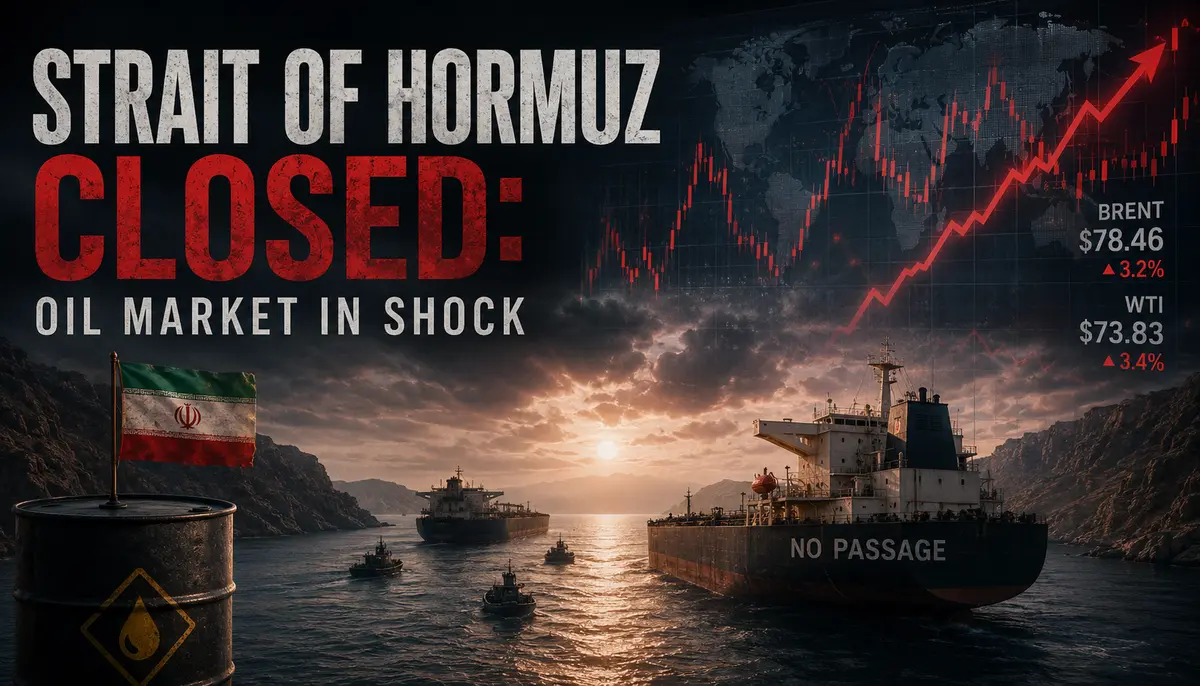
Strait of Hormuz Closed: Oil Market in Shock

Strait of Hormuz Closed: Oil Market in Shock

Introduction: The Red Line Has Been Crossed

Monday began with an explosion in the oil markets—literally. Iran expanded its missile and drone attacks against Persian Gulf countries, including Qatar and the United Arab Emirates, and then announced the closure of the Strait of Hormuz. Oil prices surged by more than three percent within hours. Brent futures climbed to $78.46 per barrel, while WTI rose to $73.83.

This is not simply another geopolitical escalation. It is a strike at the very heart of the global energy system. The Strait of Hormuz is more than just a maritime route. It is an artery through which the lifeblood of the modern economy flows. Around twenty percent of all the oil consumed worldwide passes through it. Now, according to Tehran, this channel has been closed.

What is behind this decision? Who attacked the commercial vessel? Most importantly, how long will this crisis last, and what will it mean for the global economy? In this article, we examine every aspect of a situation that transformed the oil market in a single morning and forced traders around the world to recalculate their models.

Escalation: How the Strait Came to Be Closed

From Ceasefire to War in a Matter of Days

The history of this conflict is a classic example of how fragile peace can collapse in an instant. Just a week ago, it appeared that diplomatic efforts to restore the memorandum of understanding between the United States and Iran were producing results. Negotiations were underway, mediators were working, and both sides were avoiding drastic moves.

Then everything changed. Trump announced the end of the ceasefire and intensified strikes against Iranian facilities. Tehran, which had exercised restraint for a long time, responded. Its response proved far more severe than Washington had expected. Missile attacks against Qatar and...

Continue reading...
0
0
Tim Drening

Morning Momentum in Asian Trading

Morning Momentum in Asian Trading

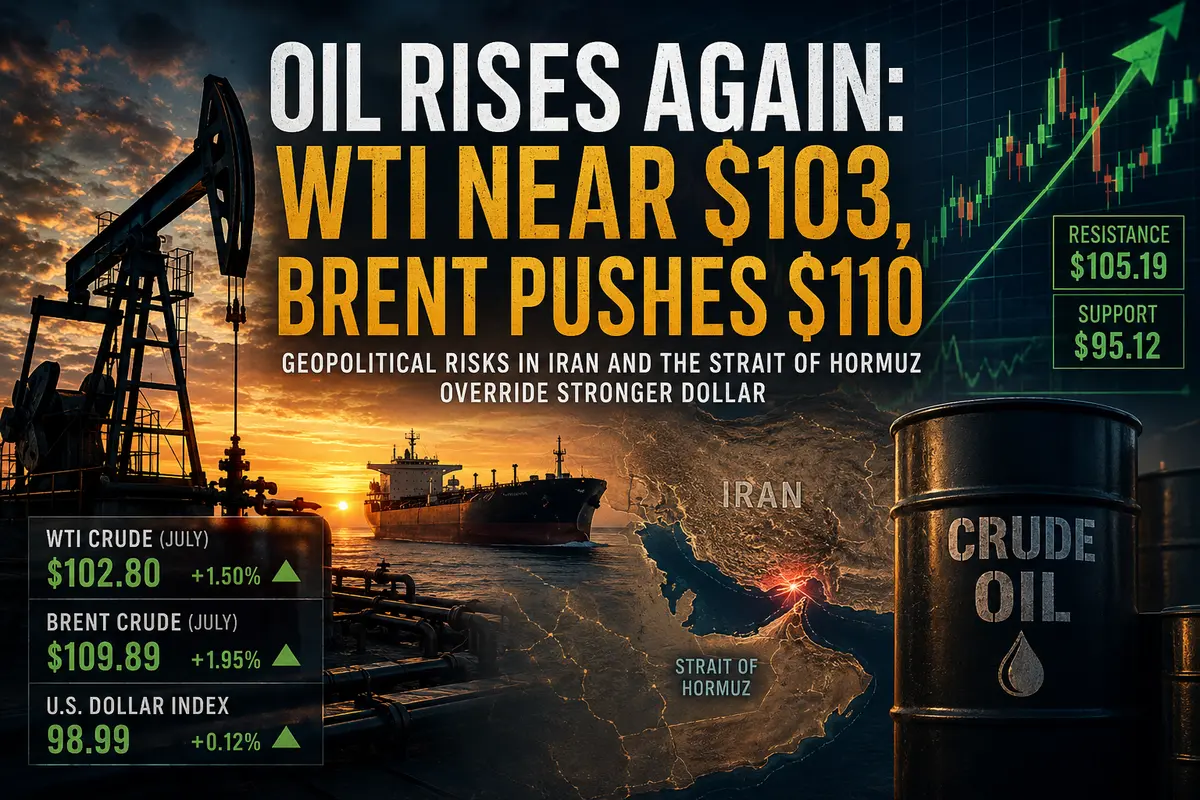
Tuesday began with a confident rise in the oil market. On the New York Mercantile Exchange, July WTI crude oil futures climbed by one and a half percent, settling near $102.80 per barrel. This is not an explosive surge or a panic-driven rally, but rather a steady, methodical move higher that suggests bullish sentiment in the oil market has not disappeared. It merely paused briefly the day before and is now returning with renewed strength.

The session high moved above $103 — territory where oil has not traded since early May. Intraday support formed around $95, a level where buyers appear willing to enter the market without waiting for a deeper pullback. On the upside, resistance is located near $105, a key zone whose breakout could open the path to new highs.

But before examining why oil is rising today specifically, it is worth paying attention to one critically important detail: oil is gaining alongside the U.S. dollar. This is an unusual combination under normal market conditions and deserves separate analysis.

The Dollar and Oil: An Unusual Duo

The U.S. Dollar Index, which measures the strength of the American currency against a basket of six major peers, gained 0.12% and is trading near 98.99. Normally, a stronger dollar puts pressure on oil prices: when the U.S. currency appreciates, dollar-denominated commodities become more expensive for foreign buyers, reducing demand. This inverse relationship is a classic principle taught in introductory finance courses.

But today, that relationship is not working. Oil and the dollar are rising simultaneously, which says a great deal about the nature of the current move. When commodities rally despite a strengthening dollar, it means a powerful market-specific factor is outweighing the currency effect. And that factor is well known — geopolitical tensions surrounding Iran and ongoing supply concerns in...

Continue reading...
0
0
Lin Brings

Morning Explosion in Asian Trading

Morning Explosion in Asian Trading

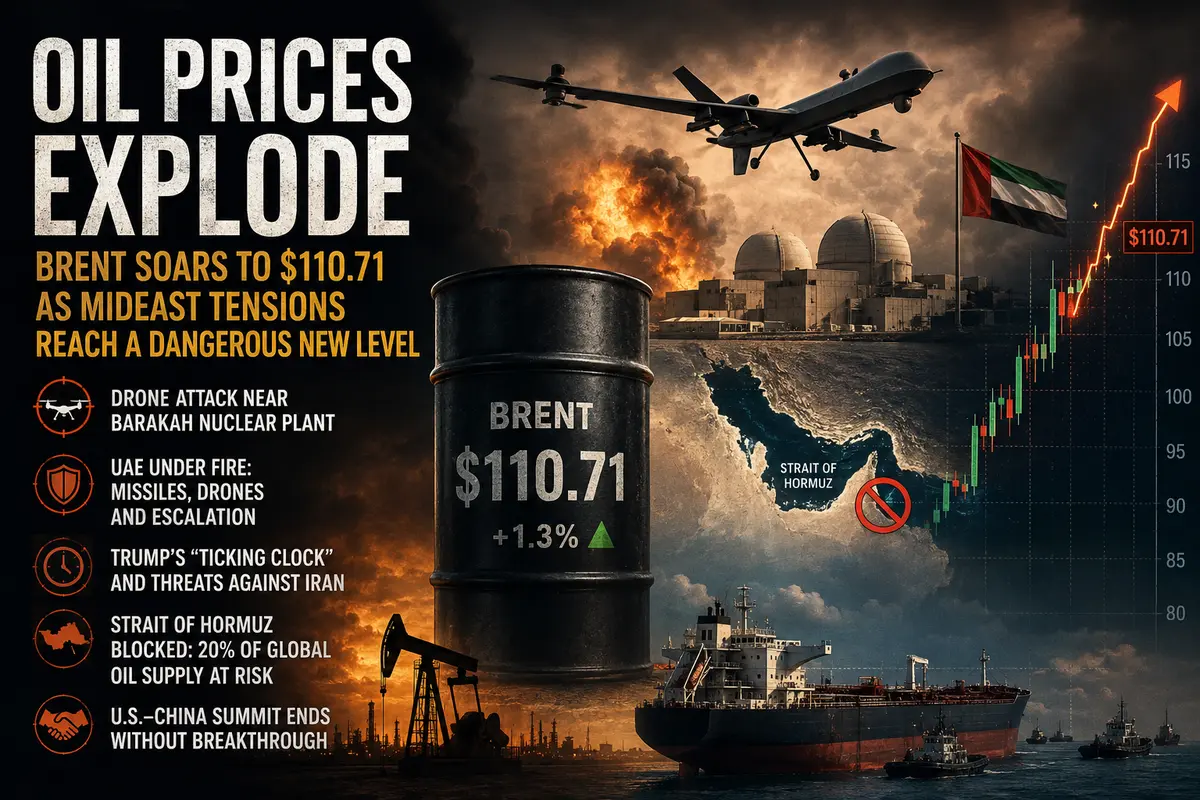
Monday began with a sharp surge in oil prices. As soon as Asian markets opened, July futures for North Sea Brent crude jumped 1.3%, reaching $110.71 per barrel. For early morning trading, when liquidity is still relatively thin, this is a highly significant move. It indicates that a buildup of news over the weekend was bound to spill over into prices.

Traders arriving at their desks in Tokyo, Singapore, and Shanghai were greeted by a troubling picture on their terminals: oil was climbing again, the geopolitical fire in the Middle East showed no signs of cooling, and diplomatic efforts had yet to produce meaningful results. While they were sipping their morning coffee, algorithmic trading systems were already pricing in a new phase of escalation.

Drone Over Barakah: An Attack That Changes the Rules

The key trigger behind the morning spike was an event that at first glance might have seemed like a local incident, but in reality carries far-reaching implications. On Sunday, drones struck a facility near the Barakah nuclear power plant in the United Arab Emirates. The fire that broke out after the attack was contained, but the aftermath left a far deeper impact than the material damage itself.

Barakah is not just a power plant. It is the first and only operational nuclear power station in the Arab world, a symbol of the UAE’s technological ambitions, and a site under close scrutiny from international nuclear safety regulators. A drone strike near such a facility represents an entirely new level of escalation. This is no longer about tankers in the Persian Gulf or oil infrastructure. It is about the potential for a nuclear catastrophe in a densely populated region, and the market reacted accordingly — as a signal that the conflict has entered a far more dangerous phase.

According...

Continue reading...
0
0
Navigation menu
instaforex banner