Bar Pipa
We pay for a post of 10$
Big Pip

Platform Updates, Roadmap, and Market Pulse: NVDA & BTC
Platform Updates, Roadmap, and Market Pulse: NVDA & BTC

Hi everyone! Pip here. I hope you are all having a great trading week.

Today, I want to share some exciting platform updates, outline our development plans, and give you my current take on the market.

Massive Update: Market Quotes are Live!

Today, the development team and I rolled out a major update. We have loaded comprehensive quotes for a wide range of financial instruments onto the site.

Currently, they are accessible via direct links, but very soon, we will introduce a full "Market Map" and dedicated discussion boards for each financial instrument. You will be able to communicate directly with traders and investors who are trading your favorite assets, debate setups, and exchange opinions right alongside the live charts.

New Categories Added

To keep our content perfectly structured, we have added 3 new topics for your daily posts:

Analytics

Companies Reporting

IPO / SPO Please make sure to utilize these new categories when publishing your research!

Telegram Auto-Posting

We’ve also successfully implemented an auto-posting feature to our official platform Telegram channel. If you haven't already, please subscribe to stay up-to-date with the latest events, top posts, and platform news. And don't forget to invite your friends and fellow traders to join our growing community!

What’s Next? (Our Roadmap)

Enhanced Quotes & Forums: We will continue to refine the market quote service and launch the specialized instrument forums I mentioned above.

Advertising Module: We will soon begin connecting our custom advertising module. Businesses will be able to independently select specific, static advertising locations across the site to effectively showcase their company and promote products or services directly to our audience.

Welcome to our community — we are always thrilled to see new readers, as well as new authors maintaining their dedicated blogs right here with us!

📈 Market Pulse: Nvidia...


Continue reading...
0
0

Server Fever: How Dell Transformed from a PC Maker into an Artificial Intelligence King

Server Fever: How Dell Transformed from a PC Maker into an Artificial Intelligence King

There are moments in corporate history when a company stops being what it has been for decades and becomes something entirely different. For Dell Technologies, that moment has arrived. The stock rose 3.2% in pre-market trading, extending a rally that began after the company released its quarterly earnings. Dell, a company millions of people know as a manufacturer of laptops and desktop computers, has suddenly found itself at the center of the hottest theme in global equity markets—artificial intelligence. And the numbers it reported force investors to rethink everything they thought they knew about the business.

A Quarter That Will Be Studied in Business Schools

Dell’s financial results for the first quarter of fiscal 2027 look almost too good to be true. Revenue reached $43.8 billion, up 88% year-over-year—the fastest quarterly growth rate since the company returned to the public markets in 2018. GAAP diluted earnings per share came in at $5.24, a 282% increase. Non-GAAP earnings per share reached $4.86, up 214%.

But the most astonishing figure was the magnitude of the earnings beat. Analysts had expected non-GAAP EPS of $2.93. Dell delivered $4.86—nearly 66% above consensus expectations. In a market where companies typically beat estimates by a few cents, such a deviation is extraordinary.

The primary driver of this explosive growth was Dell’s Infrastructure Solutions Group (ISG). Revenue from AI-optimized servers reached $16.1 billion, soaring 757% year-over-year. Yes, 757%. ISG as a whole generated $29 billion in revenue, representing 181% growth.

$24 Billion in Orders: AI Demand Shows No Signs of Slowing

Dell COO Jeff Clarke summarized the situation perfectly:

“We received $24.4 billion in AI orders and recognized $16.1 billion in AI server revenue. We are raising our fiscal 2027 AI server revenue outlook to $60 billion, further reinforcing that AI opportunities show no signs of slowing...

Continue reading...
0
0
Lin Brings

Gold Under Crossfire: Why Bombing Raids on Iran Are Sinking the Precious Metal Again

Gold Under Crossfire: Why Bombing Raids on Iran Are Sinking the Precious Metal Again

Monday began with headlines that have become an alarming routine in recent weeks. U.S. forces launched new strikes against Iranian targets—this time focusing on air defense positions and drone infrastructure. Iran responded with an attack on an airbase used by U.S. forces. Meanwhile, Israel pushed troops deeper into southern Lebanon, where fighting with Hezbollah has intensified once again. The Middle East is burning, and gold, which in the past would have been the first asset to rally on such news, is now falling.

Spot gold dropped 0.8% to $4,501 per ounce, while futures plunged an even steeper 1.3%. At first glance, this seems to defy all logic. Yet within this contradiction lies the most important story in today’s precious metals market.

The War Paradox: Why Bombs Are Hurting Gold

Traditional finance textbooks teach that when guns fire, investors rush into gold. This defensive reflex worked for decades. Vietnam, Iraq, Afghanistan, Crimea—every major military crisis sent the yellow metal higher.

But the current conflict involving Iran has rewritten the rules.

The reason is simple: the market has learned to focus not on the war itself, but on its economic consequences. And those consequences are proving devastating for gold.

The chain reaction looks like this:

Strikes on Iran and retaliatory attacks suggest a prolonged conflict. A prolonged conflict increases the likelihood that the Strait of Hormuz will remain closed or partially restricted. A restricted strait means disruptions to global oil supplies. Supply disruptions keep energy prices elevated. Higher energy prices fuel inflation. Inflation forces the Federal Reserve to keep interest rates higher for longer—or even consider raising them further.

And high interest rates are toxic for gold, an asset that generates no yield.

That is precisely the logic that pushed gold lower on Monday. The market saw fresh bombings and concluded that...

Continue reading...
0
0
Tom Maffin

Rupee Under the Oil Press: Why ING Doesn’t Expect a Meltdown

Rupee Under the Oil Press: Why ING Doesn’t Expect a Meltdown

In recent weeks, the Indian rupee has looked like a punching bag—hitting seven consecutive record lows, slipping close to 97 per dollar, and triggering waves of panic headlines in the local press. But if we step back from the day-to-day volatility and look at the broader picture, a more nuanced—and surprisingly less alarming—reality emerges.

ING analysts have examined the rupee's situation under a microscope and reached a clear conclusion: yes, the currency is likely to remain under pressure as long as oil prices stay elevated. However, the risk of a disorderly collapse—the kind that forces central banks into emergency rate hikes and sends the IMF scrambling to prepare rescue packages—appears limited. India has come a long way since 2013 and now stands on a much stronger foundation.

Oil Shock: Why It Hurts Less Than Before

Back in 2013, when the Federal Reserve merely hinted at reducing monetary stimulus, the rupee plunged and India found itself on the brink of a balance-of-payments crisis. At the time, the current account deficit had reached nearly 5% of GDP, foreign exchange reserves were thin, and the country's dependence on oil imports seemed like a structural vulnerability.

Today, the picture is very different. ING expects India's current account deficit to widen to around 2.1% of GDP in 2026. For comparison, it was roughly 0.5% last year. The increase is driven almost entirely by higher oil prices. India still imports more than 80% of the crude oil it consumes, and when oil becomes more expensive, the import bill inevitably swells.

But a deficit of just over 2% of GDP is not the same as 5%. It remains a manageable level that does not threaten macroeconomic stability. Why? Because India has diversified its sources of energy supply. Whereas the country once depended heavily on a small group...

Continue reading...
0
0

Ether at the Bottom: Why Standard Chartered Believes Ethereum Can Return to Its 2021 Glory

Ether at the Bottom: Why Standard Chartered Believes Ethereum Can Return to Its 2021 Glory

Fifty-seven percent. That’s how much Ethereum has fallen from its August 2025 peak. Today, the world’s second-largest cryptocurrency trades at around $2,100, and looking at the chart, it’s hard to imagine that it once climbed to heights that seemed unreachable. Over the same period, the ETH/BTC ratio has dropped by 37%. Bears are celebrating, bulls are licking their wounds, and retail investors are asking the same question in panic: Is this the end for Ethereum?

Jeff Kendrick of Standard Chartered answers that question with a confidence that may seem provocative. No, it’s not the end. It’s a temporary disconnect between fundamentals and price. And if history teaches us anything, it’s that such gaps eventually close. The only question is when—and how high Ether can rise when it does.

The Dot-Com Parallel: What Ethereum Can Learn from Amazon

Standard Chartered draws a comparison that is both encouraging and sobering.

The year is 2001. The dot-com bubble bursts. Technology stocks plunge. Amazon—now worth trillions of dollars—loses 90% of its market value. Yet inside the company, something important is happening that stock charts fail to capture. Business processes are improving. The customer base is growing. Infrastructure is becoming more reliable.

At the time, Jeff Bezos made a statement that would later become famous: “While the stock price was moving in the wrong direction, everything inside the company was moving in the right direction.”

Kendrick believes the same logic applies to ETH today.

On the surface, everything looks terrible. The price chart resembles a falling knife. Sentiment across the crypto market is bleak. Bitcoin ETFs are seeing outflows, macroeconomic conditions are weighing on risk assets, and geopolitical uncertainty is adding another layer of fear.

Yet beneath the surface, activity on the Ethereum blockchain remains strong. Transaction volumes are hovering near historic highs. Total value...

Continue reading...
0
0
Big Pip

Pip.Bar User Agreement & Community Guidelines

Pip.Bar User Agreement & Community Guidelines
1. General Compliance & Constructive Communication

All users of https://pip.bar are required to comply with the rules of the resource.

Pip Bar is designed as a space for constructive and creative communication.

Any manifestations of rudeness, offensive behavior, or trolling toward other community members are strictly prohibited and will be punished by an account ban.

An account will be blocked even if the offensive behavior was a retaliatory reaction to another user's rudeness.

Users are expected to behave politely and avoid succumbing to provocations.

All moderation decisions are made within the framework of these rules at the sole discretion of the resource's administrators and moderators, and these decisions are not subject to discussion.

Discussing the rules or the administrative actions taken is not permitted on Pip Bar.

2. Content Quality & Originality Requirements

All posts must be meaningful.

A post cannot consist of just a single sentence or solely of external links.

Users must blog directly on the platform; therefore, a post cannot serve merely as an introduction to content hosted elsewhere.

The core material must be published directly on Pip Bar, while external links may only be included for informational purposes to cite a source.

Copy-pasting is strictly forbidden on the platform.

Users must not clutter Pip Bar with material stolen from other resources.

When referencing outside information, users must write their own opinions, summarize the material in their own words, and provide a link to the original source rather than copying it directly.

Any material copied from other sources may be deleted without explanation, and the author will be warned or banned.

Deliberately distorting words, using unprintable expressions, or publishing text with an abundance of grammatical errors will result in the post being moved to the off-topic section.

The use of profanity in posts and comments is strictly...

Continue reading...
0
0
Big Pip

Privacy Policy

Privacy Policy
1. General Provisions

1.1. This Privacy Policy (hereinafter referred to as the "Policy") for the website https://pip.bar is designed to ensure the protection of human and civil rights and freedoms during the processing of personal data, including the protection of rights to privacy, as well as personal and family confidentiality.

1.2. The Policy applies to all personal data of https://pip.bar users that they voluntarily provide during the registration process on the website.

1.3. This Policy covers the personal data processing relationships established by the Operator both before and after the approval of this Policy.

1.4. This Policy is published and freely available on the Internet.

1.5. Key Terms used in this Policy:

Personal Data: Any information relating directly or indirectly to a specific or identifiable natural person (the data subject).

Personal Data Operator (Operator): The administrator of the https://pip.bar domain name, who organizes and conducts the processing of personal data, determines the purposes of processing, the composition of the data to be processed, and the actions (operations) performed with such data.

Website User: A legally competent natural person who has voluntarily completed the registration procedure on the Website.

Processing of Personal Data: Any action (operation) or a series of actions performed with or without the use of automated means involving personal data. This includes collection, recording, systematization, accumulation, storage, clarification (updating, modification), extraction, use, transfer (distribution, provision, access), depersonalization, blocking, deletion, and destruction.

Automated Processing of Personal Data: Processing of personal data using computer technology.

Blocking of Personal Data: Temporary suspension of personal data processing (unless processing is necessary to clarify personal data).

Destruction of Personal Data: Actions that make it impossible to restore the content of personal data in the information system and/or result in the destruction of the physical media containing the personal data.

1.6. Core Rights and...

Continue reading...
0
0

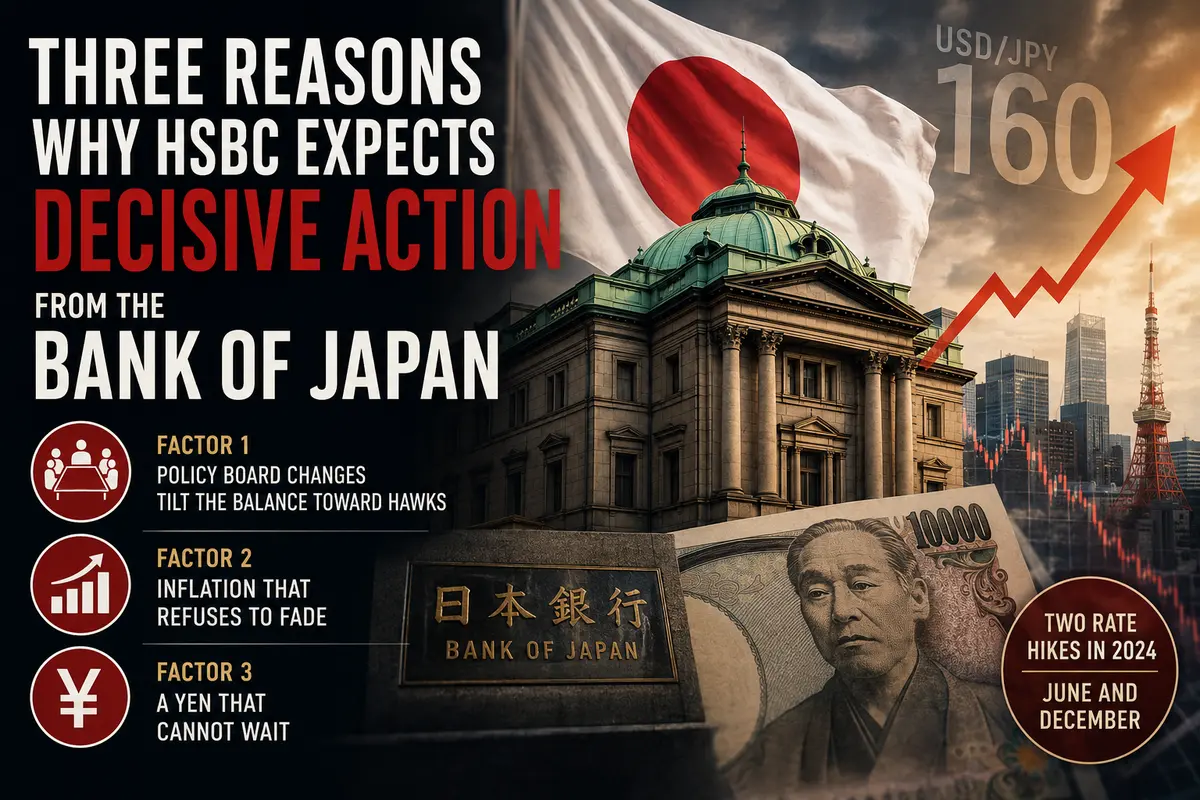
Three Reasons Why HSBC Expects Decisive Action from the Bank of Japan

Three Reasons Why HSBC Expects Decisive Action from the Bank of Japan

For decades, the Bank of Japan has been synonymous with monetary easing. While the Federal Reserve, the European Central Bank, and the Bank of England raised interest rates, fought inflation, and adopted more hawkish rhetoric, Tokyo remained an island of cheap money in a world of expensive capital. But that island now appears to be sinking.

HSBC has revised its forecast and now expects the Japanese central bank to raise rates twice this year. The first hike is projected for June rather than July, as previously anticipated. The second is expected in December. By year-end, the policy rate is forecast to reach 1.25%.

For a country that has spent decades with zero or even negative interest rates, this is close to a revolution. HSBC economist Frederik Neumann outlined three factors behind the revised outlook, and each deserves close attention.

Factor One: Changes on the Policy Board

Central banks are not abstract institutions run by algorithms. They are run by people—specific men and women who sit around a table, debate, vote, and make decisions. The fate of entire economies can depend on who occupies those seats. At the Bank of Japan, a changing of the guard is underway that could shift the balance of power toward the hawks.

Junko Nakagawa, a member of the Policy Board, will leave her post on June 29. Her final meeting will take place on June 16—the very meeting at which HSBC believes a rate hike could be approved. Nakagawa was one of three dissenting members who voted in favor of a rate increase at the previous meeting. In other words, she was already part of the hawkish camp. Yet her departure could paradoxically strengthen that camp’s influence.

Her likely successor is Ayano Sato, whom HSBC characterizes as more inclined toward accommodative monetary policy. This means...

Continue reading...
0
0
Tom Maffin

A Space Giant Begins Its Descent: Why SpaceX Is Lowering the Bar Ahead of Its IPO

A Space Giant Begins Its Descent: Why SpaceX Is Lowering the Bar Ahead of Its IPO

In a world where technology companies are accustomed to inflating valuations to astronomical heights, news that SpaceX is lowering its target valuation ahead of its initial public offering sounds almost like an admission of defeat. But it is not defeat. It is a sober calculation.

According to Bloomberg, Elon Musk and his advisers have revised expectations from $2 trillion down to $1.8 trillion. The difference—$200 billion—is larger than the market capitalization of most Fortune 500 companies. Yet even after lowering the target, SpaceX is still positioning itself for what could become the largest IPO in human history. And that story deserves a closer look.

From $2 Trillion to $1.8 Trillion: Why the Target Is Coming Down

In April, Bloomberg reported that SpaceX was aiming for a valuation exceeding $2 trillion. It was a breathtaking figure. For comparison, Apple, the world’s most valuable public company, is worth around $3 trillion. Microsoft is valued at roughly $2.5 trillion. In other words, before even going public, SpaceX sought to stand shoulder to shoulder with the most powerful corporations of the modern era, surpassing giants such as Saudi Aramco, Alphabet, and Amazon. It was a bold statement reflecting Musk’s belief that SpaceX is not merely a launch provider, but something far greater.

Now the target has been lowered. As is often the case, the reason lies in discussions with advisers and investors. Investment banks tasked with marketing SpaceX shares to the public have conducted preliminary demand assessments. Apparently, investor appetite was not quite as limitless as initially expected. A market that has learned hard lessons from overvalued IPOs in recent years has become more demanding. Investors want not only a grand vision but also numbers that support it. And when it comes to the numbers, the SpaceX story is more nuanced.

A valuation of...

Continue reading...
0
0

Silence at the Summit: Wall Street Pauses Between Peace and Inflation

Silence at the Summit: Wall Street Pauses Between Peace and Inflation

Thursday evening on the U.S. stock market was marked by a wait-and-see mood. S&P 500 futures gained a symbolic 0.1%, while the Nasdaq and Dow Jones remained virtually unchanged. This stillness may seem dull on the surface, but it conceals enormous tension. The market has just closed at record highs for the second consecutive session. The S&P 500 reached 7,563 points, while the NASDAQ Composite surged to 26,917. Such milestones are usually celebrated, yet traders are in no hurry to pop champagne today. They are waiting. Waiting to see whether the ceasefire with Iran holds. Waiting for what Trump will say. Waiting for inflation to finally begin easing. And in that waiting lies the essence of the current market environment.

Ceasefire on the Horizon: The Market Wants to Believe

The main catalyst behind the rally that pushed indexes to record highs was reports that the United States and Iran had reached a preliminary agreement to extend the ceasefire for sixty days. Axios reported that the deal includes reopening the Strait of Hormuz, which would represent a major breakthrough after months of conflict. The market reacted immediately and enthusiastically. Oil prices moved lower, while equities moved higher.

The logic behind the move is straightforward. Reopening the strait means restoring oil supplies. Restored supplies mean lower energy prices. Lower energy prices mean reduced inflationary pressure. Reduced inflation means the Federal Reserve may not need to continue tightening policy—or could even begin considering easing. And easier monetary policy is a favorable environment for equities, especially technology stocks, whose future earnings are discounted at lower rates.

Yet the market is experienced enough to understand that a wide gap exists between a preliminary agreement and lasting peace. The proposed deal still requires President Trump’s approval. Trump is known for unexpected policy shifts. Meanwhile, Iranian media...

Continue reading...
0
0
Navigation menu
instaforex banner