
Bar Pipa
We pay for a post of 10$

Ethereum

John Madnes

Cardano Cryptocurrency Plunges 10% in a Bearish Market Pullback

Cardano Cryptocurrency Plunges 10% in a Bearish Market Pullback
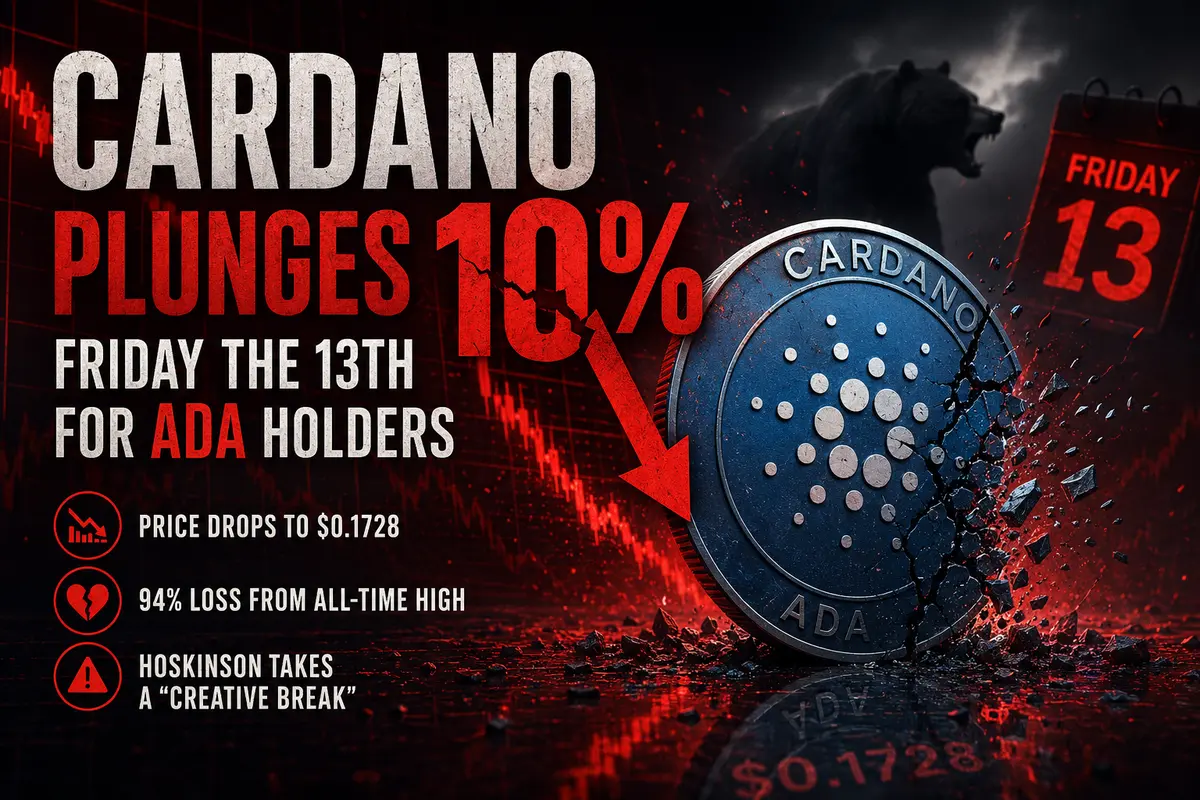
Friday the 13th for ADA Holders

Friday turned into a bloodbath for Cardano supporters. Cardano, once among the world's top three cryptocurrencies and a contender for the throne, fell 10.17% in a single day. The price dropped to $0.1728, marking its sharpest decline since June 4 and coming at a time when the broader market was already on edge.

The numbers confronting ADA holders are enough to break the heart of even the most resilient crypto enthusiast. Cardano’s market capitalization shrank to $6.28 billion. That sounds enormous until you remember that at its peak in 2021, Cardano was worth nearly $95 billion. Since then, its value has evaporated like morning mist. The token has lost 94% of its value from its all-time high of $3.10 reached on September 2, 2021.

Over the past week, Cardano has fallen 26%. Twenty-six percent in seven days is not a correction—it is a collapse. Trading volume over the last 24 hours reached nearly $937 million, accounting for 0.69% of the entire cryptocurrency market's turnover. People are selling in panic. Some are cutting their losses; others are simply leaving and may never return to the asset.

At the time of writing, Cardano ranks 15th among all cryptocurrencies by market capitalization. It was once third. That decline in ranking is perhaps the clearest indication of how much has gone wrong.

But the most frightening aspect for holders is not the numbers themselves. It is the news accompanying them. Project founder and spiritual leader Charles Hoskinson announced that he is taking a “creative break.” Just four words posted on X: “I'm taking a break. TTYL.” The market heard those words—and collapsed.

Four Words That Wiped Out Billions

It is difficult to overstate Hoskinson’s influence on Cardano. He is not merely the founder; he is the face, voice,...

Continue reading...
0
0

Ether at the Bottom: Why Standard Chartered Believes Ethereum Can Return to Its 2021 Glory

Ether at the Bottom: Why Standard Chartered Believes Ethereum Can Return to Its 2021 Glory

Fifty-seven percent. That’s how much Ethereum has fallen from its August 2025 peak. Today, the world’s second-largest cryptocurrency trades at around $2,100, and looking at the chart, it’s hard to imagine that it once climbed to heights that seemed unreachable. Over the same period, the ETH/BTC ratio has dropped by 37%. Bears are celebrating, bulls are licking their wounds, and retail investors are asking the same question in panic: Is this the end for Ethereum?

Jeff Kendrick of Standard Chartered answers that question with a confidence that may seem provocative. No, it’s not the end. It’s a temporary disconnect between fundamentals and price. And if history teaches us anything, it’s that such gaps eventually close. The only question is when—and how high Ether can rise when it does.

The Dot-Com Parallel: What Ethereum Can Learn from Amazon

Standard Chartered draws a comparison that is both encouraging and sobering.

The year is 2001. The dot-com bubble bursts. Technology stocks plunge. Amazon—now worth trillions of dollars—loses 90% of its market value. Yet inside the company, something important is happening that stock charts fail to capture. Business processes are improving. The customer base is growing. Infrastructure is becoming more reliable.

At the time, Jeff Bezos made a statement that would later become famous: “While the stock price was moving in the wrong direction, everything inside the company was moving in the right direction.”

Kendrick believes the same logic applies to ETH today.

On the surface, everything looks terrible. The price chart resembles a falling knife. Sentiment across the crypto market is bleak. Bitcoin ETFs are seeing outflows, macroeconomic conditions are weighing on risk assets, and geopolitical uncertainty is adding another layer of fear.

Yet beneath the surface, activity on the Ethereum blockchain remains strong. Transaction volumes are hovering near historic highs. Total value...

Continue reading...
0
0

Bitcoin Over the Abyss: An Oil Truce Beckons, but Bond Yields Keep a Stranglehold

Bitcoin Over the Abyss: An Oil Truce Beckons, but Bond Yields Keep a Stranglehold

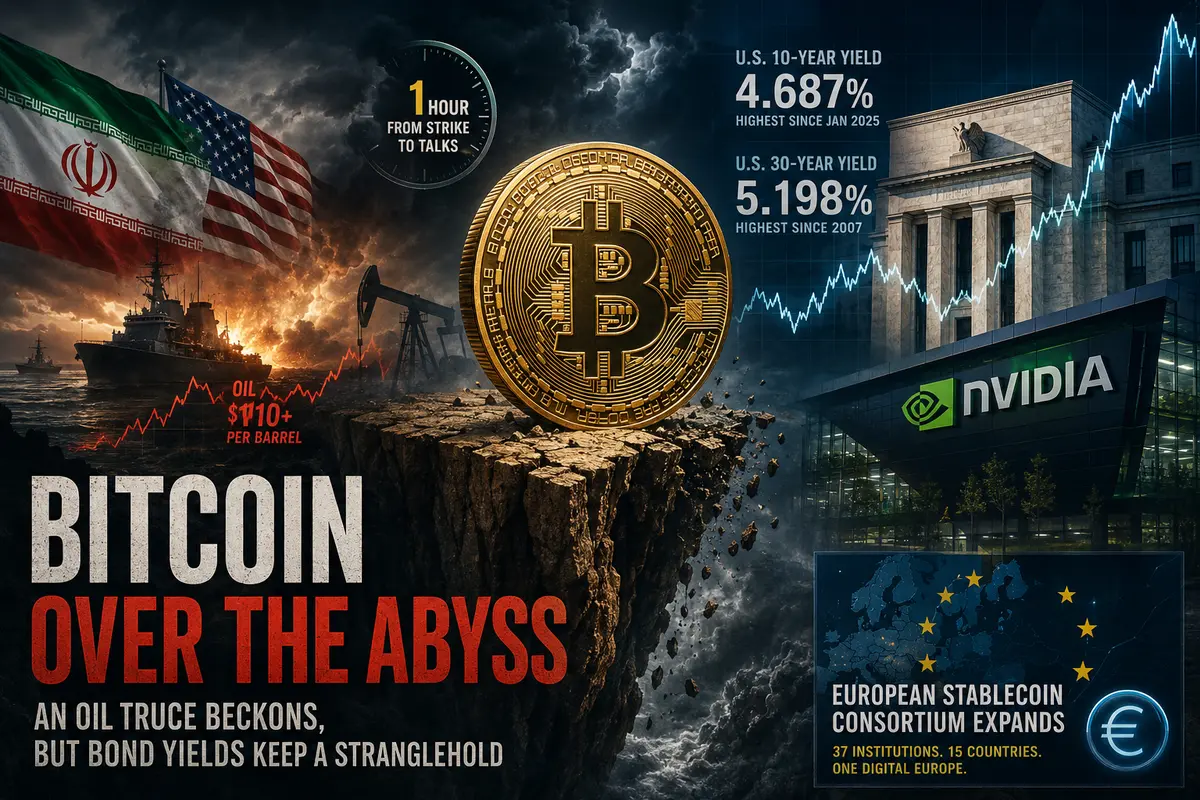
Seventy-seven thousand one hundred twenty-seven dollars. On Wednesday evening, Bitcoin hovered at that mark, gaining a symbolic four-tenths of a percent for the session. A move that, in normal times, wouldn’t even make the news feed now tells an entire story. A story about how the world’s leading cryptocurrency is trying to find solid ground after being rejected from the coveted eighty-two-thousand-dollar level and thrown back into the abyss of uncertainty. And that abyss is lined not with technical failures or regulatory fears, but with old-fashioned macroeconomic forces — Treasury yields, oil prices, and geopolitical swings orchestrated personally by Donald Trump.

The Iranian Pendulum: From Bombs to Negotiations in Sixty Minutes

Trumpian diplomacy is always theater, and the current Iranian drama is no exception. On Tuesday, the U.S. president made a statement that left traders breathless. He admitted he was “an hour away” from authorizing another military strike against Iran. One hour. Sixty minutes separated the world from another escalation in the Persian Gulf, another spike in oil prices, another wave of inflation, and, as a consequence, another collapse in risk assets, including cryptocurrencies. But the strike was postponed. Trump decided to give diplomacy one more chance.

The admission was a masterful rhetorical maneuver. At the same time, Trump portrayed himself as both a decisive leader ready to press the button and a prudent peacemaker who prefers negotiations over war. For markets, this creates an explosive mixture of hope and fear. Hope that the conflict may genuinely be moving toward resolution. Fear that the entire structure could collapse at any moment. Vice President J.D. Vance added fuel to the fire by declaring that the United States would remain “ready for combat” if negotiations fail. A double signal: we believe in peace, but our hand remains on the trigger.

For Bitcoin,...

Continue reading...
0
0

The Quantum Threat to Bitcoin: Why the World’s Largest Banks Are Warning About the End of the Cryptographic Era

The Quantum Threat to Bitcoin: Why the World’s Largest Banks Are Warning About the End of the Cryptographic Era

When financial giants like Citigroup publish alarming analytical reports, they rarely do so with sensational headlines or emotional rhetoric. Their language is usually dry, calculated, and clinically precise. That is exactly why such reports carry so much weight. Behind the carefully chosen wording lies not speculation, but a cold assessment of systemic risk.

And when an institution managing trillions of dollars begins warning about “shrinking time horizons” and a “growing threat” to the very foundation of cryptocurrencies, it is no longer science fiction. It is a signal that a fundamental problem has moved from theory into strategic reality.

This is not about another Bitcoin price correction, a temporary bear market, or the collapse of a crypto exchange. The issue runs much deeper: can the cryptographic foundation of digital assets survive the coming age of quantum computing?

Cryptography Is the Real Foundation of Bitcoin

Most people think about Bitcoin in terms of price movements, mining, ETFs, or halving cycles. But the true backbone of the network lies much deeper — in mathematics.

Bitcoin’s security is built on public-key cryptography, specifically the Elliptic Curve Digital Signature Algorithm, or ECDSA. This system allows users to prove ownership of funds without exposing their private keys.

In simplified terms, a Bitcoin address is like a lock that anyone can see and send money to. The private key is the unique key capable of opening that lock and moving the funds.

The entire architecture depends on one critical assumption: deriving a private key from a public key must be computationally impossible within any practical timeframe. Even with the combined power of modern supercomputers, the task remains effectively unattainable.

For years, this mathematical barrier was considered absolute.

Why Quantum Computers Change the Rules Entirely

The danger of quantum computing is not merely that quantum machines are “faster.”...

Continue reading...
0
0
Navigation menu