Bar Pipa
We pay for a post of 10$

IPO

A Space Giant Begins Its Descent: Why SpaceX Is Lowering the Bar Ahead of Its IPO

A Space Giant Begins Its Descent: Why SpaceX Is Lowering the Bar Ahead of Its IPO

In a world where technology companies are accustomed to inflating valuations to astronomical heights, news that SpaceX is lowering its target valuation ahead of its initial public offering sounds almost like an admission of defeat. But it is not defeat. It is a sober calculation.

According to Bloomberg, Elon Musk and his advisers have revised expectations from $2 trillion down to $1.8 trillion. The difference—$200 billion—is larger than the market capitalization of most Fortune 500 companies. Yet even after lowering the target, SpaceX is still positioning itself for what could become the largest IPO in human history. And that story deserves a closer look.

From $2 Trillion to $1.8 Trillion: Why the Target Is Coming Down

In April, Bloomberg reported that SpaceX was aiming for a valuation exceeding $2 trillion. It was a breathtaking figure. For comparison, Apple, the world’s most valuable public company, is worth around $3 trillion. Microsoft is valued at roughly $2.5 trillion. In other words, before even going public, SpaceX sought to stand shoulder to shoulder with the most powerful corporations of the modern era, surpassing giants such as Saudi Aramco, Alphabet, and Amazon. It was a bold statement reflecting Musk’s belief that SpaceX is not merely a launch provider, but something far greater.

Now the target has been lowered. As is often the case, the reason lies in discussions with advisers and investors. Investment banks tasked with marketing SpaceX shares to the public have conducted preliminary demand assessments. Apparently, investor appetite was not quite as limitless as initially expected. A market that has learned hard lessons from overvalued IPOs in recent years has become more demanding. Investors want not only a grand vision but also numbers that support it. And when it comes to the numbers, the SpaceX story is more nuanced.

A valuation of...

Continue reading...
0
0
Lin Brings

Two Titans Slam the Door Shut at the Same Time

Two Titans Slam the Door Shut at the Same Time

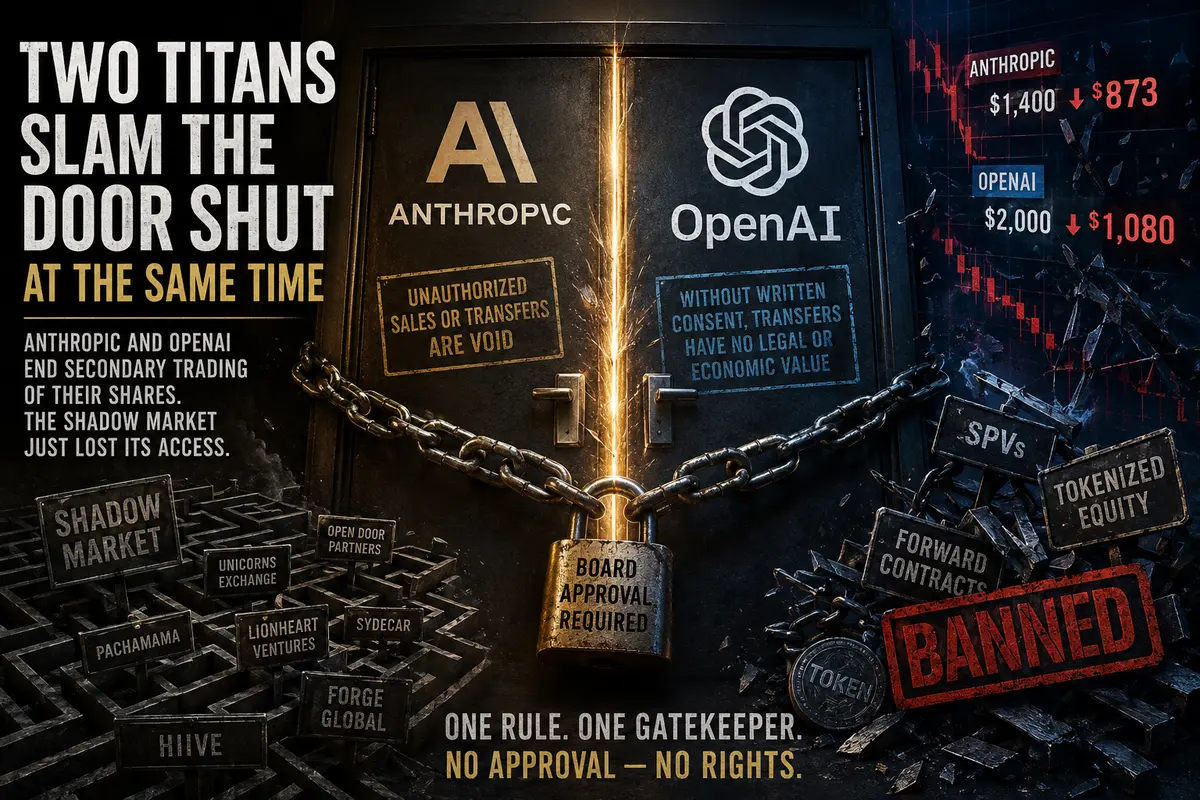
Anthropic and OpenAI have done what many had long expected but what participants in the shadow market refused to believe until the very last moment. Both companies updated their internal policies almost in sync, putting a firm stop to secondary trading of their shares. The wording published on their respective pages sounds nearly identical, as if the lawyers of two fierce rivals had been copying off each other. But that's not really the point. The point is that the two hottest AI startups on the planet have just cut off the oxygen supply to an entire industry that grew up around investors desperate to grab a piece of their businesses before either goes public.

At Anthropic, the language is brutally clear: any sale or transfer of securities without board approval is declared void. A buyer who risks entering such a transaction will not be recognized as a shareholder and will receive absolutely no rights whatsoever. OpenAI mirrors the exact same structure: without the company's written consent, any transfer of shares has neither legal nor economic value. In plain terms: if you bought without asking, you might as well have thrown your money to the wind.

An Entire List of Grey Schemes Now Banned

What's most interesting is that neither company limited itself to a generic prohibition. They named specific avenues that are now considered illegitimate. The list includes direct sales, special purpose vehicles, tokenized equity interests, and forward contracts. This is not a random collection of words. These are precisely the tools that the market has spent the last several years using to carve out detours toward shares in private AI giants.

The notorious SPVs — special purpose vehicles — deserve particular attention. The scheme is simple and elegant in its audacity. A shell company is created with the sole...

Continue reading...
0
0
Lin Brings

The Private Market Is Now The Real Fintech Index

The Private Market Is Now The Real Fintech Index

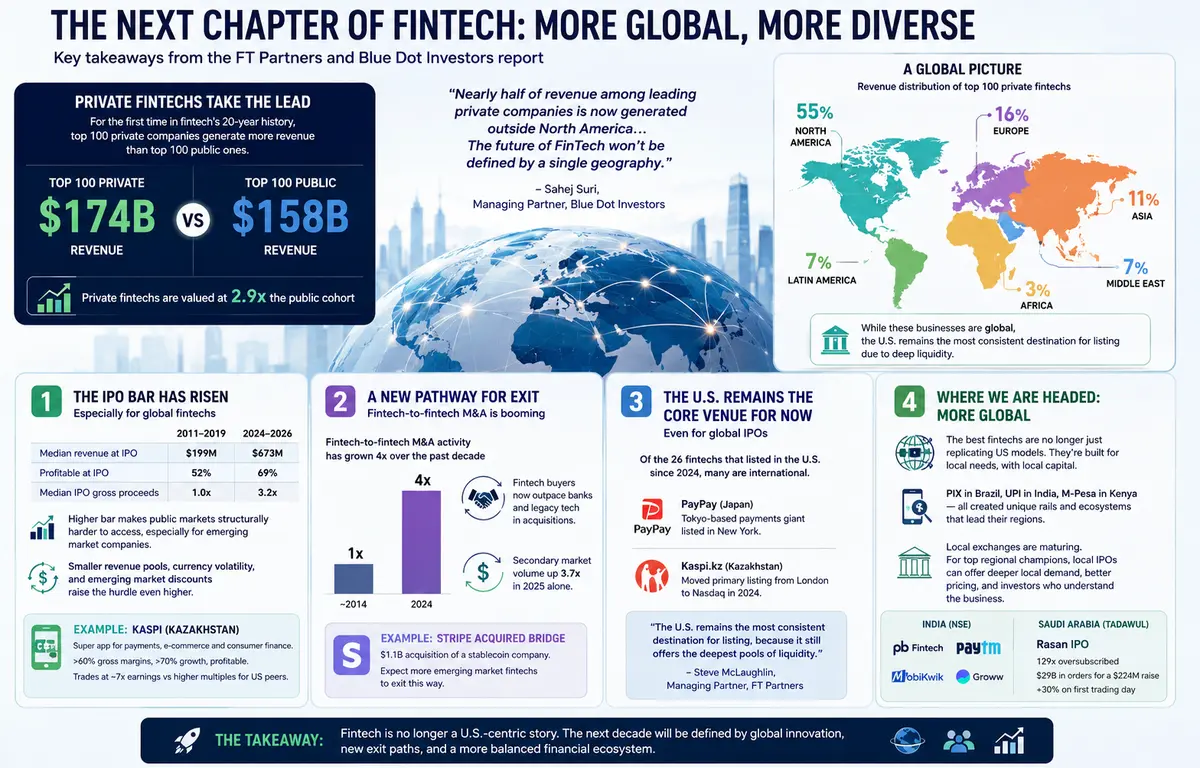
For the first time in fintech’s twenty-year history, the sector’s largest private companies are generating more revenue than the biggest public ones. Today, the top 100 private fintechs bring in around $174 billion in revenue versus $158 billion for the top 100 public companies founded after 2006. At the same time, private fintechs are valued at nearly three times more. These figures come from a new report by FT Partners and Blue Dot Investors.

But the report’s most important takeaway goes beyond the numbers. If you want to understand where financial services are heading, private companies are where you should look. Public markets increasingly reflect a relatively narrow group of firms that managed to catch the IPO window — especially during 2020 and 2021. The private market is broader, more diverse, and, importantly, far more global.

As Blue Dot Investors Managing Partner Sahej Suri noted, nearly half of the revenue generated by leading private fintech companies already comes from outside North America. And the future of fintech is unlikely to be defined by a single geography.

IPOs Have Become Much Harder — Especially for International Fintechs

A decade ago, companies could go public with around $200 million in revenue. Today, the median figure is closer to $670 million. On top of that, most recent fintech IPOs are already profitable at the time of listing.

For investors, this may look like a healthy shift toward rewarding stronger businesses. But there’s another side to it: public markets have become far less accessible for globally important fintechs, especially those from emerging markets.

There are several reasons for this. In many countries, the addressable market is simply smaller than in the US. Currency volatility also reduces dollar-denominated revenue even for fast-growing businesses. And public market investors still apply an “emerging markets discount,” even when...

Continue reading...
0
0
Navigation menu