

Server Fever: How Dell Transformed from a PC Maker into an Artificial Intelligence King
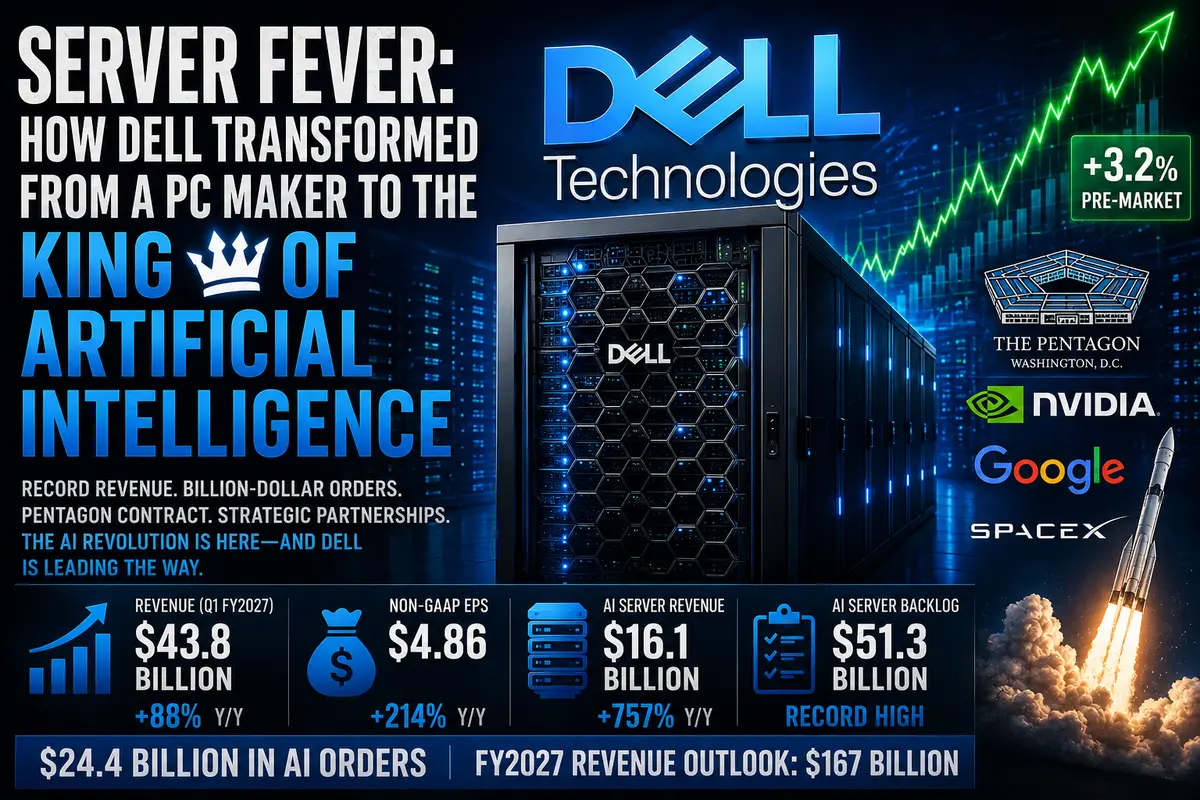
There are moments in corporate history when a company stops being what it has been for decades and becomes something entirely different. For Dell Technologies, that moment has arrived. The stock rose 3.2% in pre-market trading, extending a rally that began after the company released its quarterly earnings. Dell, a company millions of people know as a manufacturer of laptops and desktop computers, has suddenly found itself at the center of the hottest theme in global equity markets—artificial intelligence. And the numbers it reported force investors to rethink everything they thought they knew about the business.
A Quarter That Will Be Studied in Business Schools
Dell’s financial results for the first quarter of fiscal 2027 look almost too good to be true. Revenue reached $43.8 billion, up 88% year-over-year—the fastest quarterly growth rate since the company returned to the public markets in 2018. GAAP diluted earnings per share came in at $5.24, a 282% increase. Non-GAAP earnings per share reached $4.86, up 214%.
But the most astonishing figure was the magnitude of the earnings beat. Analysts had expected non-GAAP EPS of $2.93. Dell delivered $4.86—nearly 66% above consensus expectations. In a market where companies typically beat estimates by a few cents, such a deviation is extraordinary.
The primary driver of this explosive growth was Dell’s Infrastructure Solutions Group (ISG). Revenue from AI-optimized servers reached $16.1 billion, soaring 757% year-over-year. Yes, 757%. ISG as a whole generated $29 billion in revenue, representing 181% growth.
$24 Billion in Orders: AI Demand Shows No Signs of Slowing
Dell COO Jeff Clarke summarized the situation perfectly:
“We received $24.4 billion in AI orders and recognized $16.1 billion in AI server revenue. We are raising our fiscal 2027 AI server revenue outlook to $60 billion, further reinforcing that AI opportunities show no signs of slowing down.”
Sixty billion dollars in AI server revenue alone is a staggering number. For comparison, Dell’s entire business generated less than $100 billion in annual revenue just a few years ago. Now, its AI server segment alone is approaching that level.
This represents a tectonic shift in Dell’s business model. A company long associated with personal computers is rapidly transforming into an infrastructure powerhouse essential to the global AI boom.
Its AI server backlog reached a record $51.3 billion. These are orders already committed by customers but not yet recognized as revenue. They will be converted into sales over the coming quarters, providing a powerful foundation for continued growth.
Analysts Race to Raise Price Targets
Wall Street’s reaction to Dell’s earnings report was swift and overwhelmingly positive.
-
Susquehanna upgraded the stock to “Positive” from “Neutral” and raised its price target to $700 from $138.
-
Barclays increased its target to $550.
-
JPMorgan lifted its target to $500, citing stronger fiscal 2027 guidance and growing market share.
-
Mizuho maintained its “Outperform” rating while raising its target from $350 to $435.
This wave of upgrades reflects a fundamental reassessment of Dell’s investment story. The market is no longer valuing Dell as a cyclical PC manufacturer. Instead, it is increasingly viewing the company as a critical infrastructure provider operating at the forefront of the AI revolution.
The Pentagon, Nvidia, and SpaceX: An Ecosystem Working in Dell’s Favor
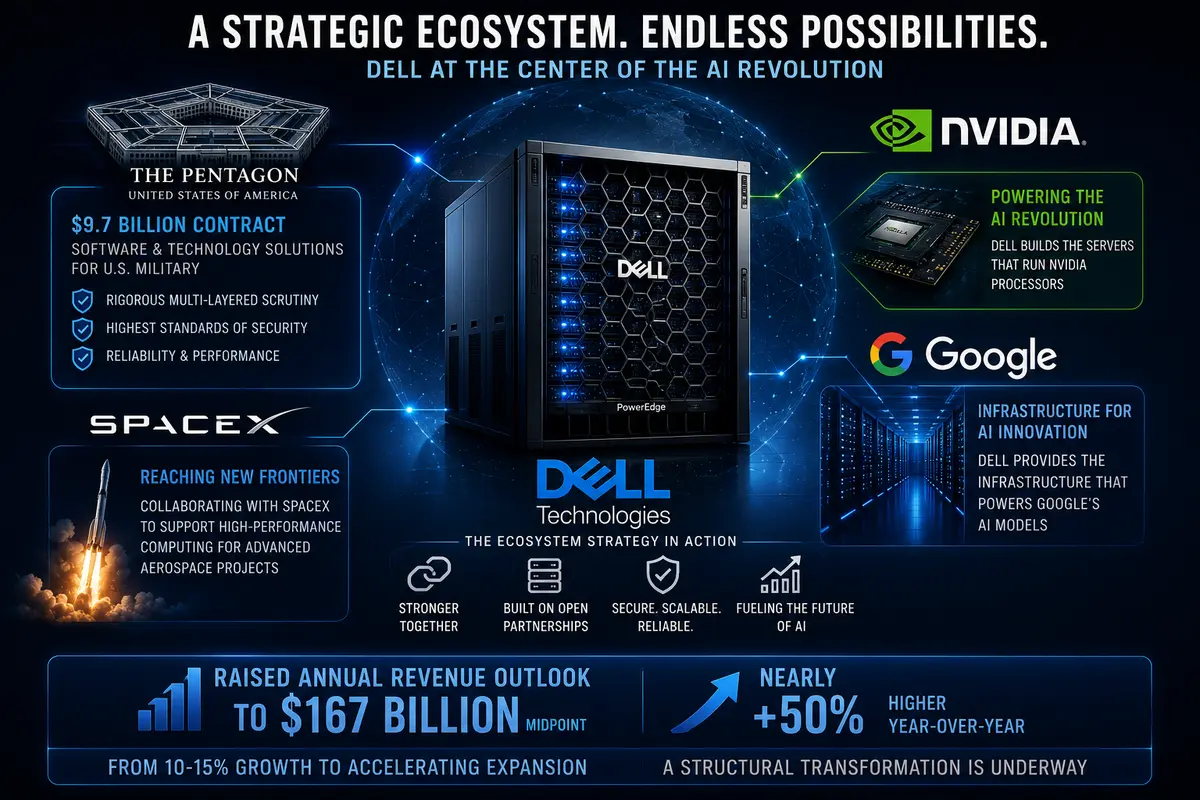
Another catalyst was Dell’s $9.7 billion contract with the Pentagon to provide software and technology solutions for the U.S. military.
This is more than just a large contract—it is a powerful endorsement. When the Pentagon selects a supplier, it subjects candidates to rigorous, multi-layered scrutiny. A contract of this magnitude signals that Dell’s technology meets the highest standards of security, reliability, and performance.
At Dell Technologies World 2026, the company unveiled new AI infrastructure products and expanded partnerships with Nvidia, Google, and SpaceX AI.
This is a crucial strategic advantage. Dell is not attempting to compete with Nvidia in chip design. Instead, it builds the servers that run Nvidia’s processors. It provides the infrastructure on which Google’s AI models operate. It collaborates with SpaceX to support the computing demands of advanced aerospace projects.
This is the ecosystem strategy in action: rather than trying to do everything itself, Dell is positioning itself as an indispensable link in the AI value chain.
Chief Financial Officer David Kennedy also announced an increase in the company’s annual revenue forecast to a midpoint of $167 billion—nearly 50% higher than the previous year.
A company that once grew at 10–15% annually is now expanding several times faster. And this appears less like a temporary surge and more like the beginning of a structural transformation.
Computex, Lenovo, and the Bigger Picture
Dell’s results are resonating far beyond the company itself.
Shares of Lenovo Group climbed more than 10%, reaching an all-time high. Investors interpreted Dell’s performance as confirmation that the entire AI infrastructure sector is still in the early stages of a major growth cycle. If Dell is receiving tens of billions of dollars in AI orders, competitors and suppliers across the ecosystem are likely benefiting as well.
Computex 2026, taking place from June 1–5, is adding further momentum. The event’s central theme is AI infrastructure. Nvidia CEO Jensen Huang is scheduled to deliver a keynote address, with expectations of new product launches, partnerships, and strategic announcements.
For Dell, this creates additional tailwinds. The company sits at the center of the AI infrastructure narrative, and every major announcement at Computex reinforces the idea that the AI revolution is still in its early innings.
A Historic Rally at Historic Highs
The combination of record revenue, record profits, a record order backlog, sharply increased annual guidance, the Pentagon contract, and a wave of analyst upgrades has created an exceptionally powerful catalyst for Dell shares.
The stock had already gained roughly 24% during the previous week following announcements at Dell Technologies World. After the earnings release, the rally continued.
This is unfolding against a favorable macroeconomic backdrop, with the Dow Jones Industrial Average recently surpassing the 51,000-point milestone for the first time. Investors believe in AI. They believe in infrastructure. And increasingly, they believe in Dell.
A company that once began by selling computers over the phone has evolved into one of the pillars of a new technological era. And judging by the numbers, this transformation is only beginning.
Sixty billion dollars in AI server revenue this year may not be the ceiling—it may simply be the new baseline from which Dell continues to grow. Alongside it, the entire AI infrastructure market appears poised for expansion, with maturity still years away.

Comments
No comments yet. Be the first to share your thoughts!
Authentication Required
You must be logged in to post a comment.