

A Space Giant Begins Its Descent: Why SpaceX Is Lowering the Bar Ahead of Its IPO
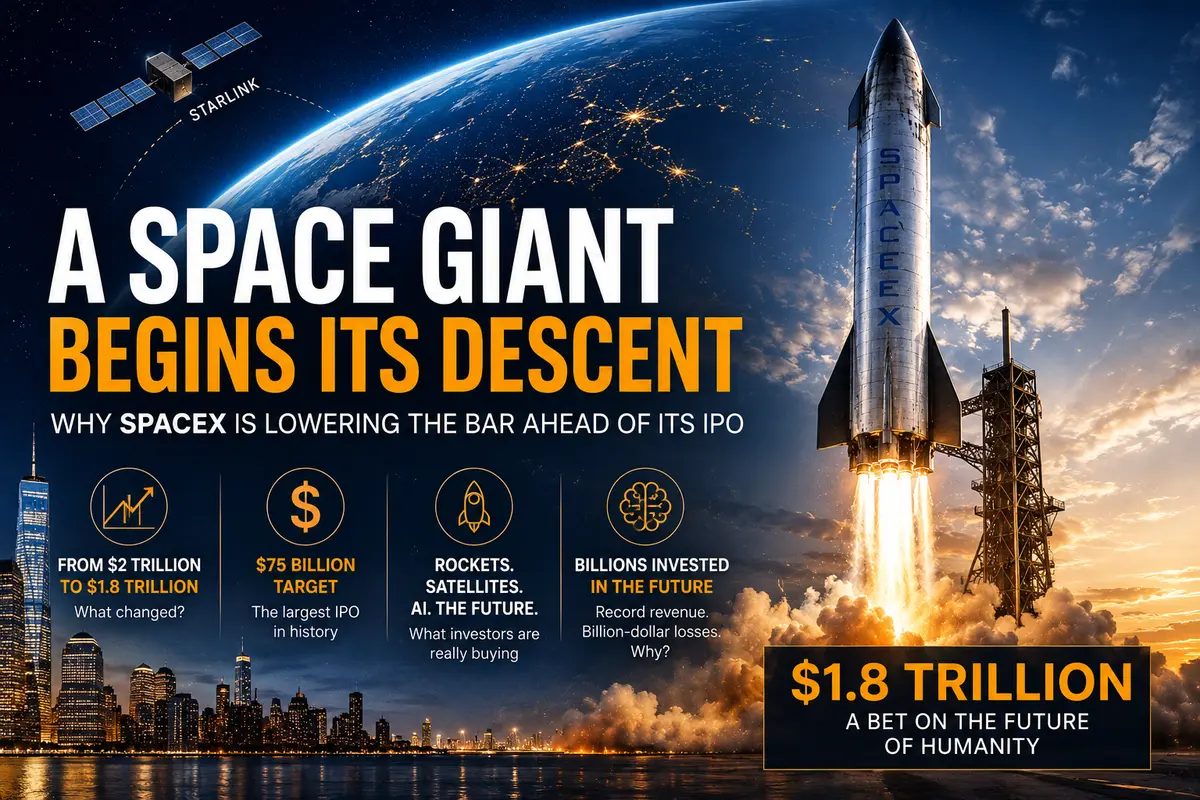
In a world where technology companies are accustomed to inflating valuations to astronomical heights, news that SpaceX is lowering its target valuation ahead of its initial public offering sounds almost like an admission of defeat. But it is not defeat. It is a sober calculation.
According to Bloomberg, Elon Musk and his advisers have revised expectations from $2 trillion down to $1.8 trillion. The difference—$200 billion—is larger than the market capitalization of most Fortune 500 companies. Yet even after lowering the target, SpaceX is still positioning itself for what could become the largest IPO in human history. And that story deserves a closer look.
From $2 Trillion to $1.8 Trillion: Why the Target Is Coming Down
In April, Bloomberg reported that SpaceX was aiming for a valuation exceeding $2 trillion. It was a breathtaking figure. For comparison, Apple, the world’s most valuable public company, is worth around $3 trillion. Microsoft is valued at roughly $2.5 trillion. In other words, before even going public, SpaceX sought to stand shoulder to shoulder with the most powerful corporations of the modern era, surpassing giants such as Saudi Aramco, Alphabet, and Amazon. It was a bold statement reflecting Musk’s belief that SpaceX is not merely a launch provider, but something far greater.
Now the target has been lowered. As is often the case, the reason lies in discussions with advisers and investors. Investment banks tasked with marketing SpaceX shares to the public have conducted preliminary demand assessments. Apparently, investor appetite was not quite as limitless as initially expected. A market that has learned hard lessons from overvalued IPOs in recent years has become more demanding. Investors want not only a grand vision but also numbers that support it. And when it comes to the numbers, the SpaceX story is more nuanced.
A valuation of $1.8 trillion is still enormous. To put it in perspective, it exceeds the GDP of countries such as Spain or Australia. It is larger than the combined market value of the entire aerospace industry, including Boeing, Lockheed Martin, Airbus, and Northrop Grumman. SpaceX, a private company founded in 2002, is preparing to enter public markets with a valuation that outweighs an industry built over more than a century. Even with a reduced target, the ambition is unprecedented.
Seventy-Five Billion Dollars in a Single Day: The Largest IPO in History
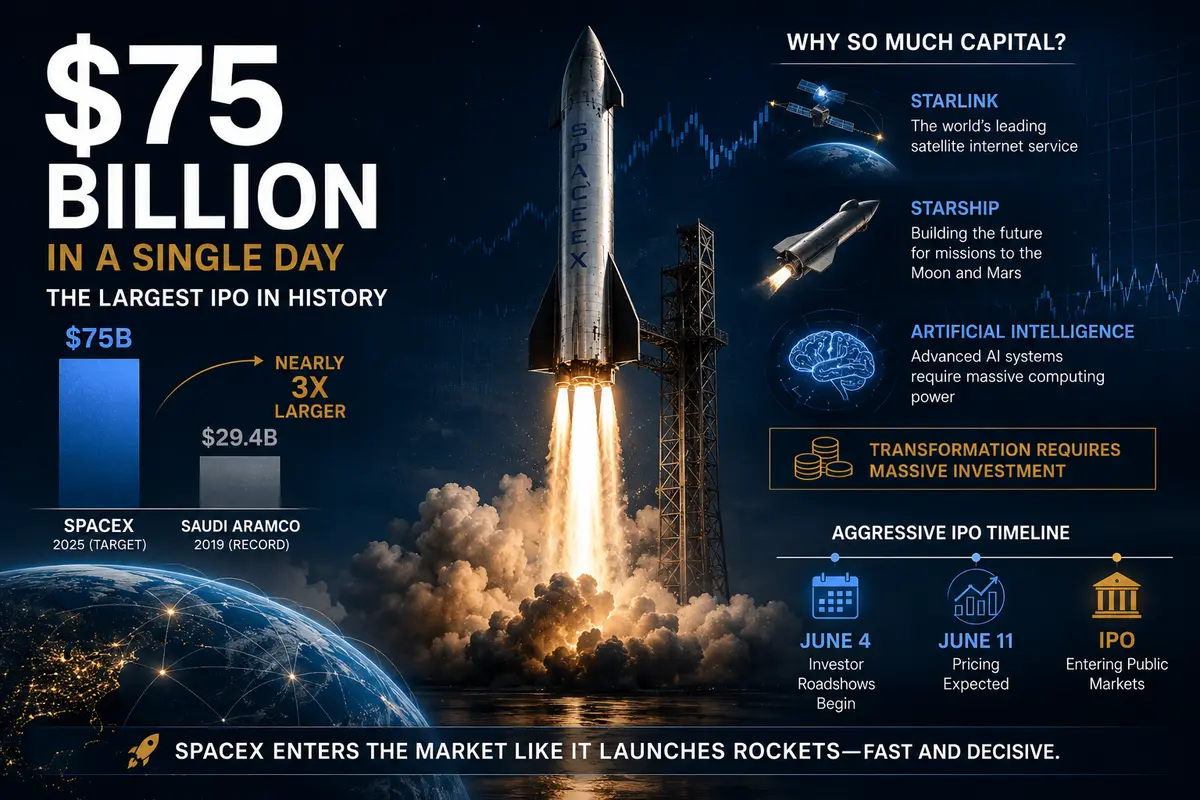
A lower valuation does not mean lower ambitions. SpaceX plans to raise as much as $75 billion through the offering. That would be more than any company has ever raised in an IPO. The current record belongs to Saudi Aramco, which raised $29.4 billion in 2019. SpaceX aims to surpass that figure by nearly three times.
Why does the company need so much capital? The answer lies in its transformation. SpaceX is no longer just a rocket company. Starlink, its satellite internet service, has already become a major source of revenue. Starship, its giant spacecraft, is being developed for missions to the Moon and Mars. Artificial intelligence systems integrated into its operations require massive computing resources. All of this consumes capital at an extraordinary rate.
The IPO timetable is aggressive. Investor roadshows could begin as early as June 4, with pricing expected around June 11. This suggests that SpaceX management and its banking partners are confident that demand will be sufficient and have no intention of prolonging the process. The company is entering public markets the same way its rockets leave the launch pad—quickly and without unnecessary ceremony.
The Financial Paradox: Record Revenue and Multi-Billion-Dollar Losses
This is where the story becomes especially interesting.
On one hand, SpaceX’s revenue growth has been remarkable. In 2025, the company generated $18.7 billion in revenue, up 34% from $14 billion in 2024. These are growth rates that most technology giants would envy. SpaceX is genuinely expanding—and doing so rapidly.
On the other hand, there is a significant downside. In 2024, the company reported net income of $791 million. In 2025, however, it posted a net loss of $4.94 billion. That is a dramatic reversal—from profitability to losses, from self-sufficiency to a renewed need for external funding.
The reason is accelerating investment in artificial intelligence and infrastructure. SpaceX is pouring billions into Starship, expanding the Starlink network, and developing proprietary AI systems for autonomous spacecraft operations. This follows the classic playbook of technology companies: sacrificing current profits for future dominance. Amazon did it for years. Tesla went through the same phase. Now SpaceX is following a similar path.
Investors participating in the IPO should understand what they are buying. They are not purchasing a mature, highly profitable business. They are buying an option on the future. They are paying for a vision, a technology platform, and a strategic position within an industry that is still in its infancy.
That is what makes a $1.8 trillion valuation so fascinating. How do you value a company losing nearly $5 billion annually while controlling the world’s most advanced rocket fleet, the largest satellite constellation ever deployed, and technologies that could shape humanity’s future? Wall Street will soon have to answer that question.
What Are Investors Actually Buying: Rockets, Satellites, or AI?
To understand why investors might be willing to pay trillions, it helps to break SpaceX into its core businesses.
Launch Services
Falcon 9 and Falcon Heavy are the workhorses that deliver payloads to orbit with reliability few competitors can match. Reusable rockets have dramatically reduced launch costs and helped SpaceX dominate the commercial launch market. Yet important as it is, this business alone is not worth a trillion dollars.
Starlink
Starlink provides satellite internet coverage across the globe, from densely populated cities to remote villages and polar research stations. It has already become a major revenue generator and continues to grow rapidly, producing billions of dollars in subscription revenue worldwide. This business alone could potentially be worth hundreds of billions.
Starship
Starship represents a bet on a future where humanity establishes permanent settlements on the Moon and Mars, and where intercontinental travel through space takes thirty minutes rather than twelve hours. It has not yet proven its economic viability, but its potential is enormous. If Starship succeeds as envisioned, it could transform both terrestrial and space logistics.
Artificial Intelligence
SpaceX is developing proprietary AI systems for flight control, docking operations, orbital optimization, and autonomous spacecraft management. This is not the kind of AI that generates significant profits today, but it lays the foundation for a future in which space systems operate with minimal human intervention.
Investors are not buying rockets, satellites, or software individually. They are buying an ecosystem that integrates all of these capabilities and creates powerful synergies among them. They are buying Elon Musk’s vision—a vision that has repeatedly proven more achievable than many critics initially believed. And they are willing to pay a premium for that possibility.
A Defining Moment for the Market
The SpaceX IPO could become a watershed moment.
Either it will confirm that investors are willing to value companies not on current earnings, but on their potential to reshape the world. Or it will serve as a reminder that even the grandest visions must eventually be supported by hard financial results.
A valuation of $1.8 trillion is ultimately a bet on a future in which space becomes as integral to the global economy as the internet or electricity. And June 4, when the roadshows are expected to begin, may mark the first day of public life for a company that promises to help make that future a reality.
Fasten your seatbelts. It is going to be an interesting ride.

Comments
No comments yet. Be the first to share your thoughts!
Authentication Required
You must be logged in to post a comment.