
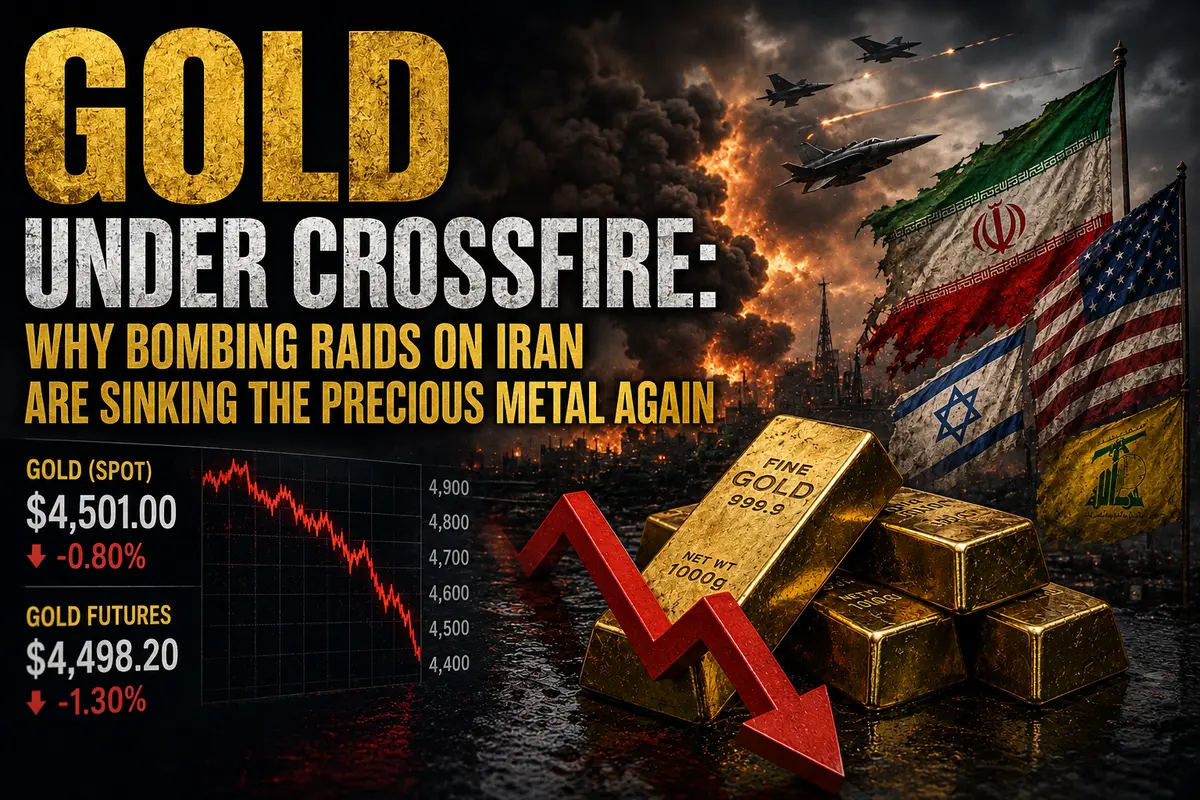
Gold Under Crossfire: Why Bombing Raids on Iran Are Sinking the Precious Metal Again
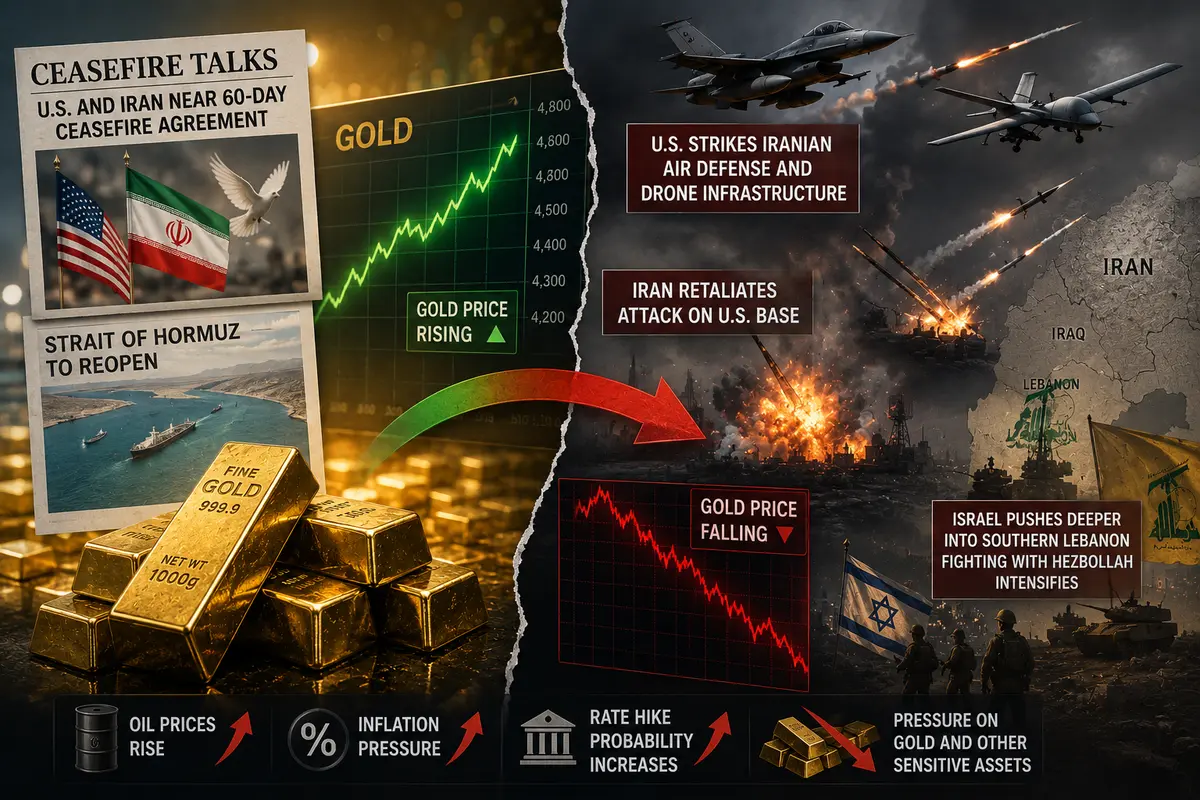
Monday began with headlines that have become an alarming routine in recent weeks. U.S. forces launched new strikes against Iranian targets—this time focusing on air defense positions and drone infrastructure. Iran responded with an attack on an airbase used by U.S. forces. Meanwhile, Israel pushed troops deeper into southern Lebanon, where fighting with Hezbollah has intensified once again. The Middle East is burning, and gold, which in the past would have been the first asset to rally on such news, is now falling.
Spot gold dropped 0.8% to $4,501 per ounce, while futures plunged an even steeper 1.3%. At first glance, this seems to defy all logic. Yet within this contradiction lies the most important story in today’s precious metals market.
The War Paradox: Why Bombs Are Hurting Gold
Traditional finance textbooks teach that when guns fire, investors rush into gold. This defensive reflex worked for decades. Vietnam, Iraq, Afghanistan, Crimea—every major military crisis sent the yellow metal higher.
But the current conflict involving Iran has rewritten the rules.
The reason is simple: the market has learned to focus not on the war itself, but on its economic consequences. And those consequences are proving devastating for gold.
The chain reaction looks like this:
Strikes on Iran and retaliatory attacks suggest a prolonged conflict. A prolonged conflict increases the likelihood that the Strait of Hormuz will remain closed or partially restricted. A restricted strait means disruptions to global oil supplies. Supply disruptions keep energy prices elevated. Higher energy prices fuel inflation. Inflation forces the Federal Reserve to keep interest rates higher for longer—or even consider raising them further.
And high interest rates are toxic for gold, an asset that generates no yield.
That is precisely the logic that pushed gold lower on Monday. The market saw fresh bombings and concluded that peace remains distant, oil will stay expensive, the Fed will remain hawkish, and rates will stay elevated.
As a result, traders sold gold.
Not because war is no longer frightening, but because fears of inflation and higher interest rates have outweighed fears of the war itself.
The Weekend That Crushed Market Hopes
As recently as Friday, markets were operating on a different narrative.
Reports emerged suggesting that the United States and Iran were close to extending a sixty-day ceasefire and reopening the Strait of Hormuz. Those reports boosted gold prices, because in the current environment peace is actually more beneficial for gold than conflict. Peace would lower oil prices and reduce the probability of further rate hikes.
But the weekend erased those hopes.
The U.S. military announced strikes against Iranian air defense assets and drone infrastructure, reportedly in response to the downing of an American drone. Tehran retaliated with an attack on a base used by U.S. forces. Air defense systems across the region intercepted missiles and drones.
These are no longer the limited defensive actions that officials discussed earlier. This is a full-scale exchange of military operations, with each side escalating the confrontation.
At the same time, Israel moved troops deeper into southern Lebanon. Fighting with the Iran-backed Hezbollah has intensified. What began as a U.S.-Iran confrontation is spreading across the region.
And that expansion is hurting all assets sensitive to inflation and interest rates—including gold.
Oil Up, Dollar Up, Gold Down
Oil prices moved higher on Monday as markets priced in a greater risk of supply disruptions.
Expensive oil means higher gasoline prices, higher transportation costs, and more expensive heating. Those costs eventually filter into consumer prices, accelerating inflation.
And inflation, as investors know all too well, is exactly what keeps the Federal Reserve hawkish.
The U.S. Dollar Index also gained 0.1%.
The dollar is strengthening as investors seek safety in the world’s reserve currency during periods of geopolitical stress. A stronger dollar creates an additional headwind for gold. Because gold is priced in dollars, it becomes more expensive for holders of other currencies when the greenback appreciates. Demand weakens, and prices decline.
The result is a triple blow:
-
Rising oil prices intensify inflation fears.
-
A stronger dollar makes gold less affordable globally.
-
Elevated Treasury yields offer investors an attractive alternative to a non-yielding metal.
In such an environment, it becomes extremely difficult for gold to rally.
Two-Month Lows and Brief Respites
Last week, gold already fell to a two-month low.
It then rebounded on hopes of a ceasefire.
Now it is falling again.
This pattern—sharp declines on negative developments, temporary recoveries on signs of progress, followed by fresh selloffs—has become the defining characteristic of the precious metals market during the Iran conflict.
Gold remains trapped in a range and has been unable to break out.
Bulls continue to hope that central banks will eventually ease monetary policy. Bears are betting that inflation will remain elevated and interest rates will stay restrictive.
So far, the bears have the upper hand.
Every new escalation in the conflict, every jump in oil prices, and every hawkish comment from the Federal Reserve shifts the balance further against gold.
Traders are closely monitoring speeches from Fed officials and incoming economic data, particularly labor market indicators. Any signal that the Fed is prepared to raise rates again would represent another major blow to gold.
Conversely, any evidence that inflation is finally slowing could provide the metal with temporary relief.
Silver and Platinum: A Ray of Light in the Darkness
While gold struggled, other precious metals showed surprising resilience.
Silver rose 0.5% to $75.69 per ounce.
Platinum gained 1.1% to $1,940.95 per ounce.
Copper also advanced, both on the London market and in U.S. futures trading.
Why are silver and platinum rising while gold is falling?
The answer lies in their industrial nature.
Silver is widely used in electronics, solar panels, and medical equipment. Platinum plays a critical role in automotive catalytic converters. If investors believe the global economy can withstand the oil shock and avoid recession, industrial demand can continue to support these metals.
In addition, both silver and platinum suffered significant declines in previous weeks. Part of today’s advance reflects a technical rebound and bargain hunting after heavily oversold conditions.
Traders who viewed the selloff as excessive have been covering short positions and initiating new long positions.
Conclusion
Gold once again came under pressure on Monday.
A war that should theoretically be gold’s ally has become its enemy through the channels of inflation and interest rates.
Fresh strikes on Iran, retaliatory attacks, and escalating conflict in Lebanon are not helping gold—they are hurting it.
As long as the conflict continues, oil remains expensive, and the Federal Reserve maintains a hawkish stance, gold is likely to remain trapped in this paradoxical situation: a safe-haven asset unable to rally because the world has become too dangerous.
Traders, hardened by the experience of recent weeks, are no longer expecting miracles.
They are waiting for data.
They are waiting for signals from the Federal Reserve.
They are waiting for oil prices to finally move lower.
Until that happens, gold may continue to fall on good news and fall on bad news alike. Brief rallies will be followed by fresh setbacks. The only development capable of breaking this vicious cycle would be a genuine ceasefire, the reopening of the Strait of Hormuz, and a sustained decline in inflation.
For now, however, that still appears to be a distant dream.
Comments
No comments yet. Be the first to share your thoughts!
Comments only for logged-in users.