Bar Pipa
We pay for a post of 10$

U.S. Dollar / Chinese Yuan

USDCNY FOREX

6.7687
-0.05%

Key Statistics

Open
6.7720
Day Range
6.7581 - 6.7728
52W Range
6.7555 - 7.2131
Price AVG 50
6.7800
Prev Close
6.7720

About U.S. Dollar / Chinese Yuan

U.S. Dollar / Chinese Yuan is a foreign exchange currency pair. It represents the relative value between the two currencies and is traded on the global decentralized forex market.

Asset Type: Currency Pair
Base Currency: CNY

Discussion

Authentication Required

You must be logged in to post a comment.

Asian Currencies Hold Steady as the Middle East and Oil Take Center Stage

Asian Currencies Hold Steady as the Middle East and Oil Take Center Stage

Tuesday: Dollar Reaches a One-Week High

Tuesday’s 21.07.2026 Asian currency trading was marked by caution. Most regional currencies remained confined to narrow trading ranges, unwilling to make a decisive move in either direction. Investors faced a difficult choice: on the one hand, the escalating conflict in the Middle East was pushing the dollar higher as a safe-haven currency; on the other, hopes for a diplomatic resolution prevented it from strengthening too sharply.

The U.S. Dollar Index rose to 100.99, its highest level since July 15. This appreciation was not driven by strong U.S. economic data or hawkish signals from the Federal Reserve. It was purely a geopolitical risk premium. In a world where military action is expanding with each passing day, the dollar remains one of the most reliable assets.

However, the dollar’s strength is putting pressure on Asian currencies. Energy-importing countries are particularly vulnerable: the rise in oil prices observed over the past several days is worsening their trade balances and creating additional inflationary pressure. For countries forced to purchase expensive oil on global markets, this represents a serious challenge. Their central banks now face a dilemma: raise interest rates to combat inflation and the risk of currency depreciation, or maintain accommodative policies to support economic growth.

Middle East Conflict: Ninth Consecutive Night of Strikes

The escalating conflict between the United States and Iran remains at the center of attention. U.S. Central Command confirmed the completion of a ninth consecutive night of airstrikes against Iranian targets. The strikes targeted command centers, missile and drone launch sites, and maritime infrastructure.

However, the most alarming development occurred on another front. The Iran-backed Houthi movement in Yemen announced a naval blockade of Saudi Arabia. This means that energy supplies passing through the Red Sea and the Bab el-Mandeb Strait could be disrupted....


Continue reading...
0
0

Asian Currencies Pause in Anticipation as the Won Surges Ahead on Reforms

Asian Currencies Pause in Anticipation as the Won Surges Ahead on Reforms

Monday on the Currency Markets: The Calm Before the Storm

The first trading day of the week on Asian currency markets was marked by cautious anticipation. Most regional currencies remained within narrow trading ranges, as though listening closely to events unfolding thousands of kilometres away. Investors faced a difficult choice: on the one hand, the US dollar is receiving safe-haven support amid the escalating conflict in the Middle East; on the other hand, declining US Treasury yields and expectations that the Federal Reserve will keep its policy unchanged are putting pressure on the currency.

The US Dollar Index stabilised at 100.73 after briefly strengthening at the beginning of the session. However, this calm may be deceptive, as a busy week lies ahead, featuring central bank meetings and the release of key economic data across Asia. Markets are preparing for possible surprises.

The Dollar and the Middle East: A Game on Two Fronts

Geopolitics continues to be the primary driver of currency markets. The conflict between the United States and Iran has entered its ninth consecutive night of air strikes. Brent crude oil prices have risen sharply, automatically intensifying concerns about global inflation. Should energy supplies be disrupted, fuel prices could soar, affecting consumers and manufacturers worldwide.

For the US dollar, this situation is a double-edged sword. On the one hand, rising oil prices support the dollar because the United States is a major energy exporter, and higher oil prices improve the country’s trade balance. On the other hand, elevated oil prices could force the Federal Reserve to reconsider its monetary policy if inflation begins to accelerate.

For now, however, markets are pricing in the continuation of the Fed’s current policy at its meeting on 29 July. Federal funds futures indicate an 85.6% probability that interest rates will remain unchanged. This...

Continue reading...
0
0

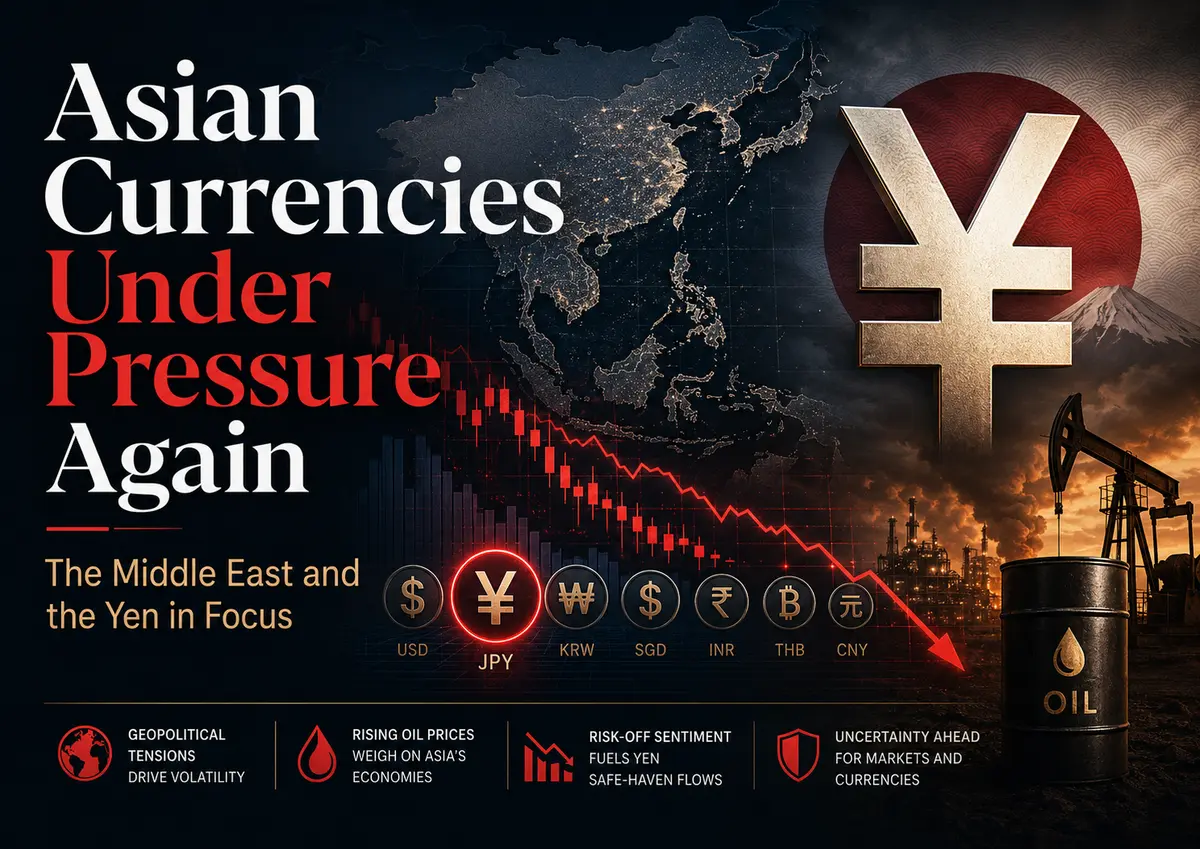
Asian Currencies Under Pressure Again: The Middle East and the Yen in Focus

Asian Currencies Under Pressure Again: The Middle East and the Yen in Focus

Friday Morning: Asia Holds Its Breath

Friday began across Asian currency markets with a sense of uneasy calm. Most regional currencies remained confined to narrow trading ranges, seemingly waiting for developments unfolding thousands of kilometres away. The Middle East once again became the main source of market-moving news, and its influence outweighed even the much-anticipated weakening of the US dollar.

The US Dollar Index, which fell to one-month lows this week following softer inflation data, edged up by 0.1% to 100.79 on Friday morning. The move may appear insignificant, but it was enough to encourage caution among Asian currencies. The dollar continues to benefit from its safe-haven status, and whenever geopolitical tensions intensify, investors begin turning back toward the US currency despite its fundamental weaknesses.

The situation in the Middle East is indeed becoming increasingly tense. The United States and Iran continue to exchange strikes, while yesterday’s reports of renewed military action confirmed that neither side appears ready to de-escalate the conflict. Oil prices remain close to one-month highs, automatically triggering a chain of rising inflation expectations. More expensive oil means higher energy costs, higher consumer prices and, ultimately, tighter monetary policy. For Asian economies, most of which are net energy importers, this represents a double blow.

The Yen: Near a 40-Year Low and Hoping for a Miracle

The Japanese yen remains the central currency drama of the year. The USDJPY ... pair is once again trading near 162.4, only a few tenths below the 40-year low of 162.84 reached earlier this month. The yen has not been this weak since the Japanese economy was operating under entirely different conditions.

The reasons behind the decline are well known and no longer surprise market participants. The enormous interest-rate gap between the United States and Japan continues to work against the yen. While...

Continue reading...
0
0

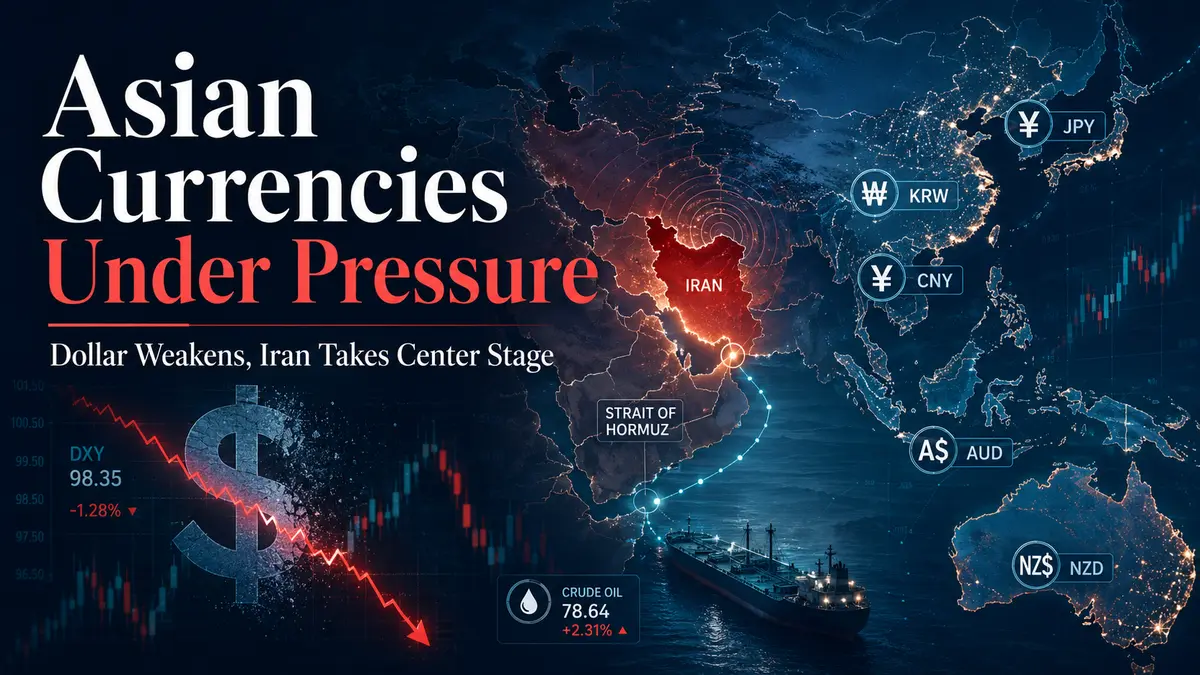
Asian Currencies Under Pressure as the Dollar Weakens and Iran Takes Center Stage

Asian Currencies Under Pressure as the Dollar Weakens and Iran Takes Center Stage

Introduction: The Calm Before the Storm or the Quiet After It?

Thursday’s trading session in Asian currency markets was surprisingly subdued. Most regional currencies remained confined to narrow trading ranges, as though bracing themselves for an inevitable shock. The weakening of the US dollar, which would normally provide support to Asian assets, was completely offset by increasingly troubling geopolitical developments. Investors who were ready to embrace risk only yesterday have now adopted a wait-and-see approach—and they have compelling reasons to do so.

The Middle East is once again at the center of global attention, and this time the situation appears far more serious than another escalation in rhetoric. For the fifth consecutive day, the US military has carried out strikes against Iranian targets. The Pentagon has not commented on the details of the operations, but regional sources indicate that the attacks are specifically targeting Iran’s military infrastructure.

Tehran, meanwhile, has responded with increasingly forceful statements, and the Strait of Hormuz has become the central subject of every discussion. Iranian officials have once again emphasized that control over this strategic route is not merely a matter of economic advantage but a cornerstone of national security. For financial markets, this sounds like a warning: disruptions to energy supplies are no longer a purely hypothetical threat but an increasingly realistic scenario.

Against this backdrop, the US dollar is struggling to find firm ground. The weakness of the American currency no longer appears to be a temporary correction. Inflation data released the previous day came in below expectations, and markets are now almost unanimous in expecting the Federal Reserve to leave interest rates unchanged at its next meeting.

The US Dollar Index has stabilized near 100.5, hovering close to its monthly lows. However, rather than celebrating the weaker dollar, Asian investors are choosing to...

Continue reading...
0
0
Navigation menu
instaforex banner