

Asia freezes ahead of the Fed: everyone awaits a signal from Kevin Warsh
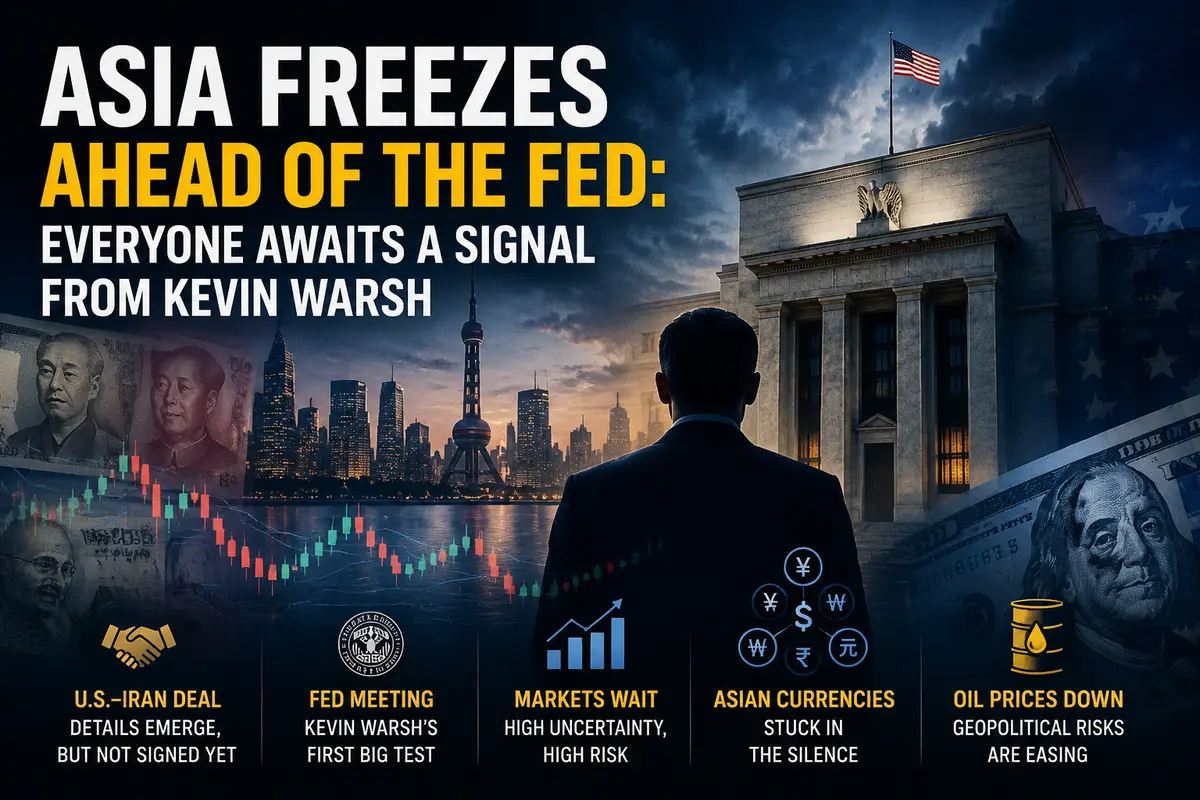
Wednesday in Asian currency markets began with an oppressive calm. Asian currencies did not move. The dollar did not move. The dollar index (DXY) remained frozen after four days of decline. Everyone stood still. Like rabbits before a predator. Or like traders ahead of the most important event of the week — the meeting of the U.S. Federal Reserve, the first under new Chairman Kevin Warsh.
USD/JPY — the Japanese yen — fell by 0.1% to 160.30. It was a symbolic move. Even after the Bank of Japan raised its rate to 1.0% the previous day — the highest in 31 years — the yen did not strengthen. Because everyone is waiting for the Fed.
USD/CNY — the Chinese yuan — was unchanged. USD/SGD — the Singapore dollar — was unchanged. USD/INR — the Indian rupee — fell by 0.3%, but this was a local move. AUD/USD — the Australian dollar — was unchanged after the RBA kept rates steady.
Only USD/KRW — the South Korean won — rose by 0.4%, breaking away from the general trend. But even this was likely linked to a tech rally in Samsung and SK Hynix shares rather than currency policy.
The reason for the calm is anticipation. Traders do not want to open new positions ahead of the Fed meeting. Uncertainty is too high. The risks are too large.
There is also the peace agreement between the U.S. and Iran. Details are becoming clearer. On Tuesday, the first concrete terms emerged. The agreement provides for the immediate resumption of Iranian oil exports. Iran agrees not to develop nuclear weapons and freezes its nuclear program for 60 days for negotiations.
This is positive for markets. But traders want to see a signed document, not just words. So they wait.
So what is happening in Asian currency markets on Wednesday, why everything has frozen, and what comes next?
Peace with Iran: details that change everything
On Monday, markets surged on news of a preliminary peace agreement. On Tuesday, details emerged — and they matter.
According to the proposed deal, Iran will be allowed to immediately resume oil exports once the agreement takes effect. This means Iranian oil could return to the market within weeks. An additional 1–2 million barrels per day of supply is a serious blow to prices.
In the nuclear sphere, Iran has agreed not to develop or acquire nuclear weapons. This is a key demand of the U.S. and Israel. In addition, Iran is freezing further expansion of its nuclear program for a 60-day negotiation period.
This means the sides will continue talks on a longer-term agreement. But even this freeze is progress.
For currency markets, this implies reduced geopolitical risk. Investors are less afraid of war in the Persian Gulf. They are more willing to sell the dollar as a safe haven and buy riskier currencies.
But until the agreement is signed, traders remain cautious. That is why Asian currencies are frozen.
The Fed: the main event of the day
The U.S. Federal Reserve meeting is the event that can change everything. It begins today, June 16, and concludes in the second half of the day New York time.
The Fed is expected to keep interest rates unchanged. That is not a surprise. But the surprise may come from the rhetoric of new Chairman Kevin Warsh.
Warsh, who took over the Fed last month, is undergoing his first major test. He must demonstrate he can manage the central bank amid high inflation and uncertainty.
Investors will watch three things closely.
First — the economic projections (dot plot).
In March, the Fed projected three rate cuts in 2026. But inflation turned out higher than expected. Warsh is likely to revise forecasts. There may now be only one cut, or possibly none.
Second — Warsh’s press conference.
He will answer journalists’ questions. Every word may be interpreted as “hawkish” or “dovish.” Warsh is known for a tough stance on inflation. But he also understands that excessively high rates could damage the economy.
Third — the dollar’s reaction.
If the Fed is hawkish, the dollar strengthens. If dovish, it weakens. And Asian currencies depend on the dollar.
Markets are pricing in a 49% probability of a Fed rate hike in December. A week ago it was 69%. The shift follows softer inflation data (core CPI was weaker) and news of peace with Iran.
If Warsh confirms this shift, the dollar may fall and Asian currencies may rise. If he rejects it, the dollar will strengthen.
Japanese yen: BoJ raised rates, but yen did not strengthen
Yesterday the Bank of Japan raised rates to 1.0% — the highest in 31 years. This was expected. Markets had already priced it in. As a result, the yen barely reacted.
This morning USD/JPY fell 0.1% to 160.30. It is a symbolic move. The yen remains weak.
Why? Because even at 1%, Japanese rates are still far below U.S. rates (5.5%). The interest rate gap remains enormous. Investors continue borrowing yen to invest in dollars (carry trade). This pressures the yen.
In addition, government data released Wednesday showed Japanese exports rose for the ninth consecutive month in May. The reason is strong semiconductor demand tied to AI investment. This is good for the Japanese economy, but not for the yen, because exporters sell dollars for yen, which can weaken the currency.
If the Fed is hawkish, USD/JPY could rise to 161–162. If dovish, it could fall to 158–159.
South Korean won: the exception
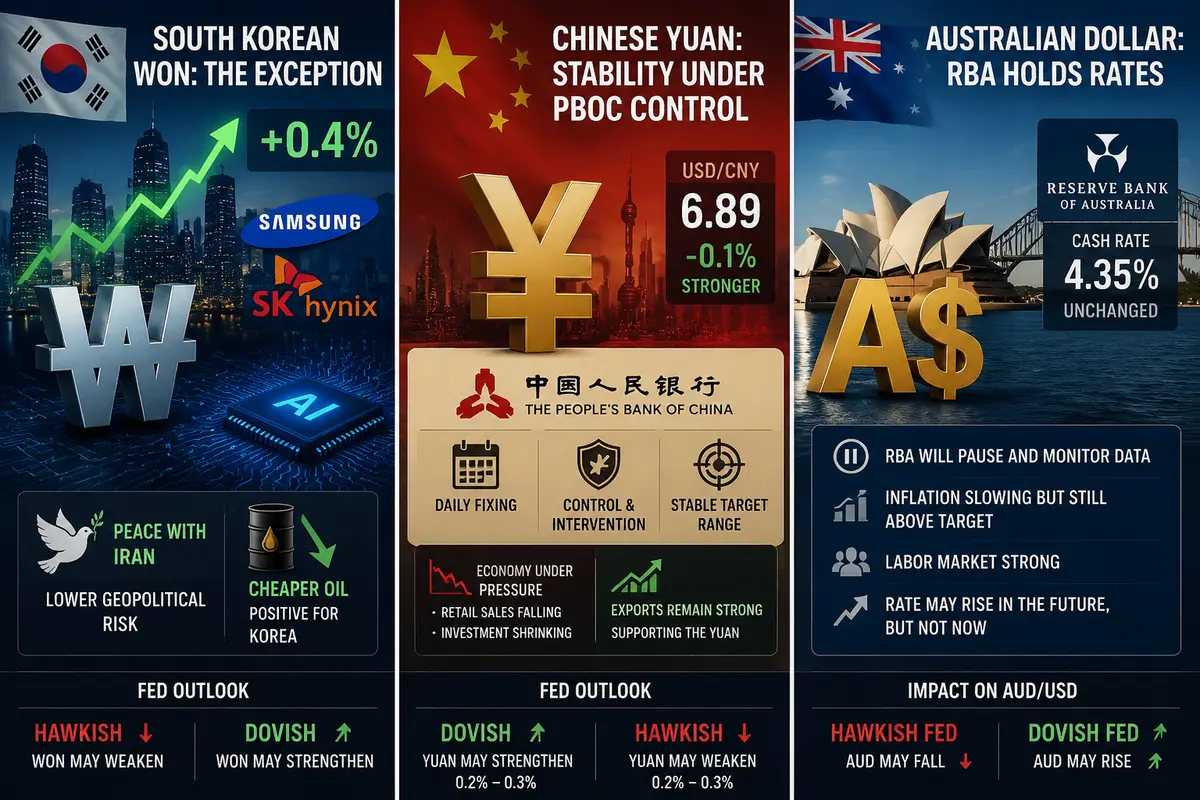
The South Korean won (USD/KRW) rose 0.4% on Wednesday — the only major Asian currency to show a notable move.
The reason is the technology sector. Shares of Samsung and SK Hynix continue to recover after a recent drop. Investors believe in long-term demand for AI chips. This improves sentiment toward the won.
In addition, peace with Iran reduces geopolitical risk for South Korea, which is heavily dependent on energy imports. Cheaper oil is good for the Korean economy and its currency.
But if the Fed is hawkish, the won may weaken. If dovish, it may strengthen.
Chinese yuan: stability under PBoC control
The Chinese yuan (USD/CNY) was almost unchanged on Wednesday. The People’s Bank of China (PBoC) set the fixing rate at 6.89 — about 0.1% stronger than yesterday. This is a symbolic strengthening.
The PBoC controls the yuan via daily fixing and intervention. It does not allow the currency to deviate significantly from its target range. As a result, the yuan remains stable even amid global moves.
China’s economy is still under pressure. Retail sales are falling, investment is shrinking. But exports remain strong, supporting the yuan.
If the Fed is dovish, the yuan may strengthen by 0.2–0.3%. If hawkish, it may weaken by the same amount.
Australian dollar: RBA holds rates
The Australian dollar (AUD/USD) traded flat on Wednesday. The Reserve Bank of Australia kept rates at 4.35% the previous day, as expected.
The RBA signaled it will pause and monitor economic data. Inflation in Australia is slowing but remains above target. The labor market is strong. The RBA may raise rates again in the future, but not now.
This is neutral for the Australian dollar. A hawkish Fed would likely push AUD lower; a dovish Fed would lift it.
Indian rupee: decline amid dollar strength
The Indian rupee (USD/INR) fell 0.3%, reaching a more than five-week low. This is a local move.
India is a major oil importer. Falling oil prices earlier this week were positive for the rupee. But on Wednesday oil stabilized, and that momentum faded.
In addition, investors are waiting for the Fed decision. They do not want to hold rupee positions ahead of a major event.
If the Fed is dovish, the rupee may strengthen. If hawkish, it may weaken.
What to expect from Kevin Warsh?
Kevin Warsh is the new Fed chair. He was appointed by Donald Trump in early 2026. Warsh is a hawk on inflation. He served on the Fed Board during the 2008 financial crisis and is known for his tough stance.
But in his new role, he may moderate his tone. He must balance fighting inflation with supporting economic growth. If he is too aggressive, he could trigger a recession. If too soft, inflation could become entrenched.
Markets expect Warsh to keep rates unchanged but deliver a hawkish signal. He may say inflation is still too high and the Fed is ready to raise rates further.
If he does so, the dollar will strengthen and Asian currencies will weaken.
If he is cautious instead, the dollar will weaken and Asian currencies will rise.
Conclusion: calm before the storm
Wednesday in Asian currency markets is a lull. Currencies are not moving. Traders are waiting.
The main event is the Fed meeting, which concludes today. Kevin Warsh’s rhetoric will determine the dollar’s direction for weeks ahead.
The second key factor is the peace agreement between the U.S. and Iran. Details are emerging, but it has not yet been signed.
Investors are also watching inflation data, oil prices, and China’s economic indicators.
For now — silence. A heavy, tense silence, worse than any noise. Because in silence, you can only wait. And waiting is the hardest part of trading.
But soon the silence will end. Warsh will speak. And then movement will begin. Billions of dollars will shift. Asian currencies will either surge or fall.
Everyone is frozen. Waiting.

Comments
No comments yet. Be the first to share your thoughts!
Comments only for logged-in users.