
Bar Pipa
We pay for a post of 10$

USD/CNH

Asia Holds Its Breath: Currency Markets Freeze Ahead of a Decisive Fed Week

Asia Holds Its Breath: Currency Markets Freeze Ahead of a Decisive Fed Week

Tuesday Morning: The Calm Before the Storm

Tuesday 28.07.2026 began across Asian currency markets with the kind of unusual silence that typically precedes major events. Most regional currencies traded within narrow ranges, as though holding their breath ahead of the US Federal Reserve meeting scheduled for Wednesday. Meanwhile, the US dollar remained close to a one-month high, creating tension that could be felt in every movement of the exchange rates.

The US Dollar Index fell by 0.1% to 101.46. The decline was barely noticeable, but it highlighted the market’s indecision. Investors were reluctant to open new positions, preferring to wait for signals from the Fed. Even the decline in oil prices, which normally reduces inflation concerns and may put pressure on the dollar, failed to move the market out of its standstill. Traders remained frozen in anticipation.

Markets currently estimate the probability of a 25-basis-point Fed rate increase on Wednesday at approximately 38%. This is not the dominant scenario, but the probability is high enough to make investors cautious. Should the Fed raise rates, the decision could surprise many market participants and trigger sharp movements across global markets. Should rates remain unchanged, attention will shift to comments from Chair Kevin Warsh, who may provide signals regarding the future direction of monetary policy.

Additional uncertainty comes from the upcoming US GDP and core PCE inflation data, which are also scheduled for release this week. These indicators may provide further guidance on monetary policy and influence investor expectations.

The Yen Near Multi-Year Lows: Awaiting the Bank of Japan

The Japanese yen remains the main victim of the current market environment. USDJPY ... was virtually unchanged at 163.72 yen, keeping the Japanese currency close to multi-year lows. Traders are eagerly awaiting the Bank of Japan’s decision on Friday, hoping to receive new guidance regarding...


Continue reading...
0
0

Asian Currencies Under Pressure: The Dollar Advances as the Yen Fights for Survival

Asian Currencies Under Pressure: The Dollar Advances as the Yen Fights for Survival

Introduction: Monday Begins with a Sell-Off

The new trading week began with an all-too-familiar scenario for Asian currencies: the dollar strengthened, regional currencies weakened, and investors sought refuge in U.S. assets. Rising U.S. Treasury yields and geopolitical tensions surrounding Iran created a perfect storm for emerging-market currencies and even some developed-market currencies.

However, amid this sea of red, one exception has captured the attention of market participants. The Japanese yen, which until recently was considered the weakest performer among G10 currencies, is unexpectedly showing signs of life. Renewed speculation about possible asset repatriation by the world’s largest pension fund is giving the yen hope of some relief.

What is driving the markets this Monday morning? What factors are prompting investors to flee Asian assets, and why has the yen suddenly become the center of attention? Let us unravel this complex combination of geopolitics, monetary policy, and hopes for a Japanese miracle.

The Dollar on Top: Why the U.S. Currency Continues to Rise

Inflation Fears and Interest Rate Expectations

The dollar’s strengthening on Monday is not a coincidence but the logical result of developments over the past few days. Investors are seriously concerned that inflation may remain elevated for much longer than previously expected. Geopolitical factors are only intensifying these concerns.

The upcoming testimony of Federal Reserve Chair Kevin Warsh before Congress and the U.S. inflation data scheduled for release on Tuesday have become the main events setting the tone for trading. Markets are looking for any indication of how long the Fed intends to keep interest rates elevated.

The rise in U.S. Treasury yields is a direct result of these expectations. When investors believe that interest rates will remain high, they demand higher yields on bonds. This, in turn, makes dollar-denominated assets more attractive and strengthens the currency.

Geopolitics as...

Continue reading...
0
0
Tom Maffin

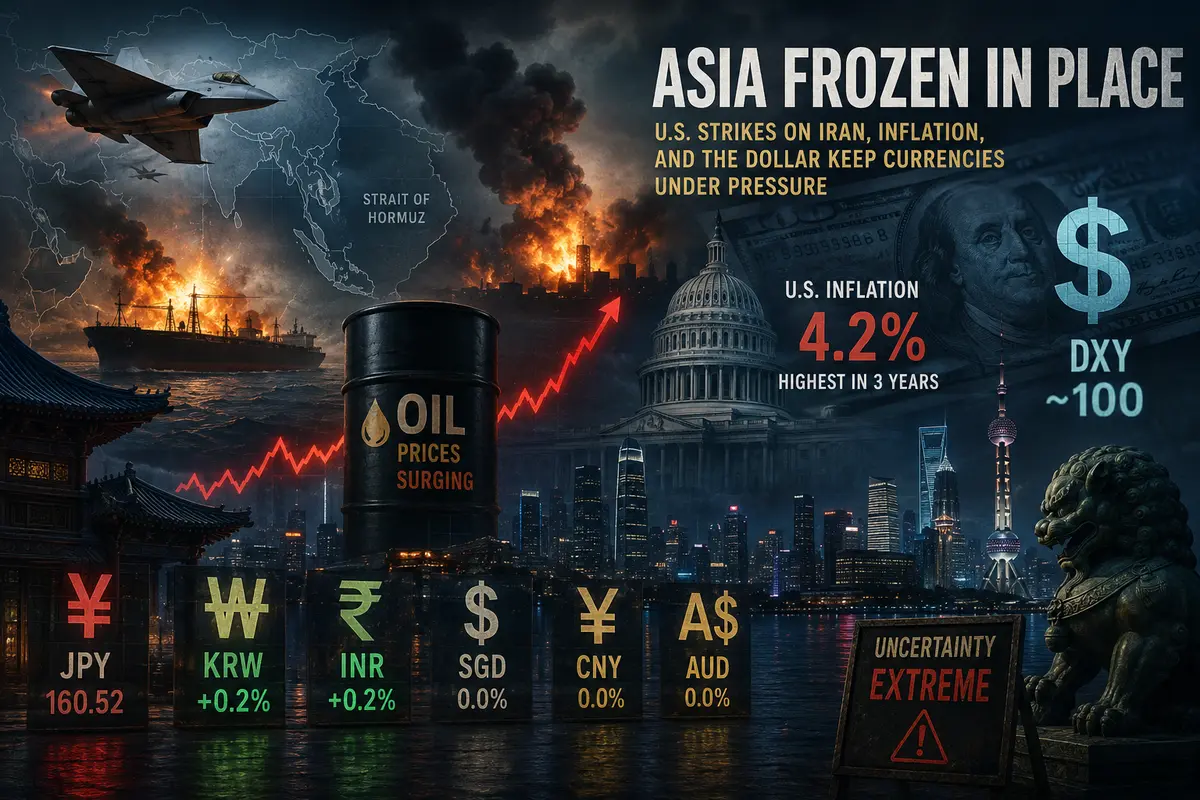
Asia Frozen in Place: U.S. Strikes on Iran, Inflation, and the Dollar Keep Currencies Under Pressure

Asia Frozen in Place: U.S. Strikes on Iran, Inflation, and the Dollar Keep Currencies Under Pressure

Thursday Morning: Calm Before the Storm or Quiet After the Shock?

When you wake up in Singapore, Tokyo, or Shanghai on Thursday and open the charts, you see something unusual. Asian currencies are neither falling nor rising. They are standing still — like rabbits frozen in the headlights.

The South Korean won gained just 0.2%, a move barely beyond statistical noise. The Indian rupee also rose 0.2%. The Singapore dollar, Australian dollar, and Chinese yuan were virtually unchanged. The Japanese yen remained stuck at 160.52 per U.S. dollar.

The U.S. Dollar Index (DXY) is holding near 100. It is not falling, despite inflation data released yesterday that ING analysts described as “softer than expected.” It is not rising either, even after overnight reports of new U.S. military strikes against Iranian targets. It is simply standing still — as if the entire world is holding its breath.

And that is what makes this calm so unsettling. Beneath the surface are forces capable of tearing markets apart at any moment: new U.S. strikes on Iran, the threat of a blockade of the Strait of Hormuz, oil prices that have surged but have not yet been fully reflected in currency markets, U.S. inflation accelerating to a three-year high, and the possibility of a Bank of Japan rate hike next week while its governor is reportedly hospitalized.

Traders do not know what to do. They are neither buying nor selling. They are waiting for clarity.

And there is none.

Let’s examine what happened over the last 24 hours and where Asian currencies could head next.

New U.S. Strikes on Iran: Is the Strait of Hormuz Closed?

Wednesday night brought fresh concerns. U.S. forces reportedly carried out additional strikes against Iranian targets. The Pentagon described them as a “proportional response” to earlier Iranian actions, including...

Continue reading...
0
0
Navigation menu
instaforex banner