


Bar Pipa
We pay for a post of 10$

U.S. Dollar / New Zealand Dollar

USDNZD FOREX

1.7244
+0.36%

Key Statistics

Volume
57,019
Open
1.7190
Day Range
1.7178 - 1.7255
52W Range
1.6418 - 1.7913
Price AVG 50
1.7300
Prev Close
1.7183

About U.S. Dollar / New Zealand Dollar

U.S. Dollar / New Zealand Dollar is a foreign exchange currency pair. It represents the relative value between the two currencies and is traded on the global decentralized forex market.

Asset Type: Currency Pair
Base Currency: NZD

Discussion

Authentication Required

You must be logged in to post a comment.

Asian Currencies Hold Steady as the Middle East and Oil Take Center Stage

Asian Currencies Hold Steady as the Middle East and Oil Take Center Stage

Tuesday: Dollar Reaches a One-Week High

Tuesday’s 21.07.2026 Asian currency trading was marked by caution. Most regional currencies remained confined to narrow trading ranges, unwilling to make a decisive move in either direction. Investors faced a difficult choice: on the one hand, the escalating conflict in the Middle East was pushing the dollar higher as a safe-haven currency; on the other, hopes for a diplomatic resolution prevented it from strengthening too sharply.

The U.S. Dollar Index rose to 100.99, its highest level since July 15. This appreciation was not driven by strong U.S. economic data or hawkish signals from the Federal Reserve. It was purely a geopolitical risk premium. In a world where military action is expanding with each passing day, the dollar remains one of the most reliable assets.

However, the dollar’s strength is putting pressure on Asian currencies. Energy-importing countries are particularly vulnerable: the rise in oil prices observed over the past several days is worsening their trade balances and creating additional inflationary pressure. For countries forced to purchase expensive oil on global markets, this represents a serious challenge. Their central banks now face a dilemma: raise interest rates to combat inflation and the risk of currency depreciation, or maintain accommodative policies to support economic growth.

Middle East Conflict: Ninth Consecutive Night of Strikes

The escalating conflict between the United States and Iran remains at the center of attention. U.S. Central Command confirmed the completion of a ninth consecutive night of airstrikes against Iranian targets. The strikes targeted command centers, missile and drone launch sites, and maritime infrastructure.

However, the most alarming development occurred on another front. The Iran-backed Houthi movement in Yemen announced a naval blockade of Saudi Arabia. This means that energy supplies passing through the Red Sea and the Bab el-Mandeb Strait could be disrupted....

Continue reading...
0
0

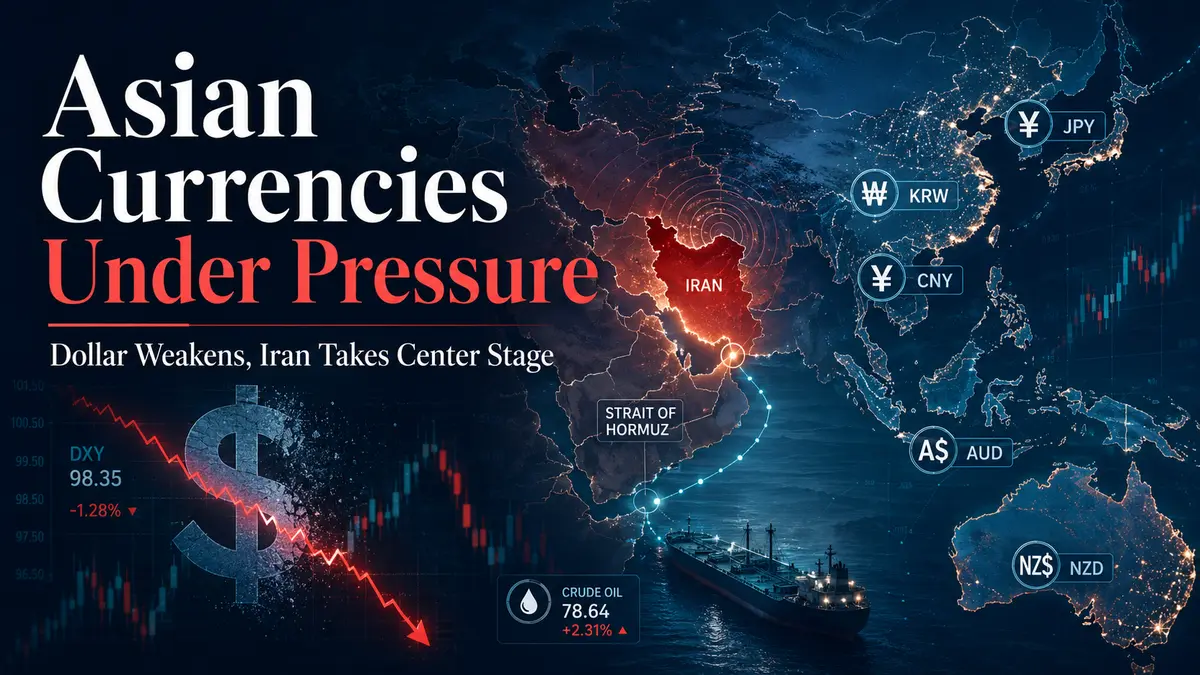
Asian Currencies Under Pressure as the Dollar Weakens and Iran Takes Center Stage

Asian Currencies Under Pressure as the Dollar Weakens and Iran Takes Center Stage

Introduction: The Calm Before the Storm or the Quiet After It?

Thursday’s trading session in Asian currency markets was surprisingly subdued. Most regional currencies remained confined to narrow trading ranges, as though bracing themselves for an inevitable shock. The weakening of the US dollar, which would normally provide support to Asian assets, was completely offset by increasingly troubling geopolitical developments. Investors who were ready to embrace risk only yesterday have now adopted a wait-and-see approach—and they have compelling reasons to do so.

The Middle East is once again at the center of global attention, and this time the situation appears far more serious than another escalation in rhetoric. For the fifth consecutive day, the US military has carried out strikes against Iranian targets. The Pentagon has not commented on the details of the operations, but regional sources indicate that the attacks are specifically targeting Iran’s military infrastructure.

Tehran, meanwhile, has responded with increasingly forceful statements, and the Strait of Hormuz has become the central subject of every discussion. Iranian officials have once again emphasized that control over this strategic route is not merely a matter of economic advantage but a cornerstone of national security. For financial markets, this sounds like a warning: disruptions to energy supplies are no longer a purely hypothetical threat but an increasingly realistic scenario.

Against this backdrop, the US dollar is struggling to find firm ground. The weakness of the American currency no longer appears to be a temporary correction. Inflation data released the previous day came in below expectations, and markets are now almost unanimous in expecting the Federal Reserve to leave interest rates unchanged at its next meeting.

The US Dollar Index has stabilized near 100.5, hovering close to its monthly lows. However, rather than celebrating the weaker dollar, Asian investors are choosing to...

Continue reading...
0
0
Navigation menu
instaforex banner
