

Currency options on the FX market expire on Wednesday
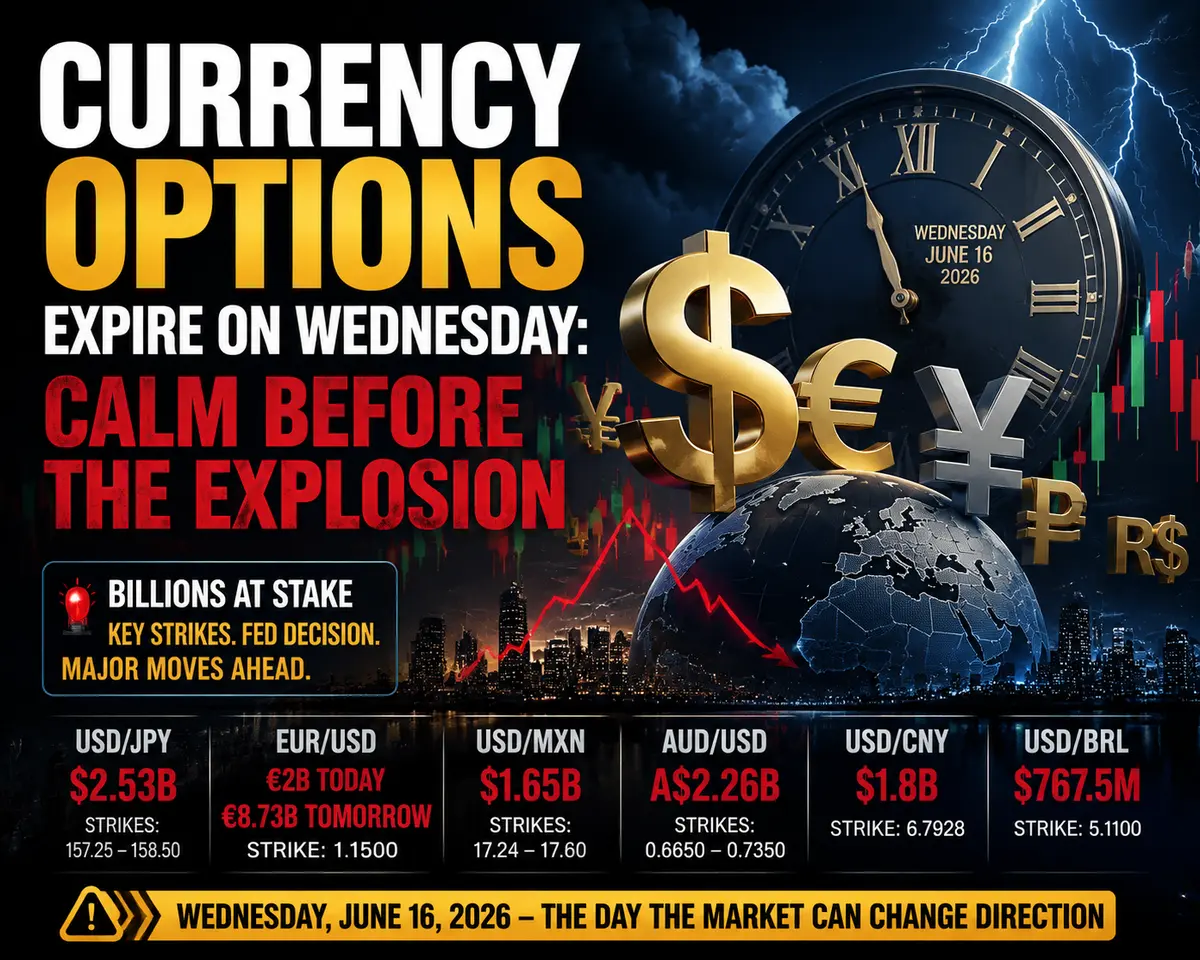
On Wednesday, June 16, 2026, an event is taking place in the foreign exchange market that most ordinary people will not even notice. But those who trade currencies know: today, large FX options are expiring. Billions of dollars, euros, yen, pesos, yuan, and reais may be exercised, not exercised, or rolled over. And depending on what happens, exchange rates could shift by tenths of a percent—or more.
This is not just a technical detail. It is a key market moment. Because options are both insurance and speculation at the same time. When they expire, the market loses support or resistance levels. Prices can move sharply. Traders holding positions may be forced to close them.
And today, on Wednesday, large options expire across several currency pairs. Let’s start with USD/JPY. The largest option is worth $1.09 billion with a strike at 158.00. Almost a billion dollars! What does this mean? The trader who bought this option has the right to buy or sell dollars at 158 yen per dollar. If the market is above 158, the option is in the money. If below, it is worthless.
In addition, options expire for $749.6 million at 157.25 and $691.1 million at 158.50. There are also USD/CNY options worth $1.8 billion at a strike of 6.7928. USD/BRL options worth $767.5 million at 5.1100. EUR/USD options worth nearly 1 billion euros at 1.1450. AUD/USD options worth 933.3 million AUD at 0.6650. USD/MXN options worth $629.5 million at 17.24.
All of these expire today. And they may affect markets.
But that’s only today. On June 18 (tomorrow), even larger options expire: EUR/USD options worth 8.73 billion euros at 1.1500! Yes, nearly 9 billion euros. No joke. And USD/JPY options worth $1.79 billion at 155.00. And USD/CAD options worth $884 million at 1.3735.
These are truly large sums. When they expire, markets can move significantly.
Let’s break down what FX options are, why they matter, and what may happen today and tomorrow.
What is a currency option and how does it work
A currency option is a derivative financial instrument. The buyer of an option gets the right (but not the obligation) to buy or sell a currency at a predetermined price (strike) on or before a specific date.
There are two types of options: calls (right to buy) and puts (right to sell).
For example, a USD/JPY call option with a strike of 158.00 gives the holder the right to buy dollars at 158 yen per dollar. If the market is above 158 (say 160 yen), the holder can buy at 158 and immediately sell at 160, earning the difference. If the market is below 158, the option is worthless.
The seller of the option receives a premium and takes on the obligation to fulfill the contract if the buyer exercises it.
When options expire, holders must decide whether to exercise their rights. Often, automated hedging strategies are used to lock in profits or manage risk.
For markets, what matters is where expiring option strikes are located. They create so-called “magnet levels”: price often gravitates toward these levels because traders hedge positions or try to push price through strikes so options end up in or out of the money.
If a large option expires in the money (market above strike for calls or below for puts), it can cause price movement toward or away from the strike depending on how dealers unwind hedges.
USD/JPY: nearly $3 billion at stake
Let’s start with the most popular pair—USD/JPY. Today, options worth about $2.53 billion expire (1.09B + 0.75B + 0.69B). Strikes: 158.00, 157.25, 158.50.
What does this mean for USD/JPY? The pair is currently trading around 160 yen per dollar. That is above all strikes. This means these call options are in the money. Buyers can exercise them and buy dollars at 157.25–158.50, then sell at 160, locking in profit.
But there is a nuance. Option sellers who must deliver dollars at these levels previously hedged their exposure. They bought dollars in the market to prepare. When options expire, they may need to unwind hedges by selling dollars. This can push USD/JPY lower (yen strengthening).
On the other hand, option buyers taking profits may also sell dollars to lock gains. This also creates downward pressure.
So today, USD/JPY could drift slightly lower due to option expiry effects. But this is not guaranteed, because other factors also matter—Fed meetings, Japanese news, global sentiment.
Note: tomorrow, June 18, a $1.79 billion option at 155.00 expires. If USD/JPY falls to 155, it becomes relevant. If it stays near 160, it expires worthless.
EUR/USD: nearly €1 billion today, €9 billion tomorrow
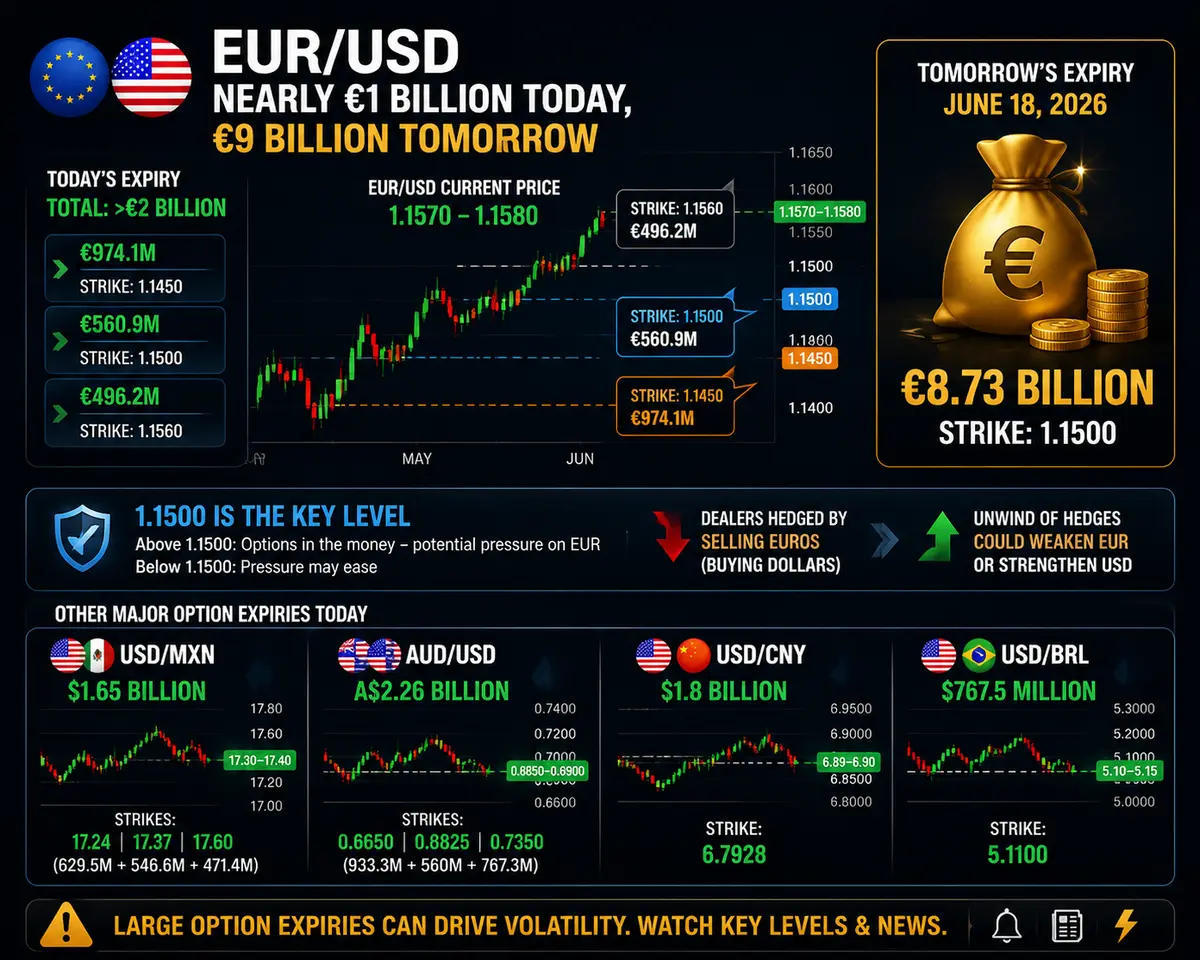
For EUR/USD today, options worth €974.1 million at 1.1450, €560.9 million at 1.1500, and €496.2 million at 1.1560 expire. Total: over €2 billion.
Current EUR/USD is around 1.1570–1.1580. That is above 1.1450 and 1.1500, but close to 1.1560. The 1.1450 and 1.1500 strikes are in the money.
But the real story is tomorrow: a massive €8.73 billion option at 1.1500 expires. Almost €9 billion. If EUR/USD stays above 1.1500, it remains in the money and may trigger significant positioning effects.
Dealers likely hedged by selling euros (buying dollars). When the option expires, they may unwind hedges, which could weaken the euro or strengthen the dollar.
If EUR/USD drops below 1.1500, pressure may ease.
So 1.1500 becomes a critical level in the coming days.
USD/MXN and other currencies
For USD/MXN today, options worth about $1.65 billion expire (629.5M + 546.6M + 471.4M) at strikes 17.24, 17.37, and 17.60. Current price is around 17.30–17.40.
For AUD/USD, options worth 933.3M AUD at 0.6650, 767.3M at 0.7350, and 560M at 0.6825 expire. Current price is around 0.6850–0.6900.
For USD/CNY, a $1.8 billion option at 6.7928 expires. Current rate is around 6.89–6.90, above strike.
For USD/BRL, a $767.5 million option at 5.1100 expires, close to current levels.
All of these can contribute to volatility.
Trader strategies before option expiry
Before large expiries, traders adjust positions. They try to anticipate whether price will settle above or below strikes.
Option sellers hedge dynamically, buying or selling spot FX depending on exposure. This can create additional flows that “pull” price toward strikes.
Complex strategies like straddles and strangles are also common.
In general, expiry days mean higher volatility.
Macroeconomic impact
On Wednesday, June 16, the Federal Reserve also holds a meeting. This is the most important event for FX markets.
A dovish Fed could weaken the dollar; a hawkish Fed could strengthen it.
Option expiry combined with Fed news can amplify moves. For example, dovish Fed + EUR/USD options in the money could strengthen euro more sharply. Hawkish Fed + USD/JPY options in the money could strengthen the yen.
How investors should react
For ordinary investors, this may go unnoticed. But if you hold foreign currency assets or plan conversions, be aware.
Rates can move 0.5–1% in a single day due to combined effects.
For traders, caution is advised. Volatility can bring both profit and loss.
Watch key strikes:
-
USD/JPY: 158.00–158.50
-
EUR/USD: 1.1450–1.1560
-
USD/MXN: 17.24–17.60
-
AUD/USD: 0.6650–0.7350
Conclusion: the day options meet the Fed
Wednesday, June 16, 2026, is expected to be volatile. Large FX options expire across USD/JPY, EUR/USD, USD/MXN, AUD/USD, USD/CNY, and USD/BRL.
At the same time, the Federal Reserve makes its decision, potentially impacting all currencies.
Tomorrow, even larger expiries follow: €8.73B EUR/USD, $1.79B USD/JPY, $884M USD/CAD.
This means pressure will continue into Thursday.
For traders and investors, today is a day to be ready for sudden moves. Calm can turn into storm at any moment. Billions are at stake. And when they move, markets may change—possibly permanently, or until the next option expiry.

Comments
No comments yet. Be the first to share your thoughts!
Authentication Required
You must be logged in to post a comment.