

Systemic vs. Unsystematic Trading and the Art of Investment Diversification
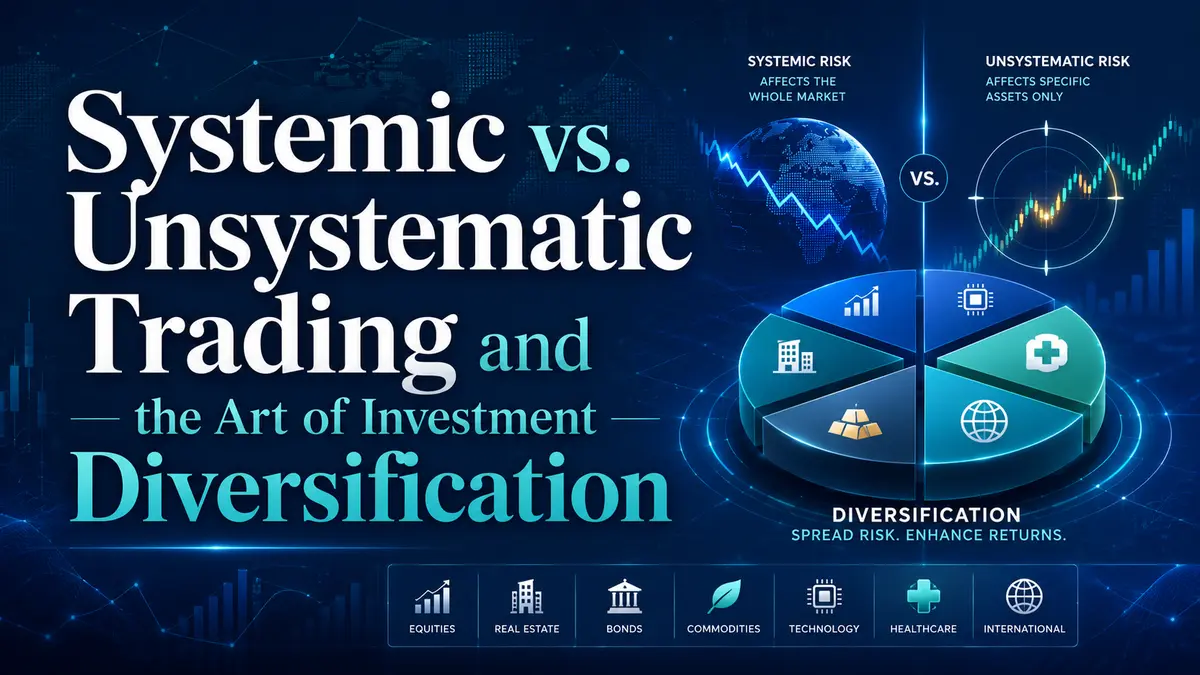
The vast majority of novice investors enter the stock market without a clear roadmap. This lack of preparation often leads to unpredictable results, transforming what should be a calculated financial endeavor into an emotional rollercoaster. To truly succeed, one must bridge the gap between unsystematic guessing and systemic, strategic trading.
What Exactly is a Trading Plan?
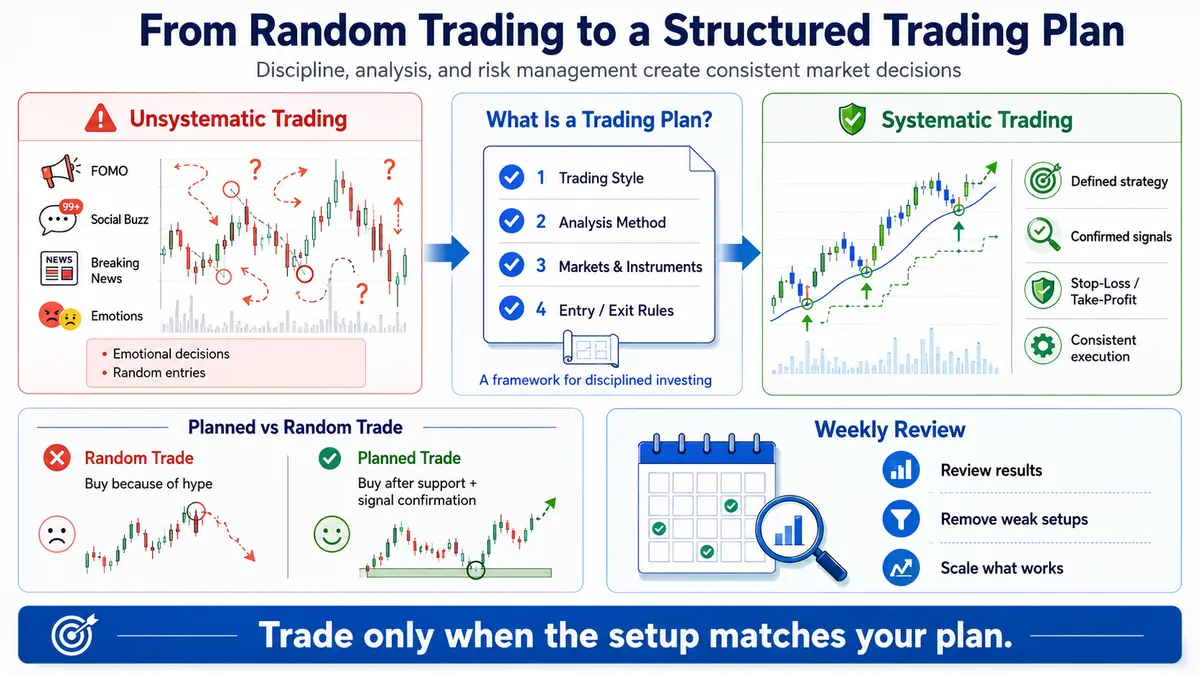
A trading plan is, first and foremost, the embodiment of discipline. It is a comprehensive framework that only works effectively when combined with other essential components, such as technical indicators, fundamental research, and risk management rules.
Regardless of whether your goal is to earn a regular active income on the exchange or to build a passive source of long-term wealth, creating a trading plan plays a monumental role. Without it, investing rapidly degenerates into mere gambling.
The only valid exception where you might bypass creating a personal trading plan is when you utilize a ready-made portfolio, invest in mutual funds, or employ the services of a professional financial advisor or portfolio manager. In these scenarios, you are essentially adopting an already developed and tested investment strategy, which minimizes the likelihood of amateur mistakes.
Key Components of a Winning Trading Plan
To achieve true independence and autonomy in the securities market, the absolute first thing you need is a detailed trading plan. Within this document, an investor must explicitly define the following crucial elements:
-
Preferred Trading Style: Are you a scalper looking for split-second gains, an intraday trader closing all positions before the market shuts, a swing trader holding for weeks, or a long-term investor planning for retirement?
-
Analytical Methodology: Will you rely heavily on technical analysis (chart patterns, volume, moving averages), fundamental analysis (earnings reports, macroeconomic indicators, company leadership), or a hybrid of both?
-
Choice of Markets and Instruments:
-
Geographic focus: Are you trading domestic equities or venturing into international securities markets?
-
Asset class focus: Will you specialize in the stock market, the commodities market, or the foreign exchange (Forex) market?
-
-
Entry and Exit Rules: Precisely what technical or fundamental triggers must occur for you to open a position? What exact parameters will dictate when you take profits or cut your losses?
Adhering strictly to a trading plan ensures that your market operations are executed systematically and thoughtfully. Over time, your skills will naturally refine, dramatically increasing your investment efficiency. You will develop the intuition to recognize whether you made a genuine analytical error or if the market simply behaved irrationally, as it occasionally does.
Eliminating the “Random Trade” Mistake
A classic hallmark of unsystematic trading is opening a “random” or impulsive position. This usually happens due to FOMO (Fear Of Missing Out) after seeing a stock spike on the news or reading a hyped post on social media.
Every single purchase or sale of a security must be executed only after a thorough analysis of the current market situation, strictly aligning with your trading plan and confirmed by your chosen Buy or Sell indicators.
Example of a Planned vs. Random Trade: Random: You see an electric vehicle company trending on Twitter, so you immediately buy $1,000 worth of shares at the market peak, hoping it goes higher. Planned: You identify the same company, note that it is approaching a historical support level of $150. Your plan dictates waiting for the RSI indicator to show “oversold” conditions. Once confirmed, you buy, setting a strict stop-loss at $140 and a take-profit at $180.
Before committing capital to any trade, you must formulate a forecast that clearly answers these vital questions:
-
Why might the price change, and what catalysts are preceding this move? (e.g., An upcoming earnings report or a change in interest rates).
-
At what specific price levels will I lock in my profit (Take-Profit) and cap my losses (Stop-Loss), and what is the technical justification for these levels?
Even a beginner investor must clearly understand why the mathematical probabilities of a successful trade are “on their side” before executing an order.
Pro Tips for Sustainable Growth
-
Set Realistic and Achievable Goals: Forget the myth of getting rich overnight. For a private investor with limited capital, achieving a consistent 5% to 10% return per month is a phenomenal, world-class success.
-
Constantly Experiment and Scale: If your current trading plan consistently yields profits and your drawdowns (portfolio dips) remain well within your acceptable limits, slowly try increasing your lot size or position sizing to compound your gains.
-
Conduct Weekly Reviews: Cultivate the habit of sitting down once a week, in a calm and objective state of mind, to audit your trading plan. Ruthlessly discard the strategies or indicators that are failing you, and double down on the market behavioral patterns you’ve noticed are working.
The Power of Investment Diversification
Systemic trading is only half the battle; the other half is asset allocation. Diversification in investing is the process of filling your investment portfolio with a variety of assets spanning different industries, sectors, and classes. By adhering to specific diversification rules, you construct a robust, resilient financial vehicle capable of generating stable profits while weathering economic storms.
Sector Diversification: Balancing Your Portfolio
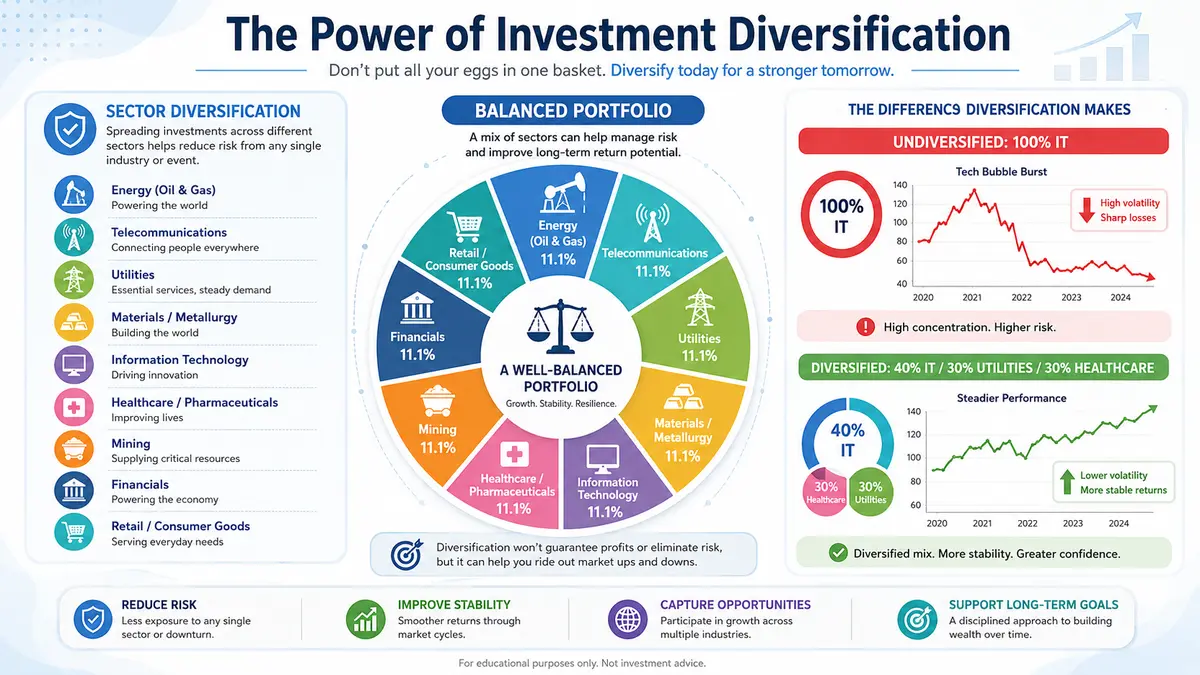
Distributing your investments across various sectors of the economy is of paramount importance. Market cycles dictate that while some stocks depreciate, others will appreciate. Maintaining a balanced investment portfolio guarantees a more stable equity curve.
The global stock market is generally categorized into the following major economic sectors:
-
Oil & Gas (Energy)
-
Telecommunications
-
Utilities (Electric power, water)
-
Metallurgy and Materials
-
Information Technology (IT)
-
Pharmaceuticals and Healthcare
-
Mining and Extraction
-
Financials (Banks, insurance)
-
Retail and Consumer Goods
You are not required to pour money into every single industry at once. Novice investors should focus on selecting the most attractive sectors or, more importantly, the ones where they genuinely understand the underlying business model.
Example of Sector Diversification: If you invest 100% of your money in IT companies and the tech bubble bursts, your entire portfolio crashes. However, if you allocate 40% to IT, 30% to Utilities, and 30% to Healthcare, a tech downturn might be entirely offset by strong earnings in the defensive utility and healthcare sectors.
There is no sense in buying an excessive number of diverse instruments just for the sake of having them. It is far better to understand where a company is investing its capital. A recommended approach is to build a portfolio across diverse economic sectors by finding the most promising companies within them, limiting your selection to just 1–3 top-tier representatives per sector to avoid “di-worsification” (spreading yourself too thin).
Basic Rules for Every Investor
The central thesis of diversification is to create a harmonized asset mix that delivers reliable returns while mitigating the idiosyncratic risks associated with individual investments. There is no “one-size-fits-all” template because:
-
Yield Objectives Vary: One investor might be perfectly content with a safe 10% annual return, while an aggressive growth investor demands 20% or more.
-
Time Horizons Differ: Some are trading to buy a house in two years, while others are investing for a retirement that is decades away.
-
Risk Tolerance is Personal: A 3% portfolio drawdown might cause immense stress for a conservative saver, whereas a seasoned crypto trader might remain completely unfazed by a 30% drop.
The golden rule of sector diversification boils down to asset correlation: the securities in your portfolio should ideally be independent of one another. The companies you own should react differently to the same macroeconomic news.
Beyond Stocks: Broadening Your Asset Classes
For a truly comprehensive application of diversification, you must look beyond individual company stocks. A robust portfolio should ideally include broader market indices, physical commodities, and even modern digital assets like cryptocurrency.
Major Stock Indices (Broad Market Exposure):
-
S&P 500: The 500 largest companies on the NYSE and NASDAQ, representing roughly 75% of the total US stock market capitalization.
-
NASDAQ 100: The top 100 non-financial companies listed on the NASDAQ, heavily weighted toward tech.
-
DJI 30 (Dow Jones): 30 prominent “Blue Chip” companies in the US, excluding transportation and utilities.
-
NIKKEI 225: The 225 largest, top-rated companies on the Tokyo Stock Exchange.
-
DAX 30: The premium “Blue Chips” of the Frankfurt Stock Exchange in Germany.
-
CAC 40: The top 40 multinational equities on the Euronext Paris.
-
IBEX 35: The benchmark stock market index of the Bolsa de Madrid (Spain).
-
FTSE 100: The 100 companies listed on the London Stock Exchange with the highest market capitalization.
-
HSI 50 (Hang Seng): The largest “Blue Chip” companies trading on the Hong Kong Stock Exchange.
-
STOXX 50: European “Blue Chips” representing top companies across 12 Eurozone countries.
-
ASX 200: High-capitalization companies traded on the Australian Securities Exchange.
Commodities (Hedge Against Inflation):
Cryptocurrencies (High-Risk/High-Reward Alternatives):
The Art of Portfolio Rebalancing
Market quotes fluctuate constantly, which means the initial ratio of different assets in your portfolio will drift over time. To maintain your desired risk profile, you must periodically “rebalance.”
Example of Rebalancing: Let’s say your plan is to hold 50% Stocks and 50% Gold. After a massive stock market rally, stocks now make up 70% of your portfolio’s value, and Gold is only 30%. To rebalance, you would sell off 20% of your stock profits and buy more Gold, returning the portfolio to its original 50/50 risk profile.
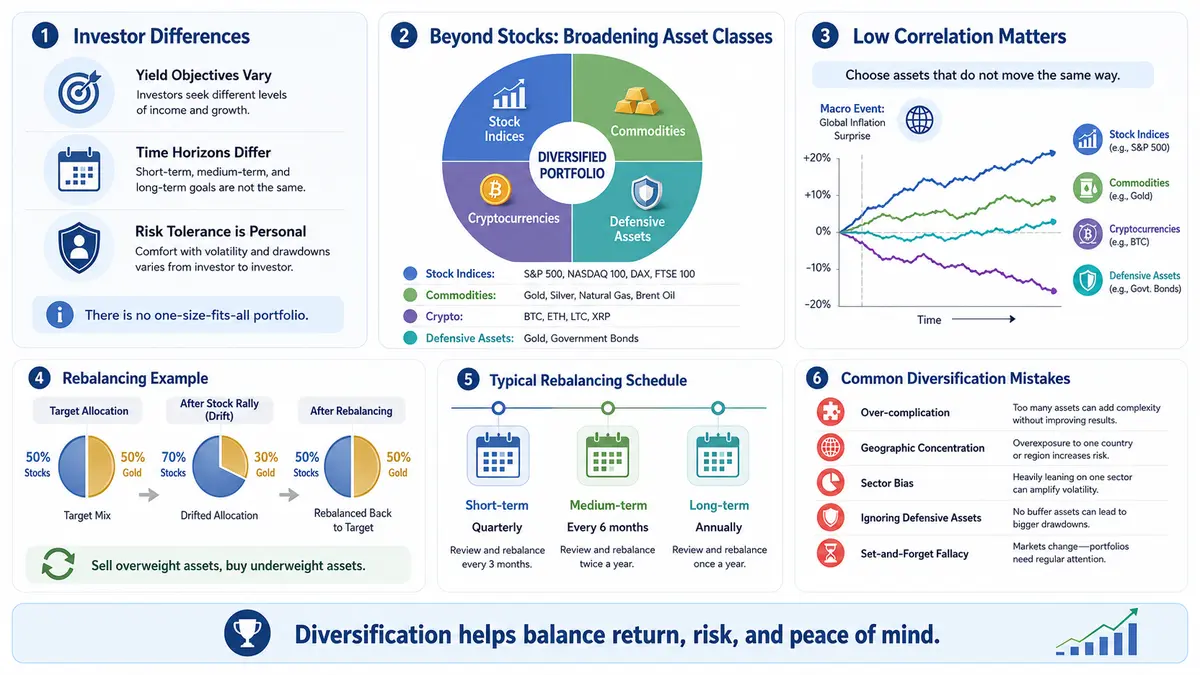
For short-term planners, executing this procedure once a quarter is sufficient. For medium-term investors, once every six months is standard, and for long-term “buy-and-hold” investors, a thorough annual rebalancing is enough — provided there haven’t been drastic changes in the fundamental weights of the chosen instruments.
Common Diversification Mistakes to Avoid
Even with good intentions, investors often fall into the following traps when trying to diversify:
-
Over-complication: Accumulating far too many different companies, making it impossible to keep track of their fundamental health.
-
Geographic Concentration: Investing exclusively in the companies of a single country, leaving the portfolio vulnerable to localized economic or political crises.
-
Sector Bias: Allocating an overwhelming majority of capital into just one “hot” industry (e.g., putting 80% into AI stocks).
-
Ignoring Defensive Assets: Failing to include safe-haven assets (like physical Gold or government bonds) that protect capital during brutal bear markets.
-
The “Set and Forget” Fallacy: Taking absolutely no action after the initial portfolio is formed, completely ignoring the necessary rebalancing process.
Ultimately, through intelligent and systemic diversification, an investor secures comparative peace of mind. When one specific industry or company inevitably faces a downturn, the well-prepared investor sleeps soundly, knowing the rest of their portfolio is structured to absorb the impact.

Comments
No comments yet. Be the first to share your thoughts!
Authentication Required
You must be logged in to post a comment.