

A Comprehensive Guide to Calculating Potential Profit in Trading
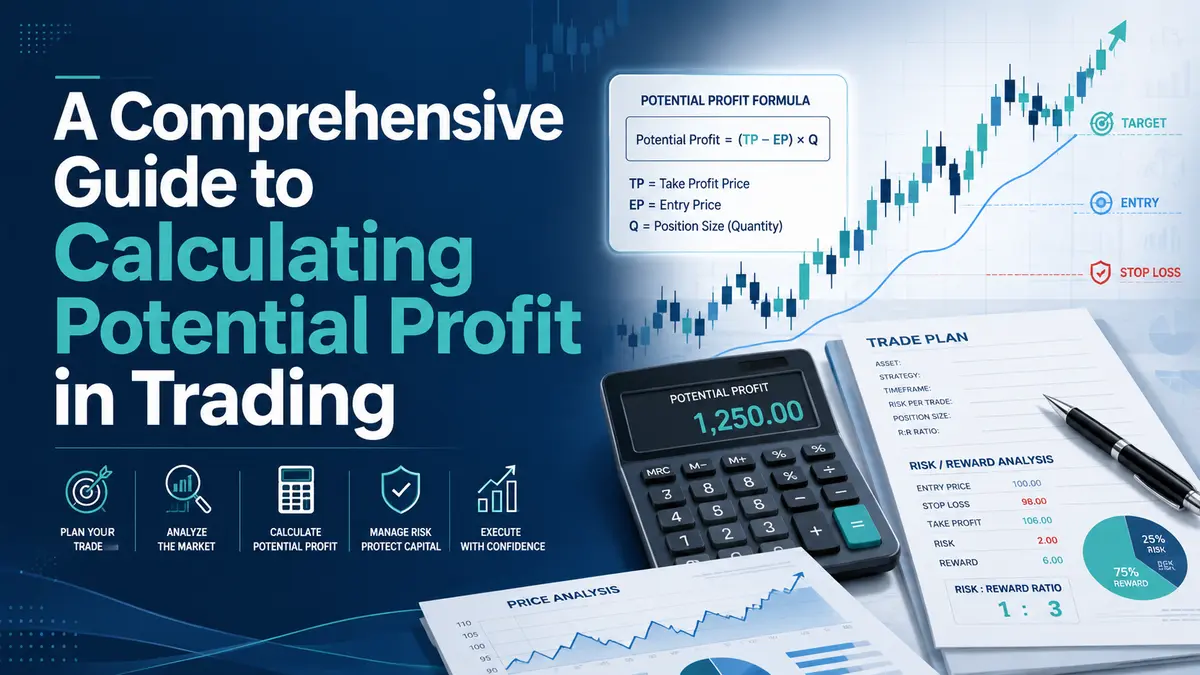
Before entering any financial market, professional traders must calculate their potential gains and risks. Relying on intuition is a quick path to losing capital. Calculating your potential profit in advance allows you to maintain strict risk management, plan your trade effectively, and remove emotional decision-making from the process.
Below is a detailed, step-by-step algorithm for preparing your trade and mathematically determining your expected return.
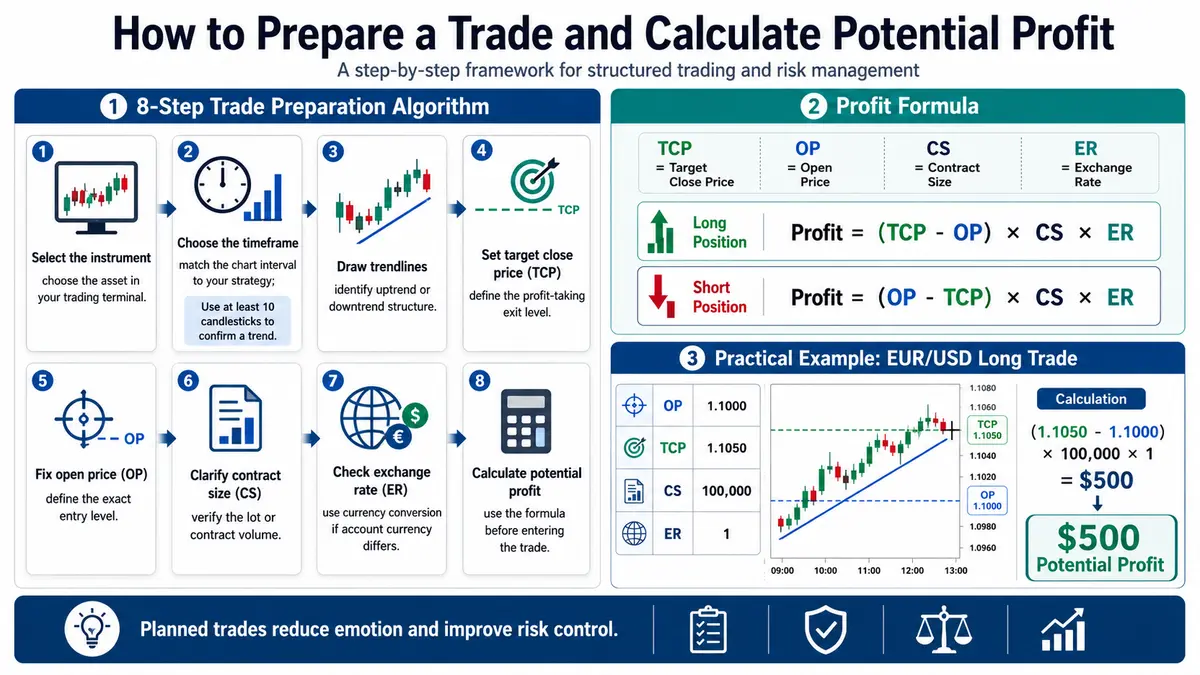
Step-by-Step Algorithm for Trade Preparation
1. Select and Open the Trading Instrument Start by launching your trading terminal (such as MetaTrader, TradingView, or your broker’s proprietary platform) and selecting the specific financial asset you want to trade. This could be a Forex currency pair, a stock, a cryptocurrency, or a commodity.
2. Choose the Appropriate Timeframe Select the chart interval that matches your specific trading strategy (e.g., 15-minute, 1-hour, or Daily charts). Crucial rule: To establish a reliable and technically sound trend, your analysis should be based on a sequence of at least 10 consecutive candlesticks. Anything less may just be random market noise.
3. Draw the Trendlines Conduct your technical analysis by drawing trendlines on the chart. Connect the higher lows to identify an uptrend, or the lower highs to outline a downtrend. This visual representation is vital for understanding the overall market direction and spotting optimal entry and exit zones.
4. Determine the Target Close Price (TCP) Use the crosshair tool in your trading platform (usually activated by pressing the Middle Mouse Button or using the Ctrl+F shortcut) to pinpoint the exact price level where you plan to exit the trade with a profit. This target level is your Target Close Price.
5. Fix Your Open Price (OP) Identify the exact price at which you will enter the market. Whether you are executing a market order immediately or setting a pending limit order, locking in your precise Open Price is necessary to calculate the spread between your entry and your target.
6. Clarify the Contract Size (CS) Every asset has a specific contract or lot size. For example, in Forex, one standard lot typically equals 100,000 units of the base currency. In commodities, it might be 100 barrels of oil. You must check the specific asset’s specifications in your broker’s platform to know exactly what volume you are trading.
7. Determine the Account Currency and Exchange Rate (ER) If you are trading an asset that is priced in a currency different from your main account balance (for instance, trading a Japanese Yen pair while your account is in US Dollars), you must account for the current Currency Exchange Rate. If the asset and your account share the same currency, this multiplier is simply 1.
8. Calculate the Potential Profit Once you have gathered all the technical data from the steps above, apply the standard mathematical formula to find out exactly how much money you stand to make before you even risk your capital.
The Mathematics of Profit: Understanding the Formula
To calculate your exact potential profit, use the standard formulas below based on market direction.
Terminology Legend:
-
TCP (Target Close Price): The price at which you plan to close the position.
-
OP (Open Price): The price at which you entered the market.
-
CS (Contract Size): The volume or lot size of your position.
-
ER (Exchange Rate): The currency conversion rate applied to your account balance.
Formula for a Long Position (Buy)
When you expect the market to go up, you buy the asset. Your profit is generated from the price increasing.
-
Profit = (TCP – OP) CS ER
Formula for a Short Position (Sell)
When you expect the market to crash or trend downward, you sell the asset. Your profit is generated from the price dropping.
-
Profit = (OP – TCP) CS ER
Practical Example
To make this perfectly clear, imagine you are buying (Long) the EUR/USD currency pair.
-
Your Open Price (OP) is 1.1000.
-
Your technical analysis tells you to set a Target Close Price (TCP) at 1.1050.
-
You are trading 1 standard lot, meaning your Contract Size (CS) is 100,000.
-
Your account is in USD, so the Exchange Rate (ER) multiplier is just 1.
Calculation: (1.1050 – 1.1000) 100,000 1 = $500 Potential Profit.
By strictly following these eight steps and utilizing the formulas, you transform trading from an emotional guessing game into a highly structured, mathematical business.

Comments
No comments yet. Be the first to share your thoughts!
Authentication Required
You must be logged in to post a comment.