

Two Advanced Methods for Trading Without a Stop Loss
One of the most fundamental and universally taught rules of trading in financial markets is the mandatory use of protective Stop Loss orders. Traditionally, a Stop Loss is essential to prevent losing your entire deposit or suffering a catastrophic drawdown if the market suddenly moves against your position. It acts as an automatic emergency exit.
However, many experienced traders become frustrated with traditional stop losses due to market noise, “stop hunting” by large institutional players, or sudden price spikes that trigger a stop only for the market to immediately reverse in the originally anticipated direction. Because of this, some traders choose to operate without protective stop orders.
Trading without a Stop Loss does not mean trading without risk management. Instead of relying on an automated exit, these methods involve actively managing the position to protect the account’s capital. Below, we will explore two comprehensive strategies that allow you to manage losing trades without using a traditional Stop Loss.
Method 1: Position Locking (Hedging)
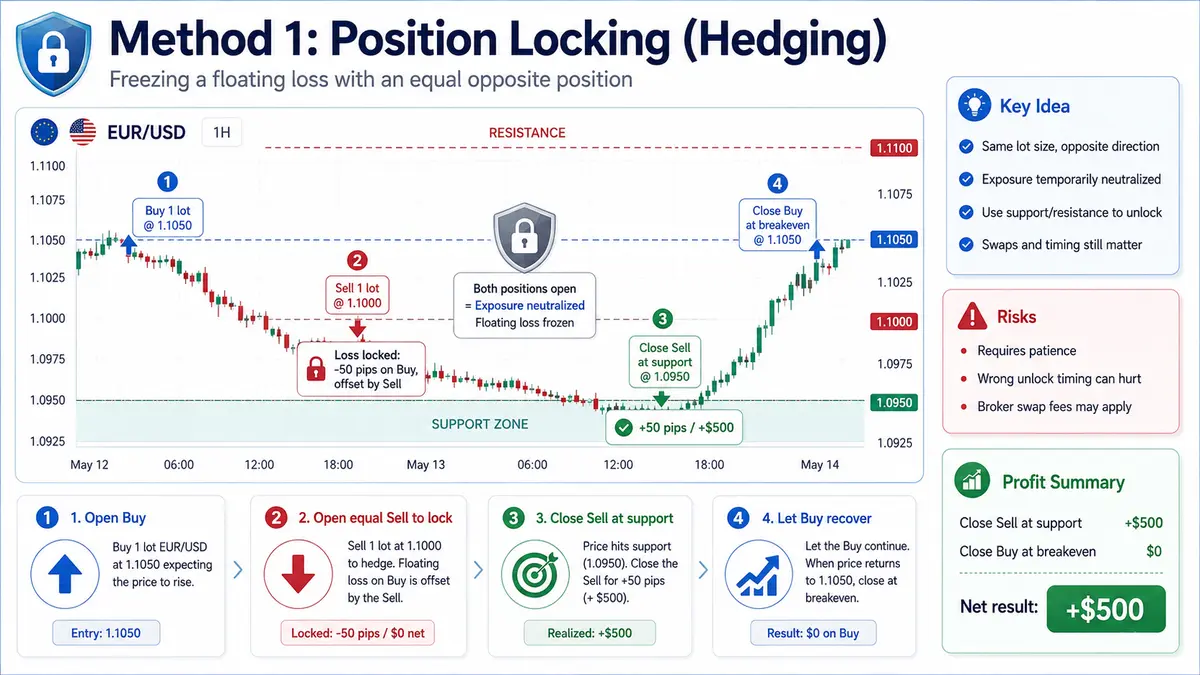
The locking method — often referred to as direct hedging in Western financial markets — involves opening an opposing position of the exact same volume to “freeze” a floating loss, rather than closing the losing trade outright.
When applying a lock, you must understand the core principle: you are temporarily neutralizing your market exposure. Eventually, one of the two positions will be closed earlier (usually a short-term correction trade), while the second position is held longer (the original long-term trade).
The Mechanics of the Lock
Imagine you open a Buy (Long) order based on a bullish forecast. However, the market unexpectedly reverses and starts trending downwards. Instead of accepting the loss and hitting a Stop Loss, you open a Sell (Short) order of the exact same lot size.
At this exact moment, your floating loss is “locked.” No matter how much further the market falls or rises, your negative balance will remain exactly the same because the profit from the Sell order will perfectly offset the continuing loss from the Buy order.
To exit the lock successfully, you must wait for the market to reach a strong support or resistance level where a reversal is highly probable.
-
Closing the Short: When the market reaches a strong bottom (support), you close the Sell order, taking the profit generated from the downward move.
-
Waiting for the Long: Now, your Buy order is “unlocked.” As the market bounces off the support level and moves upward, the floating loss of the original Buy order decreases until it eventually reaches breakeven or profit.
-
Only Take Profits are used: In this scenario, both positions are managed exclusively using Take Profit (TP) orders to lock in gains.
Step-by-Step Example of Locking in a Sideways Trend
Let’s say you are trading the EUR/USD currency pair.
-
The price is currently at 1.1050, and you believe it will go up. You open a Buy position of 1 standard lot.
-
Unfortunately, the price drops to 1.1000. You are currently floating a loss of 50 pips (roughly $500).
-
To prevent further losses, you open a Sell position of 1 standard lot at 1.1000. Your $500 loss is now locked.
-
The market continues to drop to 1.0950, hitting a major historical support zone.
-
You close your Sell position at 1.0950. You just made a profit of 50 pips ($500) on the short trade.
-
The market bounces off the support and rallies back up to 1.1050. Your original Buy position is now at breakeven ($0 loss).
-
You close the Buy position. Overall, you salvaged a losing situation and walked away with a $500 net profit.
Risks and Considerations of Locking
While locking sounds mathematically perfect, it is psychologically demanding. It requires immense patience and an excellent understanding of market structure (support and resistance). Furthermore, holding two opposing positions often incurs daily “swap” fees from your broker, which can slowly eat away at your account balance over time. Finally, unlocking a position at the wrong time can leave you exposed to even greater losses.
Method 2: Position Averaging (Cost Averaging)
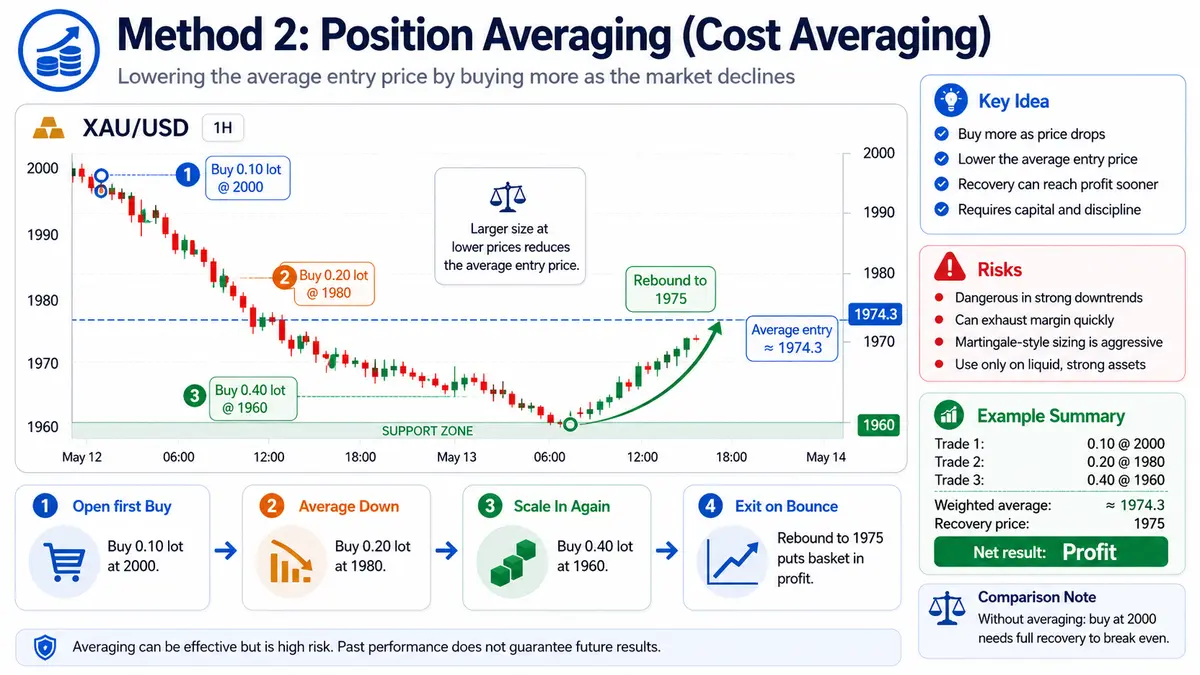
The averaging strategy is widely used in both active trading and long-term investing. It involves buying more of an asset as its price drops, thereby lowering the average entry price of your total position.
Most commonly, this strategy is utilized during temporary market corrections or crashes. If you fundamentally believe in the value of an asset, a drop in price is simply viewed as a “discount.” By systematically purchasing more as the price falls, you ensure that the market doesn’t have to rise all the way back to your original entry point for you to make a profit.
How Averaging Down Works
When a trader uses this method, they deliberately divide their total intended investment into smaller chunks.
For example, imagine a stock is currently experiencing a severe downtrend: its price drops from $100 to $90, then to $80, and finally to $70.
-
If we periodically buy shares for the exact same dollar amount at these respective prices, our mathematical average purchase price will be heavily weighted toward the bottom.
-
In this scenario, the average entry price would be roughly $83 per share.
-
When the stock eventually recovers and climbs back to its original price of $100, the investor who used the averaging method will already enjoy a 20% total return.
-
Conversely, an impatient investor who deployed all their capital at the initial $100 price point will merely be sitting at a breakeven point (0% profit) after the exact same market recovery.
Step-by-Step Example of Aggressive Averaging (Increasing Lot Size)
Active Forex and commodity traders often use an aggressive variant of this strategy, sometimes referred to as the Martingale approach. Instead of buying the same amount, they increase the lot size (volume) as the asset becomes cheaper.
Let’s look at a practical example trading Gold (XAU/USD):
-
Trade 1: You buy 0.10 lots of Gold at $2,000. The price drops to $1,980.
-
Trade 2: Instead of taking a loss, you average down by buying 0.20 lots at $1,980. The price drops further to $1,960.
-
Trade 3: You average down again, this time buying 0.40 lots at $1,960.
Because your largest position (0.40 lots) is at the very bottom, you do not need Gold to return to $2,000 to be profitable. If the price simply bounces from $1,960 to $1,975, the massive profit generated by the 0.40 lot trade will completely erase the minor losses of the earlier trades, putting your entire account into a net profit.
As illustrated on the chart, as the asset’s value decreases, you buy more while scaling up the lot size. The potential profit of the overall basket of trades increases with every subsequent position added at a lower price.
The Dangers of Averaging
Averaging is an incredibly powerful tool, but it is notoriously dangerous for inexperienced traders. It is the number one reason why beginners blow up their trading accounts.
To use averaging safely, you must have a substantial capital buffer (a large deposit) and strictly limit your leverage. If the asset enters a prolonged, multi-year downtrend — or if a company goes bankrupt — averaging down is essentially trying to catch a “falling knife.” The market can remain irrational much longer than your margin can remain solvent. Therefore, averaging should only be applied to highly liquid, fundamentally strong assets that are historically proven to recover over time.

Comments
No comments yet. Be the first to share your thoughts!
Authentication Required
You must be logged in to post a comment.