

The Martingale Strategy: Mechanics, Risks, and Practical Application
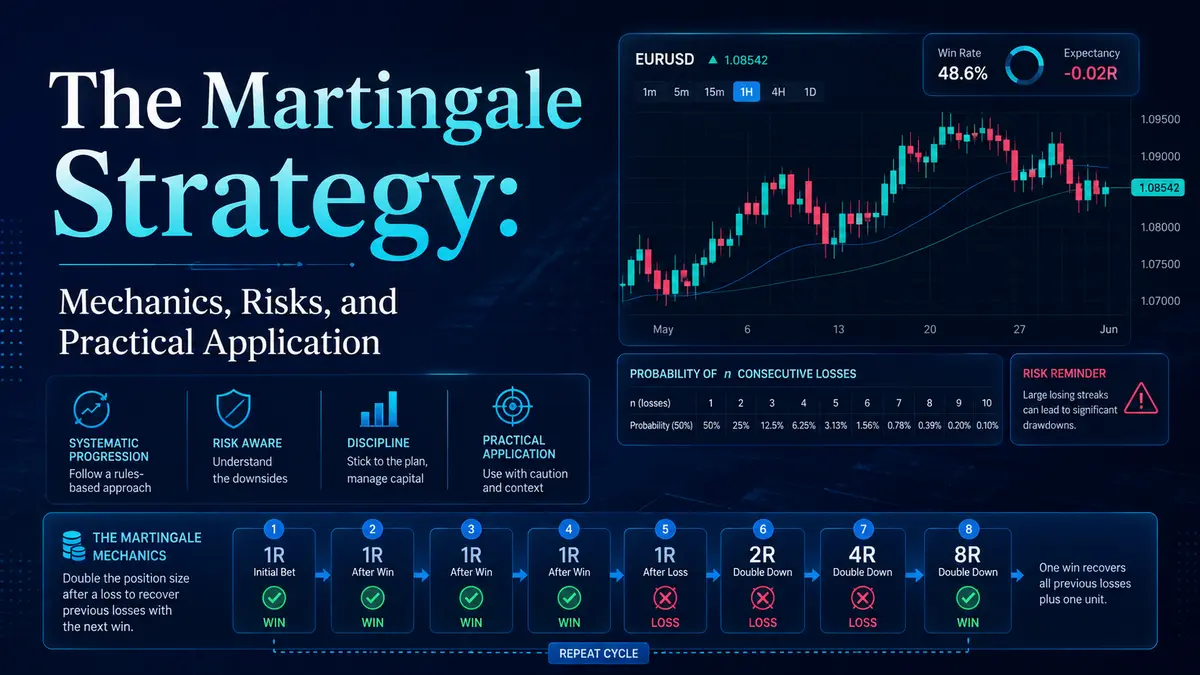
The Martingale system is one of the oldest, most polarizing betting and trading strategies in existence. While it promises a mathematical certainty of winning under ideal conditions, applying it to real-world financial markets requires a deep understanding of its hidden dangers, strict capital management, and psychological resilience.
The Origins of the Martingale System
Originally, this system was developed in 18th-century France for simple games of chance, most notably roulette. The math was tailored for even-money bets, such as wagering on Red or Black.
The Core Mechanism: The Illusion of a Guaranteed Win
The fundamental concept behind the Martingale system is remarkably straightforward: you double your stake after every single loss.
To see how this works in a classic casino setting, let’s look at a basic progression:
-
You bet $1 on Red, but the ball lands on Black. You lose your $1 stake.
-
To recover, you place a $2 bet on Red. If Black appears again, you are now down $3 in total.
-
You double your stake again to $4 on Red. Another loss brings your total deficit to $7.
-
You increase your bet to $8.
When your color finally hits, your payout for that winning round will be $16 (your $8 stake returned plus $8 in winnings). If you subtract all your cumulative losses ($1 + $2 + $4 + $7 = $15), you are left with a net profit of exactly $1. No matter how long or brutal your losing streak is, the final winning round instantly claws back all previous losses and hands you a profit equal to your original starting bet.
The Casino Reality Check: Why Theory Fails in Practice
In a vacuum, the Martingale system looks mathematically flawless. However, real-world casinos are run by very smart operators who identified the fatal flaw of this strategy: exponential growth. To protect themselves from billionaire gamblers weaponizing this tactic, casinos introduced table limits — strict caps on the maximum amount anyone can wager on a single bet.
Because your bet sizes grow exponentially, you will inevitably hit the house ceiling during an extended losing streak. Once you hit the maximum allowed bet, you can no longer double your stake, meaning you can never recover your accumulated losses. No casino on earth will allow you to place an infinitely large bet to win back a single dollar.
Applying the Martingale Strategy to Financial Markets
Translating this betting system into the world of trading and investments is surprisingly simple. Instead of betting on red or black, a trader interacts with the directional movements of financial instruments, whether they are stocks, stock indices, commodities, currency pairs, or cryptocurrencies.
Trading the Reversal (Shorting an Overbought Asset)
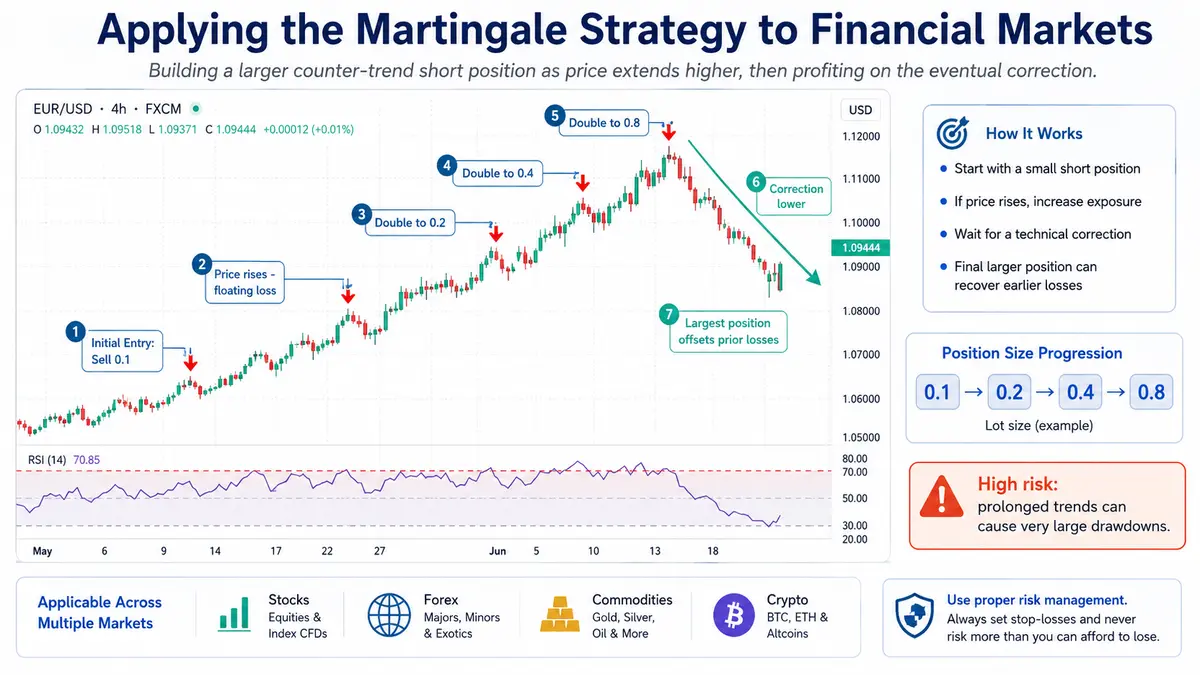
In trading, the Martingale system is frequently utilized during market overextensions — when an asset becomes heavily overbought or oversold. Instead of waiting for a perfect reversal signal, a Martingale trader will start building a position against the current trend, confident that the market must eventually correct.
Let’s look at how a trader might manage a short position as the market moves against them:
-
The Initial Entry: A trader spots an asset that looks heavily overbought on the chart and decides to open a sell (short) position with a conservative initial lot size of 0.1.
-
The Trend Continues: Instead of reversing, the asset enters a strong, continuous uptrend and moves even higher. The initial 0.1 lot trade goes into a floating loss.
-
The First Double: The trader closes the losing position (or adds to it) and opens a new short position, doubling the exposure to 0.2 lots. Now, the trader waits for the price to drop.
-
Scaling Up: If the price defies expectations and continues to conquer new highs, the trader opens yet another short position, doubling the lot size to 0.4 lots, then 0.8 lots, and so on.
When the price eventually hits an exhaustion point and undergoes a minor technical correction downward, the massive profit generated by the final, largest position will easily wipe out the accumulated losses of the previous smaller trades, pulling the entire account into a net profit.
A Detailed Practical Trading Example
To understand the immense gravity of this strategy, let’s analyze a realistic scenario in the foreign exchange (Forex) market involving a trader shorting a currency pair that is experiencing an unexpected rally.
The Scenario in Action
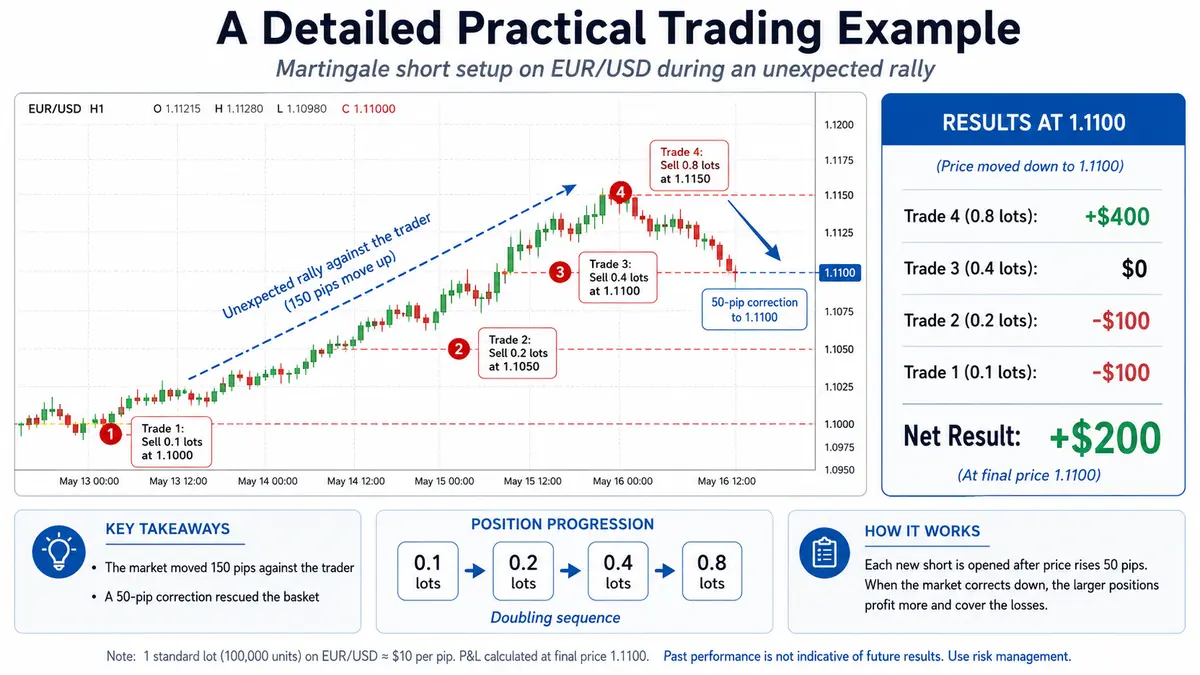
Suppose a trader believes the EUR/USD pair is topping out at 1.1000 and opens a short position:
-
Trade 1: Sell 0.1 lots at 1.1000. The market continues to rise. At 1.1050 (a 50-pip loss), the trade is down roughly $50.
-
Trade 2: The trader doubles down and sells 0.2 lots at 1.1050. The market ignores the resistance and surges to 1.1100. The total floating loss across both trades is now $200 ($100 from Trade 1 and $100 from Trade 2).
-
Trade 3: The trader opens a 0.4 lot short position at 1.1100. The market pushes up one last time to 1.1150. The total floating loss across all positions mushrooms to $500.
-
Trade 4: The trader opens a 0.8 lot short position at 1.1150.
Finally, the market runs out of buyers and undergoes a routine 50-pip correction back down to 1.1100. Let’s look at the financial outcome at 1.1100:
-
Trade 4 (0.8 lots) moved from 1.1150 to 1.1100, generating a +$400 profit.
-
Trade 3 (0.4 lots) is exactly at its break-even point ($0).
-
Trade 2 (0.2 lots) is at a -$100 loss (moved from 1.1050 to 1.1100).
-
Trade 1 (0.1 lots) is at a -$100 loss (moved from 1.1000 to 1.1100).
The Net Result: +$400 (Profit) – $200 (Total Losses) = +$200 Net Profit.
Even though the market went completely against the trader for 150 pips, a minor 50-pip retracement was all it took to rescue the entire basket of trades and yield a handsome profit.
Capital Requirements and the Risk of Exponential Growth
The example above highlights why the Martingale strategy is so alluring: it allows you to be wrong multiple times in a row and still come out ahead. However, this comes with a massive catch.
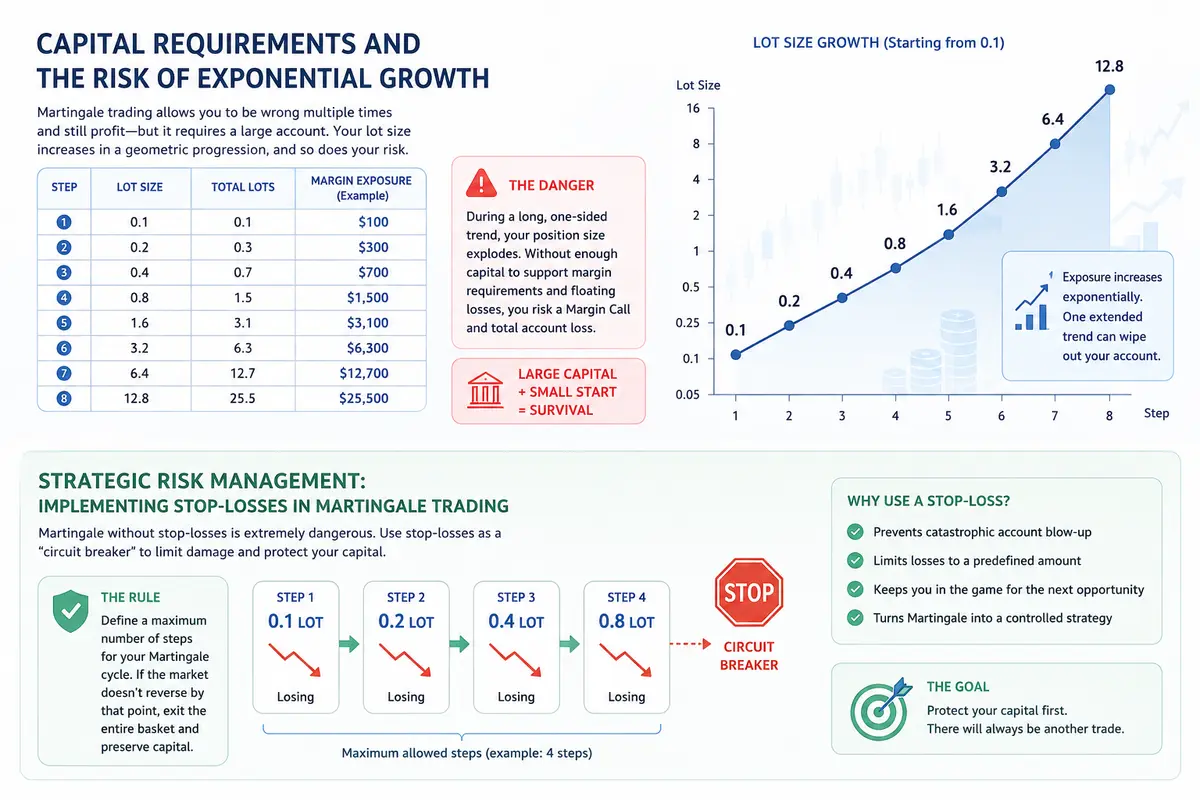
The ultimate, non-negotiable requirement for successful Martingale trading is having a massive account balance. Because your lot sizes increase in a geometric progression, your account’s financial exposure escalates at a terrifying speed.
Consider a starting lot of 0.1 that experiences an extended, unyielding multi-week trend without any pullbacks:
-
Step 1: 0.1 lots
-
Step 2: 0.2 lots
-
Step 3: 0.4 lots
-
Step 4: 0.8 lots
-
Step 5: 1.6 lots
-
Step 6: 3.2 lots
-
Step 7: 6.4 lots
-
Step 8: 12.8 lots
By the eighth step, you are no longer trading micro-lots; you are managing a massive 12.8-lot position. If your account does not have enough capital to sustain the margin requirements and the floating losses of these combined positions, the broker will trigger a Margin Call, automatically liquidating your entire account and wiping out your capital.
If you possess proper skills, an accurate understanding of market cycles, and an incredibly conservative starting lot size relative to your total equity, this tactic can provide a highly consistent revenue stream. But if you get greedy with your starting volumes, it can be financial suicide.
Strategic Risk Management: Implementing Stop-Losses in Martingale Trading
A widespread and dangerous misconception in the trading community is that the Martingale strategy can only be executed without using stop-losses. Many believe that you must leave your positions completely open to the elements, simply praying for an eventual market turnaround. This is a recipe for a catastrophic account blow-up.
Implementing a “Circuit Breaker” Stop-Loss
Stop-losses can — and absolutely should — be incorporated into a Martingale framework to act as an emergency circuit breaker.
Instead of letting a losing streak run indefinitely into infinity, a professional systematic trader will establish a strict boundary on their progression. For example, you can decide beforehand that your Martingale cycle will consist of a maximum of four steps.
If the market triggers Trade 1 (0.1), Trade 2 (0.2), Trade 3 (0.4), and Trade 4 (0.8), and still refuses to reverse after a specific distance, a hard stop-loss is triggered across the entire basket. You accept the loss, protect the remaining 80% of your account capital, and exit the market to fight another day.
Using protective stops in this manner ensures that a single, unpredictable macroeconomic event (a “Black Swan”) will never completely destroy your financial future.

Comments
No comments yet. Be the first to share your thoughts!
Authentication Required
You must be logged in to post a comment.