

Trade Management: Trailing Profitable Positions
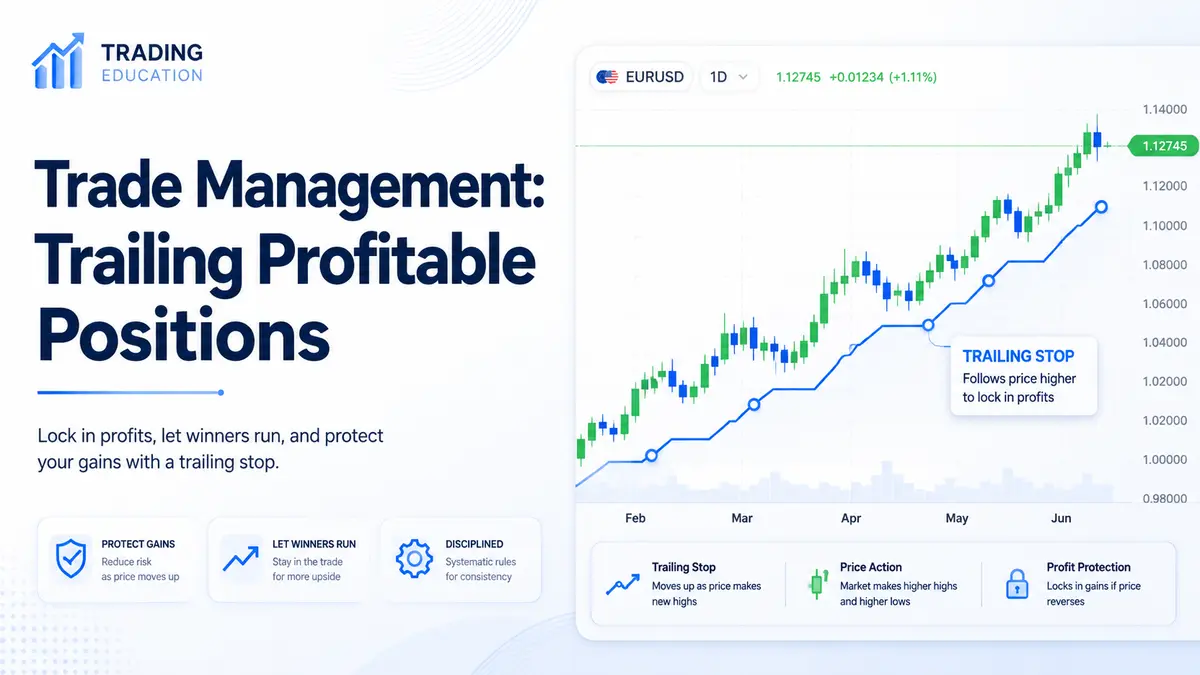
Successfully opening a trade is only half the battle; managing it effectively is what separates professional traders from amateurs. One of the most powerful tools for active trade management is the Trailing Stop. A trailing stop allows you to lock in profits during strong, trending market movements while still giving your position room to grow. Instead of capping your potential upside with a static take-profit order, this dynamic tool adapts to the market, protecting your hard-earned gains as the trend develops.
What is a Trailing Stop?
Essentially, a trailing stop is a flexible, dynamic Stop Loss order that follows the current market price at a predetermined distance. As the asset’s price moves in your favor, the trailing stop automatically moves along with it, adjusting your exit point to reflect your newly acquired paper profits.
However, if the market suddenly reverses and moves against your position, the trailing stop remains firmly in place. The trade will only be closed if the market turns against your position by the specific number of points (or pips) you have set. This ensures that you capture a significant portion of a trend without giving back all your profits during a sudden market correction.
How to Set Up a Trailing Stop
While trading platforms may vary slightly in their visual interfaces, the general setup process is straightforward:
-
Locate your open position: Find the active trade in your platform’s terminal or order window.
-
Access the protection settings: Click on the shield icon (usually located to the left or right of your open order).
-
Select the advanced options: Choose the “Advanced Stop Loss” or “Trailing Stop” feature from the menu.
-
Define the trailing distance: Set your desired trailing level in points, pips, or a fixed dollar amount. This distance should be wide enough to withstand normal market volatility but tight enough to protect your core profits.
The Mechanics of the Trailing Stop
To truly master this tool, you must understand its core mechanic: it acts as an automated, one-way safety net. For a long (buy) position, the trailing stop will only move up. For a short (sell) position, it will only move down.
Because the trailing stop automatically follows the price at your specified distance, you no longer need to manually monitor the charts and adjust your stop loss every few minutes. This removes emotional decision-making from your trade management, preventing you from closing a winning trade too early out of fear or holding on too long out of greed.
Practical Trading Examples
To fully grasp how this works in real-time, let’s look at a few detailed examples across different market scenarios.
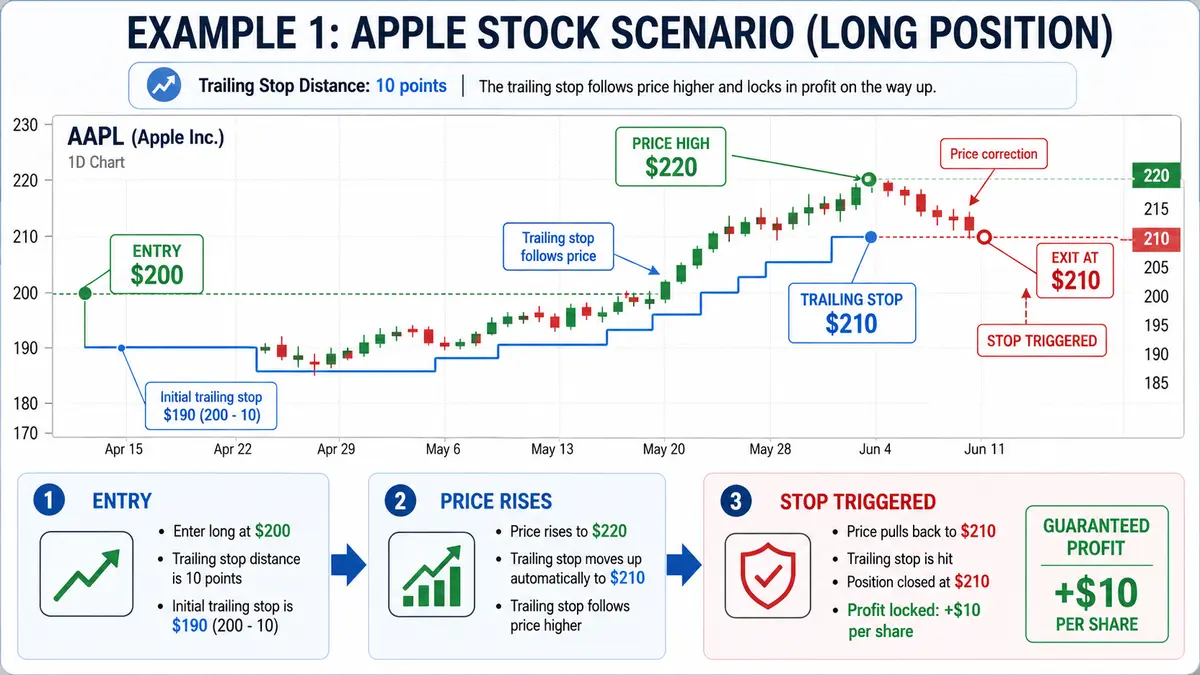
Example 1: The Apple Stock Scenario (Long Position) Imagine you purchased 1 lot of Apple (AAPL) shares at an entry price of $200. You decide to set a trailing stop at a distance of 10 points (which equals $10 in this context).
-
If the price immediately drops to $190, your stop loss is triggered, and you exit the trade with a $10 loss.
-
However, let’s say the stock price rallies beautifully to $220. Your trailing stop automatically follows the price upward, maintaining that 10-point gap. Your new stop loss level is now securely placed at $210 ($220 – $10).
-
If the price then corrects and drops to $210, your trade is automatically closed. You secure a guaranteed profit of $10 per share, even though the market eventually reversed.
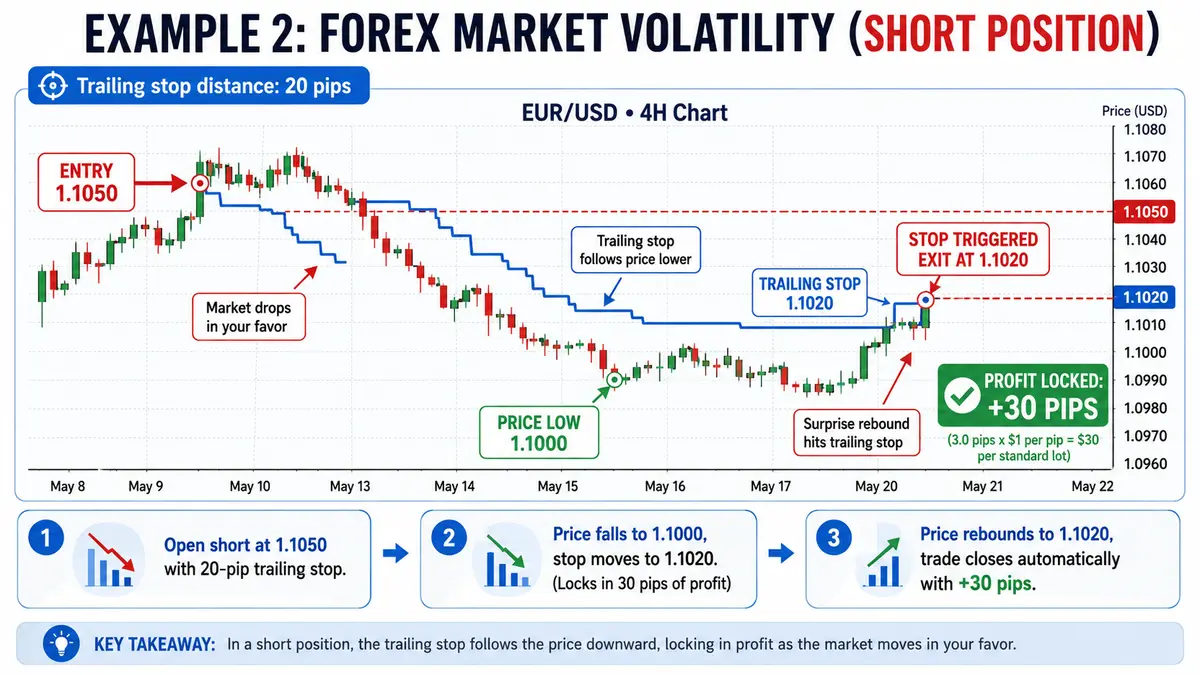
Example 2: Forex Market Volatility (Short Position) Let’s say you open a short (sell) position on the EUR/USD currency pair at 1.1050, anticipating a drop in the Euro. You set a trailing stop of 20 pips.
-
The market moves heavily in your favor, dropping to 1.1000.
-
Because you are short, your trailing stop automatically moves down behind the price to 1.1020 (1.1000 + 20 pips).
-
You have now locked in 30 pips of profit. If the market suddenly spikes upward due to a surprise news release and hits 1.1020, your trade closes automatically. You walk away with a solid gain instead of a loss.
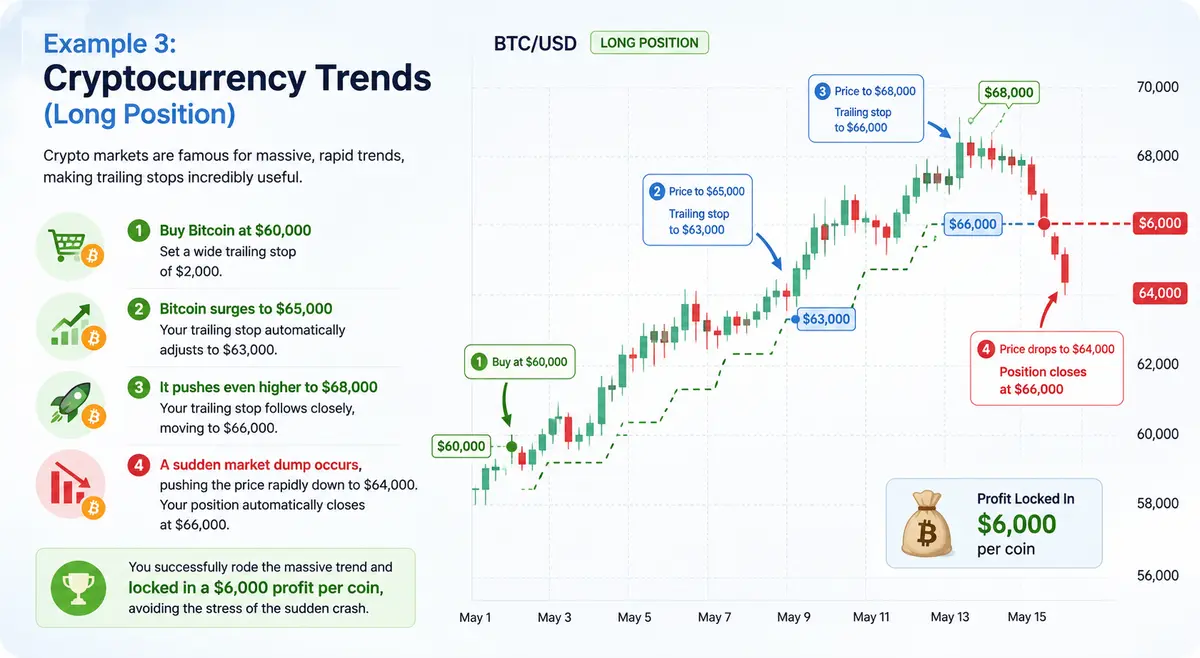
Example 3: Cryptocurrency Trends (Long Position) Crypto markets are famous for massive, rapid trends, making trailing stops incredibly useful. You buy Bitcoin at $60,000 and set a wide trailing stop of $2,000 to account for normal, daily price swings.
-
Bitcoin surges to $65,000. Your trailing stop automatically adjusts to $63,000.
-
It pushes even higher to $68,000. Your trailing stop follows closely, moving to $66,000.
-
A sudden market dump occurs, pushing the price rapidly down to $64,000. Your position automatically closes at $66,000. You successfully rode the massive trend and locked in a $6,000 profit per coin, avoiding the stress of the sudden crash.
Final Thoughts
A trailing stop automatically follows the price at a set number of points, acting as your personal, automated risk manager. By integrating this tool into your strategy, you can confidently ride long-term trends and systematically protect your growing profits from unexpected market reversals.

Comments
No comments yet. Be the first to share your thoughts!
Authentication Required
You must be logged in to post a comment.