

ByteDance Goes All In: The Chinese Giant Turns to Baidu and Little-Known Iluvatar for AI Chips
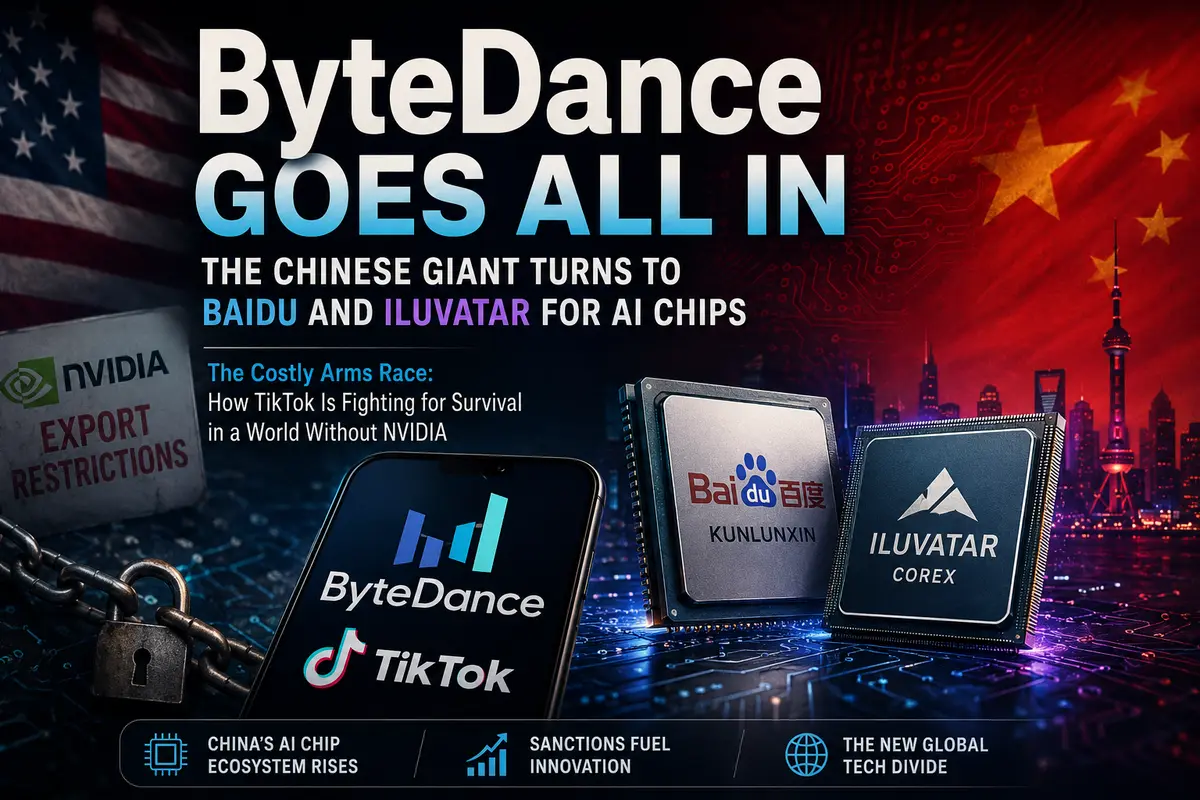
The Costly Arms Race: How TikTok Is Fighting for Survival in a World Without NVIDIA
While the Western world is captivated by U.S.–Iran peace talks and falling oil prices, a quieter but no less dramatic battle is unfolding in China. A battle for chips. A battle for artificial intelligence. A battle for survival in a world where America is cutting off access to the most advanced NVIDIA processors through export restrictions.
On Monday, Reuters reported news that caught the attention of investors across Hong Kong’s technology sector. ByteDance—the parent company of TikTok and owner of the world’s most downloaded app—is in talks to purchase AI chips from two Chinese manufacturers. The first is Iluvatar CoreX, a relatively unknown Shanghai-based company that has largely relied on government contracts. The second is Baidu, the internet giant that has spent years trying to turn its Kunlunxin chip project into an independent business.
The report broke during trading hours, sending Iluvatar CoreX shares (ticker 9903 on the Hong Kong Stock Exchange) up nearly 12% at one point. Although much of those gains were later erased, the message was clear: ByteDance is looking for alternatives, and those alternatives increasingly lead to Chinese chipmakers.
Why does this matter? Because ByteDance is not just another Chinese startup. It is a global phenomenon. TikTok—and its Chinese AI-powered platform Doubao—process terabytes of data, generate billions of AI-related requests, and require enormous computing resources. If ByteDance cannot secure chips, its AI ambitions stall. That is why it is willing to buy hardware from almost anyone—even Baidu, a direct competitor in online advertising and search.
Let’s take a closer look at what these negotiations mean, who Iluvatar and Baidu Kunlunxin are, and why this potential deal could reshape the AI landscape.
Iluvatar CoreX: Shanghai’s Dark Horse
For most people, the name Iluvatar CoreX means very little—and that is understandable. Founded in 2016 (according to some reports, slightly earlier), the company remained in the shadow of better-known competitors such as Huawei’s Ascend division, Cambricon, and Baidu.
However, Iluvatar has one important advantage: its chips are believed to be less vulnerable to U.S. sanctions. Built around technology derived from Imagination Technologies, a British company not subject to the same U.S. export restrictions, Iluvatar’s processors can reportedly be manufactured in China with a lower risk of triggering sanctions-related disruptions.
If the ByteDance deal goes through, Iluvatar would become the company’s third major domestic GPU supplier after Huawei and Cambricon. ByteDance is reportedly evaluating Iluvatar’s chips primarily for inference workloads—that is, running already-trained AI models rather than training new ones.
This distinction matters. Inference is a massive, high-volume business. Training cutting-edge models may require tens of thousands of chips, but serving AI products at scale often requires hundreds of thousands.
According to Reuters, ByteDance could purchase at least 50,000 Iluvatar chips this year. That is an enormous order. For a company that has largely depended on government projects, it would represent a major commercial breakthrough.
Baidu Kunlunxin: The Chip That Was Supposed to Stand on Its Own
The story of Baidu Kunlunxin is a drama in its own right.
Baidu, one of China’s earliest AI pioneers, began developing proprietary AI chips back in 2012. What started as an internal project eventually evolved into a separate business unit, and in recent years Baidu has been working to transform Kunlunxin into a standalone semiconductor company.
In January 2026, just five months before today’s news, Baidu announced plans to spin off Kunlunxin and pursue a listing on the Hong Kong Stock Exchange. The goal was to attract outside investors and demonstrate the unit’s market value.
At the time, Reuters reported that Kunlunxin was valued at approximately 21 billion yuan (around $3 billion). Baidu submitted a confidential filing and was expected to complete the listing during the first half of 2026.
Much has changed since then. Geopolitical tensions, inflation, and market volatility may have slowed those plans. Now, instead of selling its chip business to public investors, Baidu appears to be trying to sell chips directly to ByteDance—its rival in digital advertising.
Tencent, another major competitor of ByteDance, is already among Kunlunxin’s customers. If ByteDance also adopts Baidu chips, it would send a powerful message of confidence. After all, if you are buying chips from a direct competitor, it suggests that viable alternatives are in short supply.
Why Can’t ByteDance Just Buy NVIDIA Chips?
Many observers ask this question, but the answer lies in American policy rather than Chinese economics.
Since 2022, the United States has steadily tightened export controls on advanced semiconductors that could be used for AI development and military applications.
As an American company, NVIDIA cannot freely sell its most powerful GPUs—such as the H100, B100, and B200—to Chinese firms without special licenses. Such licenses are rarely granted and are generally reserved for exceptional cases.
Despite its size and influence, ByteDance cannot legally access these chips at scale. There are, of course, gray-market channels involving intermediaries, third countries, and complex procurement networks. But these routes carry significant risks, including shipment seizures, legal exposure, and reputational damage.
As a result, ByteDance has little choice but to increasingly rely on domestic alternatives—even if they are less powerful, less available, or more expensive.
In May 2026, ByteDance signed another important agreement with Qualcomm. Under that arrangement, Qualcomm will supply specialized ASIC chips for data centers and help ByteDance bring its own custom AI chip into mass production.
Notably, Qualcomm is also an American company. The difference is that its chips are designed to remain below U.S. performance thresholds for export restrictions. In other words, ByteDance can legally buy them, but they are not as capable as the hardware it would ideally obtain from NVIDIA.
Think of it as buying a Kia instead of a Ferrari. It may not be as fast, but it still gets you where you need to go.
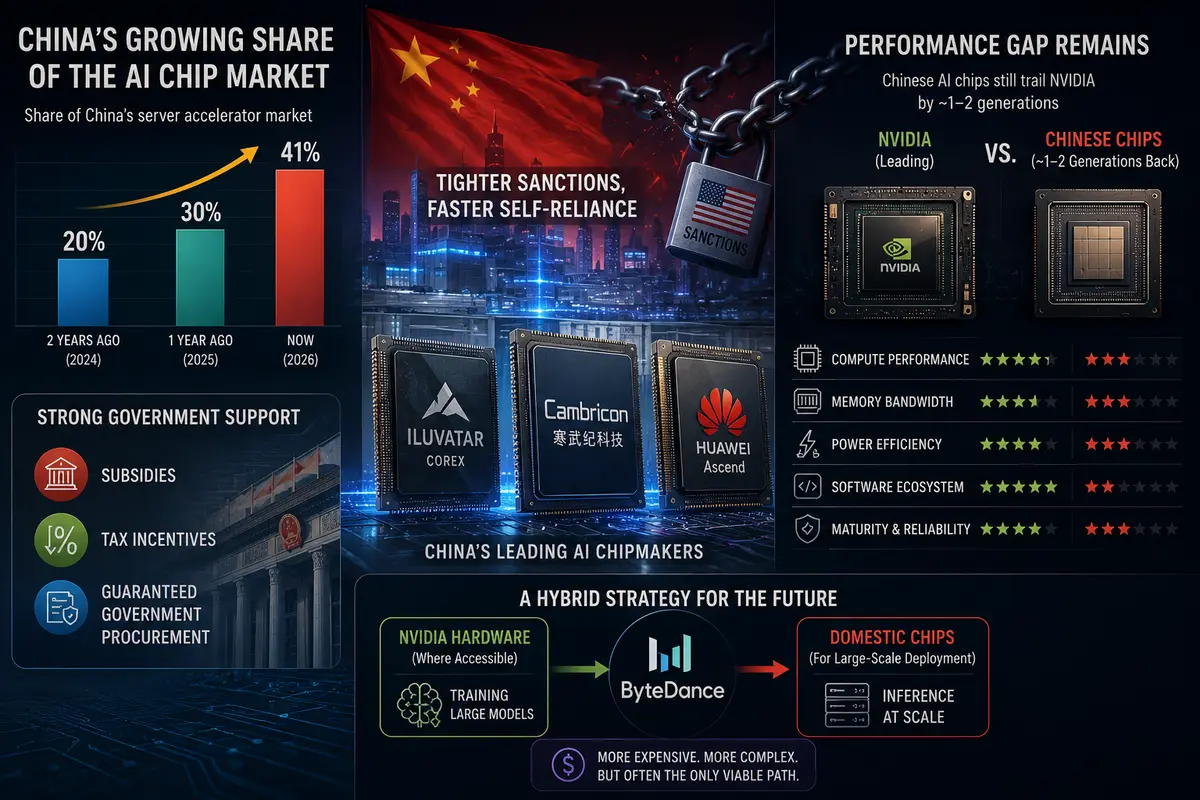
The Bigger Picture: China’s Growing Share of the AI Chip Market
Behind these developments lies a larger trend.
According to industry analysts, Chinese manufacturers now account for roughly 41% of China’s server accelerator market. A year ago, that figure was around 30%. Two years ago, it was closer to 20%.
The trend is unmistakable: the tighter the sanctions, the faster China invests in domestic production.
Beijing has consistently pursued technological self-sufficiency through subsidies, tax incentives, and guaranteed government procurement. Iluvatar itself grew primarily through public-sector contracts involving ministries, state-owned enterprises, and government-backed projects.
Cambricon followed a similar path. Huawei Ascend has become the flagship of China’s semiconductor ambitions despite years of sanctions pressure.
Yet challenges remain—especially performance.
Chinese AI chips still trail NVIDIA’s best products by roughly one or two generations. That does not make them ineffective. For many workloads, including inference, video processing, and recommendation systems, they are more than adequate. But for training the world’s most advanced models—systems comparable to GPT-4 or Gemini—they remain at a disadvantage.
As a result, ByteDance will likely pursue a hybrid strategy: NVIDIA hardware where accessible for training, and domestic chips for large-scale inference deployment.
It is a more expensive and complicated approach, but it may be the only practical option.
What Does This Mean for ByteDance?
ByteDance finds itself in a difficult position.
On one hand, its products—from TikTok and Doubao to recommendation engines—require ever-increasing computational power. On the other hand, access to that power is becoming more constrained.
The company has already invested billions in building data centers and developing proprietary chips. But designing a successful semiconductor is a long-term endeavor. Development takes years, and manufacturing depends on foundries such as TSMC or SMIC—both operating under varying degrees of geopolitical pressure.
In the meantime, ByteDance must buy chips from others.
It already purchases hardware from Huawei and Cambricon. It has reached agreements with Qualcomm. Now it is exploring relationships with Iluvatar and Baidu.
Supplier diversification is itself a strategic decision. By avoiding dependence on a single vendor, ByteDance reduces its exposure to sanctions, shortages, technical failures, or production bottlenecks.
For ByteDance, this is no longer simply about efficiency. It is about survival.
Without chips, there is no AI.
Without AI, there are no recommendation engines.
Without recommendations, user engagement suffers.
Without engagement, advertising revenue declines.
And without advertising revenue, the business model begins to unravel.
What Does This Mean for Baidu and Iluvatar?
For Baidu, a deal with ByteDance would be a significant validation.
Baidu is primarily known as an internet company, and Kunlunxin has long been viewed as an internal initiative rather than a serious commercial semiconductor business. If a major competitor like ByteDance adopts Baidu’s chips, it would signal that Kunlunxin has become a credible market product.
Such validation could also strengthen any future IPO efforts. Investors love large, recognizable customers—and few are larger than ByteDance.
For Iluvatar, the opportunity is even more transformative.
A company that was virtually unknown outside industry circles could suddenly become a critical supplier to one of the world’s most valuable technology firms. While its stock gave back some gains after Monday’s initial rally, investor sentiment remains positive. Many see Iluvatar as a potential successor to Cambricon’s growth story.
Risks: Politics, Technology, and Execution
There are also substantial risks.
First, negotiations remain ongoing. Reuters explicitly noted that discussions continue and deal terms may change. Nothing has been finalized. Iluvatar may ultimately supply 50,000 chips, 10,000 chips, or none at all.
Second, politics remains a wildcard. Washington could expand restrictions if it determines that Iluvatar’s products pose national-security concerns. The company may use British-origin technology, but it remains a Chinese manufacturer. Success often attracts scrutiny.
Third, there is technological risk. Iluvatar’s chips have yet to prove themselves at ByteDance’s scale. Supporting government projects is one thing; powering a global consumer platform is another. Issues involving reliability, energy efficiency, software compatibility, or thermal management could emerge.
Finally, the broader geopolitical backdrop remains unpredictable. Temporary shifts in global attention do not eliminate the underlying U.S.–China technology rivalry. Future administrations in Washington could tighten restrictions further.
Conclusion: The Rise of China’s AI Chip Ecosystem
Monday, June 15, 2026, may ultimately be remembered as another milestone in the maturation of China’s AI semiconductor industry.
ByteDance—a global leader in recommendation systems and artificial intelligence—is reportedly considering purchases from Iluvatar and Baidu. This is more than a business transaction.
It is a political statement: China can increasingly build the chips it needs.
It is a market signal: domestic chipmakers have real customers.
And it is a technological challenge: within five years, the gap between NVIDIA and China’s leading manufacturers may narrow significantly.
For now, however, ByteDance must assemble a complex patchwork of suppliers—Huawei, Cambricon, Qualcomm, Iluvatar, Baidu, and potentially its own future chips.
It is expensive, complicated, and risky.
But there may be no alternative.
A few years ago, technological globalization seemed irreversible. Today, the world is fragmenting into competing ecosystems, each with its own chips, standards, winners, and losers.
ByteDance is betting on Chinese chipmakers.
Iluvatar and Baidu are betting on ByteDance.
And the rest of us will be watching closely, because the stakes are measured not only in billions of dollars, but in the future of artificial intelligence itself.

Comments
No comments yet. Be the first to share your thoughts!
Authentication Required
You must be logged in to post a comment.