
Bar Pipa
We pay for a post of 10$

Metals

BCR

Daily Analysis 10 June 2026 | Markets Brace for CPI as Dollar Holds Firm and Oil Volatility Eases

Daily Analysis 10 June 2026 | Markets Brace for CPI as Dollar Holds Firm and Oil Volatility Eases

Currency & Commodity Analysis:


US Dollar Index


The US dollar fell slightly on Tuesday but remained near its highest level in nearly two months, after Iran and Israel agreed to cease attacks on each other, prompting investors to shift to other currencies. Strong US May jobs data boosted market expectations for a Federal Reserve rate hike, with the market now pricing in a roughly 40% probability of a rate hike before the end of October. Investors increased their long dollar positions and reduced their euro long positions to a three-month low. Last Friday's much stronger-than-expected non-farm payroll report reinforced market expectations that the Fed will maintain high interest rates for an extended period, supporting a stronger dollar. The dollar index is expected to remain firm ahead of the CPI data release. Overall, the divergence in global monetary policy is narrowing—the Fed is holding rates steady, while other major central banks are raising rates or signaling rate hikes. This "US rates unchanged, other countries follow suit" pattern may provide a relative advantage for the dollar in the short term, but it also means that if the Fed is forced to tighten in the future, volatility in global financial markets will further intensify.


On Tuesday, the dollar index traded in a narrow range at high levels, currently hovering around 100.00. On Monday, the dollar index rose and then fell back, briefly reaching a near two-month high of 100.21 during the Asian session due to renewed fighting in the Middle East, but retreated to around the 100 mark after Trump called for a ceasefire. The US dollar index is currently in a strong upward channel on the daily chart. The price has rebounded steadily from the May low of 97.62, recently rising to near the 100 mark and approaching the...

Continue reading...
0
0

Oil Pulls Back: Middle East Ceasefire Cools the Market, but It’s Too Early to Relax

Oil Pulls Back: Middle East Ceasefire Cools the Market, but It’s Too Early to Relax
Tuesday Morning: Black Gold Gets Cheaper, but Doesn’t Fall Off a Cliff

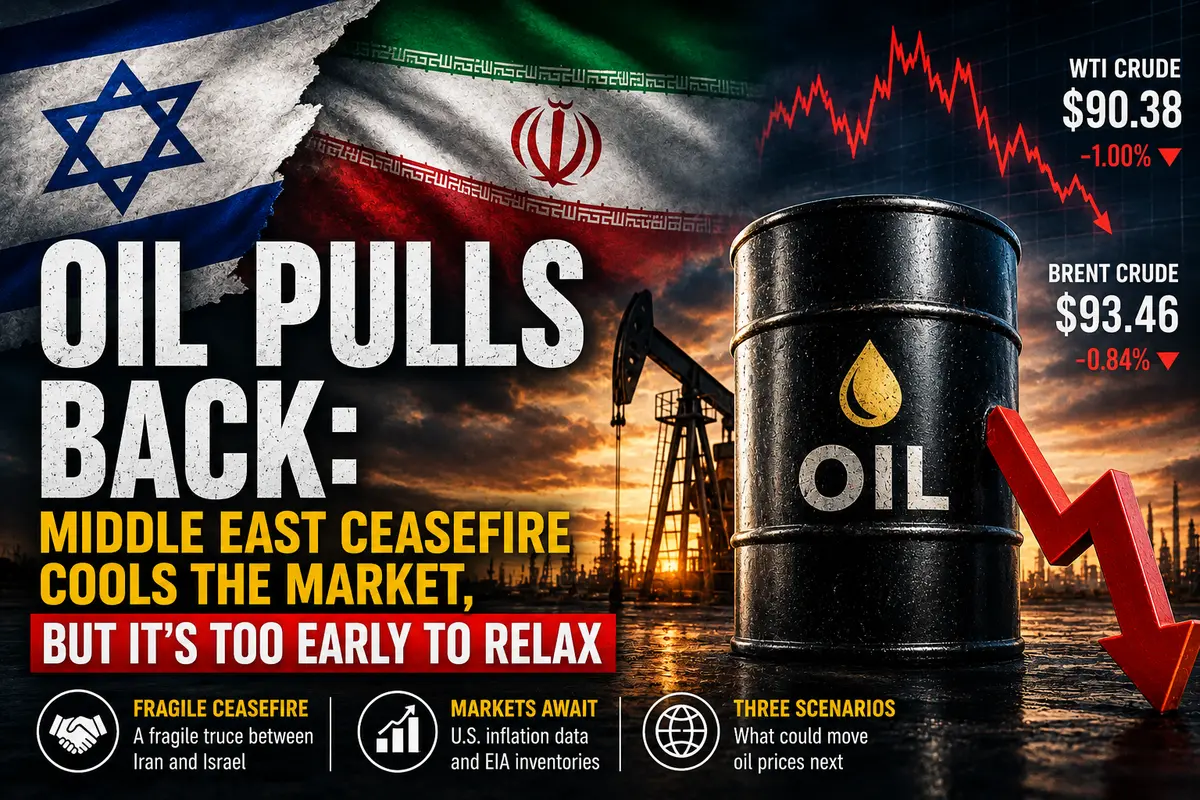
On Tuesday morning, oil traders could finally sip their coffee without their hands shaking. After the wild swings over the weekend, when Iran and Israel exchanged missile strikes and crude prices surged dramatically, a period of relative calm arrived. Futures for WTI crude oil—the benchmark for the U.S. market and beyond—moved lower. At the time of writing, a barrel was trading at $90.38, down 1% from the previous close.

At first glance, a one-percent decline may seem insignificant. But behind that single percentage point lies an entire story: negotiations behind closed doors, diplomatic maneuvering by Donald Trump, a fragile ceasefire between two countries that only yesterday appeared ready to tear each other apart, and, of course, the ever-present fears surrounding the Strait of Hormuz.

On Monday, oil prices soared. WTI climbed above $93, while Brent nearly reached $96. Markets were pricing in the worst-case scenario—a blockade of the Strait of Hormuz, a full-scale regional war, and gasoline prices in the United States rising to $5–6 per gallon. By Monday evening, however, the first signs emerged that catastrophe might be avoided. Then, on Tuesday morning, confirmation arrived: the parties had agreed to halt attacks—at least for now.

Oil markets reacted immediately. WTI slipped to $90.38, while Brent fell to $93.46. The spread between the two benchmarks stood at $3.08 per barrel in favor of Brent—a historically normal range and nothing extraordinary.

Yet beneath the surface calm, many sources of concern remain.

Donald Trump Promises “Total Victory” — But What Does That Mean?

On Monday evening, as Asian markets opened and U.S. markets were still trading, President Donald Trump made a statement that quickly spread across financial media. According to Trump, the United States...

Continue reading...
0
0

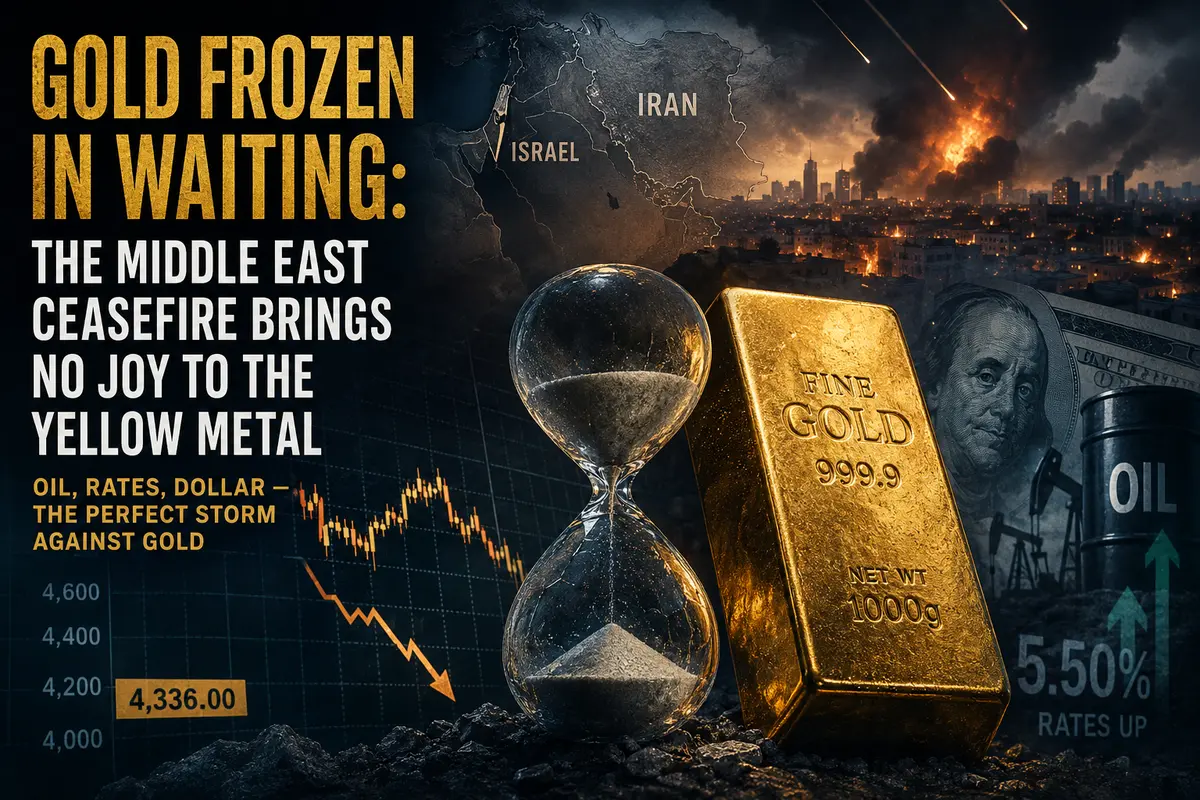
Gold Frozen in Waiting: The Middle East Ceasefire Brings No Joy to the Yellow Metal

Gold Frozen in Waiting: The Middle East Ceasefire Brings No Joy to the Yellow Metal
A Strange War in Which Gold Is Losing

There is a deeply rooted, almost archetypal belief: when the world is falling apart, when missiles fly, tanks fire, and politicians threaten one another with destruction, you buy gold. The yellow metal has been tested by centuries. It survived the fall of Rome, the plague, world wars, and the hyperinflation of the Weimar Republic. A war in the Middle East? Surely that means rushing to jewelry stores and coin dealers.

Not this time.

Reality has once again proven more complicated than the simplified lessons found in economics textbooks. The conflict between Iran and Israel, which flared up again on Sunday with missile exchanges and airstrikes, has brought gold nothing but another round of pain. On Tuesday morning, gold was trading near an 11-week low. Spot prices stood at $4,336 per ounce, up just 0.2%—not nearly enough to recover Monday’s losses. August futures were at $4,361, virtually unchanged.

What kind of war is this, where the traditional safe-haven asset falls instead of rising? And why has the ceasefire, which should theoretically calm markets and reduce demand for safe-haven assets, left gold almost exactly where it was?

As is often the case, the answer lies in three interconnected factors: oil, interest rates, and the U.S. dollar. Together, they are working against gold almost perfectly.

The Oil Paradox: The Worse It Is for the World, the Worse It Is for Gold

Let’s break it down.

Iran and Israel exchanged strikes. Iran launched missiles into northern Israel. Israel conducted airstrikes on Beirut suburbs where, according to its intelligence, Iranian assets were located. Whenever conflict erupts in the Middle East, markets immediately become nervous about oil.

The Strait of Hormuz, through which roughly one-fifth of global oil exports pass, is within range of Iranian missiles and naval...

Continue reading...
0
0

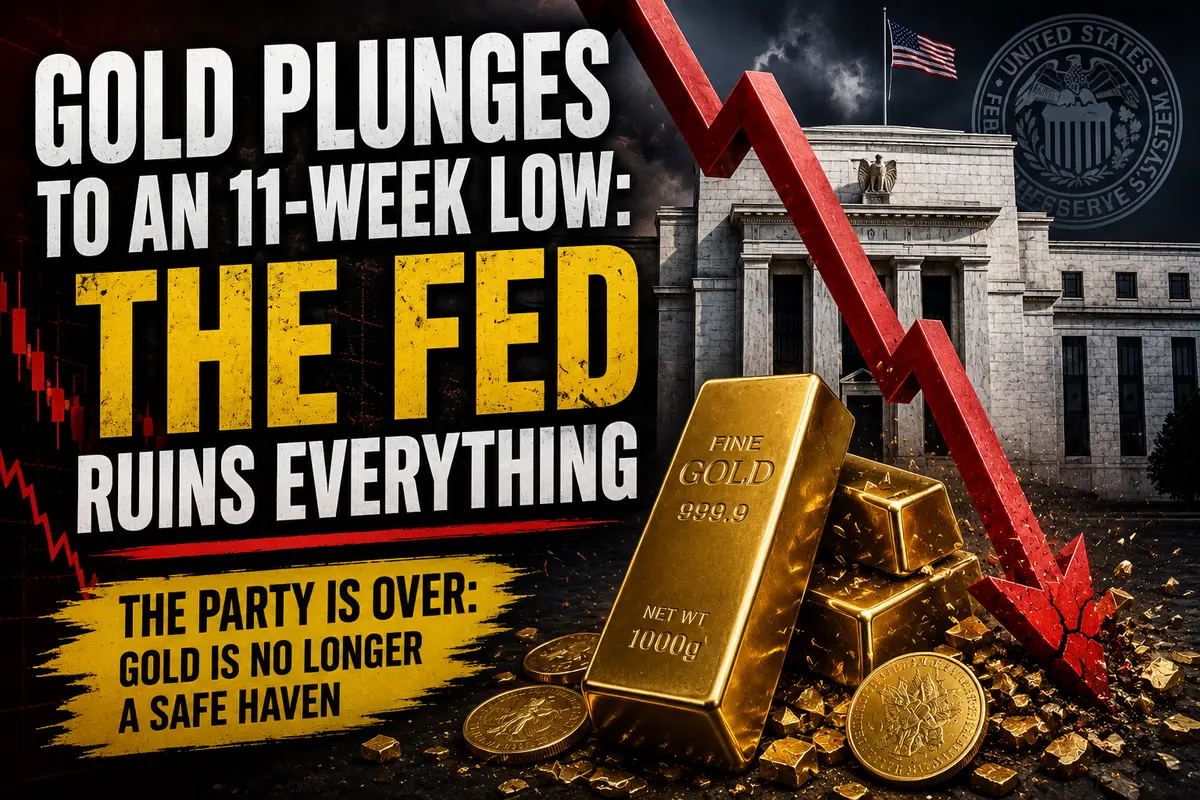
Gold Plunges to an 11-Week Low: The Fed Ruins Everything Again

Gold Plunges to an 11-Week Low: The Fed Ruins Everything Again
The Party Is Over: The Yellow Metal Is No Longer a Safe Haven

Just a couple of weeks ago, it seemed that gold was on the verge of breaking through its all-time highs and shooting to the moon. Investors were snapping up bullion like crazy, jewelry stores in Dubai and Singapore couldn't restock their displays fast enough, and millionaire YouTubers were passionately proclaiming that "the dollar is about to collapse, and the only safe haven left is gold."

And what happened in the end?

On Monday morning, gold fell to its lowest level in the past eleven weeks.

The spot price—the price at which the metal can be bought right now for immediate delivery—dropped to $4,312 per ounce, down 0.4% during a few hours of Asian trading. And that's after Friday's selloff, when gold lost more than 3% in a single day. This is no longer just a correction—it is beginning to look like a full-scale retreat.

U.S. gold futures—the contracts traded by professional speculators and hedge funds—fell to $4,337 per ounce, down another 0.7%. Doesn't sound catastrophic? Perhaps. But when you look at the monthly chart, it becomes unsettling. As recently as mid-May, gold was trading around $4,600, and everyone was predicting a rapid move to $5,000. Now it's at $4,312. And according to whispers among traders, this may only be the beginning.

The Fed Strikes Again: Jobs Data Changed Everything

So what happened?

Why are investors who were practically kissing gold bars yesterday suddenly turning their backs on them today?

The answer is simple and painfully predictable: the U.S. economy once again proved the pessimists wrong.

On Friday, the May labor market report was released. Economists, as usual, built forecasts, ran spreadsheets, and drew elegant charts. Most expected the economy to create around 120,000–130,000 new jobs....

Continue reading...
0
0

Oil Prices Surge: Iran Strikes, the Truce Collapses, and Markets Are Shaken

Oil Prices Surge: Iran Strikes, the Truce Collapses, and Markets Are Shaken
A Missile Strike That Shattered a Fragile Peace

The calm that lasted only a few weeks vanished in an instant. Late Sunday night, as most residents of Tel Aviv were preparing for bed, fiery trails of Iranian missiles lit up the skies over northern Israel. Israel’s Iron Dome air defense system sprang into action immediately—interceptions, explosions in the sky, sirens, and panic followed. Reports suggest that most of the projectiles were intercepted, but the significance of the attack far outweighed its direct military impact.

Why now? Why would Iran take such a risk? Tehran did not mince words. Iranian officials stated openly that the strike was retaliation for Israeli attacks on the southern suburbs of Beirut. Those operations were reportedly aimed at Iranian assets and proxy forces in Lebanon. One of the strikes hit an area near the Lebanese capital, where, according to Iranian authorities, advisers from the Islamic Revolutionary Guard Corps (IRGC) were among those killed.

Israel responded in its usual uncompromising manner, warning that the attack would not go unanswered. The message from Israeli military officials was essentially: “If we are attacked, we respond ten times harder.” Once again, the region appears to be standing on the edge of a broader conflict.

Perhaps most alarming is that the ceasefire reached in April—painstakingly negotiated by diplomats and viewed by many as a lifeline—now looks little more than a piece of paper. This is the most serious incident since the truce was signed. Hopes for diplomacy have dissipated faster than the smoke from the intercepted missiles.

Oil Markets React in Panic: The Numbers Speak for Themselves

As Asian markets opened on Monday morning, traders wasted no time reacting.

Brent crude futures, the global benchmark for oil prices, jumped 2.6% to $95.49 per barrel. U.S. benchmark WTI crude rose 2.4%...

Continue reading...
0
0

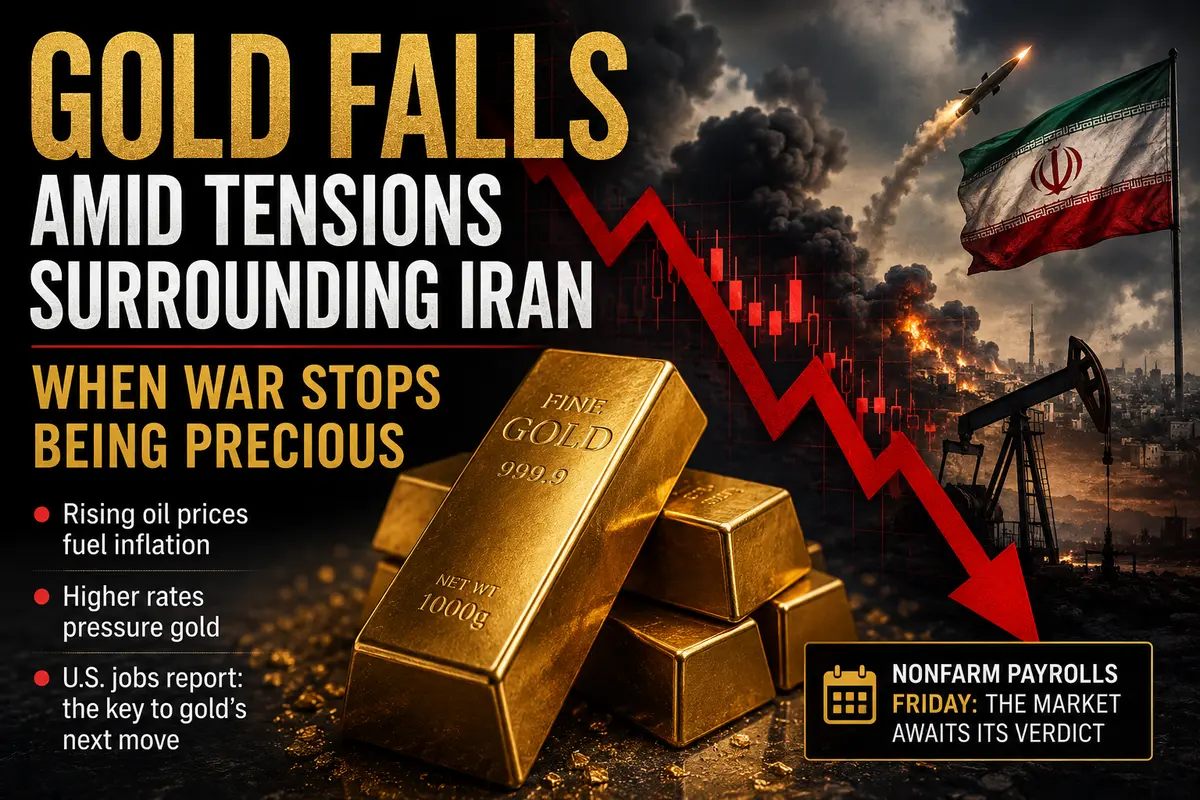
Gold Falls Amid Tensions Surrounding Iran

Gold Falls Amid Tensions Surrounding Iran
When War Stops Being Precious

Friday began on a disappointing note for precious metals markets in Asia. Gold, which has already been struggling this week, moved lower once again. Spot gold fell 0.8% to $4,440.84 per ounce, while futures declined by the same margin to $4,467. And this is happening even as the Middle East remains engulfed in conflict.

At first glance, war, missile strikes, military operations, and stalled negotiations should provide the perfect environment for gold to rally. Investors are traditionally expected to flock to the yellow metal as a safe haven. That is how it has always worked. That is what textbooks teach. That is what market logic suggests. But not today—and not this week.

The paradox has a simple explanation. The conflict between the United States and Iran, which has been ongoing for several months, has ceased to be a source of uncertainty. Instead, it has become a source of inflation. And inflation means higher interest rates. Higher interest rates, in turn, are a major headwind for gold.

Gold is down approximately 2.2% for the week, marking its worst performance since early May. The reason is not the absence of geopolitical risks, but rather their abundance. The market is no longer afraid of war itself. It is afraid of what war does to oil prices and, through oil, to inflation and interest rates.

Let’s examine how a conflict in the Middle East has become a bearish factor for gold—and what may lie ahead for the yellow metal following the release of key U.S. employment data.

Middle East: Hope Is Gone, Long Live Inflation

Developments in the Middle East have been rapid and, for those hoping for peace, discouraging. Hopes for a U.S.–Iran agreement, which still seemed realistic earlier in the week, had all but vanished by Friday.

...

Continue reading...
0
0

WTI Crude Oil Futures Rise in Asian Trading

WTI Crude Oil Futures Rise in Asian Trading
A Morning That Began with Hope

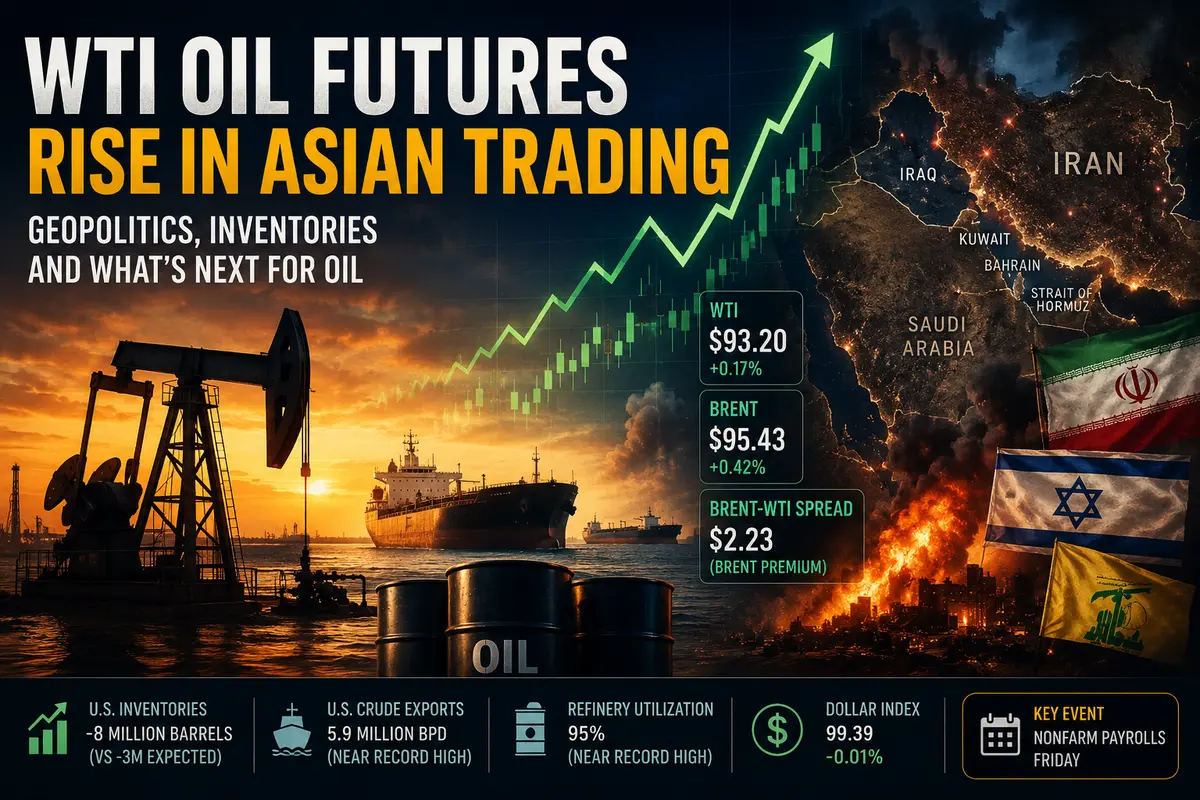
Friday’s Asian oil markets opened with cautious but steady gains. Futures for West Texas Intermediate (WTI) crude oil, the primary benchmark for the U.S. market and beyond, rose 0.17% to $93.20 per barrel. It is hardly a spectacular rally—just seventeen hundredths of a percent, more of a tremor than a surge. But after several days of volatile price swings, traders are willing to welcome any green number on their screens.

The European benchmark, Brent crude, appeared somewhat stronger. The August Brent contract gained 0.42%, climbing to $95.43 per barrel. The price spread between Brent and WTI widened to $2.23 per barrel in Brent’s favor. A week ago, the spread was narrower, below $2. The widening gap suggests that geopolitical risks concentrated around key Brent supply routes continue to weigh more heavily on Brent than on WTI, which is produced in the relatively secure environment of Texas.

The U.S. dollar, which has pressured commodity markets in recent days, weakened slightly on Friday morning. The U.S. Dollar Index futures slipped 0.01% to 99.39. The decline is tiny and almost imperceptible, but even such a modest move gives oil prices some breathing room.

The technical picture remains tense. WTI support stands at $88.45, a level sellers failed to break in recent sessions. Resistance is located at $97.00. With WTI trading at $93.20, prices sit roughly in the middle of that range, leaving traders with room for maneuver.

The key question is what will trigger the next move. Geopolitics? U.S. inventory data? Or perhaps long-awaited news regarding negotiations between Iran and the United States? As usual, Asian traders were the first to react and have already begun positioning themselves ahead of developments.

Middle East: The Calm Before the Storm

The geopolitical backdrop remains the...

Continue reading...
0
0

XAUUSD Technical Outlook – 4 June 2026

XAUUSD Technical Outlook – 4 June 2026


Descending channel, the dominant structure since February peak

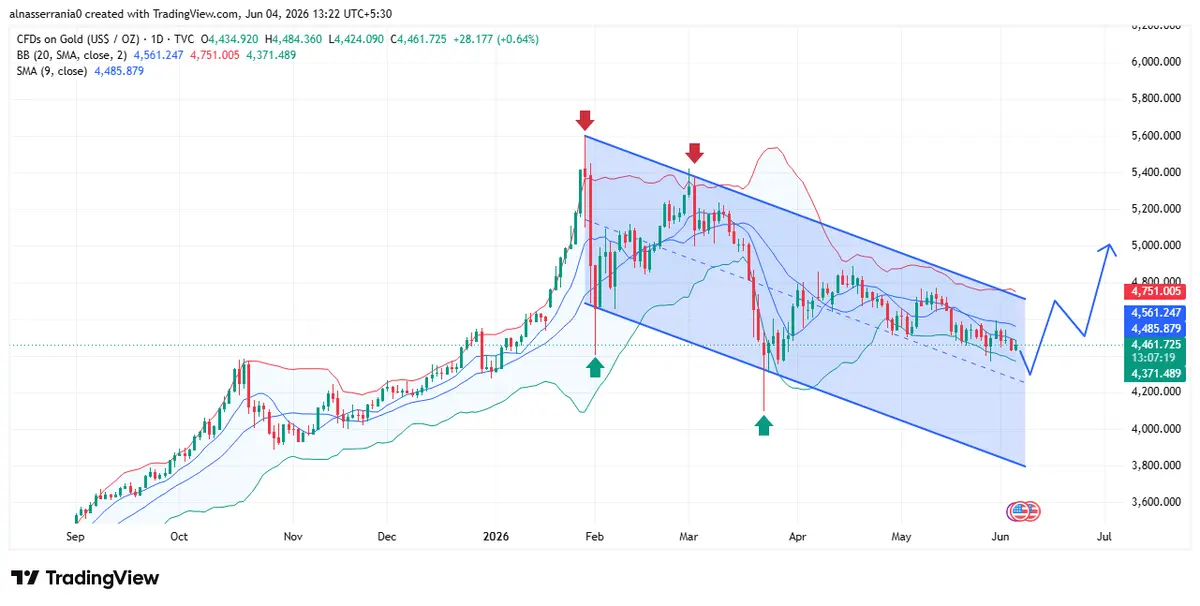
Gold peaked sharply near $5,500+ in early February 2026 and has been carving a clear descending channel (drawn in blue on the chart) ever since. Both the upper and lower channel lines are well-respected, price has tested both boundaries multiple times. The channel is sloping down from top-right to bottom-left, which tells you the sellers have been in control for 4+ months

Price is sandwiched, squeezed between channel support and SMA9

At $4,461, price is sitting right at the lower boundary of the descending channel a historically significant bounce zone. Both prior green arrows on the chart (February and March) marked rebounds from this exact region. The SMA9 ($4,485) is overhead acting as immediate dynamic resistance. Price needs to close above SMA9 on a daily basis to even hint at recovery. Until that happens, this is a range-bound squeeze with downside risk still alive.

Key Levels to watch

Channel top / BB upper - $4,751 Major resistance — unlikely near-term

SMA20 midline - $4,561 Bears defend this level

SMA9 dynamic resistance - $4,485 Immediate ceiling today

Current price - $4,461 At channel lower support

BB lower / channel floor - $4,371 Critical support — bounce or break

Breakdown target - $3,800 If $4,371 fails decisively

Continue reading...
0
0

WTI Crude Oil Futures Fall During Asian Trading

WTI Crude Oil Futures Fall During Asian Trading
A Morning That Started in the Red

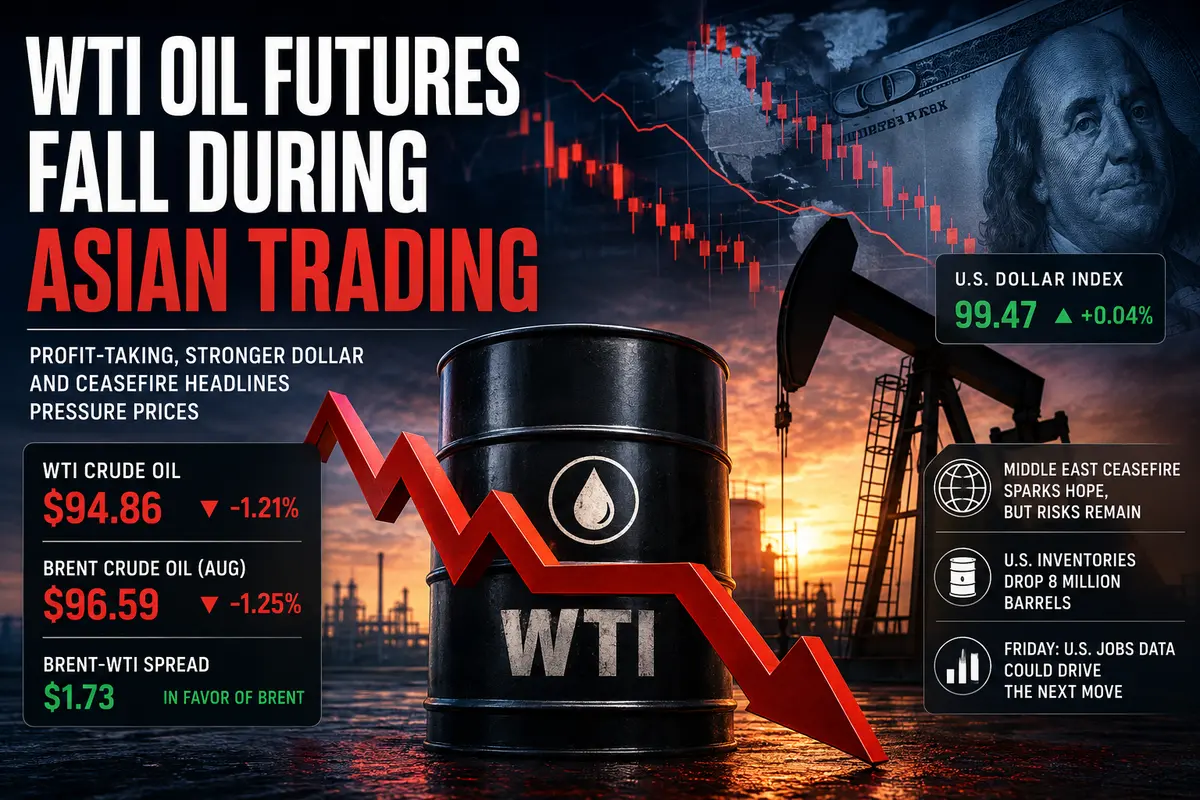
Thursday’s Asian trading session delivered a cold shower for oil bulls. Futures on West Texas Intermediate (WTI) crude oil, the benchmark for the U.S. market, moved into negative territory. And not just slightly—at the time of writing, WTI was down 1.21%, trading at $94.86 per barrel.

For traders accustomed to volatility, a one-percent move is hardly dramatic. But context matters. Just a day earlier, oil had posted its third consecutive session of gains. Market participants were beginning to embrace the idea that crude was back in favor, with geopolitics and tightening inventories providing strong support. Then came the pullback—not a crash, but sharp enough to make investors pause.

The decline coincided with a stronger U.S. dollar. The U.S. Dollar Index futures, which track the greenback against a basket of six major currencies, rose 0.04% to 99.47. It may seem insignificant, but in currency markets even small moves matter. When the dollar strengthens, oil—priced in dollars—typically becomes more expensive for foreign buyers, putting downward pressure on prices. The inverse correlation remains intact even on days when geopolitical headlines suggest higher oil prices.

Brent crude, the European benchmark, also came under pressure. August Brent futures fell 1.25% to $96.59 per barrel. The price spread between Brent and WTI narrowed to $1.73 in favor of Brent. Just a week ago, the spread was above $2. A narrowing spread suggests that U.S. crude is appreciating relative to its European counterpart, reflecting shifts in global supply flows.

The technical picture also offers food for thought. WTI has established support at $86.35 per barrel—a level sellers failed to break during previous sessions. Resistance stands at $96.98. With the current price at $94.86, the market sits roughly in the middle of that range. Traders looking at the charts see upside...

Continue reading...
0
0

Gold Rises After Lebanon Ceasefire; U.S. Labor Market Data in Focus

Gold Rises After Lebanon Ceasefire; U.S. Labor Market Data in Focus
The Yellow Metal Finds a Reason to Climb

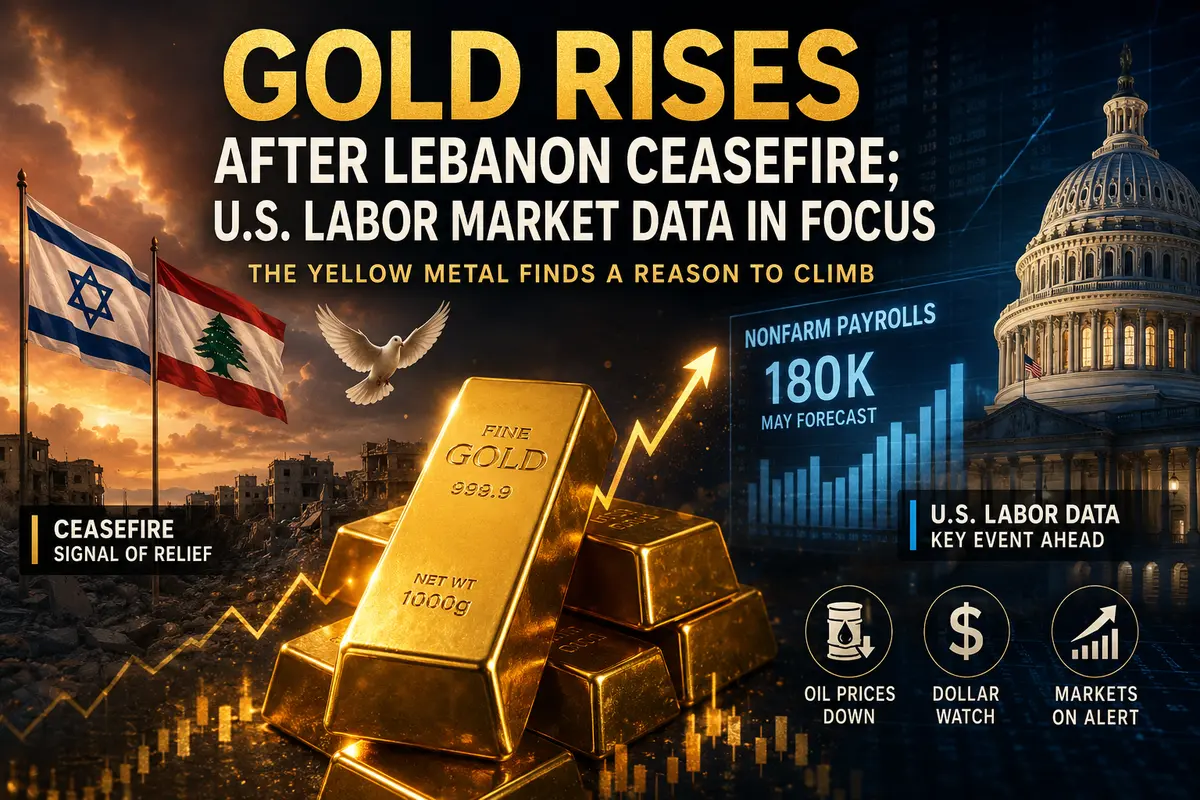
Thursday began with cautious optimism for gold. Spot gold gained just over half a percent, rising to $4,460 per ounce. Futures followed the same path, up 0.5% to $4,486. These are not record highs, but they are welcome gains—especially after Wednesday, when gold lost more than 1% under pressure from a stronger U.S. dollar.

What changed overnight? First, geopolitics. Second, expectations. Both factors worked in favor of the yellow metal.

The geopolitical backdrop remains complicated, but the first signs have emerged that the worst may be behind us. Late Wednesday, Washington announced a ceasefire agreement between Israel and Lebanon. The wording was cautious—the deal depends on Hezbollah halting hostilities—but the fact that diplomats managed to reach an agreement after talks appeared stalled only a day earlier is a meaningful signal.

Investors took notice. Oil, which had been rising this week on fears of supply disruptions, moved lower on Thursday morning. Crude prices fell after three consecutive days of gains. Lower oil prices mean lower inflation expectations. Lower inflation expectations ease pressure on central banks, reducing the need for aggressive anti-inflation measures.

Still, it is too early to relax. The Middle East conflict has not disappeared—it has merely cooled somewhat. Reports of Iranian missile strikes on Kuwait and Bahrain from Wednesday remain relevant, as do U.S. strikes on Iran’s Qeshm Island in the Strait of Hormuz. Israeli military operations in southern Lebanon also continue.

The ceasefire between Israel and Lebanon is important, but it is only one piece of a much larger puzzle. Iran remains the primary source of concern, while Hezbollah remains an unpredictable player. As a result, gold is moving higher, but without euphoria—cautiously and with one eye on the risks.

U.S. Economic Data: Two Sides of the Same...
Continue reading...
0
0
Navigation menu
instaforex banner