

Gold Plunges to an 11-Week Low: The Fed Ruins Everything Again
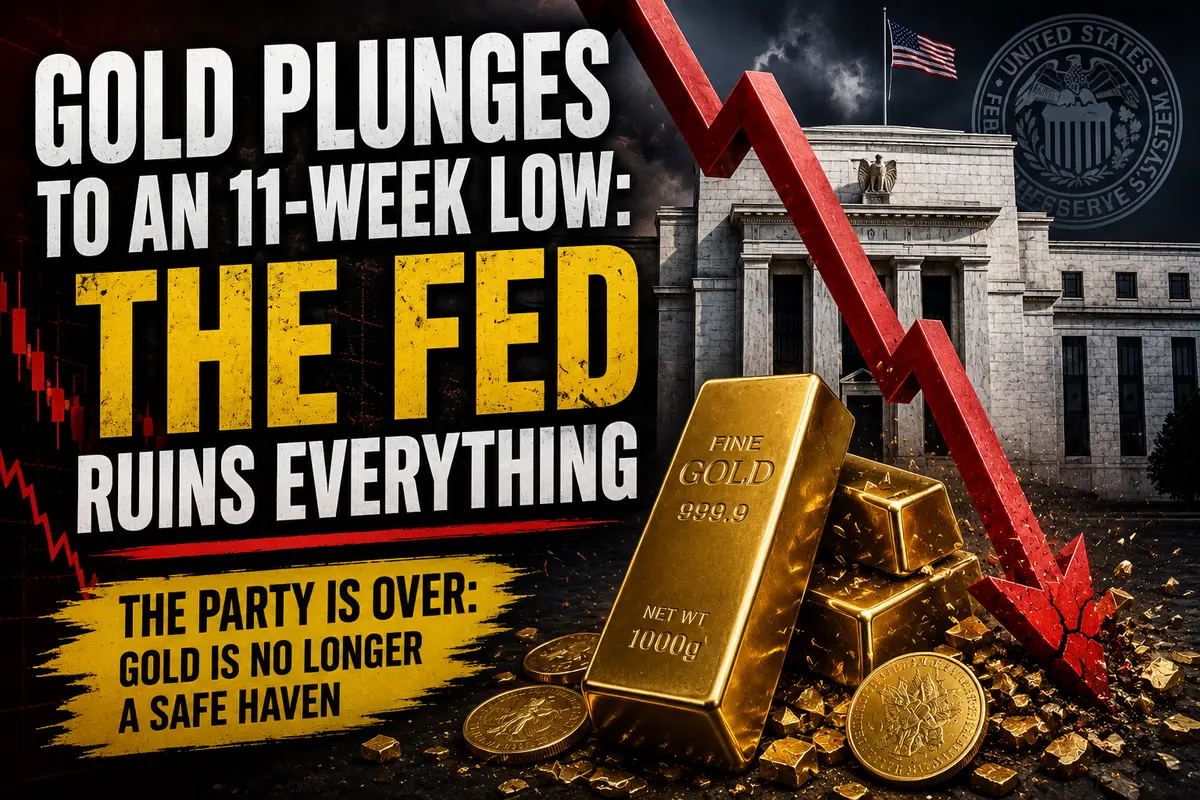
The Party Is Over: The Yellow Metal Is No Longer a Safe Haven
Just a couple of weeks ago, it seemed that gold was on the verge of breaking through its all-time highs and shooting to the moon. Investors were snapping up bullion like crazy, jewelry stores in Dubai and Singapore couldn’t restock their displays fast enough, and millionaire YouTubers were passionately proclaiming that “the dollar is about to collapse, and the only safe haven left is gold.”
And what happened in the end?
On Monday morning, gold fell to its lowest level in the past eleven weeks.
The spot price—the price at which the metal can be bought right now for immediate delivery—dropped to $4,312 per ounce, down 0.4% during a few hours of Asian trading. And that’s after Friday’s selloff, when gold lost more than 3% in a single day. This is no longer just a correction—it is beginning to look like a full-scale retreat.
U.S. gold futures—the contracts traded by professional speculators and hedge funds—fell to $4,337 per ounce, down another 0.7%. Doesn’t sound catastrophic? Perhaps. But when you look at the monthly chart, it becomes unsettling. As recently as mid-May, gold was trading around $4,600, and everyone was predicting a rapid move to $5,000. Now it’s at $4,312. And according to whispers among traders, this may only be the beginning.
The Fed Strikes Again: Jobs Data Changed Everything
So what happened?
Why are investors who were practically kissing gold bars yesterday suddenly turning their backs on them today?
The answer is simple and painfully predictable: the U.S. economy once again proved the pessimists wrong.
On Friday, the May labor market report was released. Economists, as usual, built forecasts, ran spreadsheets, and drew elegant charts. Most expected the economy to create around 120,000–130,000 new jobs. Maybe a little more, maybe a little less—normal fluctuations.
Instead, the number came in at 172,000 jobs.
Nearly one-third above even the boldest forecasts.
The unemployment rate? It remained at 4.3%. No deterioration whatsoever, despite months of warnings from bearish analysts.
The U.S. economy continues to hum like a well-oiled machine.
For most people, that’s good news.
For gold, it’s a disaster.
A strong labor market means only one thing: the Federal Reserve has no reason to rush into cutting interest rates. In fact, it may eventually have to raise them again.
And here a simple piece of logic comes into play—one that many investors consistently forget.
Gold produces no income.
Zero interest.
Zero dividends.
Zero coupons.
You buy a gold bar, put it in a vault, and hope the price rises.
But if U.S. Treasury bonds are paying 5–6% annually, why hold gold at all? Why not buy government bonds and earn a guaranteed return?
That’s exactly what traders did after Friday’s report.
They dumped gold and moved into dollars and Treasury bonds.
Ten-year Treasury yields surged. The U.S. dollar climbed to a two-month high.
Gold had nowhere to go but down.
ING Analysts: The Market Is Already Pricing in a Rate Hike
An important side note.
Analysts at ING, the Dutch banking giant, recently made a striking observation: the market is now fully pricing in a rate hike at the Federal Open Market Committee (FOMC) meeting in December.
Think about that for a moment.
Just a month ago, everyone was expecting rate cuts.
People talked about a “soft landing,” claiming the Fed had beaten inflation and would soon begin easing policy to avoid choking economic growth.
Now?
The discussion has shifted to a rate increase.
In December.
Right before Christmas.
Instead of gifts, the Fed could deliver another round of monetary tightening.
Of course, there are nuances. Labor market data doesn’t tell the whole story. Some economists point out that job figures are often revised downward later. Others argue that many of the new jobs are low-paying service-sector positions.
But the market isn’t paying attention to those details right now.
The market sees 172,000 jobs and draws its conclusions.
And those conclusions are devastating for gold.
Because if rates move higher—and that increasingly seems likely—the opportunity cost of holding gold rises even further.
Holding a metal that pays nothing while bonds yield 6% or more simply becomes unattractive.
The Oil Surprise: Iran and Israel Are Back in Focus
If you think the Fed is solely responsible for gold’s decline, there’s another factor worth considering.
Iran and Israel.
For decades, Middle Eastern tensions have been one of gold’s best friends.
But this time, the script has changed.
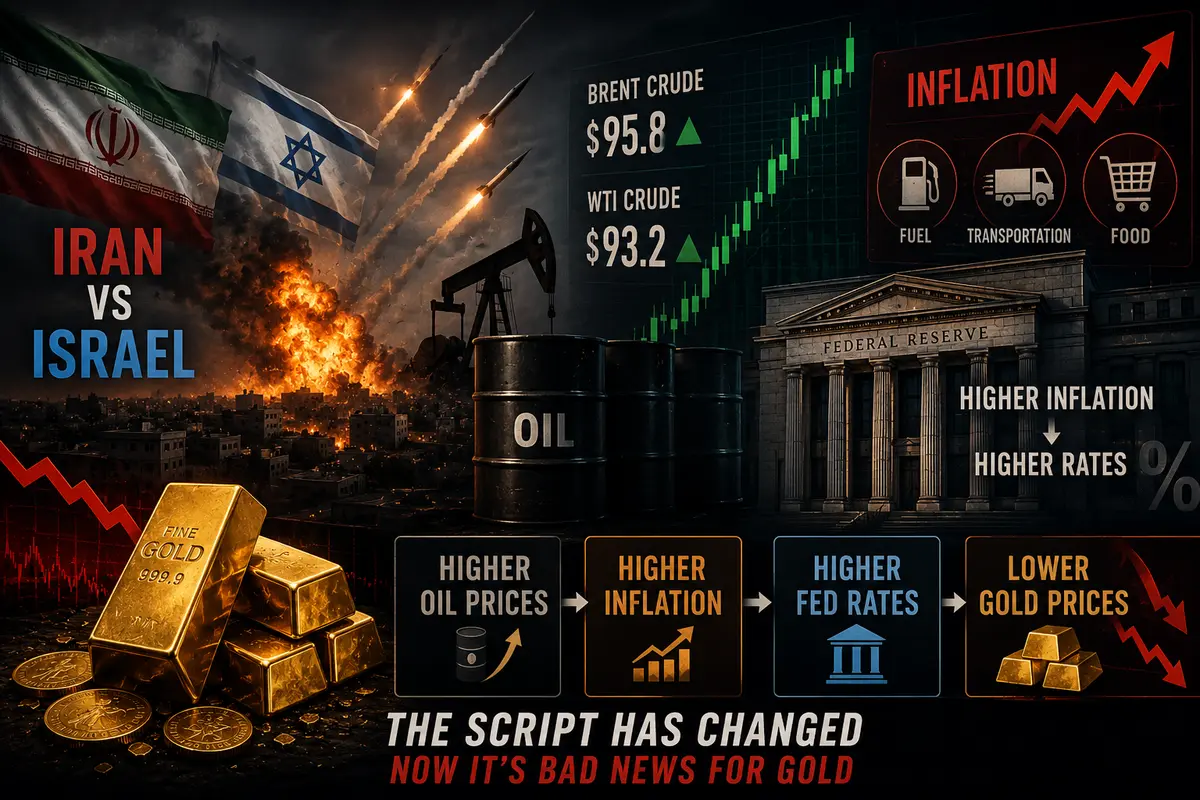
Iran launched several missile strikes against Israel in response to Israeli operations near Beirut. The fragile April ceasefire appears to be breaking down, if not collapsing entirely.
Naturally, oil prices surged.
Brent crude is approaching $96 per barrel, while U.S. WTI has climbed above $93.
Normally, geopolitical chaos would be bullish for gold.
After all, gold has traditionally been the ultimate safe-haven asset.
Wars, terrorist attacks, revolutions—gold usually rises when the world catches fire.
But this time, the opposite happened.
Why?
Because higher oil prices mean higher inflation.
More expensive fuel.
More expensive transportation.
More expensive food.
And if inflation starts accelerating again, the Fed will have even less room to cut rates.
Instead, policymakers may need to tighten further.
The equation suddenly becomes:
Higher oil prices = Higher inflation = Higher Fed rates = Lower gold prices.
Everything has been turned upside down.
Middle Eastern conflict used to be good news for gold.
Now it’s bad news.
Because the dominant market driver today is not geopolitics—it is U.S. monetary policy.
The Dollar Is Gold’s Biggest Enemy
While gold struggles, the U.S. dollar is thriving.
The Dollar Index—a basket of six major world currencies—held near a two-month high on Monday after surging on Friday.
The logic is straightforward:
-
Strong economy = Strong dollar
-
High interest rates = Strong dollar
-
Strong dollar = Weak gold
Gold is priced in dollars.
When the dollar appreciates, gold becomes more expensive for buyers using other currencies, reducing international demand.
What’s particularly remarkable is that gold is falling despite rising geopolitical tensions.
Usually, investors flock to gold during periods of uncertainty.
This time, they are flocking to the dollar.
Because the United States is showing strength.
Economic growth remains solid.
The labor market remains resilient.
The Fed remains firmly in control.
Meanwhile, Europe is flirting with recession, and China’s post-pandemic recovery continues to disappoint.
So for now, the dollar is celebrating—and gold is suffering.
Silver, Platinum, and the Rest: Everyone Is Sinking Together
Gold is not alone.
The entire precious metals sector is under pressure.
Silver, often called “gold’s poorer cousin,” fell 0.8% to $67.32 per ounce.
Platinum, which depends more heavily on industrial demand, dropped 0.6% to $1,770 per ounce.
There is no safe corner of the metals market.
Traders are exiting across the board.
The reasoning is the same everywhere: if rates stay high or move higher, assets that generate no yield become less attractive.
Even silver’s strong industrial applications—in solar panels, electronics, and medicine—have not been enough to offset the macroeconomic headwinds.
Platinum faces an additional challenge.
Its demand is closely linked to the automotive industry, particularly catalytic converters. As electric vehicles continue to gain market share, platinum demand has been declining for years.
Its current weakness is therefore both cyclical and structural.
What’s Next? June, July, August—A Summer Without Hope?
What should gold investors expect?
The unpleasant answer is probably more downside.
At least until the Fed signals a clear policy shift.
And such signals do not appear imminent.
The next Fed meeting is in June.
Rates will most likely remain unchanged.
But the tone of the meeting will matter enormously.
If Jerome Powell and his colleagues indicate that further hikes remain possible, gold could face another sharp selloff.
If they hint at a pause—or even eventual cuts—gold may enjoy a modest rally.
However, after Friday’s labor market data, expectations for a dovish message have fallen dramatically.
The market now expects tough talk.
And gold is preparing for new lows.
The much-discussed $5,000 target that seemed plausible in April now looks almost comical.
Too far away.
Too optimistic.
Too detached from reality.
Gold may test $4,200 or even $4,100 if the dollar continues strengthening.
Yes, geopolitical risks remain.
Iran and Israel are serious concerns.
But the market isn’t focused on them.
The market is focused on the Fed, inflation, and interest rates.
And for now, none of those factors favor gold.
The Only Ray of Hope (And It’s a Thin One)
Still, the situation is not entirely one-sided.
There is one bullish argument for gold that major bank analysts continue to discuss quietly.
What if the Fed makes a mistake?
What if policymakers tighten too aggressively?
What if the U.S. economy begins to stumble despite its strong labor market?
What if a bubble bursts—whether in real estate, bonds, or corporate debt?
In that scenario, the Fed would be forced to reverse course and slash rates.
And then gold could soar like never before.
Because the combination of:
-
Falling interest rates
-
Market panic
-
Geopolitical turmoil
would create the perfect storm for the yellow metal.
The only question is whether that scenario will actually happen—and when.
For now, there are few signs of trouble.
The labor market remains strong.
Consumer spending is holding up.
Businesses remain confident.
Yet history teaches us that major crashes often arrive precisely when nobody expects them.
Until then, gold continues to fall.
And it is falling hard.
Traders no longer believe in miracles.
Investors are locking in losses.
Bullion dealers in Dubai stare sadly at empty showrooms.
For gold enthusiasts, the summer of 2026 is off to a painful start.
And at the moment, there is no clear end to the decline in sight.

Comments
No comments yet. Be the first to share your thoughts!
Comments only for logged-in users.