

Meta Delays Release of New AI Model for Developers
Promises That Haven’t Materialized
The world of artificial intelligence has grown accustomed to a relentless pace. Every week brings a new breakthrough. Every month sets a new benchmark. Companies compete to launch smarter models, more convenient APIs, and cheaper tokens. In this race, Meta Platforms has occupied the position of a confident middle-ground player—not the fastest, but not the slowest either.
Until now.
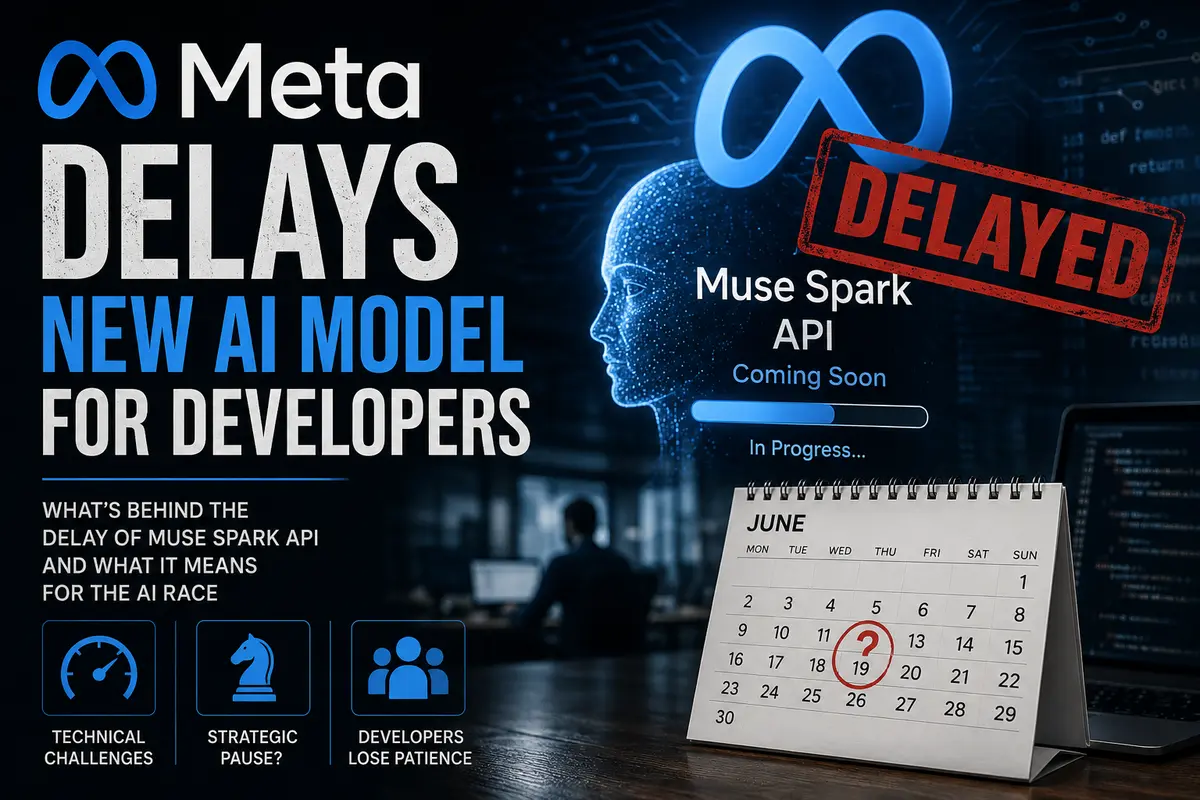
According to information published by The Wall Street Journal on Wednesday, Meta has repeatedly postponed the release of its latest AI model for developers. The delay has stretched to nearly two months, and more importantly, the company still has not committed to a new release date.
What is behind this delay? Why has a company that recently promoted its openness and rapid development suddenly gone quiet and started pushing back deadlines?
As is often the case in technology, the answer is more complicated than it appears. This is not simply a matter of unfinished code. It is a strategic pause—perhaps even a reassessment of the company’s entire approach.
The story began in April, when Meta unveiled its newest AI model, Muse Spark, with considerable fanfare. The company promised a model capable of competing with OpenAI’s GPT-4 and Google’s Gemini while remaining partially open, consistent with Meta’s broader philosophy. Developers around the world eagerly anticipated the launch of an API that would allow them to integrate Muse Spark’s capabilities into their own applications. The expected timeline was ambitious: the API would be released alongside the model itself.
April came and went. Then May.
The API never arrived.
A Promise Left Unfulfilled
According to sources cited by The Wall Street Journal, the head of Meta’s AI division assured developers that the release was coming “soon.” That statement was made nearly two months ago.
“Soon” has stretched considerably.
Developers who had planned integrations around Muse Spark found themselves in limbo.
Of course, Meta is hardly the first technology company to delay a product launch. Delays are commonplace throughout the industry. However, there is an important distinction here. Meta has long positioned itself as an open, transparent, and developer-friendly company. Unlike OpenAI, which has increasingly moved toward subscription-based products and exclusive partnerships, or Google, which maintains its own ecosystem of proprietary technologies, Meta promised developers what they wanted most: a powerful AI model, a straightforward API, and predictable pricing.
Instead, developers received delays, silence, and no updated timeline.
The company disputes the most pessimistic interpretations. A Meta spokesperson told The Wall Street Journal that the API remains under development and is currently being tested with partners. According to the spokesperson, a launch is planned for June.
But after two months of postponements, “planned” no longer carries the same confidence it once did.
Why This Matters
To understand why Meta’s API delay has attracted so much attention, it is necessary to step back and examine the broader AI landscape.
Today, the large language model market is dominated by three major players:
-
OpenAI with GPT-4 and GPT-4 Turbo.
-
Google with Gemini.
-
Anthropic with Claude.
Meta’s previous model family, Llama, carved out a niche as the leading open-weight alternative. Developers could download the models, run them on their own infrastructure, and fine-tune them for specific use cases. This attracted a large community of developers who preferred not to pay OpenAI for every token processed or depend entirely on Google’s cloud infrastructure.
However, openness comes with trade-offs.
Llama generated limited direct revenue for Meta. The company benefited indirectly through ecosystem engagement—advertising on Facebook and Instagram, integrations with WhatsApp, and broader platform participation. The AI model itself functioned more as a retention tool than as a standalone product.
Muse Spark was supposed to represent the next step forward: a more capable model that could rival closed competitors while preserving Meta’s commitment to openness.
The API was intended to be Meta’s first serious attempt at monetizing its AI investments by offering easy access to developers who preferred not to deploy and maintain large models themselves.
The ongoing delay undermines that strategy. Developers who were waiting for Muse Spark may simply move elsewhere. OpenAI, Google, and Anthropic are not standing still. Their APIs are available today—and they work.
What Went Wrong?
Meta has not publicly disclosed the reasons for the delay, but sources cited by The Wall Street Journal paint a relatively clear picture.
The problem does not appear to be that Muse Spark is underperforming. If anything, the opposite may be true.
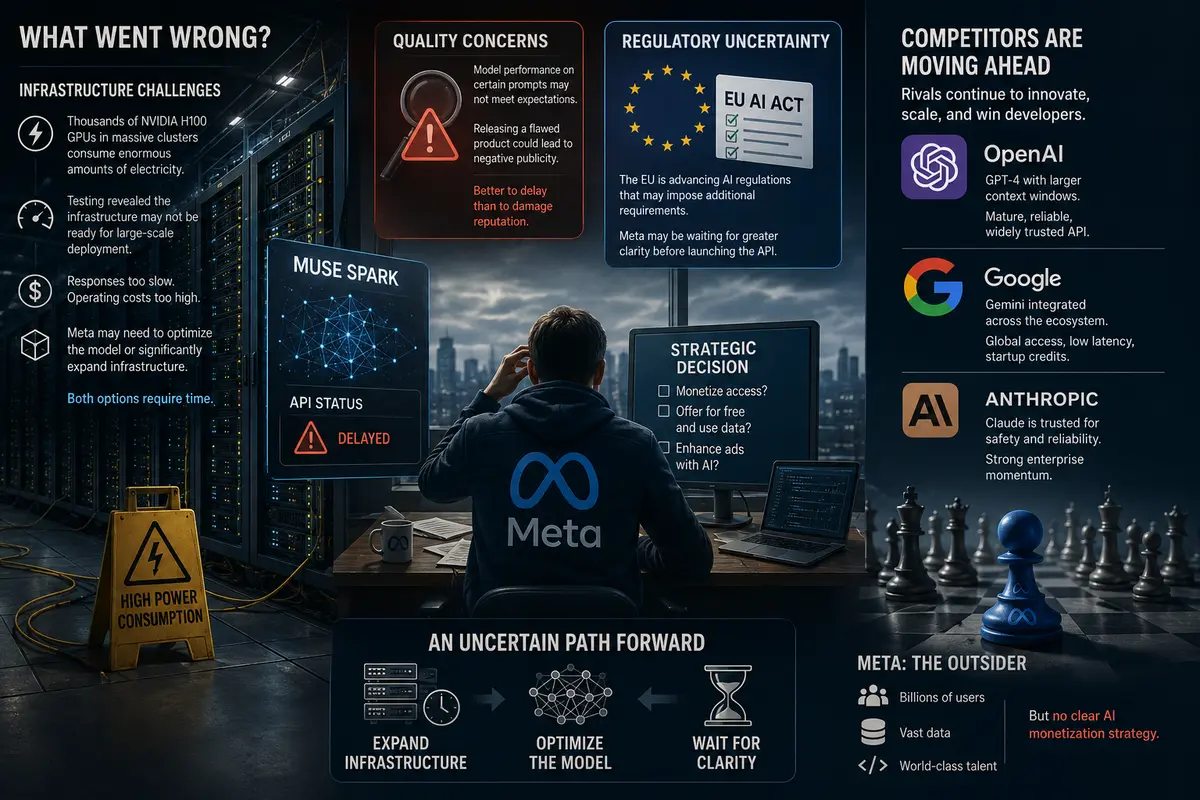
Training large language models is not only about algorithms and data—it is about infrastructure. Thousands of Nvidia H100 GPUs operating in massive clusters consume enormous amounts of electricity. Once a model is trained, a new challenge emerges: how do you serve millions of daily requests without incurring unsustainable costs or creating unacceptable latency?
Meta appears to have encountered precisely this issue.
Testing with partners reportedly revealed that the infrastructure may not yet be ready for large-scale deployment. Responses may be too slow. Operating costs may be too high. The company may need either to optimize the model or significantly expand its infrastructure footprint. Both options require time.
A second possible factor is quality control.
Meta may be dissatisfied with how Muse Spark performs on certain categories of prompts. In an era where every major AI release is immediately scrutinized by journalists, researchers, and influencers, releasing a flawed product can trigger a wave of negative publicity. Delaying a launch by a few months may be preferable to damaging the model’s reputation on day one.
A third possibility involves regulation.
The European Union is advancing AI regulations that could impose additional requirements on open-source and foundation models. Meta may be waiting for greater regulatory clarity before launching an API that could fall under new compliance obligations.
Competitors Are Moving Ahead
While Meta deliberates, its rivals continue to expand their lead.
OpenAI recently introduced enhancements to GPT-4, including dramatically larger context windows that allow the model to process vast amounts of information in a single session. Its API infrastructure remains mature, well-documented, and widely trusted.
Google has integrated Gemini throughout its ecosystem. Through Google Cloud, developers can access Gemini globally with low latency, and the company continues to attract startups through generous cloud credit programs.
Anthropic, strengthened by its partnership with Amazon, has gained significant traction in enterprise markets. Claude is widely regarded as one of the safest and most reliable models for legal, financial, and business-critical applications.
Against this backdrop, Meta increasingly appears to be the outsider.
The company possesses enormous advantages: billions of users across Facebook, Instagram, and WhatsApp; vast datasets; and world-class engineering talent.
What it lacks is a clearly defined AI monetization strategy.
The API delay may be a symptom of a deeper uncertainty. Meta has yet to decide exactly what role AI should play within its business model.
Should it charge for access?
Should it provide services for free and monetize through data and engagement?
Should AI primarily enhance advertising products?
Each approach has strengths and weaknesses, and none offers a perfect solution.
What Developers Are Saying
The developer community’s patience is beginning to wear thin.
Across social media, forums, and technical communities, the same questions appear repeatedly:
-
“Where is Meta’s API?”
-
“When can we finally try Muse Spark?”
Some developers have already moved on.
One developer from San Francisco reportedly wrote in an online discussion:
“I waited three months for Muse Spark. But my startup can’t wait forever. We switched to Google’s Gemini API. It costs more, but it works.”
Others remain loyal but want greater transparency.
“Meta, just give us a date,” another developer wrote. “If it’s two months away, we’ll wait. Just don’t leave us in the dark.”
Some observers suspect the delay reflects something larger than technical challenges.
According to one venture capital analyst, Meta may be reconsidering whether distributing a powerful AI model at low cost—or for free—is actually a sustainable business strategy. If so, the company may be revisiting its monetization plans while avoiding a public acknowledgment that its original strategy needs adjustment.
Looking Ahead
Three broad scenarios seem possible.
Scenario 1: Optimistic
Meta resolves its technical challenges and launches the Muse Spark API in June, as currently suggested. The model proves powerful, the API is reliable, and pricing is competitive. Developers embrace the platform, and Meta begins gaining market share in AI services.
Scenario 2: Moderate
The delay extends through the summer. When the API eventually launches, it offers little differentiation compared to existing alternatives. Many developers have already committed to OpenAI or Google, leaving Meta with a modest market presence and a difficult catch-up battle.
Scenario 3: Pessimistic
The challenges prove more significant than expected. Muse Spark struggles to scale efficiently. The API is postponed indefinitely—possibly into 2027. Meta gradually shifts its focus toward internal AI initiatives rather than developer-facing products, leaving OpenAI, Google, and Anthropic to dominate the market.
The second scenario currently appears the most likely.
Meta has too many resources to abandon a project of this scale entirely. At the same time, competing against companies whose primary mission revolves around AI will remain difficult. For Meta, AI is one major initiative among many. For OpenAI, it is the core business.
Final Thoughts
The delay of the Muse Spark API is not a disaster. Product delays are a routine part of the technology industry.
However, it is a warning sign.
A reminder that even a company as powerful as Meta can struggle to bring sophisticated AI products to market.
A reminder that openness and speed do not always go hand in hand.
And a reminder that developers building businesses on third-party platforms should always have a contingency plan.
Developers are waiting. Meta is testing. The market continues to move forward.
Meanwhile, OpenAI, Google, and Anthropic continue strengthening their positions.
Who will ultimately win remains uncertain. But one thing is clear: in the current round of competition, Meta is losing ground.
Whether the company can recover will depend on what happens next—and whether Muse Spark’s long-awaited API finally arrives, this month or shortly thereafter.
Because competition in AI benefits everyone: developers, businesses, and ultimately users. And without Meta, that competition would be considerably less complete.

Comments
No comments yet. Be the first to share your thoughts!
Authentication Required
You must be logged in to post a comment.