

WTI Crude Oil Futures Rise in Asian Trading
A Morning That Began with Hope
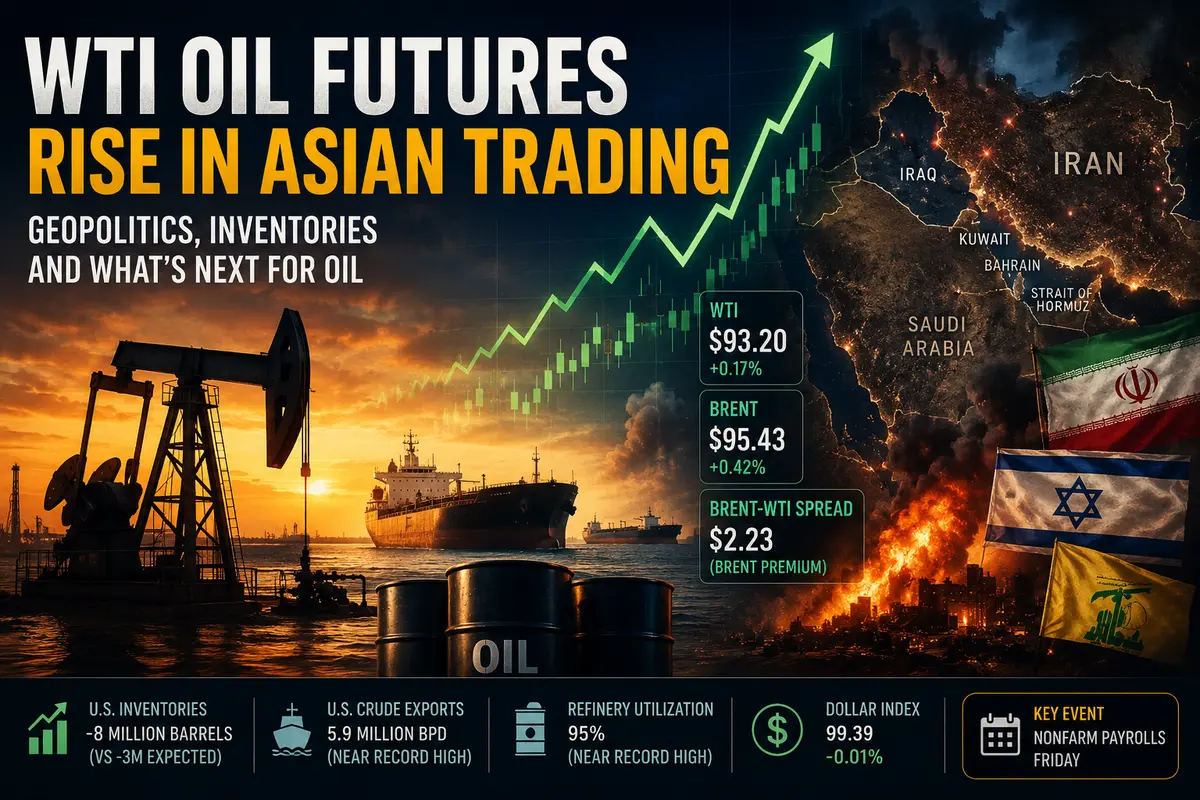
Friday’s Asian oil markets opened with cautious but steady gains. Futures for West Texas Intermediate (WTI) crude oil, the primary benchmark for the U.S. market and beyond, rose 0.17% to $93.20 per barrel. It is hardly a spectacular rally—just seventeen hundredths of a percent, more of a tremor than a surge. But after several days of volatile price swings, traders are willing to welcome any green number on their screens.
The European benchmark, Brent crude, appeared somewhat stronger. The August Brent contract gained 0.42%, climbing to $95.43 per barrel. The price spread between Brent and WTI widened to $2.23 per barrel in Brent’s favor. A week ago, the spread was narrower, below $2. The widening gap suggests that geopolitical risks concentrated around key Brent supply routes continue to weigh more heavily on Brent than on WTI, which is produced in the relatively secure environment of Texas.
The U.S. dollar, which has pressured commodity markets in recent days, weakened slightly on Friday morning. The U.S. Dollar Index futures slipped 0.01% to 99.39. The decline is tiny and almost imperceptible, but even such a modest move gives oil prices some breathing room.
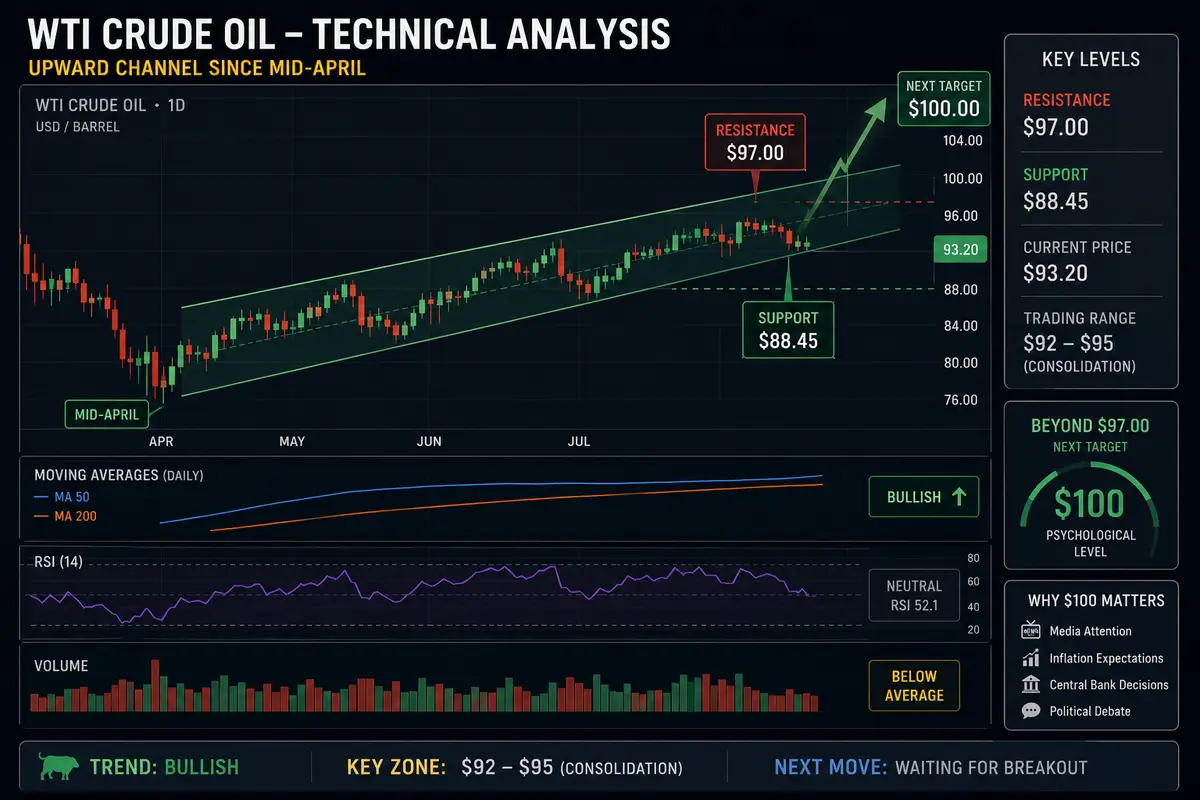
The technical picture remains tense. WTI support stands at $88.45, a level sellers failed to break in recent sessions. Resistance is located at $97.00. With WTI trading at $93.20, prices sit roughly in the middle of that range, leaving traders with room for maneuver.
The key question is what will trigger the next move. Geopolitics? U.S. inventory data? Or perhaps long-awaited news regarding negotiations between Iran and the United States? As usual, Asian traders were the first to react and have already begun positioning themselves ahead of developments.
Middle East: The Calm Before the Storm
The geopolitical backdrop remains the primary driver of oil prices, and Friday morning brought mixed signals. On one hand, there are indications that the worst may be behind us. On the other, any optimism could be shattered by reality at any moment.
Starting with the positive news, U.S.-Iran negotiations—which earlier this week appeared completely deadlocked—have unexpectedly shown signs of life. Diplomatic sources reported that indirect contacts between the two sides have resumed through intermediaries. Discussions reportedly extend beyond a ceasefire and may include a broader agreement involving Tehran’s nuclear program.
U.S. President Donald Trump, known for his bold statements, expressed confidence in an interview that an agreement could be reached within weeks. While his remarks do not represent official policy, they influence market sentiment. Investors who had priced a substantial geopolitical premium into oil this week are beginning to wonder whether they may have become overly pessimistic.
On the negative side, the ceasefire between Israel and Lebanon announced on Wednesday appears fragile. Reports emerged Friday morning of renewed shelling in southern Lebanon. The Israeli military accused Hezbollah of violating the agreement, while Hezbollah dismissed the accusations as provocation. Diplomats who celebrated a breakthrough yesterday are once again searching for ways to prevent a broader conflict.
Meanwhile, Iran continues to project strength. Missile strikes against Kuwait and Bahrain reported earlier this week have not gone unanswered. U.S. forces launched additional strikes on targets located on Qeshm Island in the Strait of Hormuz. Iranian officials promised a “crushing response,” although so far their reaction has been limited to rhetoric.
The Strait of Hormuz remains the world’s most critical oil chokepoint. Roughly 20% of global oil supplies pass through this narrow waterway. Any incident there—even an accidental one—could trigger a sharp spike in oil prices. Insurance companies have already raised premiums for tankers operating in the Persian Gulf, while some shipowners are considering alternative routes around Africa, adding several dollars per barrel to transportation costs.
As a result, the geopolitical premium embedded in oil prices remains elevated. Analysts estimate it currently ranges between $5 and $10 per barrel. If diplomacy prevails, that premium could disappear, pushing prices lower. If the conflict escalates, the premium could expand further and drive oil prices into triple-digit territory.
U.S. Inventories: Fundamental Support
While diplomats and military officials focus on geopolitical developments, fundamental factors continue to support oil prices. U.S. inventory data released on Wednesday were particularly convincing.
The Energy Information Administration reported that commercial crude oil inventories fell by 8 million barrels during the week. Analysts had expected a decline of just 3 million barrels. The actual drawdown was nearly three times larger, sending a strong signal that the global oil market remains undersupplied.
Why did inventories decline so sharply?
The primary reason is exports. The United States has become an unexpected beneficiary of the Middle East crisis. Buyers in Europe and Asia who previously relied on Persian Gulf supplies are increasingly seeking alternative sources to diversify risk—and many have turned to the U.S.
U.S. crude exports rose to 5.9 million barrels per day, one of the highest levels on record. American tankers are crossing the Atlantic to Europe and the Pacific to Asia, replacing barrels that previously came from Saudi Arabia, the UAE, and Iran.
A second factor is refinery activity. Refinery utilization has reached 95% of capacity. The U.S. summer driving season is only beginning, yet demand for gasoline and diesel is already strong. Refineries are processing crude at near-record rates, steadily drawing down inventories.
A third factor is slowing production growth in certain regions. Shale producers in Texas and North Dakota—the primary engines of U.S. production growth over the past decade—are beginning to face challenges. Wells are depleting faster than new ones are being drilled. Investment in exploration and production remains subdued amid price uncertainty and regulatory concerns.
In its latest outlook, the Energy Information Administration warned that global oil inventories could reach critically low levels by the end of the summer if current trends continue. Markets took notice. That is why even temporary pullbacks, such as Thursday’s decline, are increasingly viewed as buying opportunities rather than the start of a downtrend.
Technical Analysis: Reading the Charts
WTI crude has been trading within an upward channel since mid-April. The lower boundary of the channel sits near $88, while the upper boundary is close to $97. The support at $88.45 and resistance at $97.00 fit neatly within this framework.
For traders, this means that as long as prices remain inside the channel, the broader trend remains bullish. Pullbacks are normal. A break below $88 would signal a potential trend reversal, while a breakout above $97 would indicate accelerating upside momentum.
Daily technical indicators present a mixed picture. Moving averages remain bullish. The Relative Strength Index (RSI) has retreated from overbought territory following Thursday’s correction and now sits at neutral levels, suggesting additional upside potential remains.
Trading volumes during Friday’s Asian session were below average, indicating limited enthusiasm among regional participants. Traders may simply be waiting for the U.S. session, when liquidity and activity typically increase.
The key level to watch remains $97.00. If WTI breaks above this resistance and holds, the next target becomes the psychologically important $100-per-barrel mark.
Triple-digit oil prices are more than just a number. They attract global media attention, influence inflation expectations, affect central bank decisions, and become a subject of political debate.
For now, however, oil remains trapped within a $92–$95 trading range—a period of consolidation before the next major move, whether upward or downward.
The Dollar: A Brief Respite
Oil and the U.S. dollar traditionally move in opposite directions. When the dollar strengthens, oil tends to weaken. When the dollar declines, oil often rises.
Friday’s slight weakening of the dollar provided modest support for crude prices. Dollar Index futures fell 0.01%, a small but welcome development for oil bulls.
The dollar softened ahead of Friday’s U.S. employment report. Traders are reluctant to hold large positions before such a significant event, prompting many to reduce long-dollar exposure.
If the nonfarm payrolls report disappoints, the dollar could weaken further and provide oil with additional upside momentum. If the data exceed expectations, the dollar could strengthen and renew pressure on crude prices.
Even in that scenario, however, underlying fundamentals—including declining inventories, strong exports, and seasonal demand—should continue to support the market. Any oil selloff driven by dollar strength is therefore likely to be limited, with buyers expected to emerge around the $88–$89 support zone.
The Brent-WTI Spread: What It Means
The Brent-WTI spread widened to $2.23 per barrel in Brent’s favor, up from roughly $1.70–$1.80 earlier in the week.
This widening suggests that geopolitical risks are affecting Brent more than WTI.
Why? Because Brent is the global benchmark most sensitive to developments in the Middle East. A significant portion of the crude that influences Brent pricing travels through the Strait of Hormuz and the Suez Canal. WTI, by contrast, is produced in Texas and is either consumed domestically or exported to Asia through routes that largely avoid conflict zones.
The widening spread creates opportunities for traders. Some may choose to buy WTI, which appears relatively undervalued, while simultaneously selling Brent, betting that the spread will eventually narrow again.
However, the spread could continue expanding if tensions in the Middle East escalate. Some analysts believe the Brent premium over WTI could widen to $3–$4 per barrel in the coming weeks, reflecting increasing concerns over supply disruptions.
What Lies Ahead for Oil
Friday’s focus is firmly on the United States, where the monthly nonfarm payrolls report is scheduled for release. It is the most important economic event of the day for global financial markets, including oil.
-
Strong employment data (above 200,000 jobs): stronger dollar, weaker oil.
-
Weak employment data (below 150,000 jobs): weaker dollar, stronger oil.
-
Results near expectations (170,000–190,000 jobs): likely range-bound trading.
Yet even after the payroll report, geopolitics will remain the dominant force driving the oil market.
Iran, Israel, Lebanon, and Hezbollah are likely to have a greater impact on trader sentiment than any economic report.
Anyone attempting to forecast oil prices must therefore watch not only the United States but also the Middle East—a region where diplomats continue striving for peace, military planners prepare for worst-case scenarios, and oil prices could surge dramatically at any moment.
Friday’s Asian session suggested that risk appetite is beginning to return. Oil moved higher, and the dollar weakened. But this could prove temporary. The market is waiting for signals. And once they arrive—whether bullish or bearish—the next move could be swift and substantial.
Be prepared.

Comments
No comments yet. Be the first to share your thoughts!
Authentication Required
You must be logged in to post a comment.