

A Quarter That Shocked the Skeptics
Japan has spent so many years being described as a stagnant economy that even modest growth now feels like a surprise. For decades the country was treated as the textbook example of what happens when demographics deteriorate, consumers stop spending, and deflation becomes embedded in national psychology. Economists built entire careers around explaining why Japan could no longer grow the way it once did.
And then the first-quarter GDP numbers arrived.
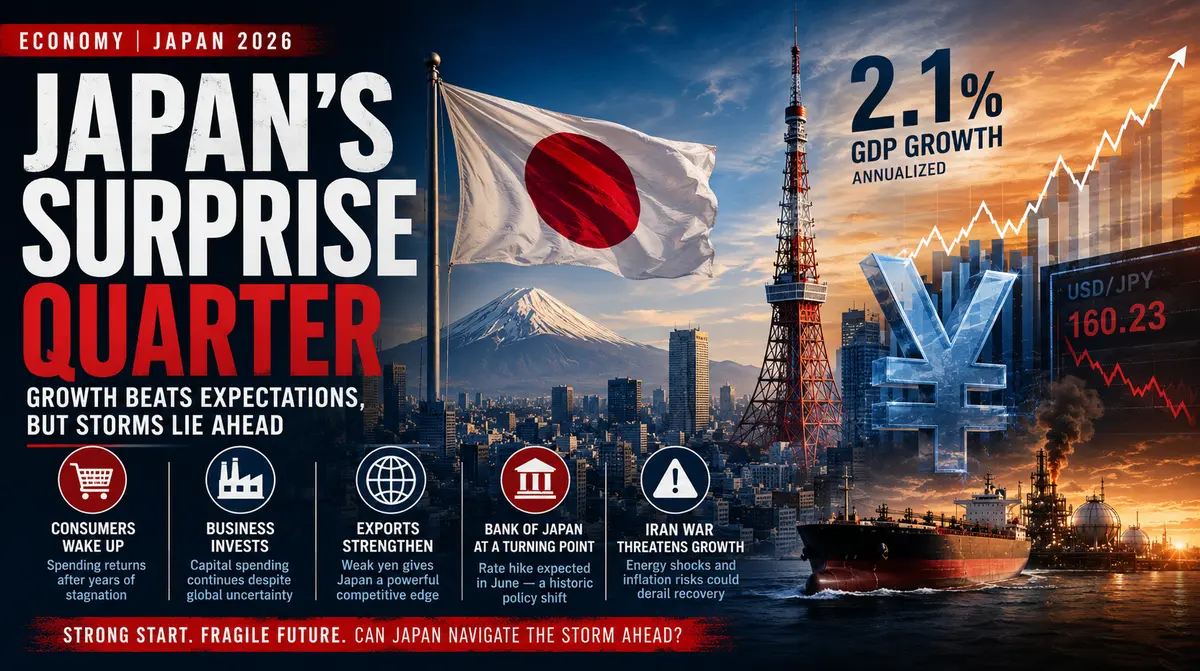
On paper, the figures may not look explosive by the standards of fast-growing emerging markets. But for Japan, they were remarkable. Annualized GDP growth accelerated to 2.1 percent, significantly above expectations and far stronger than the previous quarter’s revised 0.8 percent. Quarterly growth came in at 0.5 percent, also beating forecasts. Those are not numbers associated with an economy supposedly trapped in permanent paralysis.
What makes these results important is not just the headline growth itself. It is the composition of that growth. Japan is not being carried by a single temporary factor. Consumption improved. Investment remained positive. Exports strengthened. Inflation stayed elevated. In other words, several engines of the economy started moving at the same time.
That combination matters because Japan has spent years trying to escape a vicious cycle in which weak demand led to falling prices, falling prices encouraged consumers to delay purchases, and delayed spending weakened growth even further. Breaking that cycle was the central mission of the Bank of Japan for more than a decade.
Now, for the first time in years, there are signs that the psychology of the country may actually be changing.
The Most Important Story: Consumers Are Spending Again
The biggest development inside the GDP report was private consumption. It rose by 0.3 percent after stagnating in the previous quarter. In many economies, that would barely attract attention. In Japan, it is a major event.
Japanese consumers have long been cautious to the point of obsession. The culture of saving was reinforced by decades of economic disappointment. When people expect prices to remain flat or even fall, there is little urgency to spend money today. Why buy something now if it might be cheaper six months later? That mentality became deeply rooted after the collapse of Japan’s asset bubble in the 1990s.
The result was an economy where households accumulated enormous savings but often refused to spend them. Businesses responded by avoiding aggressive expansion. Wages stagnated. Growth slowed. Deflation became normal.
The recent shift suggests that this mindset may finally be weakening.
Inflation, ironically, is part of the reason. Rising prices create pressure to spend sooner rather than later. Japanese households are beginning to understand that delaying purchases no longer guarantees better prices in the future. At the same time, the labor market remains relatively tight. Unemployment is low, and companies are increasingly forced to raise wages because of labor shortages.
Japan’s demographic crisis is now producing a strange side effect: a shrinking workforce is finally giving workers more bargaining power.
The wage increases are not dramatic by Western standards, but psychologically they matter. After years of near-zero wage growth, even modest increases change consumer behavior. People become less defensive. Spending gradually returns.
Restaurants are seeing stronger demand. Domestic tourism remains active. Retail sales have improved. Consumers are not suddenly becoming reckless spenders, but they are slowly losing the fear that dominated Japanese economic life for decades.
That may be the most important economic transformation happening in the country right now.
Business Investment Shows Quiet Confidence
Corporate investment also exceeded expectations. Capital expenditures increased by 0.3 percent. While this represented a slowdown from the previous quarter, the broader trend remains encouraging.
Japanese companies are sitting on enormous cash reserves. For years critics accused them of becoming excessively conservative, preferring to hoard cash rather than invest in expansion or innovation. That caution was understandable. When demand is weak and prices are stagnant, aggressive investment becomes risky.
But companies are now facing different conditions.
Labor shortages are forcing firms to automate faster. Manufacturers are modernizing equipment. Technology investment continues to rise. Supply chain disruptions over recent years also pushed many businesses to rethink production strategies and improve resilience.
In addition, corporate Japan is benefiting enormously from the weak yen.
A cheap currency acts like a subsidy for exporters. Japanese products become more competitive abroad without companies needing to improve efficiency overnight. Car manufacturers, industrial machinery producers, and electronics firms all benefit when overseas revenue translates into more yen back home.
For major exporters, profits have remained extremely strong. That gives businesses room to continue investing even while the global environment becomes more uncertain.

The Weak Yen: Blessing and Curse
The yen sits at the center of nearly every major economic debate in Japan today.
On one side, exporters love it. A weak currency boosts overseas earnings and supports economic growth. Japanese corporations have enjoyed record profits partly because of favorable exchange rates.
On the other side, households hate it.
Japan imports almost all of its energy. It also imports significant quantities of food and raw materials. When the yen weakens, everything imported becomes more expensive almost immediately. Electricity bills rise. Transportation costs increase. Food prices climb.
That imported inflation hits ordinary consumers hardest.
The government has tried to cushion the blow through subsidies and fuel price controls, but these measures are expensive and temporary. They reduce visible inflation for a while without eliminating the underlying problem.
The deeper issue is that Japan’s inflation is not entirely healthy inflation.
Central banks generally want inflation that comes from strong domestic demand, rising wages, and economic expansion. Japan’s inflation is partially driven by external shocks — energy prices, imported goods, and currency weakness.
That creates a dangerous balancing act for the Bank of Japan.
The Bank of Japan’s Impossible Decision
For years the Bank of Japan was the global symbol of ultra-loose monetary policy. While other central banks worried about excessive inflation, Japan struggled to generate any inflation at all.
Interest rates remained near zero for decades. Massive bond-buying programs became routine. Financial markets grew accustomed to the idea that Japanese rates would stay extremely low forever.
Now that assumption is being challenged.
Inflation has remained above the Bank of Japan’s target for an extended period. Markets increasingly expect another rate hike in June. Even moving rates toward one percent would represent a historic shift for modern Japan.
But tightening monetary policy now carries enormous risks.
If the Bank of Japan raises rates too aggressively, it could damage the fragile recovery in consumer demand. Higher borrowing costs would pressure businesses and households at precisely the moment when spending is finally improving.
At the same time, doing nothing carries risks as well.
A persistently weak yen could trigger even higher imported inflation. Rising energy costs would continue squeezing households. Confidence in the currency could deteriorate further.
This is the central dilemma facing Japanese policymakers: how do you normalize monetary policy after decades of emergency conditions without crushing the recovery you spent years trying to create?
There is no easy answer.
The Iran Conflict Changes Everything
As difficult as Japan’s domestic economic situation already is, the geopolitical environment may become an even bigger problem.
The conflict involving Iran has introduced a dangerous level of uncertainty into global energy markets. Japan is especially vulnerable because of its dependence on imported energy and the importance of shipping routes through the Strait of Hormuz.
Any serious disruption there immediately affects Japan.
Higher oil prices worsen the trade balance. Energy-intensive industries face rising costs. Inflation accelerates. Consumer confidence weakens. Economic growth slows.
In the worst-case scenario, Japan could face stagflation — the toxic combination of weak growth and persistent inflation.
That would be a nightmare for policymakers.
Traditional economic tools become less effective during stagflation. Raising rates hurts growth. Cutting rates weakens the currency further and risks even more inflation. Governments often find themselves trapped between two bad options.
Japan understands this danger better than most countries because its economy is already unusually sensitive to external shocks.
A Country Trying to Reinvent Itself
Despite all the risks, something important is happening in Japan.
The country is beginning to look less like the permanently frozen economy described in textbooks and more like a nation slowly rediscovering momentum. Inflation, once considered impossible to generate, is now firmly present. Wage growth exists again. Consumers are spending. Businesses are investing.
None of this guarantees long-term success. Japan still faces severe structural problems: an aging population, enormous public debt, weak productivity growth in parts of the economy, and growing geopolitical vulnerability.
But the first quarter showed that the country is not economically dead.
For years the world treated Japan as a warning. Now it may become something more complicated: a case study in how even deeply entrenched economic behavior can eventually change under enough pressure.
The coming months will determine whether this recovery becomes durable or fades under the weight of global instability. Much depends on energy markets, the yen, and the Bank of Japan’s next moves.
For now, however, one thing is clear: Japan has re-entered the global economic conversation. And after decades of stagnation, that alone is a major shift.

Comments
No comments yet. Be the first to share your thoughts!
Authentication Required
You must be logged in to post a comment.