Bar Pipa
We pay for a post of 10$

Shares

Tom Maffin

Silicon Storm: How Japanese and Korean Stocks Are Rewriting History While the World Watches Iran

Silicon Storm: How Japanese and Korean Stocks Are Rewriting History While the World Watches Iran

Asian markets on Wednesday looked like two parallel worlds existing within the same universe. In the first world — inhabited by memory chip makers and AI accelerator manufacturers — euphoria reigned. Japan’s Nikkei 225 surged to a new all-time high, climbing above 66,428 points. South Korea’s KOSPI delivered an even more dramatic move, soaring five percent in a single session to reach an unprecedented 8,457 points. Shares of SK Hynix jumped nearly fourteen percent, pushing the company’s market capitalization above one trillion dollars for the first time in history.

In the second world — the world of geopolitics, oil prices, and Middle Eastern negotiations — anxiety dominated. Brent crude hovered around ninety-nine dollars a barrel, Chinese indices declined, and investors nervously scanned the horizon for an answer to a single question: would there be peace with Iran, or more bombing campaigns ahead?

SK Hynix: Crossing the Trillion-Dollar Threshold

There are moments in corporate history that divide eras. For SK Hynix, Wednesday became such a moment. A near fourteen-percent rally in a single session pushed the company’s market capitalization beyond the psychological trillion-dollar mark.

This is more than just a symbolic number. It is an entry ticket into an exclusive club where only two other memory manufacturers reside alongside SK Hynix: Samsung Electronics and Micron Technology. Three companies, three pillars supporting the global memory industry.

The reason behind the rally is both simple and monumental. The world is entering an era in which artificial intelligence requires enormous volumes of high-speed memory. Every new data center, every large language model, every Nvidia accelerator devours gigabytes and terabytes of HBM memory — a segment where SK Hynix holds a leading position.

And as technology giants like Google and Amazon announce fresh investments in AI infrastructure, the Korean memory maker can calmly count its...


Continue reading...
0
0

Vietnam Beachhead: Why Samsung Is Building a $1.5 Billion Factory

Vietnam Beachhead: Why Samsung Is Building a $1.5 Billion Factory

There is a certain irony in the fact that, at the height of a geopolitical crisis — while the world watches Iranian negotiations and anxiously awaits U.S. inflation data — Samsung is calmly and methodically laying the foundation for a new factory in Vietnam. No panic, no loud statements — just dust on a construction site in Thailand’s Thai Nguyen province and two hundred engineers who, since April, have been preparing the ground for another technological leap.

The investment totals 39 trillion Vietnamese dong, or roughly $1.5 billion. It will become Samsung’s first semiconductor testing plant ever built on Vietnamese soil. And its emergence says far more about the global restructuring of the chip industry than all the headlines about trade wars combined.

Traditional Chips: The Invisible Heroes of the Digital Age

When people talk about semiconductor shortages, they usually picture cutting-edge AI processors, high-performance HBM memory, and Nvidia accelerators. But reality is more complicated. Samsung’s new facility will focus on what industry insiders call “legacy” chips — mature, traditional technologies.

These are the previous generations of DRAM and NAND memory chips that never make headlines, yet without them no car starts, no router powers on, and no washing machine runs.

The paradox is that these chips are currently in severe shortage. While Samsung, SK Hynix, and Micron chase massive profits from supplying memory for AI data centers, traditional customers — smartphone makers, laptop manufacturers, and automakers — are left empty-handed. Manufacturing capacity is no longer enough for everyone.

Samsung’s new plant is an attempt to fill that gap. The facility is designed for annual output of 153 billion gigabits of DRAM and 255 billion gigabits of NAND — figures staggering even to veteran semiconductor engineers.

Why Vietnam — Not China, Korea, or the United States

The answer to “why...

Continue reading...
0
0
Tom Maffin

Korean Record Amid the Ashes of War: How Asian Markets Live Between Bombs and Chips

Korean Record Amid the Ashes of War: How Asian Markets Live Between Bombs and Chips

Asian stock markets on Tuesday looked like a chessboard where the black and white squares had been mixed together without any logic. Japan declined, China fell, Australia and Singapore slipped into the red. But in the middle of this sea of red indices, like an iceberg rising above the waves, stood the KOSPI — South Korea’s benchmark index hit a new all-time high, surging above 8,131 points. Hong Kong, lifted by a rally in chipmakers, also closed higher. This market schizophrenia perfectly reflects the current moment: geopolitics is pulling markets down, technology is pushing them up, and investors are swinging between fear of Iranian bombs and greed for artificial intelligence.

Strikes on Iran: Markets Back in “Run or Freeze” Mode

New U.S. strikes on missile positions and vessels in southern Iran, revealed on Monday, hit the markets like a bucket of cold water poured over the smoldering embers of optimism. Just on Sunday, markets were celebrating hopes for peace. As recently as Monday morning, oil had fallen below $100 a barrel, Asian indices were climbing, and traders were pricing in a swift reopening of the Strait of Hormuz. Today, everything looks different. Brent is back near $98, while WTI hovers around $92. Oil prices have bounced back, reminding everyone that the war is not over — it has merely paused.

Washington describes the strikes as defensive. The wording matters: it leaves room for diplomacy. Had the attacks been labeled offensive, markets would have interpreted them as escalation and reacted far more aggressively. But even “defensive” bombings during ongoing negotiations in Doha send a message. A message that diplomacy is stalling, that the sides cannot reach an agreement, and that military force remains the primary argument. And although Trump continues to say the talks are “going well,” markets have learned to...

Continue reading...
0
0

X-Ray of a Deal: Why Asia’s Oldest Conglomerate Is Buying Australian Clinics

X-Ray of a Deal: Why Asia’s Oldest Conglomerate Is Buying Australian Clinics

Jardine Matheson is a name that, for most people, sounds like a fragment of colonial history — something from the era of sailing clippers, the Opium Wars, and British trading posts in Hong Kong. And that’s true. The conglomerate was founded in 1832, survived two world wars, decolonization, the handover of Hong Kong to China, and the digital revolution.

Now, nearly two centuries later, this patriarch of Asian capitalism is making a move that says more about its vision of the future than any annual report ever could. Jardine Matheson is acquiring I-MED Radiology Network, the largest diagnostic imaging network in Australia and New Zealand, for AUD 3.4 billion. And this deal is not simply the purchase of a healthcare business. It is a bet on the intersection of two megatrends: aging populations and artificial intelligence.

215 Clinics and 7 Million Procedures: What Jardine Is Buying

I-MED is not a garage startup. It is one of the largest providers of diagnostic imaging services in Australia and New Zealand. Two hundred and fifteen clinics spread across two countries. Seven million medical procedures annually. MRI scans, CT scans, X-rays, ultrasounds, mammography — everything that allows doctors to look inside the human body without a scalpel. This is not just a medical business; it is healthcare infrastructure embedded in the daily lives of millions of people.

When Jardine Matheson buys a network like this, it is not merely purchasing a revenue stream. It is buying predictable, growing demand. Populations in developed countries are aging. The older people become, the more diagnostic imaging they require. Cancer, cardiovascular disease, neurological disorders, injuries — all of these conditions depend on imaging. And this trend is irreversible. No recession, no crisis can change the fact that people will continue to age and get sick. Which means demand...

Continue reading...
0
0

Tokyo Records and an Oil Pullback: How Asian Markets Are Celebrating Hopes for Peace

Tokyo Records and an Oil Pullback: How Asian Markets Are Celebrating Hopes for Peace

Monday began on Asian stock exchanges in a way not seen for a very long time. Japan’s Nikkei 225 soared to the skies, hitting a fresh all-time high of 65,408 points. The TOPIX followed closely behind, also rewriting the record books. Chinese indexes moved higher. Australia, Singapore, and India all painted their screens green. And all of this unfolded against the backdrop of a U.S. market holiday, with the world’s biggest players absent from their desks. Left to themselves, Asian markets staged a rally driven by the intersection of two powerful forces: renewed optimism surrounding artificial intelligence and hopes for an end to the Iran conflict.

Tokyo Records: When the Nikkei Storms the Heavens

Japan’s stock market traded on Monday as if no global crisis existed. The Nikkei 225 gained more than three percent during the session, reaching a level that would have seemed фантастical just a year ago. TOPIX, the broader gauge of Japan’s economy, climbed to nearly 3,954 points, also setting a historic record. This was not merely growth — it was a display of strength.

The driving force behind Tokyo’s rally was shares of companies tied to semiconductors and artificial intelligence. Renesas Electronics and Rohm both surged by ten percent. This was not abstract optimism but a direct spillover from Wall Street, where U.S. semiconductor companies staged their own rally late last week after upbeat earnings and forecasts. Nvidia set the tone, and now Japanese suppliers and partners have picked up the baton.

Japan, long viewed as a fading economic power trapped in deflation, has suddenly found itself in an ideal position to profit from the AI boom. Japanese firms produce critical components for chips — substrates, chemicals, and precision equipment. No TSMC or Samsung factory can operate without them. And as global demand for computing power...

Continue reading...
0
0
Tom Maffin

Silent Expansion: How Google Is Turning Missouri Cornfields into a Digital Empire

Silent Expansion: How Google Is Turning Missouri Cornfields into a Digital Empire

Fifteen billion dollars. A sum large enough to build several skyscrapers in New York, finance the space program of a small nation, or reshape the transportation system of an entire metropolis. But Google has chosen to spend that money differently. On Wednesday, the company announced it would invest the funds into land, concrete, steel frameworks, and miles of fiber-optic infrastructure in the state of Missouri.

At first glance, the news about a new data center in the small town of New Florence, tucked away among the fields of Montgomery County, looks like just another line in a corporate press release. In reality, however, the project fundamentally changes how we think about the direction of the digital economy — and who its next beneficiaries will be.

Cornfields Become the New Silicon Valley

Missouri is not the first place that comes to mind when people hear the phrase “technology hub.” Known for its ranches, beer breweries, and the blues clubs of St. Louis, the state has never seriously competed with California or Texas. Yet this is precisely where Google has chosen to place one of its largest infrastructure projects — and the decision is far from accidental.

A modern data center is not simply an office building filled with servers. It is an industrial facility comparable in scale to a steel plant, except instead of consuming coking coal, it consumes electricity. Gigawatts of electricity.

The fact that Google has already contracted more than one gigawatt of new power generation capacity in Missouri speaks volumes about the scale of its appetite. One gigawatt is roughly equivalent to the output of a large nuclear power plant or two million solar panels. And this is only the beginning. The company’s partnership with local utility provider Ameren includes the development of an additional 500 megawatts of...

Continue reading...
0
0
Lin Brings

Asia’s Red Screen: How a Samsung Strike, the Oil Crisis, and Rate Fears Crushed Markets

Asia’s Red Screen: How a Samsung Strike, the Oil Crisis, and Rate Fears Crushed Markets

Asian markets were painted deep red on Wednesday — and this was no mild correction. It was a full-scale selloff, triggered by a wave from Wall Street and intensified by local disasters. Three consecutive sessions of declines in U.S. indexes, a collapsing tech sector dragging everything else down with it, and South Korea’s KOSPI plunging more than two and a half percent to lead regional losses. This is what happens when several storms converge at one point: geopolitics pushes oil higher, oil fuels inflation, inflation drives interest rates up, and higher rates crush technology stocks. And in the middle of all this sits Samsung’s own drama, adding another canister of fuel to an already raging fire.

KOSPI and Samsung: When a Labor Dispute Becomes a Systemic Risk

South Korea’s KOSPI didn’t just fall — it collapsed, and the main culprit was the company that for decades symbolized national pride. Shares of Samsung Electronics, which erased early gains and plunged more than four percent, dragged the entire index down with them. The breakdown of negotiations with the labor union, reported by Yonhap, became exactly the trigger the market feared but hoped until the last moment to avoid.

The strike scheduled for Thursday, May 21, now looks almost inevitable. Forty-eight thousand workers, eighteen days of potential shutdowns, and no sign that the two sides will reach an agreement in time. For investors, this means an immediate repricing of risk. Samsung is not just another stock in the index — it is the pillar supporting a substantial portion of the Korean market’s capitalization. When that pillar shakes, the whole building trembles. The KOSPI’s drop of more than two and a half percent reflects growing recognition that Samsung’s problems may not be a short-term incident, but the beginning of a prolonged conflict with unpredictable...

Continue reading...
0
0
Tom Maffin

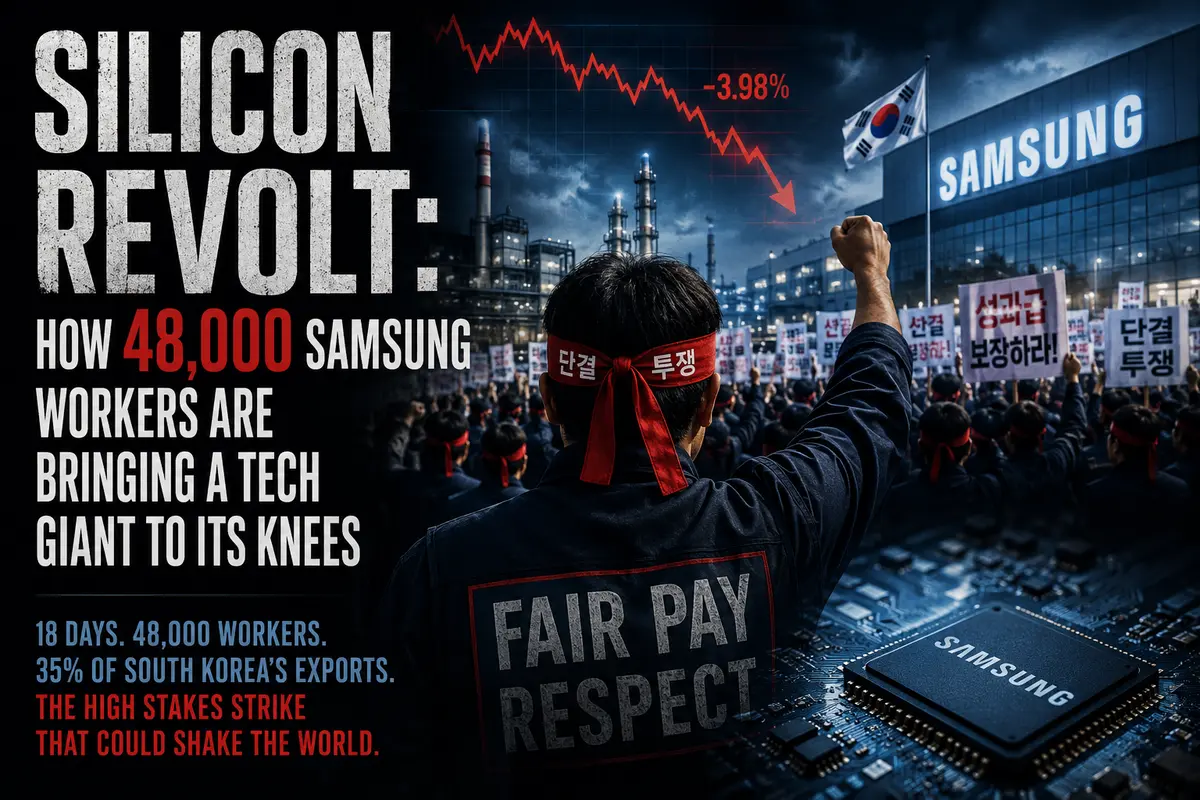
Silicon Revolt: How 48,000 Samsung Workers Are Bringing a Tech Giant to Its Knees

Silicon Revolt: How 48,000 Samsung Workers Are Bringing a Tech Giant to Its Knees

The news that came out of South Korea on Wednesday hit global technology markets with the force of a finely tuned industrial press. The largest labor union at Samsung Electronics — a company whose name has become synonymous with South Korea’s economic miracle — announced the start of a full-scale strike. Eighteen days, forty-eight thousand workers, and the complete collapse of negotiations mediated by the government. This is not merely a labor dispute; it is an event capable of redrawing the global semiconductor landscape and leaving a deep scar on South Korea’s export-driven economy. And what terrifies investors most is that this is happening not on the periphery, but at the very heart of global memory chip manufacturing, where Samsung has maintained an iron grip for decades.

Breakdown of Negotiations: Why the Government Failed to Save the Situation

When a government steps into a labor dispute, it is always a sign of extreme concern. South Korea’s labor authorities, usually operating behind the scenes, moved center stage this time and sat down at the negotiating table alongside Samsung management and union representatives. It was a desperate move driven by the understanding of what was at stake. Yet even state mediation failed to bridge the gap dividing the two sides.

The union submitted a proposal whose full details remain undisclosed, but the core issues are known: performance bonuses and compensation. It sounds like a standard list of demands, but behind those words lies a deeper shift in the relationship between Korean chaebols and their workers. For decades, Samsung cultivated a culture of loyalty in which employees identified themselves with the corporation, while the corporation provided stability and generous bonuses during prosperous years. But now, as the semiconductor industry undergoes tectonic shifts driven by the AI boom, trade wars, and supply-chain restructuring, that...

Continue reading...
0
0

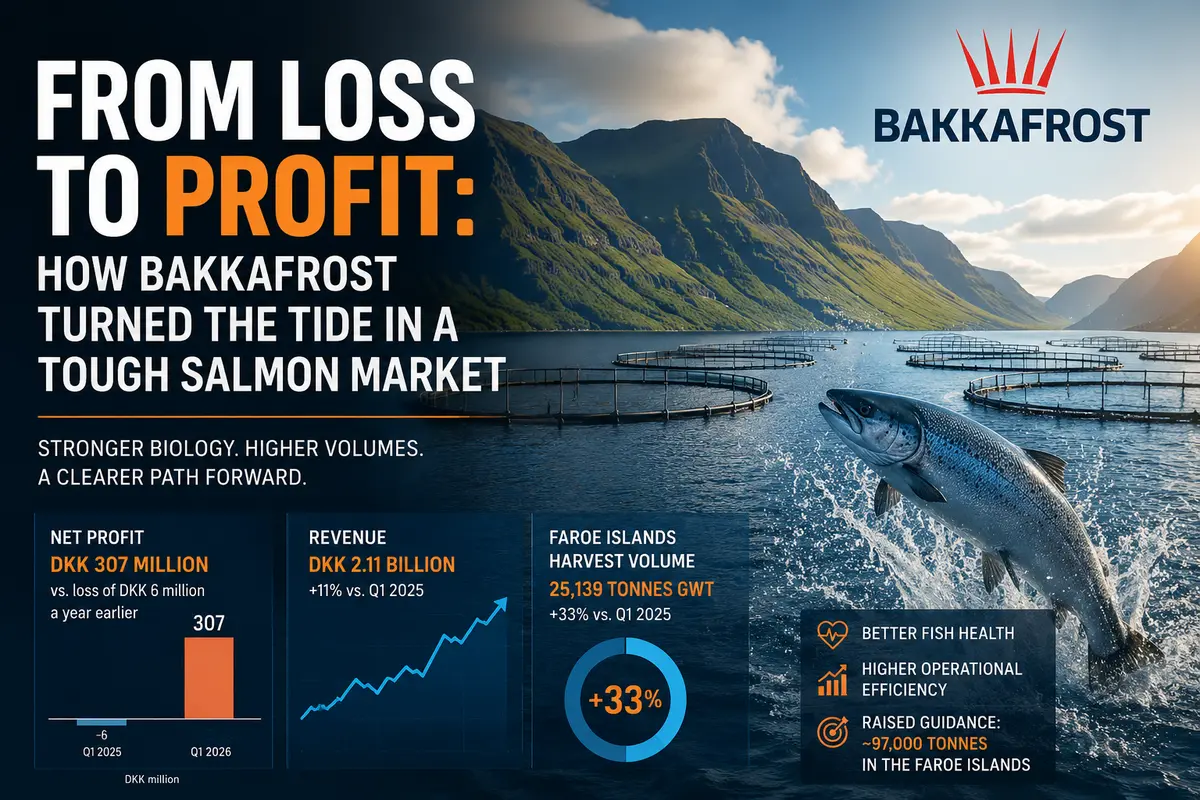
From Loss to Profit: How Bakkafrost Turned the Tide in a Tough Salmon Market

From Loss to Profit: How Bakkafrost Turned the Tide in a Tough Salmon Market
A Quarter That Changed the Narrative

When Bakkafrost published its first-quarter results, the numbers immediately caught the market’s attention. A year ago, the company reported a small net loss. This year, it delivered a net profit of DKK 307 million. On paper, it looks like a sharp turnaround. In reality, the story behind those figures is much deeper than a simple rebound in earnings. What happened over the past twelve months reveals how modern salmon farming has become a battle not only of prices and production volumes, but also of biology, geography, and operational discipline.

At first glance, the broader market environment did not look particularly favorable. Global salmon prices in the quarter were lower than a year earlier. Supply from major producing countries increased significantly, putting pressure on benchmark prices across Europe and Asia. In industries tied to commodities, lower prices usually translate directly into weaker profits. Yet Bakkafrost managed to move in the opposite direction.

That alone says a great deal about the company’s underlying condition.

Why Efficiency Matters More Than Salmon Prices

The key to understanding this quarter lies in one word: efficiency. Not the empty corporate kind of efficiency often repeated in investor presentations, but the real, measurable kind that determines whether a fish farmer makes money or loses it. In salmon farming, efficiency starts with biology. Healthy fish grow faster, require less treatment, consume feed more effectively, and survive in greater numbers until harvest. Sick fish do the opposite. Every biological problem eventually becomes a financial problem.

This is where Bakkafrost’s Faroese operations stood out.

The Faroe Islands are not just another production region on the map. For salmon farming, they are close to ideal. Cold Atlantic waters, strong ocean currents, stable temperatures, and relatively isolated fjords create natural conditions that reduce many of the...

Continue reading...
0
0

Three and a Half Million in Just a Few Weeks

Three and a Half Million in Just a Few Weeks

Tap Global, a company whose shares are traded on London’s AIM market, has released a short but highly revealing statement. Its new product, called Tap Earn, managed to attract $3.5 million in assets under management since launching in early May. For giants like Coinbase or Binance, that amount would barely register as statistical noise. But for Tap Global, whose audience is still measured in hundreds of thousands rather than tens of millions of users, it is a significant signal.

The product was officially announced on May 7, and within just a couple of weeks clients had already deposited $3.5 million into it. If that pace were extrapolated over a quarter or a year, the numbers could materially reshape the company’s financial profile. More importantly, however, customers are voting with their feet — or rather, with their wallets — for a model fundamentally different from what cryptocurrency platforms have traditionally offered.

Tap Earn provides variable yield on crypto assets and stablecoins. In practice, this means users can open the mobile app, deposit their Bitcoin, Ether, or dollar-pegged tokens, and begin earning interest on them. There is no need to trade, monitor charts, or stress over volatility — users simply deposit assets and earn passive income. The idea itself is as old as finance, but in the crypto world it has long been associated with risky decentralized finance protocols and infamous yield platforms that promised high returns before disappearing along with users’ funds. Tap Global is attempting to offer a similar product, but within a regulated framework and through a publicly traded company.

A Strategic Shift: From Transactions to Passive Income

The most interesting aspect of Tap Global’s announcement is not the $3.5 million figure itself, but what it represents. CEO Arsen Torosian described the launch of Tap Earn as the beginning...

Continue reading...
0
0
Navigation menu
instaforex banner