

Silicon Storm: How Japanese and Korean Stocks Are Rewriting History While the World Watches Iran
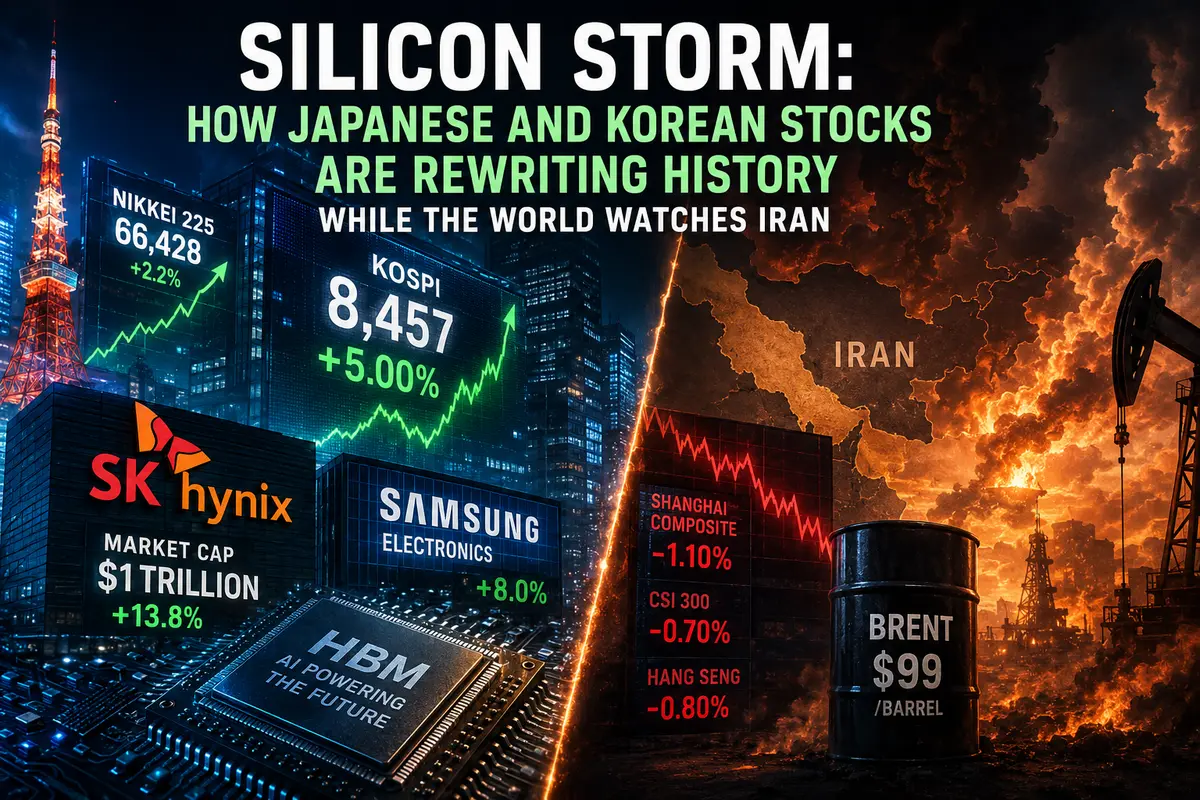
Asian markets on Wednesday looked like two parallel worlds existing within the same universe. In the first world — inhabited by memory chip makers and AI accelerator manufacturers — euphoria reigned. Japan’s Nikkei 225 surged to a new all-time high, climbing above 66,428 points. South Korea’s KOSPI delivered an even more dramatic move, soaring five percent in a single session to reach an unprecedented 8,457 points. Shares of SK Hynix jumped nearly fourteen percent, pushing the company’s market capitalization above one trillion dollars for the first time in history.
In the second world — the world of geopolitics, oil prices, and Middle Eastern negotiations — anxiety dominated. Brent crude hovered around ninety-nine dollars a barrel, Chinese indices declined, and investors nervously scanned the horizon for an answer to a single question: would there be peace with Iran, or more bombing campaigns ahead?
SK Hynix: Crossing the Trillion-Dollar Threshold
There are moments in corporate history that divide eras. For SK Hynix, Wednesday became such a moment. A near fourteen-percent rally in a single session pushed the company’s market capitalization beyond the psychological trillion-dollar mark.
This is more than just a symbolic number. It is an entry ticket into an exclusive club where only two other memory manufacturers reside alongside SK Hynix: Samsung Electronics and Micron Technology. Three companies, three pillars supporting the global memory industry.
The reason behind the rally is both simple and monumental. The world is entering an era in which artificial intelligence requires enormous volumes of high-speed memory. Every new data center, every large language model, every Nvidia accelerator devours gigabytes and terabytes of HBM memory — a segment where SK Hynix holds a leading position.
And as technology giants like Google and Amazon announce fresh investments in AI infrastructure, the Korean memory maker can calmly count its future profits. The market understands this — and votes with capital.
Samsung: Strike Averted, Record Begins
Alongside SK Hynix, shares of Samsung Electronics also surged higher. An eight-percent gain in a single session carried the stock to a new all-time high.
There were two main drivers behind the move. The first was shared across the semiconductor industry: the global AI boom demanding ever more memory chips. The second was uniquely Korean: a labor dispute that had threatened to escalate into a destructive strike was finally resolved.
Unionized workers approved a controversial agreement on wages and bonuses. This was not merely a victory for management — it was the removal of a massive risk premium hanging over the company.
Only weeks ago, the prospect of an eighteen-day strike involving tens of thousands of employees loomed over Samsung like the sword of Damocles. Supply disruptions during peak demand could have cost the company billions of dollars and market share. That risk has now disappeared. And the market responded with relief, sending Samsung shares to new highs.
Japan’s Nikkei: A Quiet Rally Driven by Technology
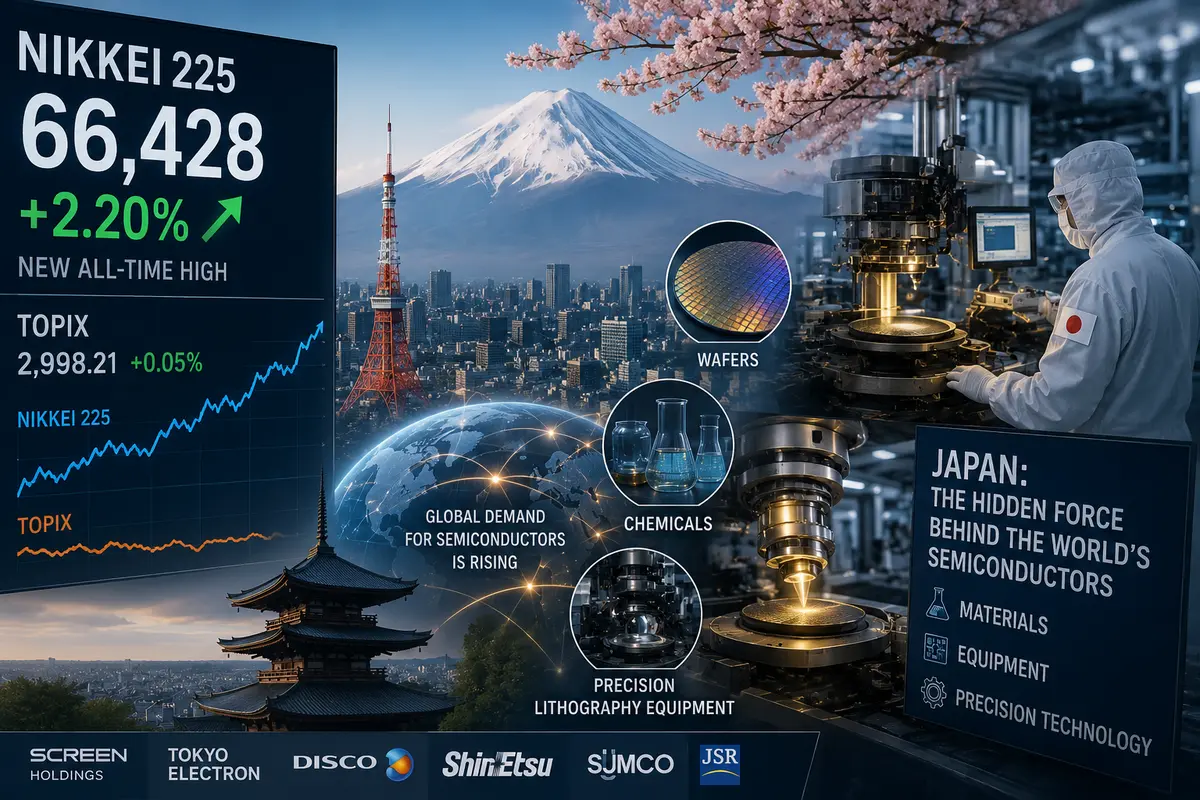
Japan’s Nikkei 225 gained 2.2 percent, reaching 66,428 points — another historic record.
But unlike the Korean market, where the rally was broad and aggressive, Japan’s advance was more restrained. The broader TOPIX index barely moved. This suggests that gains were concentrated within a narrow segment: companies tied to chip manufacturing and semiconductor equipment.
Japan occupies a unique position in the global semiconductor ecosystem. It does not produce memory chips at Samsung’s scale, nor does it design AI accelerators like Nvidia. But it manufactures the critical components without which neither Samsung nor Nvidia could operate: chemicals, wafers, and precision lithography equipment.
When global demand for semiconductors rises, Japanese suppliers become some of the primary beneficiaries. Nikkei’s record highs are not the result of a Japanese economic miracle — they are the echo of the silicon fever sweeping the world.
The Iranian Shadow: Why China Is Falling While Korea Rises
While Japan and Korea celebrated records, Chinese markets moved into negative territory. The Shanghai Composite fell 1.1 percent, the CSI 300 dropped 0.7 percent, and Hong Kong’s Hang Seng lost 0.8 percent despite gains among chipmakers.
Why the divergence?
The answer lies in geopolitics.
China is far more dependent on energy imports than either Korea or Japan. It is the world’s largest oil importer. And while Brent crude remains near ninety-nine dollars per barrel and supply disruptions through the Strait of Hormuz persist, the Chinese economy suffers.
Expensive oil means expensive gasoline, transportation, and manufacturing. That weighs heavily on corporate profits and consumer spending.
At the same time, uncertainty surrounding negotiations with Iran continues to pressure sentiment. Renewed U.S. strikes on Iranian targets have cast doubt on any quick resolution to the conflict. A prolonged war means prolonged expensive oil.
Unlike Korean investors, Chinese investors cannot fully comfort themselves with the idea that their companies are profiting from the AI boom. Chinese technology giants — despite Huawei’s breakthroughs — still cannot compete with Nvidia and Samsung on equal footing. As a result, Chinese markets fall while Korean and Japanese equities climb.
Australia and New Zealand: The Inflation Front
While Asia swung between technological optimism and geopolitical anxiety, Australia and New Zealand received fresh signals from their central banks.
Australia’s S&P/ASX 200 rose a modest 0.2 percent after data showed that core inflation accelerated to 3.4 percent year-over-year in April, up from 3.3 percent in March. That means price pressures are not easing. And it likely means the Reserve Bank of Australia will keep interest rates elevated longer than markets had anticipated.
The Reserve Bank of New Zealand went even further. Rates were held at 2.25 percent, but the accompanying statement carried a distinctly hawkish tone. Policymakers signaled that future hikes may arrive sooner and in greater magnitude than previously expected.
The reason is inflation, which could peak at 4.3 percent later this year. Conflict in the Middle East is pushing fuel and petrochemical prices higher, and even slowing economic growth may not be enough to offset that pressure.
This serves as a warning signal for central banks worldwide: supply-side inflation cannot easily be cured by raising interest rates, yet central banks are forced to act even when their tools are imperfect.
India and Singapore: On the Periphery of the Storm
India’s Nifty 50 gained 0.1 percent. This was not a rally so much as a pause. The Indian market, shaken recently by the collapse of the rupee and central bank interventions, appears to be catching its breath.
Singaporean markets were closed for a public holiday — perhaps for the best, given how contradictory and volatile the day proved to be.
Wednesday on Asian exchanges became the day when technology defeated geopolitics. SK Hynix entered the trillion-dollar club, Samsung hit new records, and the Nikkei reached fresh highs.
But this victory is not final.
Negotiations with Iran continue, oil prices remain dangerously elevated, and inflation in Australia and New Zealand serves as a reminder that price pressures have not disappeared. Markets are living in two worlds simultaneously.
And for now, it remains unclear which world will ultimately prove real — and which is merely an illusion born from the euphoria surrounding artificial intelligence.

Comments
No comments yet. Be the first to share your thoughts!
Authentication Required
You must be logged in to post a comment.