

Bar Pipa
We pay for a post of 10$

Japanese

Silicon Storm: How Japanese and Korean Stocks Are Rewriting History While the World Watches Iran
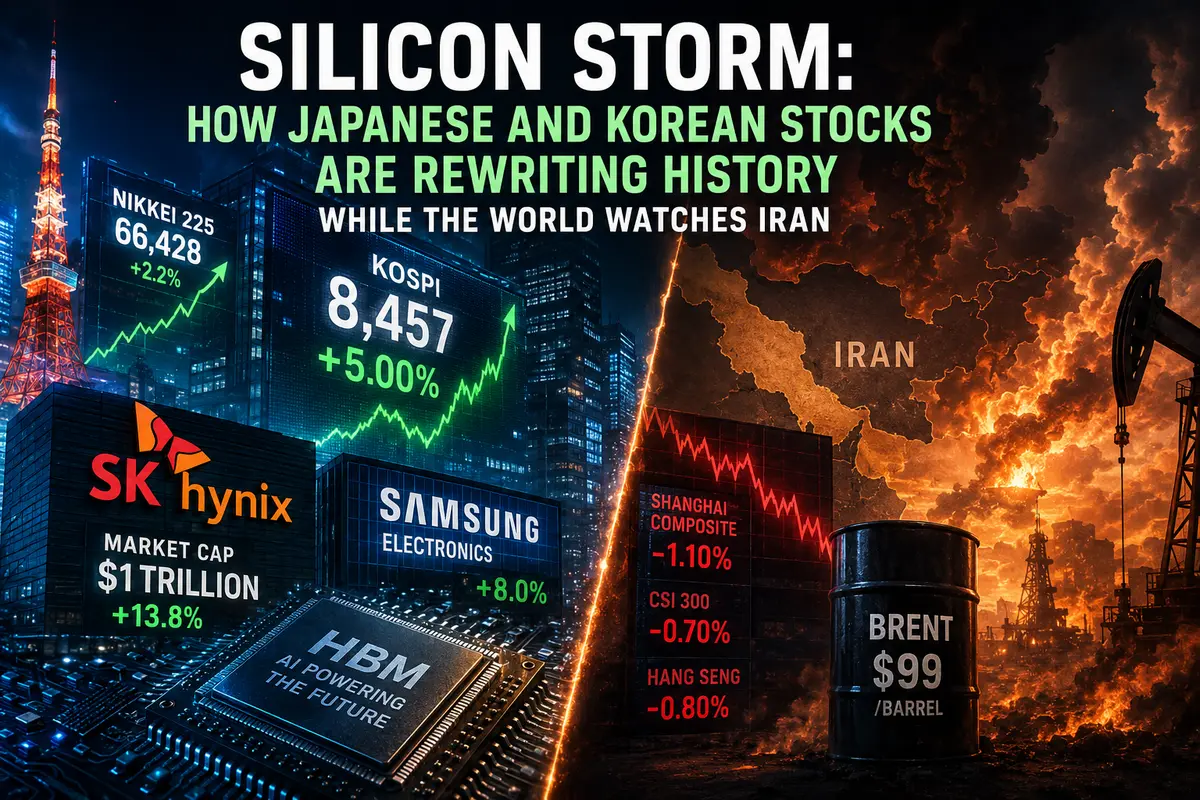
Silicon Storm: How Japanese and Korean Stocks Are Rewriting History While the World Watches Iran

Asian markets on Wednesday looked like two parallel worlds existing within the same universe. In the first world — inhabited by memory chip makers and AI accelerator manufacturers — euphoria reigned. Japan’s Nikkei 225 surged to a new all-time high, climbing above 66,428 points. South Korea’s KOSPI delivered an even more dramatic move, soaring five percent in a single session to reach an unprecedented 8,457 points. Shares of SK Hynix jumped nearly fourteen percent, pushing the company’s market capitalization above one trillion dollars for the first time in history.

In the second world — the world of geopolitics, oil prices, and Middle Eastern negotiations — anxiety dominated. Brent crude hovered around ninety-nine dollars a barrel, Chinese indices declined, and investors nervously scanned the horizon for an answer to a single question: would there be peace with Iran, or more bombing campaigns ahead?

SK Hynix: Crossing the Trillion-Dollar Threshold

There are moments in corporate history that divide eras. For SK Hynix, Wednesday became such a moment. A near fourteen-percent rally in a single session pushed the company’s market capitalization beyond the psychological trillion-dollar mark.

This is more than just a symbolic number. It is an entry ticket into an exclusive club where only two other memory manufacturers reside alongside SK Hynix: Samsung Electronics and Micron Technology. Three companies, three pillars supporting the global memory industry.

The reason behind the rally is both simple and monumental. The world is entering an era in which artificial intelligence requires enormous volumes of high-speed memory. Every new data center, every large language model, every Nvidia accelerator devours gigabytes and terabytes of HBM memory — a segment where SK Hynix holds a leading position.

And as technology giants like Google and Amazon announce fresh investments in AI infrastructure, the Korean memory maker can calmly count its...

Continue reading...
0
0

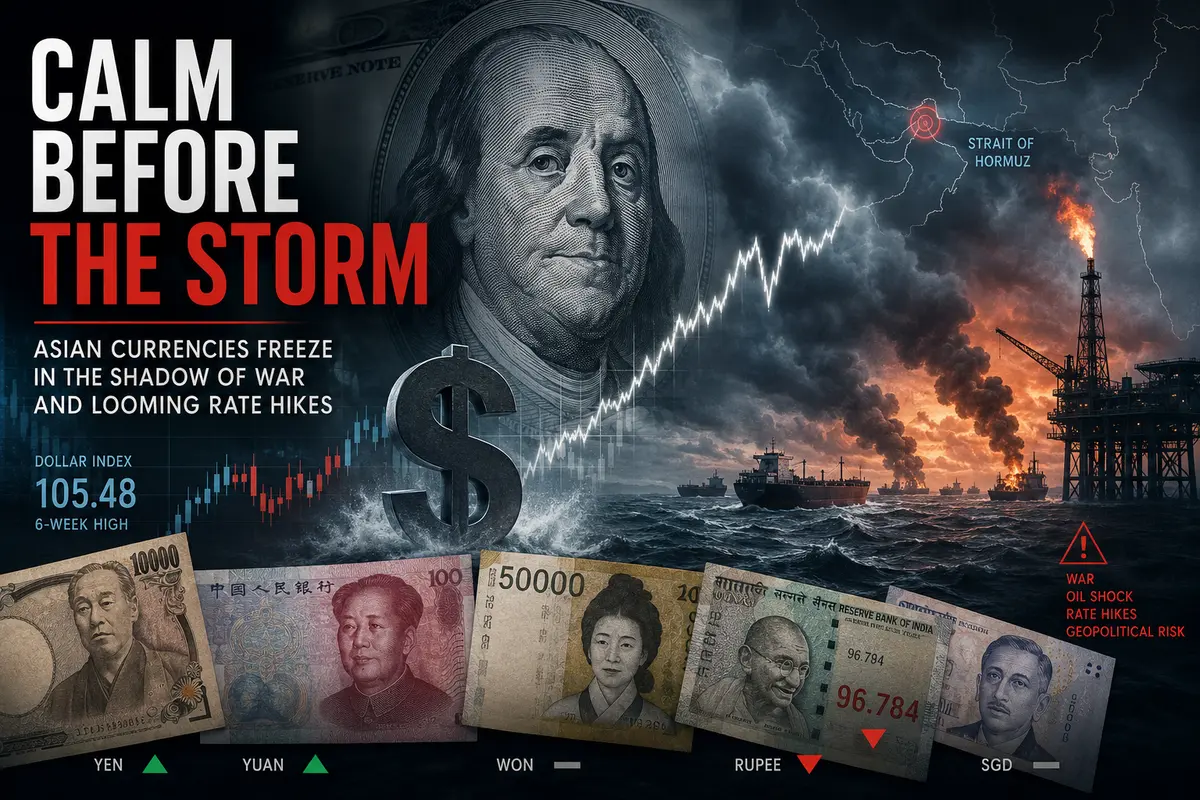
Calm Before the Storm: Asian Currencies Freeze in the Shadow of War and Looming Rate Hikes

Calm Before the Storm: Asian Currencies Freeze in the Shadow of War and Looming Rate Hikes

At first glance, Asian currency markets looked almost sleepy on Wednesday. Most pairs drifted within narrow ranges, traders seemed to hit pause, and price action resembled the heartbeat monitor of a patient under heavy sedation. But this silence is deceptive. Beneath the surface calm of sideways trading lies enormous tension ready to erupt at any moment. When three forces converge at once — a war disrupting one-fifth of global oil supplies, renewed fears of Federal Reserve rate hikes, and deepening geopolitical fractures among major powers — markets do not calm down; they become paralyzed, trying to calculate where the first blow will come from.

The Heavyweight Dollar and the Ghost of Tightening

The dollar index hovering near six-week highs is the perfect barometer of global anxiety. Whenever the world starts shaking, money inevitably rushes into the dollar, and the current situation is no exception. But what makes this moment unique is that the dollar is rising not only as a safe haven, but also as a currency that could become even more profitable. Markets have once again started talking about something they tried to forget over recent months — another Fed rate hike.

This narrative did not emerge out of nowhere. Remarks by Philadelphia Federal Reserve Bank President Anna Paulson, made almost casually on Tuesday evening, became the detonator. When a senior Fed official says it is reasonable for markets to speculate about possible rate increases, it is not just rhetoric — it is a signal. Central bankers rarely speak carelessly. Behind such comments lies growing concern within the Fed over energy-driven inflation, which has begun accelerating again after the conflict with Iran disrupted supplies through the Strait of Hormuz.

Inflation caused by a supply shock is the most unpleasant type of inflation for central banks. It cannot be fought...

Continue reading...
0
0
Navigation menu
