

From Loss to Profit: How Bakkafrost Turned the Tide in a Tough Salmon Market
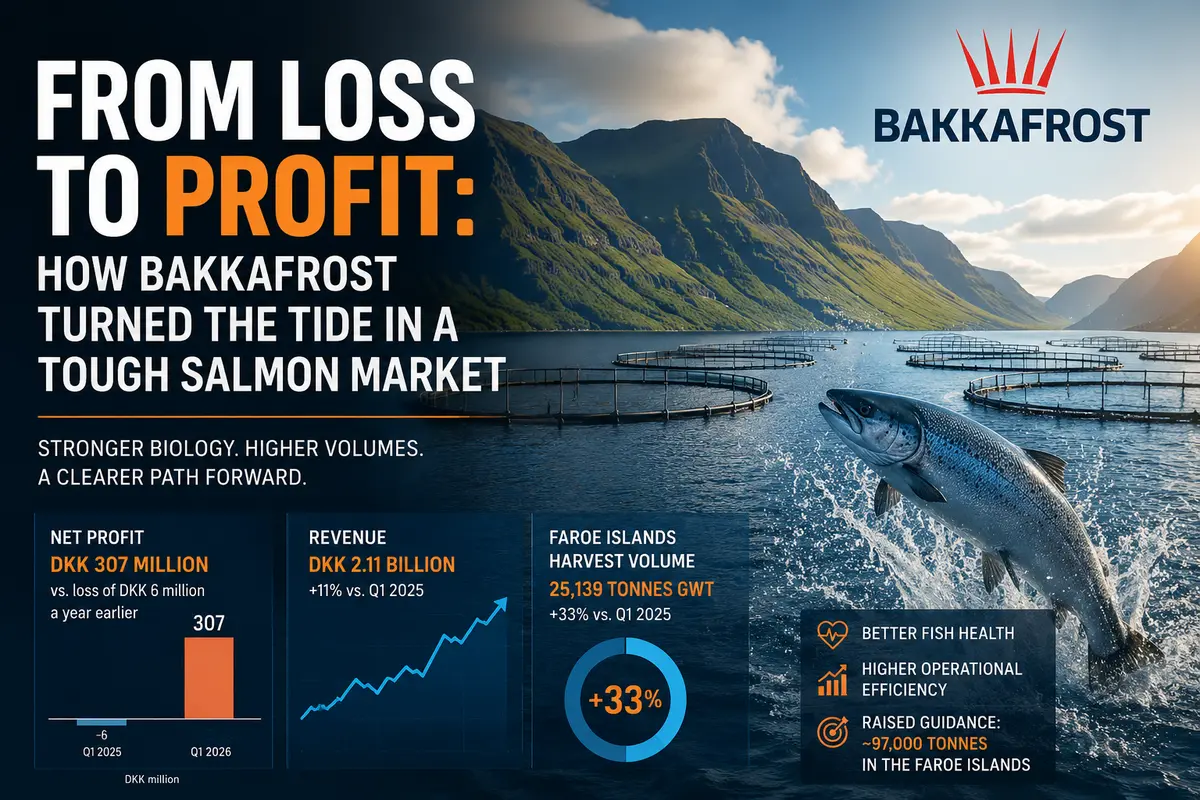
A Quarter That Changed the Narrative
When Bakkafrost published its first-quarter results, the numbers immediately caught the market’s attention. A year ago, the company reported a small net loss. This year, it delivered a net profit of DKK 307 million. On paper, it looks like a sharp turnaround. In reality, the story behind those figures is much deeper than a simple rebound in earnings. What happened over the past twelve months reveals how modern salmon farming has become a battle not only of prices and production volumes, but also of biology, geography, and operational discipline.
At first glance, the broader market environment did not look particularly favorable. Global salmon prices in the quarter were lower than a year earlier. Supply from major producing countries increased significantly, putting pressure on benchmark prices across Europe and Asia. In industries tied to commodities, lower prices usually translate directly into weaker profits. Yet Bakkafrost managed to move in the opposite direction.
That alone says a great deal about the company’s underlying condition.
Why Efficiency Matters More Than Salmon Prices
The key to understanding this quarter lies in one word: efficiency. Not the empty corporate kind of efficiency often repeated in investor presentations, but the real, measurable kind that determines whether a fish farmer makes money or loses it. In salmon farming, efficiency starts with biology. Healthy fish grow faster, require less treatment, consume feed more effectively, and survive in greater numbers until harvest. Sick fish do the opposite. Every biological problem eventually becomes a financial problem.
This is where Bakkafrost’s Faroese operations stood out.
The Faroe Islands are not just another production region on the map. For salmon farming, they are close to ideal. Cold Atlantic waters, strong ocean currents, stable temperatures, and relatively isolated fjords create natural conditions that reduce many of the...
