

From Loss to Profit: How Bakkafrost Turned the Tide in a Tough Salmon Market
A Quarter That Changed the Narrative
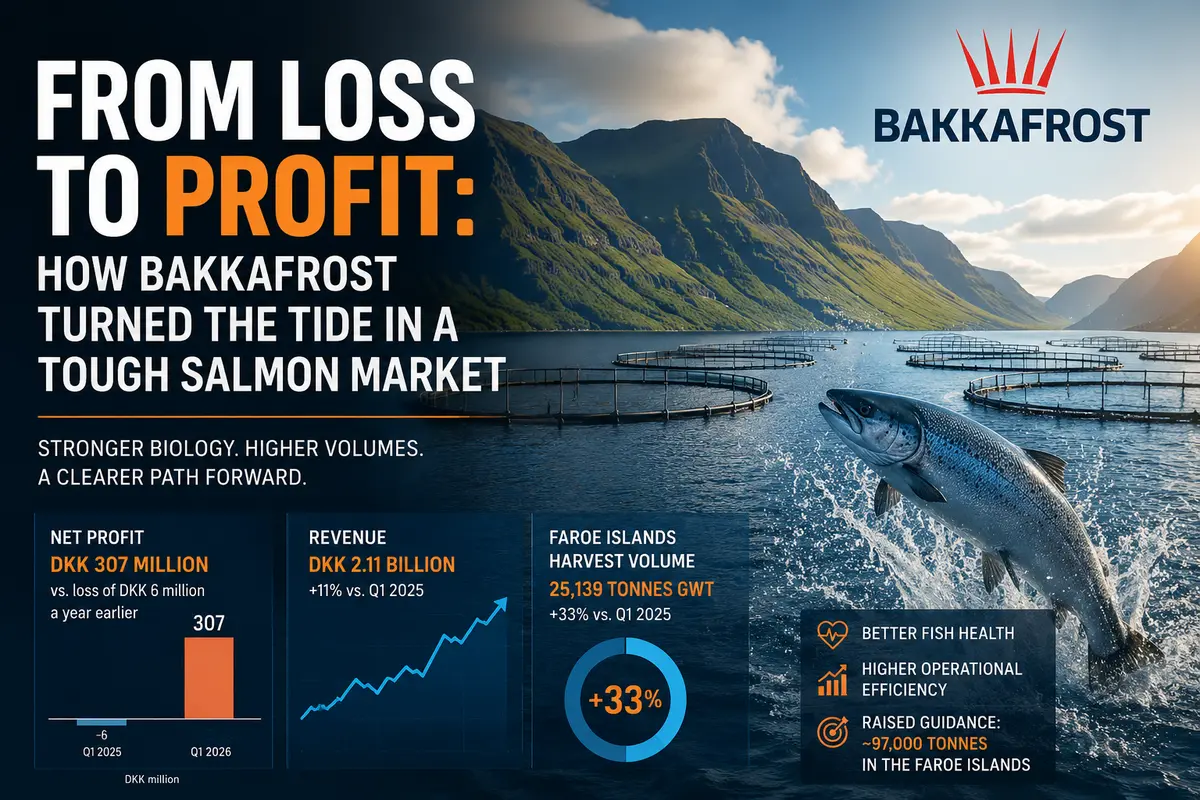
When Bakkafrost published its first-quarter results, the numbers immediately caught the market’s attention. A year ago, the company reported a small net loss. This year, it delivered a net profit of DKK 307 million. On paper, it looks like a sharp turnaround. In reality, the story behind those figures is much deeper than a simple rebound in earnings. What happened over the past twelve months reveals how modern salmon farming has become a battle not only of prices and production volumes, but also of biology, geography, and operational discipline.
At first glance, the broader market environment did not look particularly favorable. Global salmon prices in the quarter were lower than a year earlier. Supply from major producing countries increased significantly, putting pressure on benchmark prices across Europe and Asia. In industries tied to commodities, lower prices usually translate directly into weaker profits. Yet Bakkafrost managed to move in the opposite direction.
That alone says a great deal about the company’s underlying condition.
Why Efficiency Matters More Than Salmon Prices
The key to understanding this quarter lies in one word: efficiency. Not the empty corporate kind of efficiency often repeated in investor presentations, but the real, measurable kind that determines whether a fish farmer makes money or loses it. In salmon farming, efficiency starts with biology. Healthy fish grow faster, require less treatment, consume feed more effectively, and survive in greater numbers until harvest. Sick fish do the opposite. Every biological problem eventually becomes a financial problem.
This is where Bakkafrost’s Faroese operations stood out.
The Faroe Islands are not just another production region on the map. For salmon farming, they are close to ideal. Cold Atlantic waters, strong ocean currents, stable temperatures, and relatively isolated fjords create natural conditions that reduce many of the biological risks faced elsewhere. While producers in other regions regularly battle sea lice outbreaks, algae blooms, jellyfish invasions, and disease pressure, Faroese farms benefit from an environment that is naturally more stable.
Bakkafrost has spent years building its operations around those advantages. The company controls much more of its production chain than many competitors. It produces feed, operates hatcheries, farms fish at sea, processes salmon, and exports finished products worldwide. That level of integration matters because it gives management tighter control over quality, costs, and biological performance.
The Faroe Islands Became the Company’s Profit Engine
The results became visible in the first quarter.
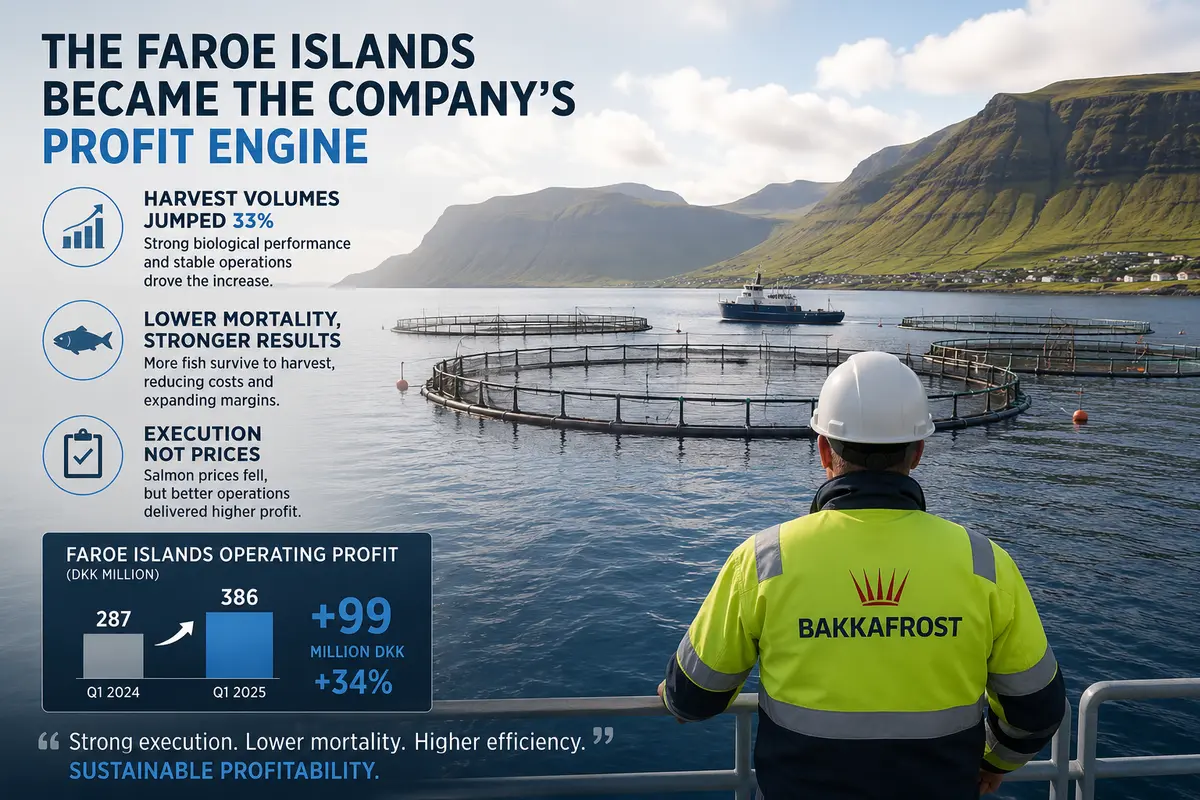
Harvest volumes in the Faroe Islands jumped by thirty-three percent. That is an enormous increase for a mature aquaculture business. Such growth does not happen by accident. It usually means several things went right simultaneously: fish survival improved, growth rates remained strong, and operational disruptions stayed under control.
In salmon farming, mortality is one of the most important indicators investors watch. Every fish that dies before harvest represents wasted feed, wasted labor, and lost revenue. High mortality can destroy profitability even during periods of strong market prices. Lower mortality, on the other hand, has a compounding effect. More fish survive to harvest size, average production costs decline, and margins expand.
That is exactly what appears to have happened at Bakkafrost.
The Faroese division generated DKK 386 million in operating profit compared with DKK 287 million a year earlier. The increase was not driven by higher salmon prices. Prices actually moved against the company. The improvement came from stronger execution.
And that is an important distinction.
Commodity businesses usually depend heavily on favorable market cycles. When prices rise, profits rise. When prices fall, margins disappear. The strongest companies are those capable of remaining profitable even when market conditions become difficult. Bakkafrost’s quarter suggests the company belongs in that category.
Scotland Remains the Weak Spot
At the same time, the report also showed that salmon farming remains an unpredictable business where geography can determine success or failure.
While the Faroese segment delivered excellent results, the Scottish operations continued to struggle badly. The contrast between the two regions could hardly be sharper.
In Scotland, Bakkafrost posted an operating loss of DKK 63 million. Only a year earlier, the division had generated a profit. Management openly blamed biological problems and operational incidents, which in the salmon industry usually means some combination of disease, fish health complications, environmental stress, or elevated mortality.
Scottish salmon farming has faced mounting challenges in recent years. Warmer waters, algae events, parasite pressure, and weather volatility have made operations increasingly difficult. Unlike the Faroe Islands, where cold ocean currents create highly favorable conditions, Scottish farming sites often operate in more fragile environments.
The entire Scottish industry has been under pressure because of these issues. Producers have repeatedly faced criticism over fish welfare, environmental management, and mortality levels. Costs have risen sharply as companies spend more on treatments, technology, and preventive measures.
Bakkafrost entered Scotland hoping to replicate the success it achieved in the Faroe Islands. But transferring a successful farming model from one region to another is not simple. Biology does not always cooperate. Conditions differ, ecosystems differ, and local risks differ.
The company’s guidance for Scotland reflects that reality. Management kept its full-year harvest forecast unchanged at around 20,000 tonnes. That is not the language of aggressive expansion. It is the language of stabilization. Right now, Scotland is less a growth engine and more a problem that needs containment.
Falling Prices Could Not Stop Revenue Growth
Still, the strength of the Faroese operations more than compensated for those losses.
Revenue rose by eleven percent to DKK 2.11 billion despite weaker salmon prices. That point deserves attention because it highlights a broader trend in the global salmon market.
Demand for salmon continues to grow worldwide, particularly in Asia. China has become one of the most important growth markets for the industry. Rising incomes, changing diets, and increasing interest in premium seafood products have created powerful long-term demand trends. Even when short-term oversupply pressures prices, consumption continues expanding.
The problem in the first quarter was not weak demand. It was excessive supply.
Norwegian producers increased harvests. Chilean exporters shipped more fish. Other farming regions also raised production. For a period, the market simply had more salmon than it could comfortably absorb at previous price levels.
As a result, benchmark prices declined by around five percent.
For many producers, that would have created immediate pressure on profitability. But Bakkafrost offset the decline through higher harvest volumes and better operational performance. In effect, the company compensated for lower prices by producing more fish more efficiently.
Raised Guidance Sent a Strong Signal to Investors
That is why management felt confident enough to raise guidance for the Faroe Islands from 92,000 tonnes to around 97,000 tonnes for the full year.
A guidance increase may sound like a technical detail, but markets pay close attention to such decisions. Companies rarely raise production forecasts unless they see strong biological conditions continuing. In salmon farming, visibility is never perfect. Fish health can deteriorate unexpectedly. Weather can shift. Disease outbreaks can appear suddenly. When management publicly increases targets, it usually means internal indicators are looking very strong.
The additional 5,000 tonnes expected from the Faroe Islands could translate into hundreds of millions of kroner in extra revenue depending on future market prices. More importantly, it signals confidence.
And confidence matters in an industry where uncertainty is constant.
Why Bakkafrost Still Stands Out in Global Aquaculture
The broader significance of Bakkafrost’s results extends beyond one quarter or even one company. The report demonstrates how the competitive landscape in aquaculture is evolving. The winners are increasingly those with the best biology, the best farming environments, and the strongest operational discipline.
Scale alone is no longer enough.
Some producers operate enormous farming networks but struggle with recurring biological crises. Others benefit from exceptional natural conditions but fail to optimize operations. The strongest companies combine both advantages: favorable environments and disciplined execution.
Bakkafrost’s Faroese business currently appears to sit in that category.
Of course, risks remain. Salmon prices could weaken further if global supply continues expanding. Scottish operations could deteriorate again. Biological events can emerge with little warning. Aquaculture will never become a completely predictable industry.
But this quarter showed something important: Bakkafrost can remain highly profitable even in a less favorable pricing environment.
That may ultimately be the most valuable takeaway from the report.
A year ago, the company was struggling to generate meaningful earnings. Today, it is producing solid profits while increasing production guidance and operating in a weaker market. That is not the result of luck or temporary market conditions. It reflects a business that has strengthened its core operations and improved its ability to navigate volatility.
And in salmon farming, where biology and markets can change quickly, that resilience may be the single most important advantage a company can have.

Comments
No comments yet. Be the first to share your thoughts!
Authentication Required
You must be logged in to post a comment.