

Tokyo Records and an Oil Pullback: How Asian Markets Are Celebrating Hopes for Peace
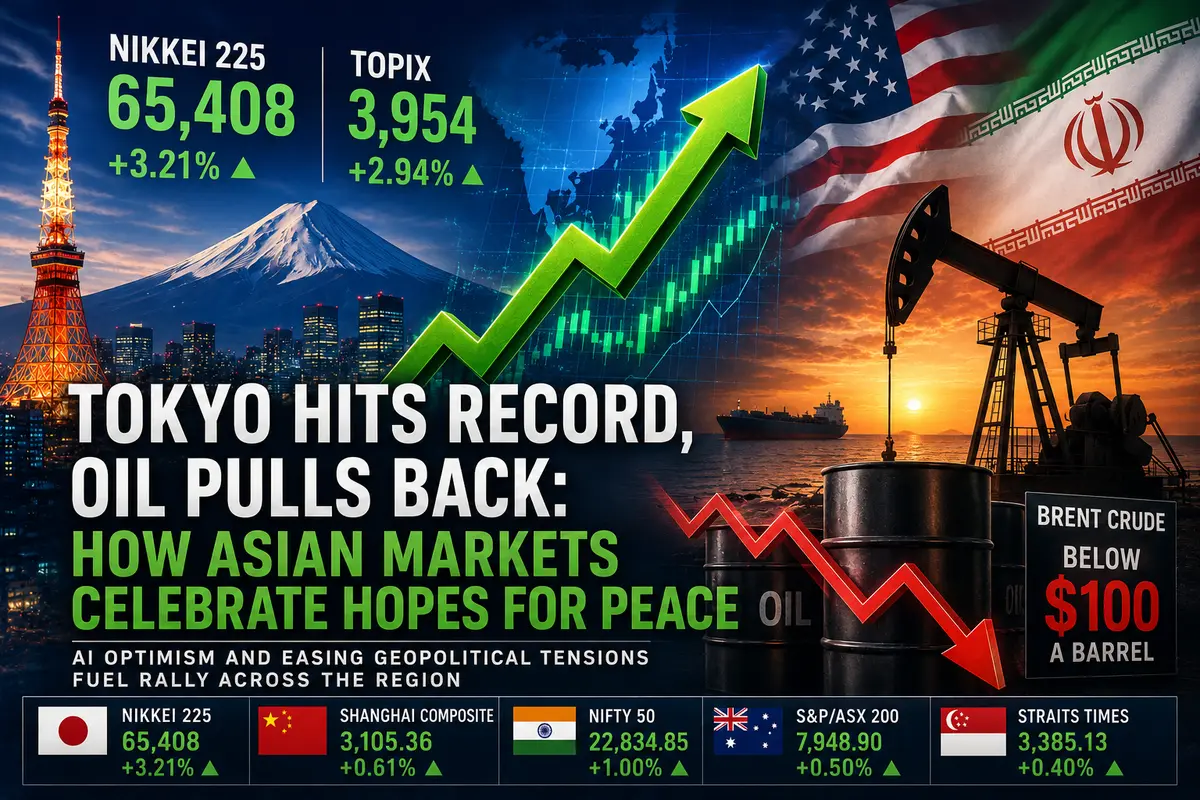
Monday began on Asian stock exchanges in a way not seen for a very long time. Japan’s Nikkei 225 soared to the skies, hitting a fresh all-time high of 65,408 points. The TOPIX followed closely behind, also rewriting the record books. Chinese indexes moved higher. Australia, Singapore, and India all painted their screens green. And all of this unfolded against the backdrop of a U.S. market holiday, with the world’s biggest players absent from their desks. Left to themselves, Asian markets staged a rally driven by the intersection of two powerful forces: renewed optimism surrounding artificial intelligence and hopes for an end to the Iran conflict.
Tokyo Records: When the Nikkei Storms the Heavens
Japan’s stock market traded on Monday as if no global crisis existed. The Nikkei 225 gained more than three percent during the session, reaching a level that would have seemed фантастical just a year ago. TOPIX, the broader gauge of Japan’s economy, climbed to nearly 3,954 points, also setting a historic record. This was not merely growth — it was a display of strength.
The driving force behind Tokyo’s rally was shares of companies tied to semiconductors and artificial intelligence. Renesas Electronics and Rohm both surged by ten percent. This was not abstract optimism but a direct spillover from Wall Street, where U.S. semiconductor companies staged their own rally late last week after upbeat earnings and forecasts. Nvidia set the tone, and now Japanese suppliers and partners have picked up the baton.
Japan, long viewed as a fading economic power trapped in deflation, has suddenly found itself in an ideal position to profit from the AI boom. Japanese firms produce critical components for chips — substrates, chemicals, and precision equipment. No TSMC or Samsung factory can operate without them. And as global demand for computing power skyrockets, Japanese manufacturers are emerging as some of the biggest beneficiaries. The Nikkei reaching historic highs is not an anomaly; it reflects the reality that the world has entered an era of total digitalization, and Japan has found its place within it.
The Iran Factor: Peace Rewriting the Rules of the Game
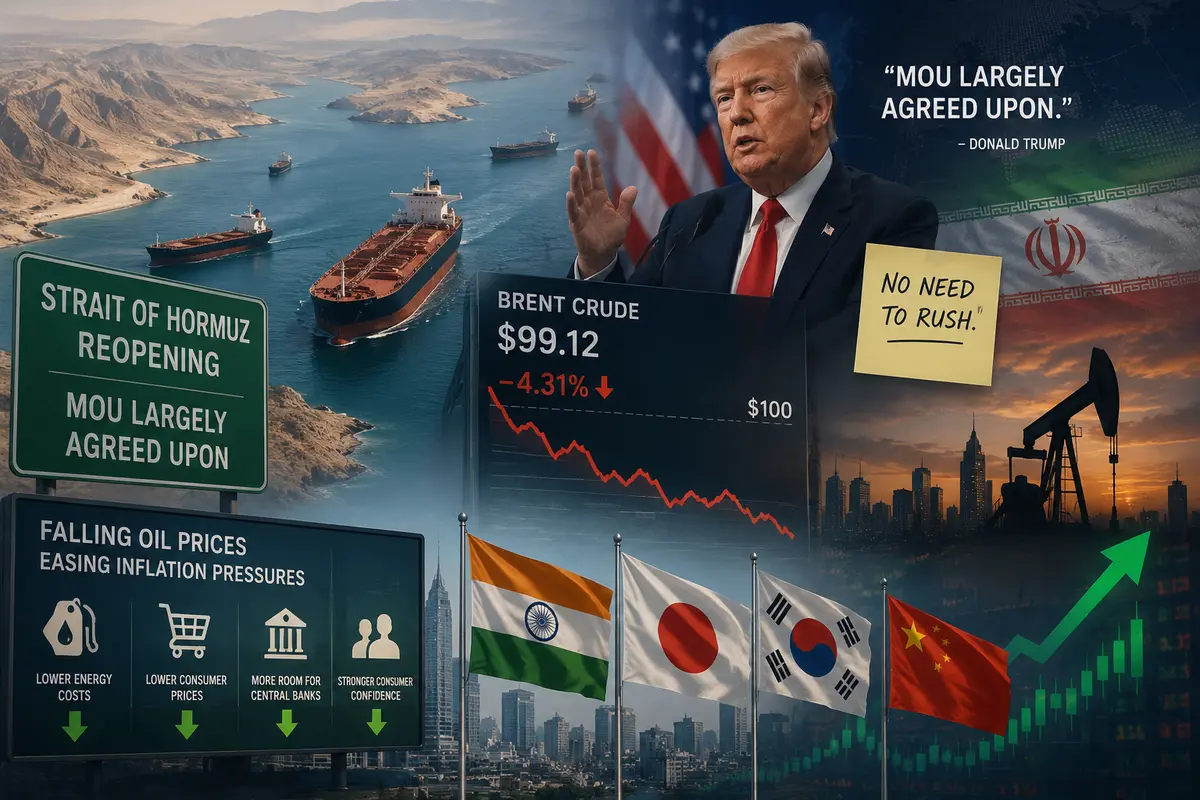
But technology is only half the story. The other half came from the Middle East. Over the weekend, Donald Trump stated that a memorandum of understanding on reopening the Strait of Hormuz was “largely agreed upon.” For Asian markets, which have spent months suffering from high oil prices and inflation fears, those words sounded like music.
Brent crude plunged more than four percent, breaking below the psychologically critical $100-per-barrel mark. That decline instantly changed the macroeconomic landscape. Expensive oil had been the main source of inflationary pressure forcing central banks around the world to threaten higher interest rates. High oil prices squeezed consumers, raised business costs, and drove up food and transportation prices. Now, with crude falling, those fears have begun to retreat.
For Asian economies, many of which are net energy importers, falling oil prices are like the cancellation of a draconian tax. India, Japan, South Korea, and China all benefit from every dollar shaved off a barrel of oil. Inflationary pressure eases, central banks gain more room to maneuver, consumers keep more money in their pockets, and stock markets — as mirrors of future profits — rise accordingly.
However, Trump immediately added a note of caution. He warned that there was no need to “rush” into a final agreement. That prompted traders to remain wary of sudden reversals. Markets have learned this lesson the hard way: Iranian negotiations have collapsed at the last minute more than once before. And today’s optimism, despite its strength, remains fragile.
China, Australia, India: Echoes of the Rally
Chinese markets, although not posting gains as spectacular as Japan’s, also finished higher. The Shanghai Composite rose six-tenths of a percent, while the CSI 300 added a full percent. For Chinese investors struggling through a prolonged property crisis and sluggish domestic demand, any improvement in the global backdrop provides relief. Falling oil prices for China — the world’s largest crude importer — mean lower industrial and transportation costs, as well as reduced inflationary pressure that has constrained the People’s Bank of China’s ability to stimulate the economy.
Australia’s S&P/ASX 200 gained half a percent, Singapore’s Straits Times added four-tenths, and India’s Nifty 50 jumped a full percent at the open. Markets in Hong Kong and South Korea were closed for holidays, but there is little doubt they would have joined the rally had trading been open.
What makes this synchronized rise important is that it is not tied to any single local story. This is not a Korean rally sparked by Samsung news or an Indian rally driven by comments from the RBI governor. It is a broad, regional surge rooted in global factors that affect everyone.
Nasdaq Futures: The AI Bet Continues
While Asian markets rallied, U.S. index futures were moving higher as well. Nasdaq futures jumped more than one percent as investors continued rotating into artificial intelligence and semiconductor stocks. The move that began on Wall Street late last week extended into Asia and, judging by futures, appears ready to return to America on Tuesday when trading resumes after the holiday.
The technology sector is currently acting as a magnet pulling in capital from around the world. Investors no longer see AI as a temporary trend or speculative bubble, but as a fundamental economic transformation comparable to the arrival of the internet or electricity. And they are willing to pay a premium for companies at the forefront of that transformation. Nvidia, TSMC, Renesas, and Rohm are all beneficiaries of this massive shift. And as long as earnings reports continue confirming strong demand for AI infrastructure, the technology rally is likely to continue.
Caution Mixed With Optimism
Despite the positive mood sweeping through Asian markets on Monday, analysts warn that it is too early to relax. Markets remain highly sensitive to headlines related to Iran negotiations. One diplomatic misstep, one sharp remark from Trump, one rejected ultimatum — and oil prices could surge again, dragging inflation expectations higher and sending stock indexes sharply lower.
In addition, the outlook for global interest rates remains uncertain. Yes, lower oil prices reduce inflationary pressure. But core inflation, stripped of energy costs, may remain stubbornly persistent. The Federal Reserve and other central banks will closely monitor incoming data before softening their rhetoric. Markets that are currently celebrating hopes for peace could quickly reverse course if macroeconomic data starts delivering unpleasant surprises.
Monday became a day when the stars aligned for Asian markets. Technological optimism, fueled by Nvidia’s results, coincided with geopolitical optimism sparked by Trump’s comments. The Nikkei at all-time highs, oil below $100, Nasdaq futures in the green — just weeks ago, such a picture seemed impossible. Yet days like this remind us that markets are driven not only by fear and greed, but also by the ability to see beyond current problems toward the outlines of a better future. The only question is how real that future will prove to be.

Comments
No comments yet. Be the first to share your thoughts!
Authentication Required
You must be logged in to post a comment.