

Vietnam Beachhead: Why Samsung Is Building a $1.5 Billion Factory

There is a certain irony in the fact that, at the height of a geopolitical crisis — while the world watches Iranian negotiations and anxiously awaits U.S. inflation data — Samsung is calmly and methodically laying the foundation for a new factory in Vietnam. No panic, no loud statements — just dust on a construction site in Thailand’s Thai Nguyen province and two hundred engineers who, since April, have been preparing the ground for another technological leap.
The investment totals 39 trillion Vietnamese dong, or roughly $1.5 billion. It will become Samsung’s first semiconductor testing plant ever built on Vietnamese soil. And its emergence says far more about the global restructuring of the chip industry than all the headlines about trade wars combined.
Traditional Chips: The Invisible Heroes of the Digital Age
When people talk about semiconductor shortages, they usually picture cutting-edge AI processors, high-performance HBM memory, and Nvidia accelerators. But reality is more complicated. Samsung’s new facility will focus on what industry insiders call “legacy” chips — mature, traditional technologies.
These are the previous generations of DRAM and NAND memory chips that never make headlines, yet without them no car starts, no router powers on, and no washing machine runs.
The paradox is that these chips are currently in severe shortage. While Samsung, SK Hynix, and Micron chase massive profits from supplying memory for AI data centers, traditional customers — smartphone makers, laptop manufacturers, and automakers — are left empty-handed. Manufacturing capacity is no longer enough for everyone.
Samsung’s new plant is an attempt to fill that gap. The facility is designed for annual output of 153 billion gigabits of DRAM and 255 billion gigabits of NAND — figures staggering even to veteran semiconductor engineers.
Why Vietnam — Not China, Korea, or the United States
The answer to “why Vietnam?” is both simple and complex.
Simple — because Samsung has invested billions into the country over the past three decades and knows every turn of the local bureaucratic maze. The South Korean giant’s total investments in Vietnam have already exceeded $23 billion. In Thai Nguyen province, where the new plant is being built, Samsung already operates massive smartphone and tablet assembly factories.
This is familiar territory: established government relationships, functioning logistics, and a trained workforce.
Complex — because choosing Vietnam reflects a broader reshaping of the global semiconductor map. China, once the world’s primary manufacturing hub, is becoming increasingly risky due to trade wars and sanctions. The United States, despite generous CHIPS Act incentives, remains expensive and suffers from a shortage of skilled labor. Korea may be Samsung’s home base, but costs there continue to rise.
Vietnam offers a unique combination: political stability, proximity to existing Korean manufacturing ecosystems, inexpensive and disciplined labor, and — importantly — convenient export logistics to China and Southeast Asia.
Thai Nguyen: Sixty Kilometers North of Hanoi
The factory location was selected with surgical precision. The industrial park in Thai Nguyen province lies just sixty kilometers north of Hanoi.
Close enough to benefit from the capital’s transportation and logistics infrastructure, yet far enough away that land remains affordable and competition for workers is far less intense than in the suburbs of the megacity.
Construction has already begun. Reuters journalists visiting the site observed heavy machinery and workers actively operating there. Security personnel confirmed: this will indeed be a Samsung factory.
Commissioning is scheduled for November 2027. Two and a half years is standard timing for a project of this scale in the semiconductor industry.
And while concrete hardens in the formwork, Samsung managers are already calculating the next move: reinvesting profits from this facility into building a second plant potentially valued at $2.5 billion.
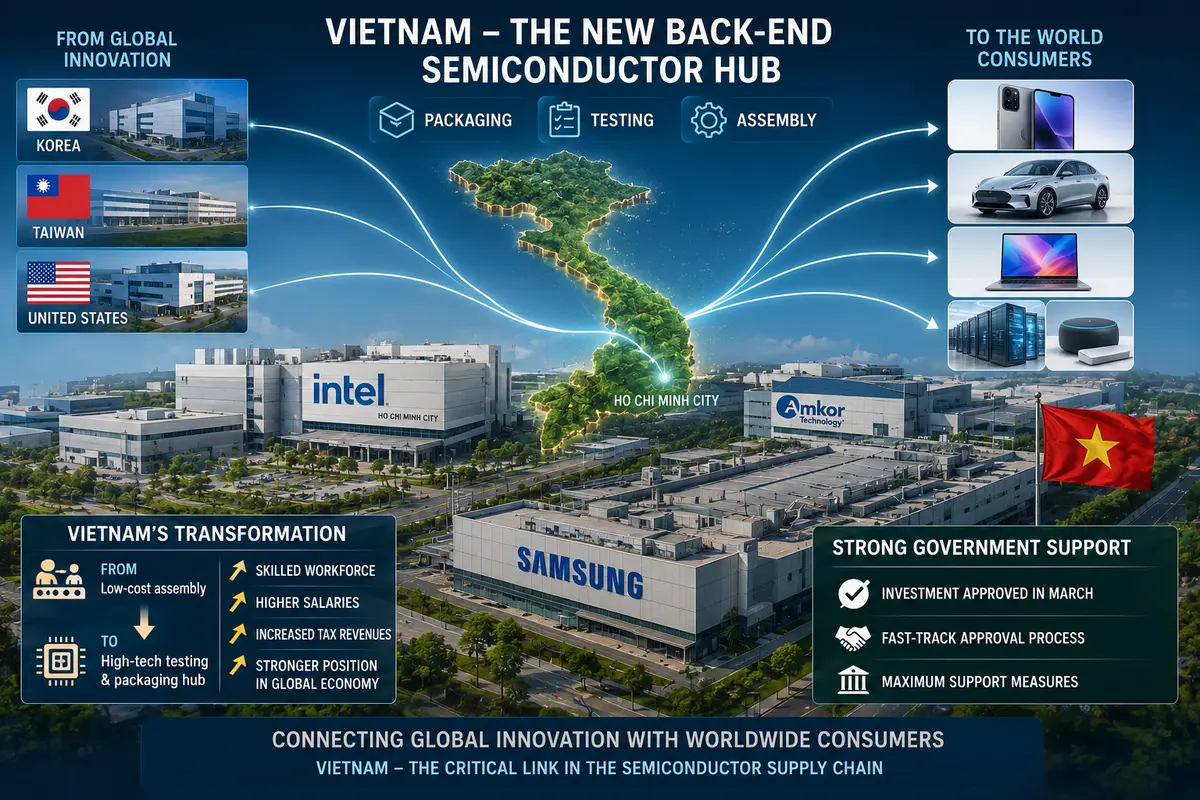
Vietnam as a New Back-End Semiconductor Hub
Samsung is not arriving in empty territory. In recent years, Vietnam has transformed into a key hub for the final stages of semiconductor manufacturing — what industry professionals call the “back-end.”
Chip packaging, testing, and assembly are less technologically complex than lithography, but they are absolutely critical to the supply chain.
Intel has spent years testing and packaging chips at its giant factory in Ho Chi Minh City. Amkor Technology, one of the world’s largest OSAT providers, has also invested heavily in Vietnam. Now Samsung joins them.
Vietnam is becoming the critical link connecting advanced research labs and wafer fabs in Korea, Taiwan, and the United States with end consumers around the world.
For Vietnam, this marks a tectonic shift. The country is evolving from a hub for cheap assembly into a center for high-tech semiconductor testing. That means a different workforce, higher salaries, new tax revenues, and a fundamentally different position in the global economy.
And the Vietnamese authorities clearly understand this. The investment was approved back in March, and judging by the speed of decision-making, the government appears to have rolled out maximum support measures.
$1.5 Billion as a Bet on Continued Shortages
$1.5 billion is not just a large investment. It is a declaration of intent.
Samsung clearly believes that shortages of traditional memory chips will not resolve themselves anytime soon. The AI boom continues to consume ever more manufacturing capacity, leaving traditional customers on increasingly tight supply allocations.
The Korean giant is betting that this imbalance will persist for years.
Moreover, Samsung is building a testing facility for chips manufactured at other fabs — in Korea and potentially, in the future, in the United States. This is a global division of labor: wafer fabrication at home, testing and packaging in Vietnam.
Such a model optimizes costs and helps navigate trade barriers. A chip manufactured in Korea but tested in Vietnam may qualify as having a different country of origin for customs purposes, potentially granting access to markets that impose restrictions on direct Korean imports.
What This Means for the Global Chip Market
For the global memory market, Samsung’s new plant is a signal.
A signal that the shortages tormenting electronics manufacturers over the past several years are not permanent. Market mechanisms are still functioning: high prices stimulate investment, investment expands supply, and increased supply eventually lowers prices.
But this will not happen tomorrow — or even next year.
November 2027 is the date when the factory is expected to begin production. Until then, smartphone makers, laptop manufacturers, and automakers will continue competing for limited chip supplies against giants such as Amazon and Google.
Meanwhile, Vietnam is becoming an increasingly important player on the global technology map. Samsung is investing, Intel is expanding, Amkor is building. The chain reaction has already begun.
And in a few years, when the new plant reaches full capacity, the phrase “Made in Vietnam” stamped on a semiconductor package will no longer surprise anyone.
This $1.5 billion investment is not merely a bet on concrete and machinery. It is a bet on a country transforming itself from an outsider into one of the key beneficiaries of the new technological era — the era in which artificial intelligence demands ever more memory, and memory requires ever more testing.
And Samsung, it seems, already knows exactly where that testing will happen.

Comments
No comments yet. Be the first to share your thoughts!
Authentication Required
You must be logged in to post a comment.