Bar Pipa
We pay for a post of 10$

Others

Big Pip

Who is a Shareholder: Fundamentals of Corporate Ownership in the Global Economy

Who is a Shareholder: Fundamentals of Corporate Ownership in the Global Economy

When you purchase a stock in a company — whether it is a single share of a tech giant like Apple AAPL ... or a massive block of a consumer staple like Nestlé NSRGF ... — you are doing something much deeper than placing a financial bet. You are legally step-typing into the role of a co-owner.

A shareholder (often referred to as a stockholder) is an individual, corporation, or institution that legally owns at least one share of a company’s capital stock.

Collectively, shareholders are the bedrock of the modern capitalist economy. They provide the equity capital that businesses need to innovate, scale, and navigate global markets, and in return, they receive a claim on the company’s future prosperity.

Understanding the delicate balance of power, rights, and duties that define a shareholder is key to understanding how global corporations are governed and how wealth is generated on the world stage.

1. Shares: The Mechanics of Fractional Ownership

To fully appreciate what a shareholder is, we must first look at the financial instrument that binds them to the corporation: the share.

What Do Shares Actually Represent?

A share is a financial security that represents a fraction of ownership in a corporation. When a business incorporates, its total value is partitioned into millions — or sometimes billions — of tiny, equal pieces.

For instance, a company like Microsoft MSFT ... has billions of outstanding shares traded on the Nasdaq. When an investor buys Microsoft shares, they do not own the actual physical desks, servers, or patents of the company directly. Instead, they own a slice of the legal corporation itself, which in turn owns those assets.

This distinction is crucial because of limited liability — one of the most revolutionary concepts in economic history.

What is Limited Liability? If a public corporation goes bankrupt...

Continue reading...
0
0
Big Pip

Understanding the Investor: Roles, Strategies, Rights, and Responsibilities in Global Markets

Understanding the Investor: Roles, Strategies, Rights, and Responsibilities in Global Markets

An investor is an individual or an entity that allocates financial capital with the primary expectation of generating a future financial return. In essence, investors act as the lifeblood of the global capitalist economy. By committing funds to various assets, they provide the necessary liquidity and capital that businesses, startups, and governments need to innovate, scale, and build infrastructure.

The landscape of modern investing spans a massive spectrum of asset classes, from traditional equities and fixed-income securities to global real estate, venture capital, and digital assets. Regardless of their scale, all investors operate under a fundamental economic principle: balancing risk against potential reward.

1. The Spectrum of Investors: From Retail to Institutional Giants

Not all investors are created equal. The global financial markets are shaped by a diverse array of participants, each possessing distinct capital structures, regulatory boundaries, and investment objectives.

Retail Investors: The Power of the Individual

Retail investors are individual, non-professional market participants who invest their personal savings. Historically, retail investors were limited by high brokerage fees and information asymmetry. However, the digital revolution and the rise of zero-commission platforms like Charles Schwab, Robinhood, and eToro have democratized access to Wall Street, London, and Tokyo exchanges.

Retail investors often invest for personal milestones — such as retirement planning through accounts like a 404(b) or an IRA, funding education, or buying property.

While individual retail accounts may be small, their collective power can influence market sentiment and drive significant liquidity into popular consumer brands like Apple AAPL ... , Microsoft MSFT ... , or Nvidia NVDA ... .

Institutional Investors: The Heavyweights of Wall Street

Institutional investors are highly specialized organizations that pool massive amounts of capital from millions of individual clients or taxpayers to invest on a grand scale. Because they execute trades worth hundreds of millions of dollars, their market...

Continue reading...
0
0
Big Pip

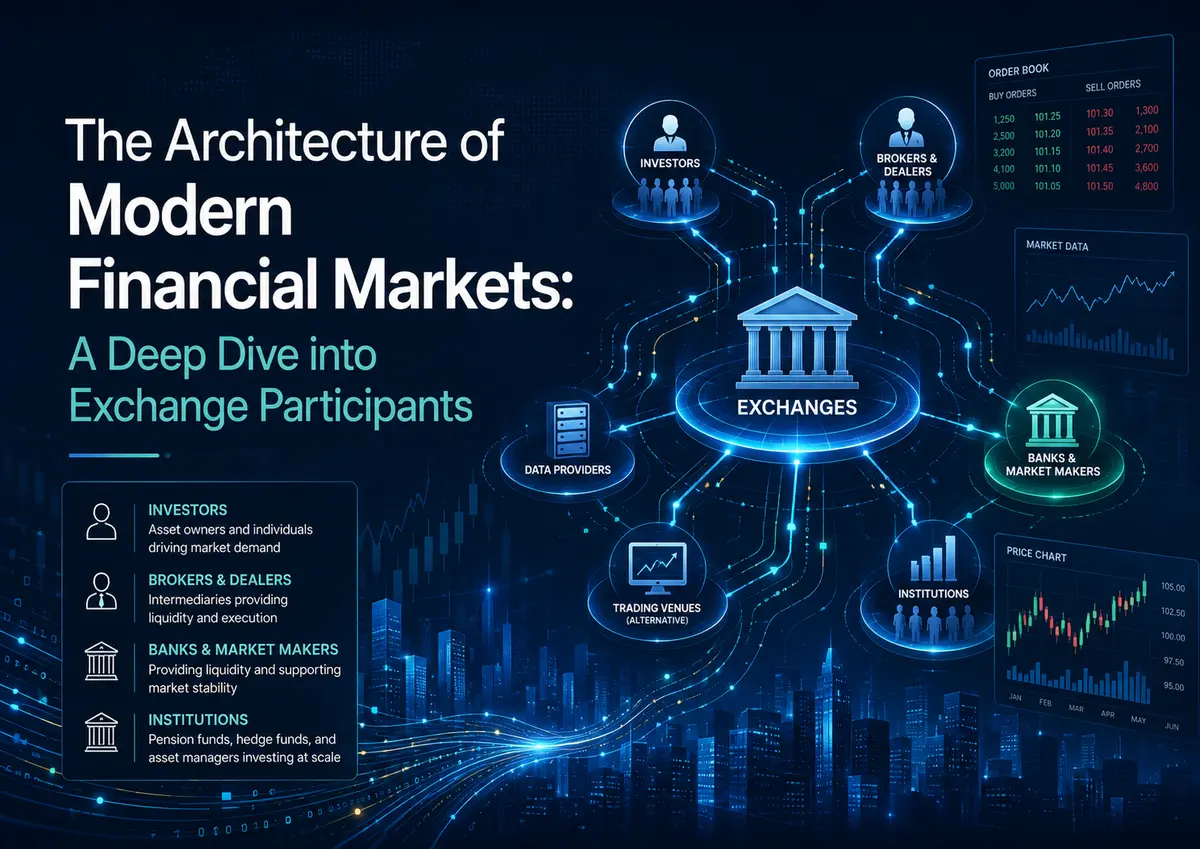
The Architecture of Modern Financial Markets: A Deep Dive into Exchange Participants

The Architecture of Modern Financial Markets: A Deep Dive into Exchange Participants

In its simplest terms, a financial exchange is not just a digital platform or a physical building in New York, London, or Tokyo. It is a highly regulated, living ecosystem where trillions of dollars change hands daily. For this ecosystem to function seamlessly, several distinct groups of participants must interact with one another.

Each player — from the individual trading on their smartphone to massive sovereign wealth funds — has a unique role, risk tolerance, and objective.

Understanding who these participants are and how they collaborate is the first step to understanding how the global economy allocates resources and prices risk.

1. Investors: The Providers of Capital

At the very heart of any exchange are the investors. These are the individuals and entities who supply the capital that fuels global business. Their primary objective is simple: to preserve and grow their wealth over time. However, their strategies, timelines, and scale vary drastically.

Retail Investors: The Democratization of Finance

Retail investors are individual, everyday people investing their personal savings. In the past, high brokerage fees and complex systems kept retail investors on the sidelines of global markets. Today, the rise of digital trading platforms like Robinhood in the US, eToro in Europe, and Tiger Brokers in Asia has democratized access to the markets.

Retail investors often focus on long-term wealth accumulation — such as saving for retirement or a child's education — though a subset engages in active daily trading. They typically invest in familiar global brands like AAPL ... , MSFT ... , or TSLA ... , and use user-friendly instruments like fractional shares (buying a portion of a high-priced stock).

Institutional Investors: The Market Heavyweights

Institutional investors are the massive organizations that pool money from millions of people to invest on a grand scale. Because of the sheer volume of capital they...

Continue reading...
0
0
Big Pip

The Global Brokerage Landscape: A Comprehensive Guide to Market Intermediaries

The Global Brokerage Landscape: A Comprehensive Guide to Market Intermediaries

Introduction to Brokerage Services

Defining the Modern Broker

In the contemporary global financial ecosystem, a broker serves as an indispensable intermediary, executing transactions and providing critical infrastructure for clients across diverse asset classes. Historically operating on physical trading floors with chaotic hand signals, the modern broker has evolved into a highly sophisticated technological enterprise. Today's brokerage firms leverage high-frequency data feeds, complex algorithmic routing networks, and intuitive user interfaces to bridge the gap between individual or institutional investors and centralized marketplaces. Whether operating as an independent digital entity or as a specialized division within an international banking conglomerate, the fundamental mandate of a broker remains unchanged: to facilitate the efficient transfer of assets, risk, and capital under strict regulatory compliance.

The Importance of Intermediaries in Global Finance

Market intermediaries are foundational to the liquidity and efficiency of international capital markets. Without brokers, the search costs for finding a counterparty to buy or sell a specific asset would be prohibitively high, stalling economic activity. By pooling thousands of orders, brokers create deep reservoirs of liquidity, which in turn narrows bid-ask spreads and minimizes transaction costs for all market participants. Furthermore, brokers assume significant operational and counterparty risks, ensuring that transactions clear and settle smoothly according to standardized global protocols. In an interconnected global economy, they act as the gatekeepers of financial integrity, enforcing strict Anti-Money Laundering (AML) and Know Your Customer (KYC) regulations to prevent illicit capital flows and maintain systemic stability.

Stock and Exchange Brokers (Equity and Commodity Intermediaries)

Core Functions and Order Execution

Stock and exchange brokers operate directly within organized public exchanges such as the New York Stock Exchange NYSX ... , NASDAQ, the London Stock Exchange LSEGY ... , and the Tokyo Stock Exchange (TSE). Their primary duty is the precise, rapid execution of client orders — ranging from...

Continue reading...
0
0
Tom Maffin

Dollar Under Pressure: Inflation Data Rewrites the Fed’s Policy Outlook

Dollar Under Pressure: Inflation Data Rewrites the Fed’s Policy Outlook

Introduction: The First Decline in Prices in Six Years

Tuesday became a day that could go down in the history of the US economy. Consumer prices in the United States declined in June for the first time in six years. The core inflation measure remained almost unchanged, easing pressure on the Federal Reserve to raise interest rates. The Consumer Price Index fell by 0.4% month over month, while analysts had expected a decline of only 0.1%. Annual inflation stood at 3.5%, compared with the forecast of 3.8%.

The dollar reacted immediately. The US Dollar Index ( USD ... ) fell by 0.52% to 100.76, reaching an intraday low of 100.60. Markets began revising their interest-rate expectations and pricing in a more accommodative Federal Reserve policy.

Against this backdrop, however, Federal Reserve Chair Kevin Warsh delivered a hawkish statement, saying that the central bank’s committee was “intolerant” of persistently high inflation and remained determined to curb price growth, which had been elevated for five years.

This contradiction between the economic data and the Fed’s rhetoric creates considerable uncertainty. In this article, we will examine every aspect of the inflation report, its impact on the dollar, and the outlook for monetary policy.

Inflation Data: Figures That Surprised the Market

CPI Declines by 0.4%

The Consumer Price Index declined by 0.4% month over month in June, while analysts had expected a fall of only 0.1%. This was the first decrease in six years, making the report a historic event.

The decline in prices was driven by several factors, including lower energy prices, reduced transportation service costs, and a degree of easing in price pressures across other categories.

Annual Inflation Falls Below Forecasts

On an annual basis, inflation stood at 3.5%, compared with the forecast of 3.8% and the previous reading of 4.2%. This represents...

Continue reading...
0
0
Lin Brings

China’s Smartphone Market: A Battle of Giants in an Era of Expensive Components

China’s Smartphone Market: A Battle of Giants in an Era of Expensive Components

Introduction: The Market Is Declining, but the Leaders Are Growing

The second quarter of 2026 was a period of sharp contrasts for China’s smartphone market. Total shipments fell by 4.3% to 66 million units. This decline was driven by rising prices for memory chips and other components, which forced many manufacturers to increase the prices of their finished products. Under these conditions, consumers became more cautious, choosing either to postpone purchases or switch to cheaper alternatives.

However, there were two bright spots in this otherwise gloomy picture. Apple and Huawei were the only manufacturers that managed to increase their shipments. Huawei’s sales rose by 20%, while Apple’s increased by 25%. Both companies maintained strong positions in the upper end of the market, while their competitors struggled with weakening demand.

In this article, we will examine the reasons behind Huawei’s and Apple’s success, assess the impact of rising component prices, and explore what may lie ahead for China’s smartphone market in the second half of 2026.

The Overall Picture: The Market Declines by 4.3%

Reasons for the Downturn

The main reason for the market decline was the rising cost of memory chips and other components. Demand from the artificial intelligence industry led to supply shortages and higher component prices. This, in turn, increased production costs, which manufacturers passed on to consumers.

Higher smartphone prices, particularly in the mid-range and budget segments, discouraged some buyers. Amid economic uncertainty, consumers became more price-sensitive and began postponing purchases.

Regional Characteristics

China’s smartphone market is the largest in the world, and its performance influences global trends. A decline in shipments in China may signal a broader slowdown in the global smartphone market.

Nevertheless, China remains a critical market for every major manufacturer, and success or failure there has a significant impact on their global positions.

...

Continue reading...
0
0
Big Pip

The Global Cryptocurrency Market: A New Era of Finance

The Global Cryptocurrency Market: A New Era of Finance

The cryptocurrency market represents a relatively new, entirely digital segment of the global financial ecosystem dedicated to the exchange of virtual assets. At their core, cryptocurrencies are digital assets that utilize advanced cryptography to guarantee transaction security, prevent double-spending, and manage the creation of new units on a decentralized ledger known as a blockchain. Over the past decade, this market has evolved from a niche cypherpunk experiment into a foundational pillar of the modern financial system, capturing the intense attention of retail investors, institutional funds, and technological innovators worldwide.

Unlike traditional financial markets like the New York Stock Exchange (NYSE) or the London Stock Exchange, the cryptocurrency market operates 24/7 without geographical limitations or opening and closing bells. This borderless nature allows users from any continent to trade digital assets seamlessly at any time of day or night. Trading primarily occurs on centralized and decentralized cryptocurrency exchanges (such as Binance, Coinbase, or Uniswap), providing global gateways where users can buy, sell, or swap thousands of different digital assets with high liquidity.

Major Cryptocurrencies Shaping the Industry

While there are currently tens of thousands of cryptocurrencies in existence, the market is largely anchored by a few foundational projects that command the majority of the global market capitalization. Some of the most recognized and widely utilized include:

Bitcoin (BTC): The Digital Gold

As the very first cryptocurrency, Bitcoin paved the way for the entire digital asset revolution. Today, it is widely viewed not just as a medium of exchange, but as a global store of value — often referred to as "digital gold." On the global stage, Bitcoin has seen massive institutional adoption, with publicly traded software companies like MicroStrategy holding billions in BTC, and even sovereign nations like El Salvador adopting it as legal tender. The recent approval of Bitcoin Spot...

Continue reading...
0
0

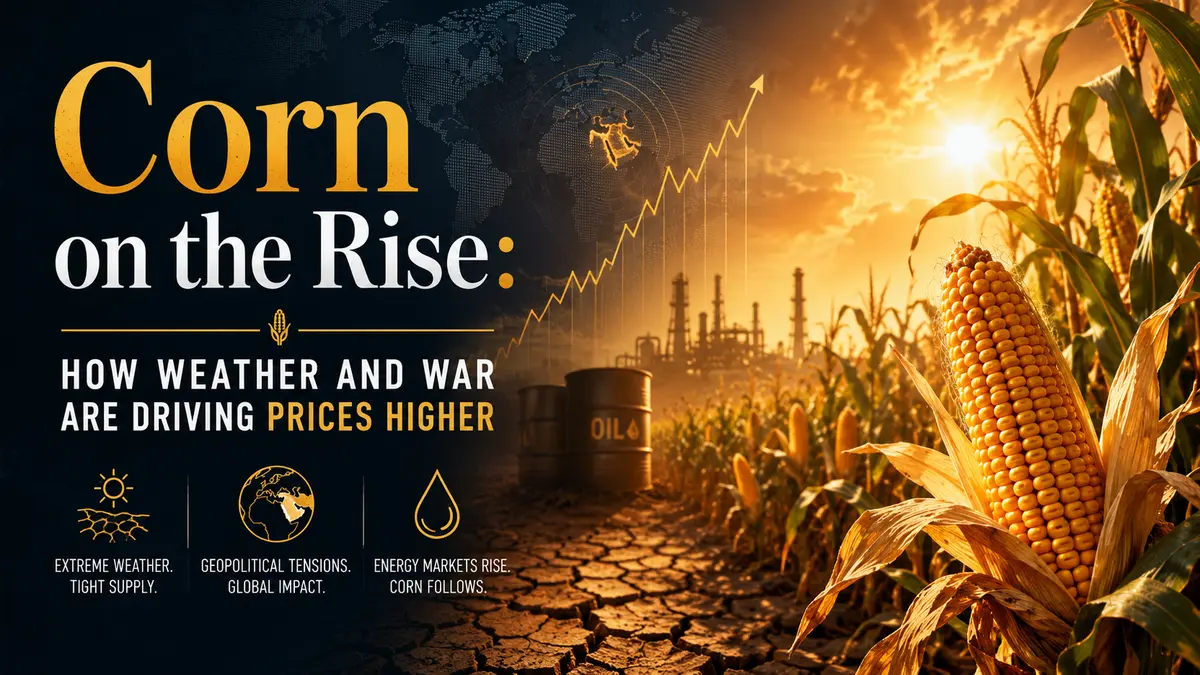
Corn on the Rise: How Weather and War Are Driving Prices Higher

Corn on the Rise: How Weather and War Are Driving Prices Higher

Introduction: A Perfect Storm for the Grain Market

Monday became the day when two completely different factors converged, creating powerful momentum for higher corn prices. Weather forecasts predicting heat and drought across the US Corn Belt, combined with geopolitical tensions in the Middle East that pushed oil prices higher, sent corn futures to their highest levels in more than a month.

The September contract closed 1.5 cents higher at $4.41 per bushel. The new-crop December contract posted an even more impressive gain, rising 2.25 cents to $4.63¼ and reaching an intraday high of $4.69½—the highest level since June 2.

What is driving this rally? Why do weather conditions in American fields and conflict in the Persian Gulf affect the price of corn? And how long could this trend continue? Let us examine this agricultural mystery, in which meteorology, geopolitics, and the biofuel economy are closely intertwined.

The Weather Factor: Heat and Drought Threaten the Harvest

A Critical Period for Corn

July is the month that determines the fate of the US corn harvest. Pollination takes place during this period—a crucial stage that directly affects kernel development. Heat and drought at this time can cause irreversible damage to the future crop.

Forecasters expect hot and predominantly dry weather across the western part of the US Corn Belt this week, with similar conditions potentially continuing into the following week. This is an alarming signal for both farmers and traders.

The Corn Belt is the heart of American agriculture and the region where most of the country’s corn is produced. Iowa, Illinois, Nebraska, and Indiana are among the states at risk. If weather conditions fail to improve, yields could decline significantly.

Moisture Deficits and Their Consequences

A lack of moisture during a critical stage of plant development causes smaller ears to form, while...

Continue reading...
0
0
Big Pip

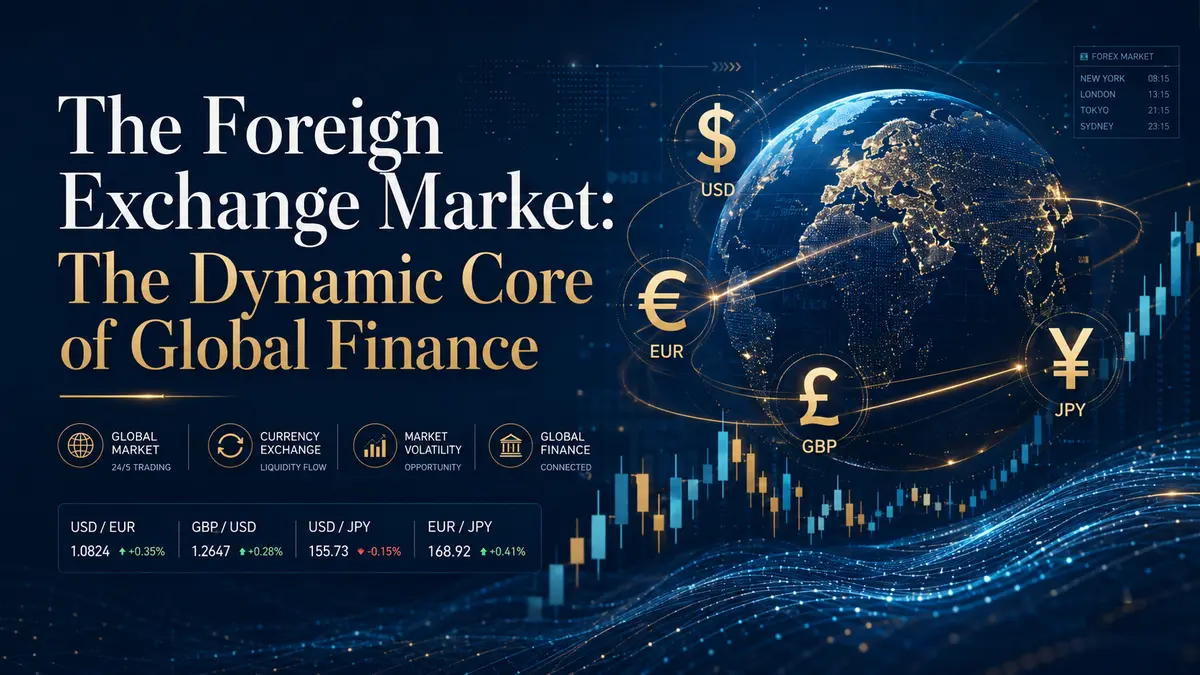
The Foreign Exchange Market: The Dynamic Core of Global Finance

The Foreign Exchange Market: The Dynamic Core of Global Finance

The foreign exchange market, commonly known as Forex or FX, is a highly specialized and massive financial arena dedicated to the exchange of global currencies. Far from being just another sector of finance, it stands as the absolute largest and most liquid financial market in the world, with daily trading volumes frequently exceeding $7 trillion. The Forex market functions as the fundamental mechanism that allows international trade, global investments, and global corporate operations to exist, enabling participants to convert national currencies seamlessly.

A Decentralized, 24-Hour Trading Arena

Unlike traditional stock markets that operate out of centralized physical locations (like the New York Stock Exchange), the Forex market is an Over-The-Counter (OTC) market. This means it has no central physical location or central clearinghouse. Instead, all operations and trades are conducted electronically via a massive, interconnected global network of computers.

Because it relies on this global network, the Forex market operates 24 hours a day, five days a week. The trading day naturally follows the sun, moving seamlessly from one major financial hub to the next. The cycle typically begins in Sydney and Wellington, moves into Tokyo and Hong Kong, transitions to the massive European hubs of London, Zurich, and Frankfurt, and finally closes the day in New York. This continuous operation means the market is highly reactive; an economic event in Asia can trigger massive trading volumes in Europe before the American markets even open.

Key Participants in the Forex Ecosystem

The immense liquidity of the foreign exchange market is driven by a diverse array of participants, each interacting with the market for entirely different strategic reasons — from essential risk management to pure financial speculation.

Commercial and Investment Banks

The interbank market is the foundational layer of Forex. Tier-1 global banks such as JPMorgan Chase, Deutsche Bank, UBS, and...

Continue reading...
0
0
Big Pip

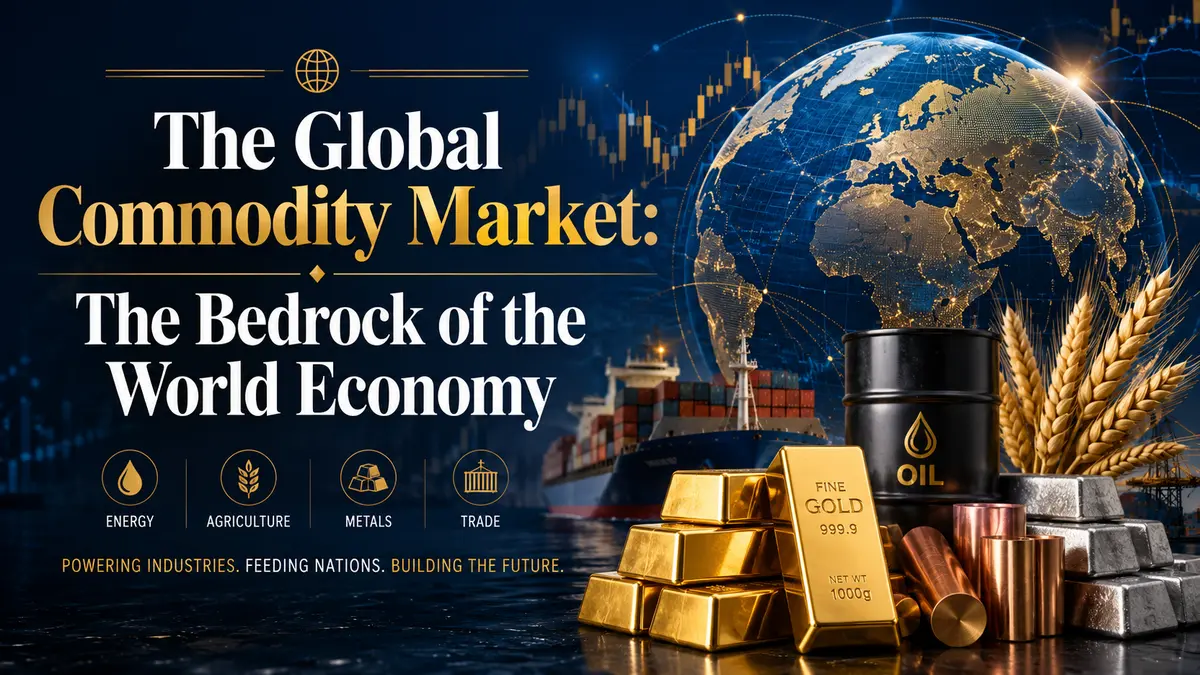
The Global Commodity Market: The Bedrock of the World Economy

The Global Commodity Market: The Bedrock of the World Economy

The commodity market is a vital and dynamic segment of the global financial system dedicated to the trading of physical raw materials and primary agricultural products. Long before the invention of corporate stocks or government bonds, early civilizations were trading grain, spices, and precious metals. Today, this market plays an absolutely indispensable role in the modern global economy. It encompasses a vast spectrum of physical assets — from the crude oil that fuels global logistics to the gold stored in central banks, and the agricultural products that feed billions of people.

Understanding the commodity market requires looking beyond simple financial speculation. It is the fundamental arena where the raw building blocks of the modern world are priced, bought, and sold, setting the baseline costs for virtually every manufactured good and consumer product on the planet.

The Mechanisms of Trade: Spot Markets and Derivatives

Trading on the commodity market occurs through two primary financial mechanisms, catering to both physical consumers of raw materials and financial speculators.

  • The Spot Market: This is the arena for immediate, physical delivery. In the spot market, commodities are bought and sold for cash and delivered immediately (or within a few days) at the current, prevailing market price. For instance, an industrial manufacturer might purchase copper on the spot market because they need the physical metal to maintain factory operations that week.

  • Futures and Options Markets: The vast majority of commodity trading happens via derivative contracts on major global exchanges, such as the Chicago Mercantile Exchange (CME) or the London Metal Exchange (LME). A futures contract is a standardized legal agreement to buy or sell a specific commodity at a predetermined price at a specified time in the future. This allows massive corporations to hedge against price volatility. For example, a major European airline like Lufthansa might...

Continue reading...
0
0
Navigation menu
instaforex banner