

The Architecture of Modern Financial Markets: A Deep Dive into Exchange Participants
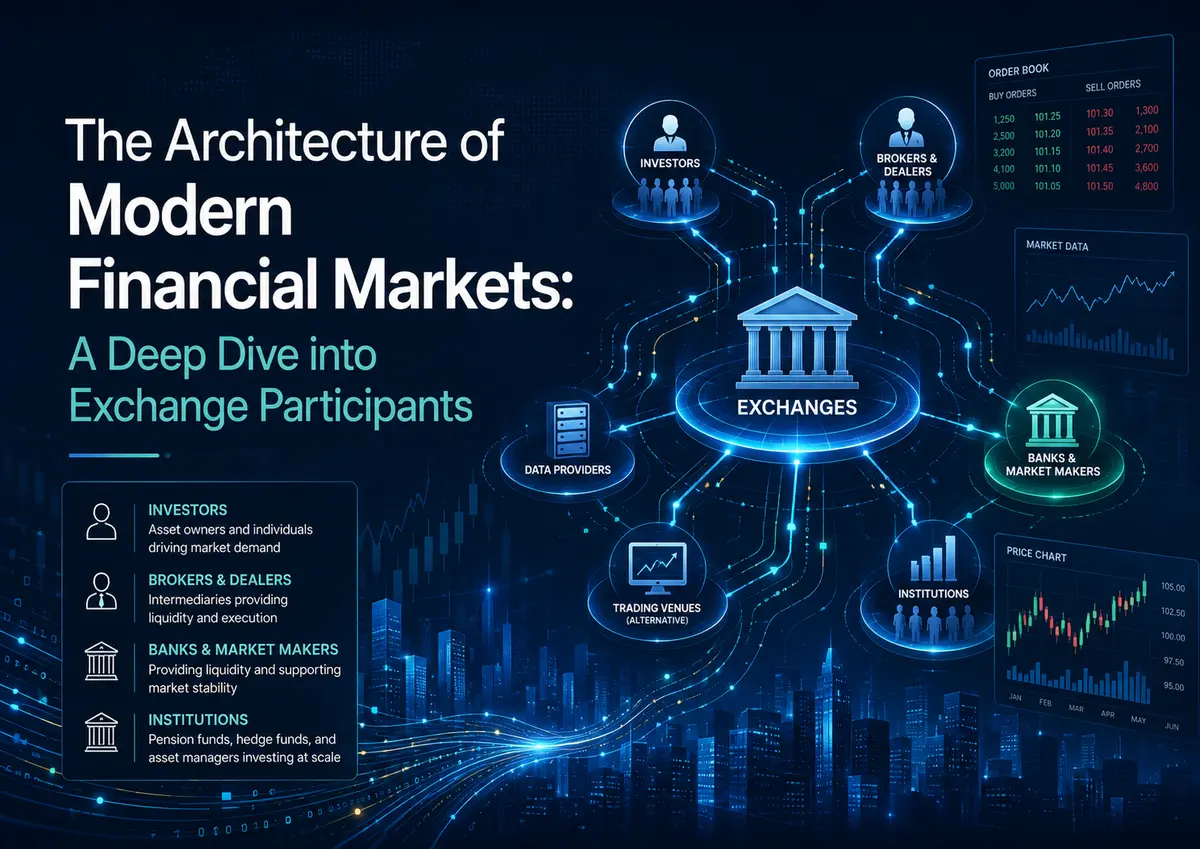
In its simplest terms, a financial exchange is not just a digital platform or a physical building in New York, London, or Tokyo. It is a highly regulated, living ecosystem where trillions of dollars change hands daily. For this ecosystem to function seamlessly, several distinct groups of participants must interact with one another.
Each player — from the individual trading on their smartphone to massive sovereign wealth funds — has a unique role, risk tolerance, and objective.
Understanding who these participants are and how they collaborate is the first step to understanding how the global economy allocates resources and prices risk.
1. Investors: The Providers of Capital
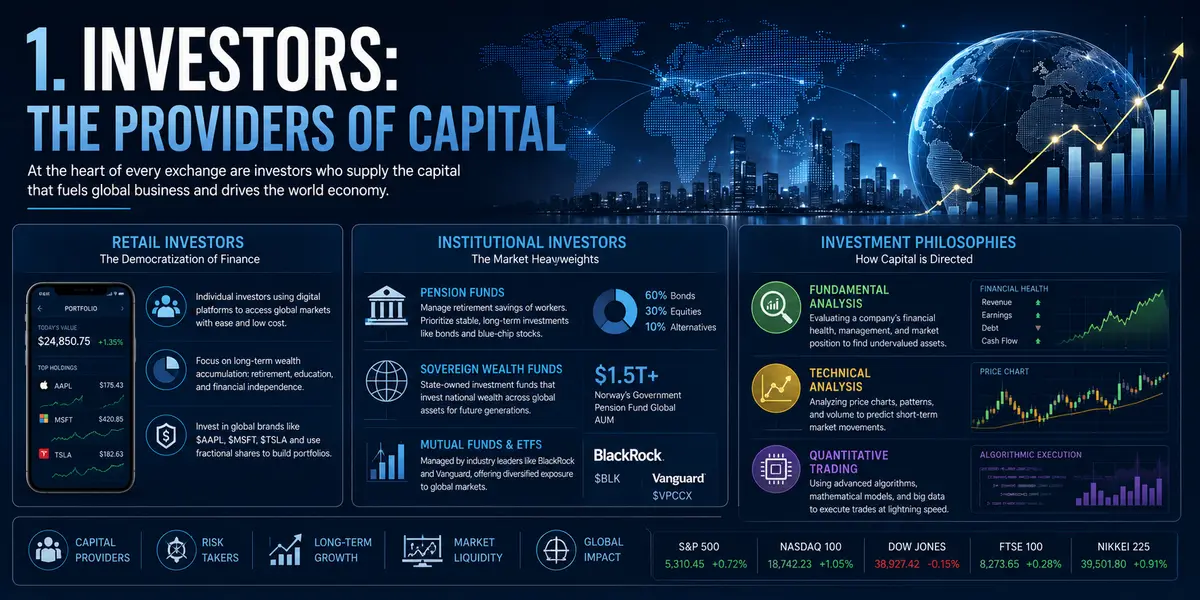
At the very heart of any exchange are the investors. These are the individuals and entities who supply the capital that fuels global business. Their primary objective is simple: to preserve and grow their wealth over time. However, their strategies, timelines, and scale vary drastically.
Retail Investors: The Democratization of Finance
Retail investors are individual, everyday people investing their personal savings. In the past, high brokerage fees and complex systems kept retail investors on the sidelines of global markets. Today, the rise of digital trading platforms like Robinhood in the US, eToro in Europe, and Tiger Brokers in Asia has democratized access to the markets.
Retail investors often focus on long-term wealth accumulation — such as saving for retirement or a child’s education — though a subset engages in active daily trading. They typically invest in familiar global brands like AAPL ... , MSFT ... , or TSLA ... , and use user-friendly instruments like fractional shares (buying a portion of a high-priced stock).
Institutional Investors: The Market Heavyweights
Institutional investors are the massive organizations that pool money from millions of people to invest on a grand scale. Because of the sheer volume of capital they control, their decisions can shift global markets in seconds.
-
Pension Funds: These funds manage the retirement savings of workers (such as the California Public Employees’ Retirement System, or CalPERS). They prioritize highly stable, long-term investments like government bonds and blue-chip stocks.
-
Sovereign Wealth Funds: These are state-owned investment funds. For example, Norway’s Government Pension Fund Global manages over $1.5 trillion of the nation’s oil wealth, investing it across global equities and real estate to secure future generations.
-
Mutual Funds and ETFs: Managed by giants like BlackRock BLK ... or Vanguard VPCCX ... , these funds allow retail investors to buy into diversified portfolios of global assets with a single purchase.
Investment Philosophies: How Capital is Directed
Investors generally align with one of several core strategies to make their decisions:
-
Fundamental Analysis: This is the cornerstone of value investing, famously practiced by Warren Buffett. It involves analyzing a company’s financial health, management team, and market position to determine if its stock is underpriced.
-
Technical Analysis: This approach ignores a company’s inner workings and focuses entirely on market data, price charts, and trading volumes to predict short-term price movements.
-
Quantitative Trading: Used by advanced hedge funds like Renaissance Technologies, this relies on complex mathematical algorithms and supercomputers to execute thousands of trades per second based on statistical anomalies.
2. Issuers: The Seekers of Capital
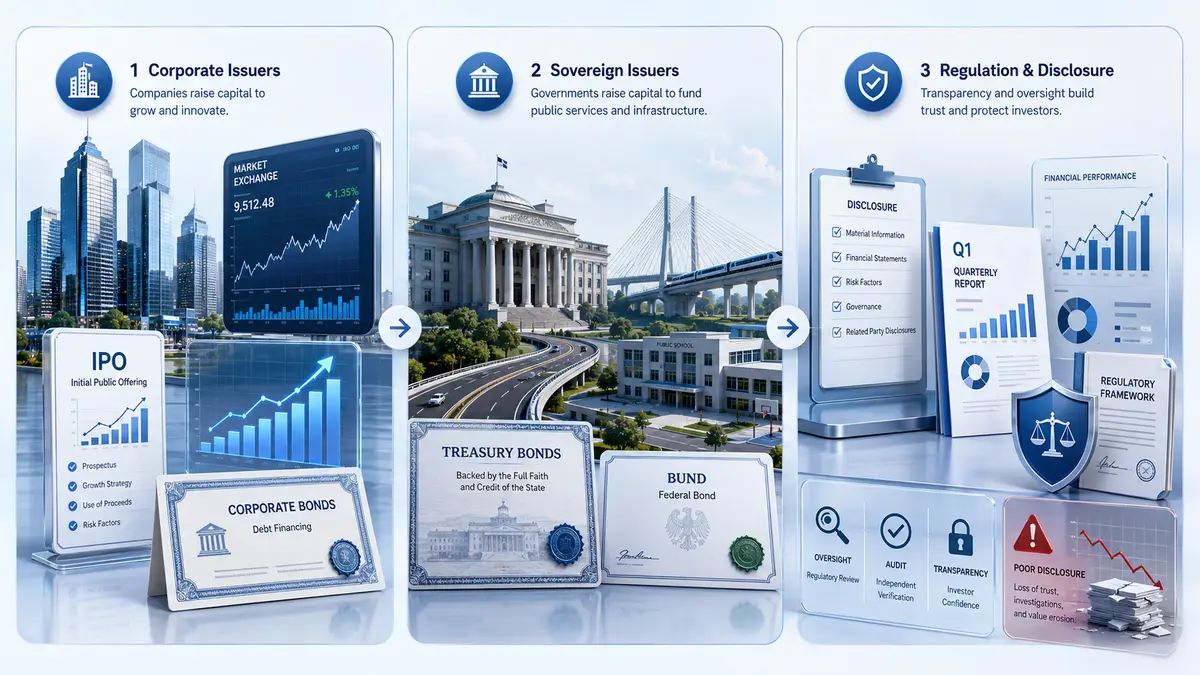
If investors provide the fuel, issuers are the engines that run on it. Issuers are corporations, municipalities, or national governments that need capital to fund projects, build infrastructure, or expand operations. To get this capital, they issue securities to investors.
Corporate Issuers: Scaling Businesses Global
When a private company reaches a certain size and wants to expand rapidly, it often undergoes an Initial Public Offering (IPO). This process turns a private company into a public one, allowing its shares to be traded on global exchanges like the Nasdaq or the London Stock Exchange.
A famous example is the e-commerce giant Alibaba BABA ... , which raised a historic $25 billion during its NYSE IPO in 2014. By issuing shares, Alibaba got the cash it needed to build massive logistics networks, while investors got a slice of the company’s future profits. Corporations can also issue corporate bonds — effectively taking a loan from the market and promising to pay it back with interest over time.
Sovereign Issuers: Funding Nations
Governments also act as issuers when they need to build schools, pave highways, or fund public services. They do this by issuing government bonds.
-
US Treasuries: Issued by the United States government, these are widely considered the safest financial assets in the world because they are backed by the “full faith and credit” of the US government.
-
German Bunds: These serve as the benchmark for low-risk euro-denominated debt across Europe.
Regulatory Responsibilities and Disclosure
Issuing securities is not a free pass to receive cash. In exchange for public funding, issuers must submit to strict regulatory oversight. In the US, the Securities and Exchange Commission (SEC) requires public companies to file quarterly and annual reports detailing their financial performance.
Failure to provide transparent, accurate data can lead to catastrophic collapses, as seen historically in global scandals like Germany’s Wirecard WRCDF ... or America’s Enron, where fraudulent accounting wiped out billions in investor wealth.
3. Brokers: The Vital Intermediaries
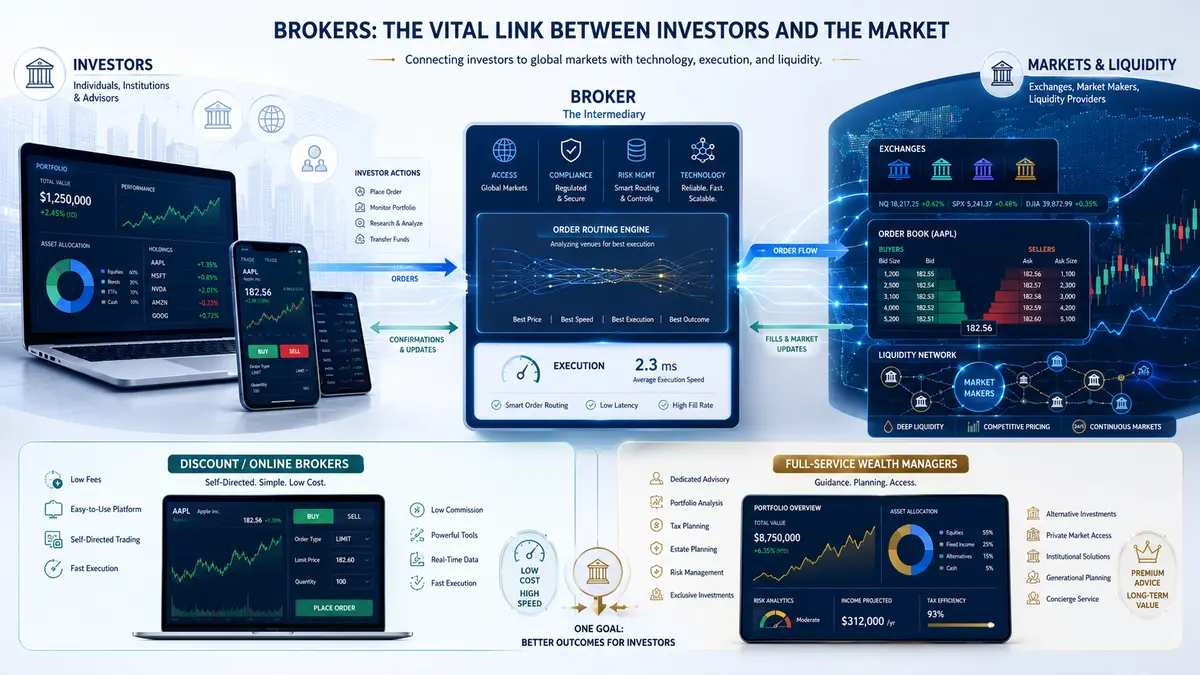
Individual investors and massive institutions do not simply call up the New York Stock Exchange to buy shares. Instead, they must go through a broker. Brokers are licensed intermediaries authorized to buy and sell securities on behalf of clients.
Full-Service vs. Discount Brokers
The global brokerage landscape has split into two distinct paths to serve different client needs:
-
Discount and Online Brokers: Platforms like Interactive Brokers or Charles Schwab focus on execution. They offer low or zero-commission trades, allowing clients to manage their own portfolios online. They are ideal for self-directed retail investors.
-
Full-Service Wealth Managers: High-net-worth individuals often turn to institutions like Morgan Stanley or UBS UBS ... . These brokers charge higher fees but provide personalized investment advice, tax planning, estate management, and access to exclusive private equity deals.
Execution Mechanics and Liquidity
Behind the scenes, modern brokers rely on highly advanced technology. When a retail investor clicks “Buy” on an app, the broker route-planners instantly send that order to the exchange or a market maker (firms like Citadel Securities that constantly quote buy and sell prices to keep the market fluid).
This process, known as order execution, happens in milliseconds, ensuring that buyers and sellers are matched at the best possible market price.
4. Asset and Wealth Managers: The Professional Custodians
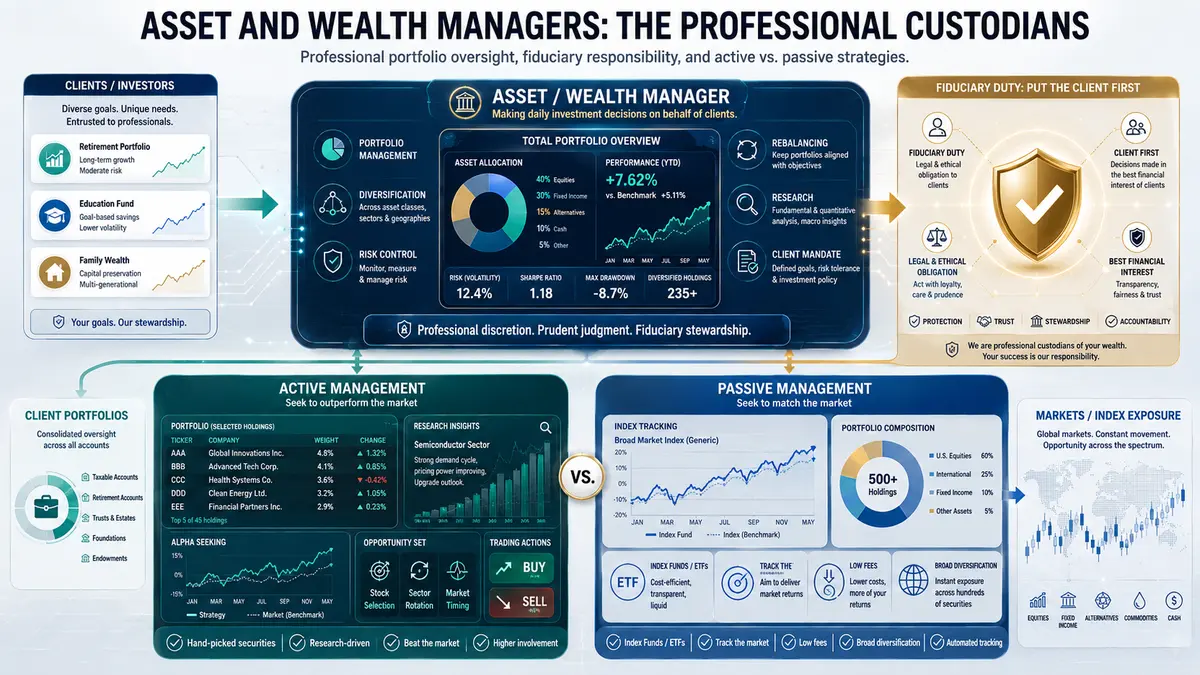
Many investors lack the time, expertise, or emotional detachment required to manage their own money. This is where asset managers (sometimes referred to as trust managers or portfolio managers) come in. They are hired to manage portfolios on behalf of clients, making daily investment decisions based on a pre-agreed mandate.
Fiduciary Duty: Put the Client First
The most critical concept in asset management is fiduciary duty. This is a legal and ethical obligation that requires asset managers to act solely in the best financial interest of their clients, rather than seeking to maximize their own profits.
Active vs. Passive Management
Asset managers generally operate under two major philosophies:
-
Active Management: Portfolio managers try to “beat the market” by hand-picking stocks they believe will outperform. This is the model used by traditional mutual funds and elite hedge funds (like Ray Dalio’s Bridgewater Associates).
-
Passive Management: Rather than trying to beat the market, passive managers aim to match its performance. They do this by setting up index funds or ETFs that automatically track an entire market index, like the S&P 500 ^GSPC ... . Championed by Vanguard’s founder, John Bogle, passive investing has grown massively because it features incredibly low fees.
5. The Charter of Rights: Protecting Market Participants
For any exchange to survive, participants must trust that the game is not rigged. Global regulatory bodies (such as the SEC in the US, the FCA in the UK, and ESMA in Europe) enforce a strict bill of rights to ensure fairness, security, and market integrity.
-
The Right to Equal Trading Conditions: Every participant, from a retail investor with $50 to a hedge fund manager with $5 billion, has the right to trade under the same regulatory rules. This right directly outlaws insider trading — the illegal practice of trading on material, non-public information to gain an unfair advantage.
-
The Right to Liquidity and Free Trade: Participants have the right to buy and sell assets freely without arbitrary blockages or artificial barriers, provided they comply with standard market regulations.
-
The Right to Information Transparency: Investors have the right to access real-time price quotes, trading volumes, and historical data. This prevents price manipulation and ensures that everyone sees the same market price at any given moment.
-
The Right to Guaranteed Settlement: When a transaction is made, the buyer must get the security, and the seller must get the cash. To guarantee this, exchanges use clearinghouses (like the Depository Trust & Clearing Corporation, or DTCC, in the US). The clearinghouse acts as the ultimate guarantor, stepping in to settle the trade even if one of the parties defaults.
-
The Right to Dispute Resolution: If a dispute arises between an investor and a broker, participants have the right to an independent arbitration process (such as those managed by FINRA in the US) to resolve the conflict without needing expensive, long-winded court battles.
-
The Right to Regulatory Protection: Above all, participants are protected by financial laws. Regulators actively monitor markets for predatory behaviors, such as market manipulation, front-running (where a broker executes their own trade before a client’s trade), or Ponzi schemes, keeping the global financial system stable and reliable.








Comments
No comments yet. Be the first to share your thoughts!
Authentication Required
You must be logged in to post a comment.