

Stablecoins Cost Banks Their Deposits: 9 Reasons Banks Are Building Tokenized Deposits

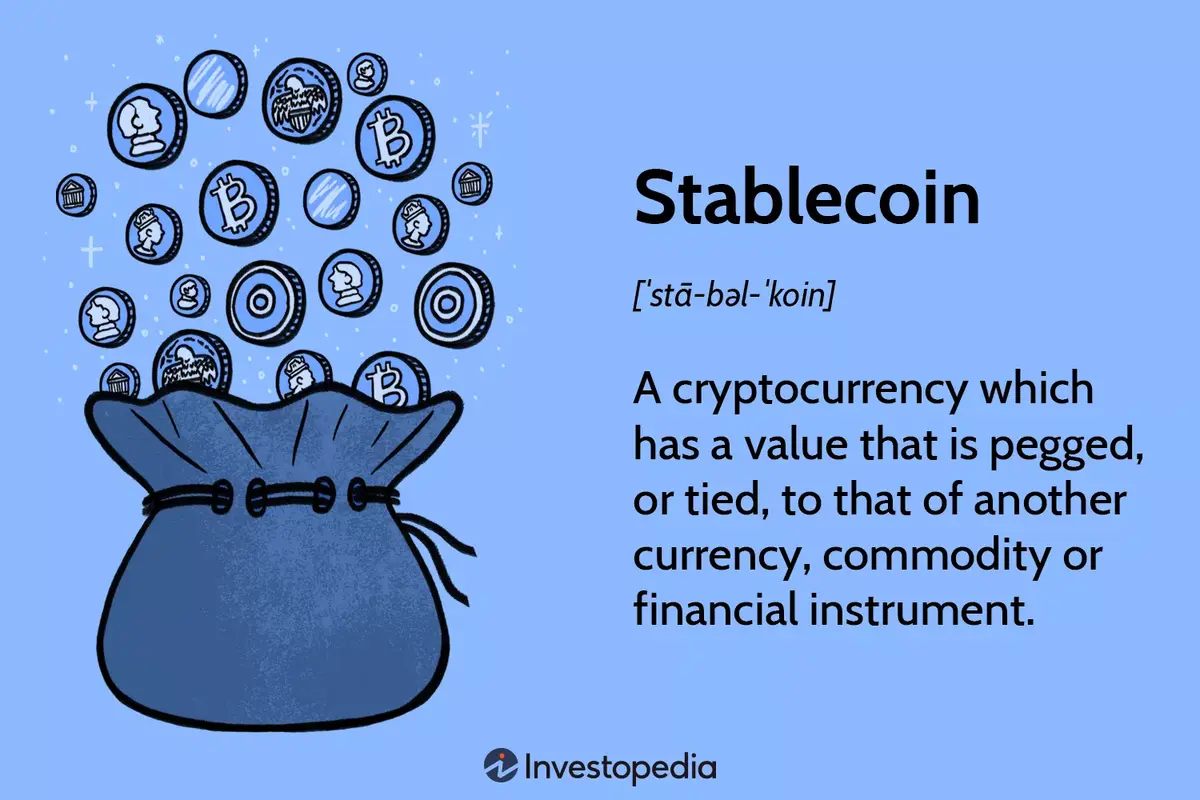
Stablecoins, tokenized deposits, and deposit tokens are all digital dollars, but they are not the same instrument even though many institutions talk about them like they are.
In April, the FDIC proposed something that received minimal coverage outside of law firm memos and discussion from those in the industry. In short, it said, the underlying technology used to record a liability is irrelevant to deposit insurance. Whether a deposit is tracked on a distributed ledger or within a legacy core banking database, it receives identical treatment as long as it satisfies the statutory definition of a deposit.
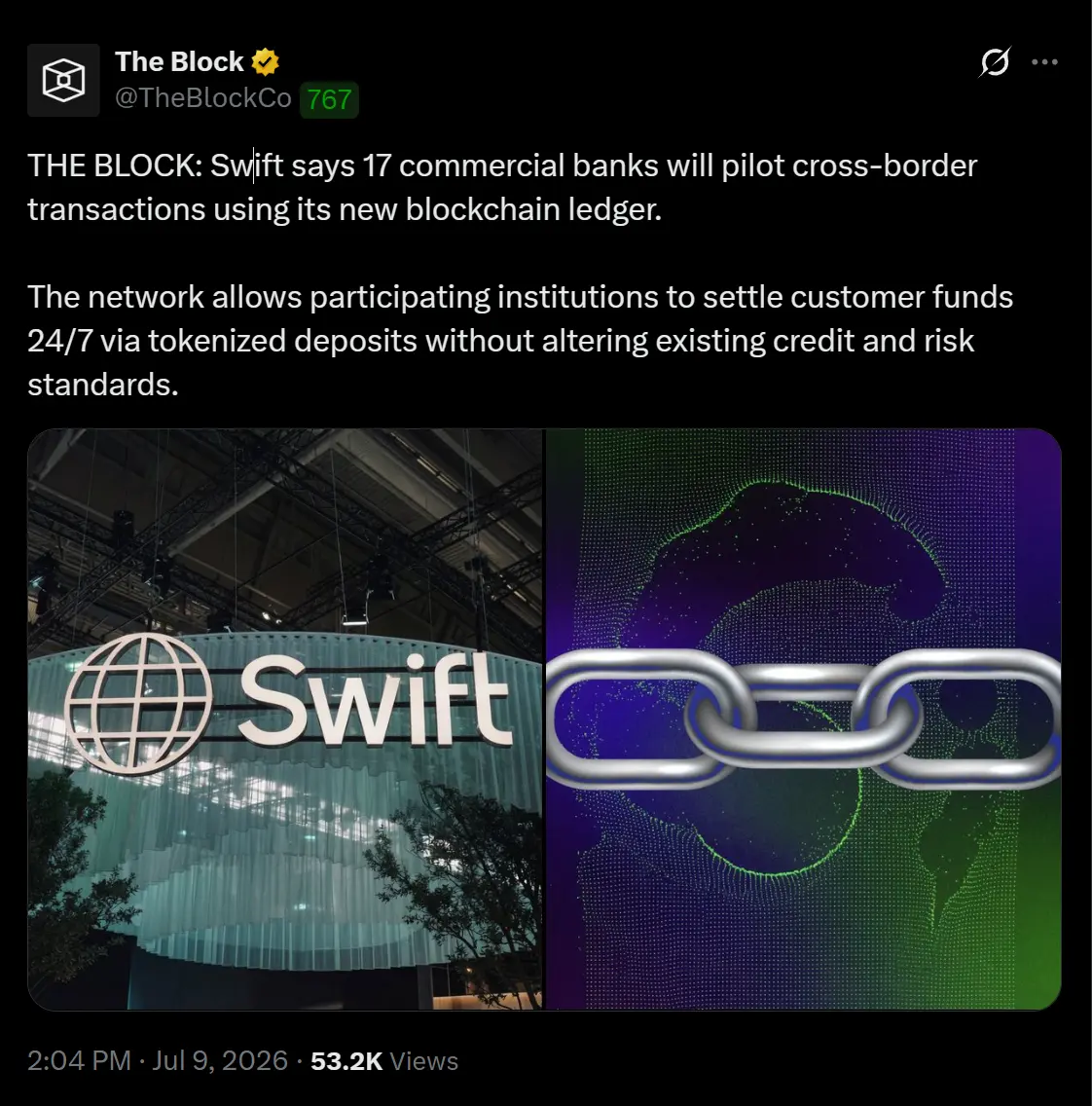
Two months later, JPMorgan, Citi, Bank of America, Wells Fargo and a dozen others said they were building a shared tokenized deposit network run by The Clearing House, targeting the first half of 2027. A separate group of regionals (Huntington, First Horizon, KeyCorp, M&T, Old National) is piloting a retail version this quarter.
The question used to be whether any of this was real, but now it’s which digital asset instrument, for which client, on which rail. That’s a harder question, because the three things people keep lumping together do very different things to your balance sheet.
WHAT BANKS GET FROM STABLECOINS
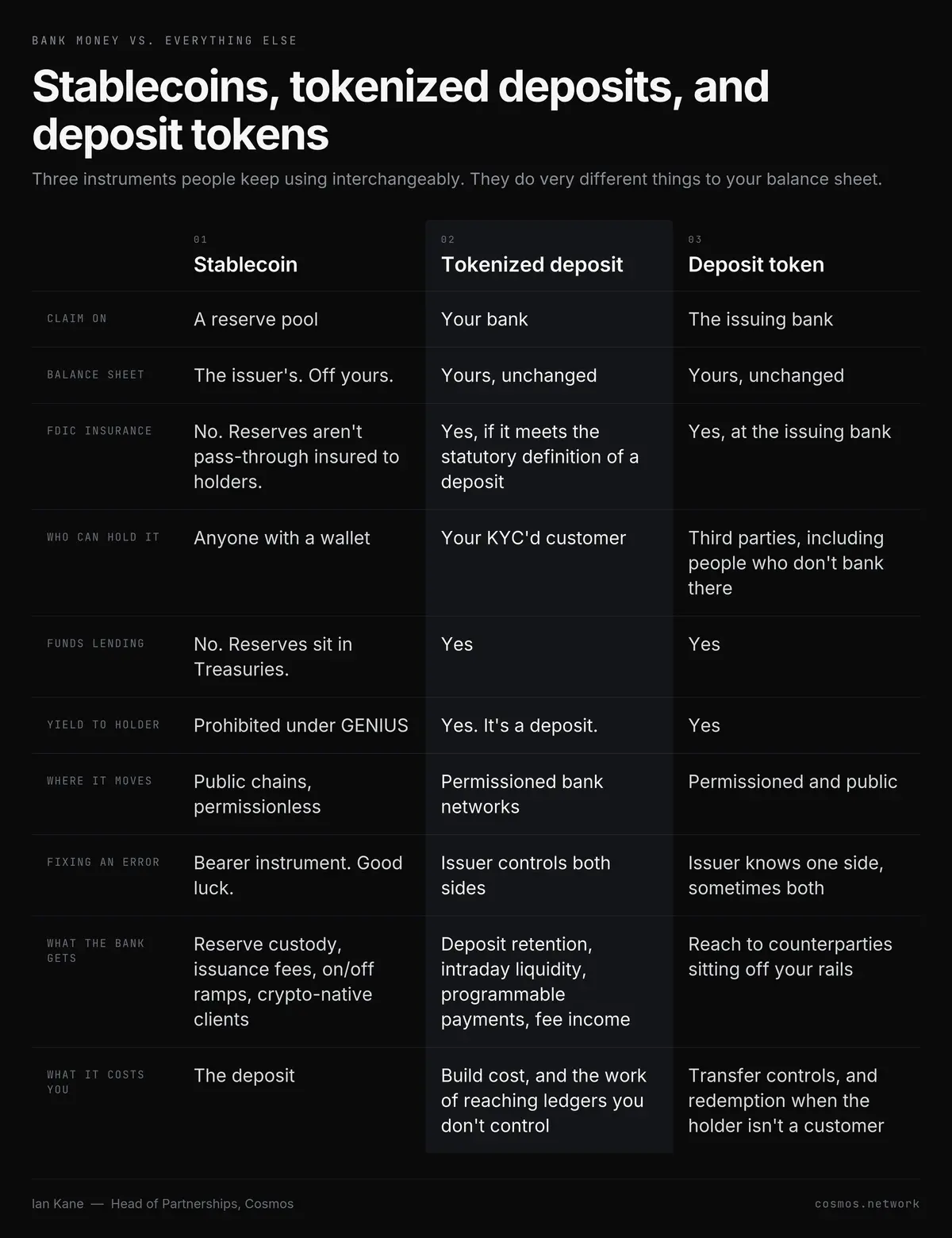
For permitted issuers, holding the underlying cash and Treasuries represents a sticky, low-risk balance that generates fee income. When building an internal business case, however, it is critical to note that these reserves lack pass-through insurance for token holders, a point explicitly detailed in the FDIC proposal.
Because GENIUS envisions issuance via bank subsidiaries, white-labeling offers an accelerated route for institutions possessing distribution channels but lacking a native product. Capitalizing on fiat conversion and the associated remittance corridors presents clear fee opportunities. Furthermore, a distinct customer segment (including crypto exchanges, crypto treasuries, PSPs, and market makers) already functions using stablecoins and requires a banking partner capable of operating fluently in this space.
What stablecoins don’t do is keep the deposit.
WHAT BANKS GET FROM DEPOSIT TOKENS
Deposit tokens address a specific challenge: enabling a bank’s client to complete a settlement with a counterparty at another institution, across an external network, even when your standard operating rails are closed.
This application is highly relevant for capital markets workflows involving distinct buyer and seller institutions, as well as for settlements on digital-asset venues demanding on-chain finality. Additionally, it provides a viable alternative for corporate clients who might otherwise turn to stablecoins – allowing a bank to offer a strategic product alternative rather than just a defensive countermeasure.
However, implementing transferability introduces new operational challenges. Institutions must determine who is permitted to hold the tokens, establish methods for vetting unfamiliar receiving wallets, and define redemption protocols for holders who are not direct customers. While these hurdles are entirely manageable, resolving them requires dedicated resources.
WHAT BANKS GET FROM TOKENIZED DEPOSITS
-
OPTIMIZING INTRADAY LIQUIDITY & TREASURY: The most expensive idle asset for most banks is cash trapped across mismatched entities, currencies, or time zones. Rather than waiting for cutoffs, tokenized deposits empower treasuries to execute continuous sweeping and concentration. Major players like Kinexys route billions daily on this premise, while Citi Token Services applies it across key hubs like New York, London, and Hong Kong. The real advantage isn’t just speed, but the reduction in required liquidity buffers.
-
TRANSFORMING CROSS-BORDER & CORRESPONDENT BANKING: Prefunded float balances exist purely to offset slow, unidirectional settlement systems. Introducing atomic, payment-versus-payment mechanisms for the cash leg liberates a substantial portion of that capital. Combined with 24/7 weekend and holiday settlement capability, this redefines the value-date proposition for corporate clients.
-
MONETIZING CONDITIONAL PAYMENTS: This goes far beyond a faster wire transfer. By embedding logic into the instrument, payments can be released automatically upon delivery confirmation, construction inspections, or document matches in trade finance. This replaces legacy workflows like manual 4pm verification calls. From parametric insurance payouts to instant commission splits upon collection, banks can capture high-margin administrative workflows that commercial clients currently outsource.
-
ANCHORING THE CASH LEG FOR TOKENIZED ASSETS: Tokenized money market funds, Treasuries, repo books, and private credit transactions all face the same structural gap: the securities leg operates on-chain, but the cash leg does not. Tokenized deposits solve this by enabling genuine Delivery-versus-Payment (DvP), hourly intraday repo pricing instead of overnight, and fail-free settlement. If an institution has a tokenized asset strategy without a corresponding digital cash instrument then its roadmap remains incomplete.
-
MITIGATING COLLATERAL & MARGIN RISKS: Market volatility does not align with standard banking hours. The ability to post and recall cash collateral globally within minutes, even after hours, provides a direct mechanism to trim capital buffers and insulate the institution during high-stress trading days.
-
DRIVING FEE INCOME VIA ADVANCED TREASURY PRODUCTS: Tokenization unlocks sophisticated commercial products: virtual accounts with real-time sub-ledger visibility, multi-entity automated sweeping, and automated payment orchestration that can instantly split a single inbound marketplace payment across hundreds of vendors. It also enables real-time supply chain finance discounting at the exact second of invoice acceptance, and self-enforcing escrow accounts where conditions are programmatic rather than manually administered.
-
PREVENTIVE COMPLIANCE FOR RESTRICTED & FIDUCIARY BALANCES: Managing legally restricted funds (such as trust, escrow, FBO, municipal disbursements, or grant pools) traditionally relies on retrospective reconciliation. Encoding spending constraints directly into the balance shifts compliance from an after-the-fact audit to a preventive control. This remains a highly underrated yet powerful vector for commercial deposit growth.
-
ELEVATING COMPLIANCE ARCHITECTURE: Tokenized bank networks ensure every participant is a fully verified customer. Travel rule data is natively attached to transfers, sanctions screening occurs pre-settlement, and transactional errors can be actively reversed due to the trusted relationship between issuers on both ends. This risk-mitigating framework provides a powerful argument for Chief Risk Officers and highlights the structural edge bank money holds over bearer instruments.
-
DEFENDING THE DEPOSIT BASE: The ultimate strategic driver behind industry collaboration is balance sheet defense. Capital migrating to stablecoins exits the banking system to purchase Treasuries, whereas tokenized deposits remain on-balance-sheet to fund lending activities. Corporate demand for programmable, continuous dollar liquidity is inevitable; the fundamental question is whose balance sheet will host those assets. The recent infrastructure agreement among a dozen of the nation’s largest banks underlines that this transition was never merely about technology – it is about deposit preservation.

Comments
No comments yet. Be the first to share your thoughts!
Authentication Required
You must be logged in to post a comment.