

Bar Pipa
We pay for a post of 10$
Alibaba Group Holding Limited

Alibaba Group Holding Limited

BABA NYSE

$116.54
-1.21%

Key Statistics

Market Cap
$279.33 B
Volume
6,590,611
Open
$116.23
Day Range
115.15 - 116.83
52W Range
91.99 - 192.67
Price AVG 50
$117.56

About Alibaba Group Holding Limited

Alibaba Group Holding Limited, through its various subsidiaries, furnishes crucial technological infrastructure and extensive marketing channels. This comprehensive support allows merchants, brands, retailers, and other businesses to effectively engage with their customer base, both within the People's Republic of China and across international markets. The company's operations are organized across seven primary segments: China Commerce, International Commerce, Local Consumer Services, Cainiao (its logistics network), Cloud Computing, Digital Media and Entertainment, and Innovation Initiatives and Others. The company's extensive digital ecosystem features premier online retail platforms like Taobao and Tmall. Wholesale business-to-business transactions are facilitated through 1688.com and Alibaba.com. Globally, it operates retail platforms such as AliExpress, Lazada, Trendyol, and Daraz. For fresh goods and groceries, it offers Freshippo, and Tmall Global specializes in import e-commerce. Monetization and advertising solutions are provided via Alimama, its proprietary platform, which offers diverse marketing services including pay-for-performance, in-feed, and display ads, supported by the Taobao Ad Network and Exchange for real-time bidding. Logistics operations are primarily handled by the Cainiao Network. Its local consumer services encompass Ele.me for on-demand food and delivery, Koubei for restaurant and local service directories, and Fliggy for travel booking. Alibaba Cloud offers a wide array of services, including elastic computing, data storage, networking, security, database management, big data analytics, and Internet of Things (IoT) solutions. It also supplies hardware, software licenses, installation, and application development and maintenance. The digital media and entertainment division includes Youku, an online video platform; Quark, an information search and content consumption tool; and Alibaba Pictures, collectively offering diverse content spanning films, live events, news feeds, literature, and music. Its innovation portfolio further extends to Amap, a mobile application for digital mapping and navigation; DingTalk, a business communication and efficiency platform; the Tmall Genie smart speaker; and Qwen, an advanced artificial intelligence chatbot. Founded in 1999, Alibaba Group is headquartered in Hangzhou, People's Republic of China.

Asset Type: Common Stock
Sector: Consumer Cyclical
Industry: Specialty Retail

Discussion

Authentication Required

You must be logged in to post a comment.

Alibaba Soars 5% as a New AI Breakthrough Shakes Up the Market
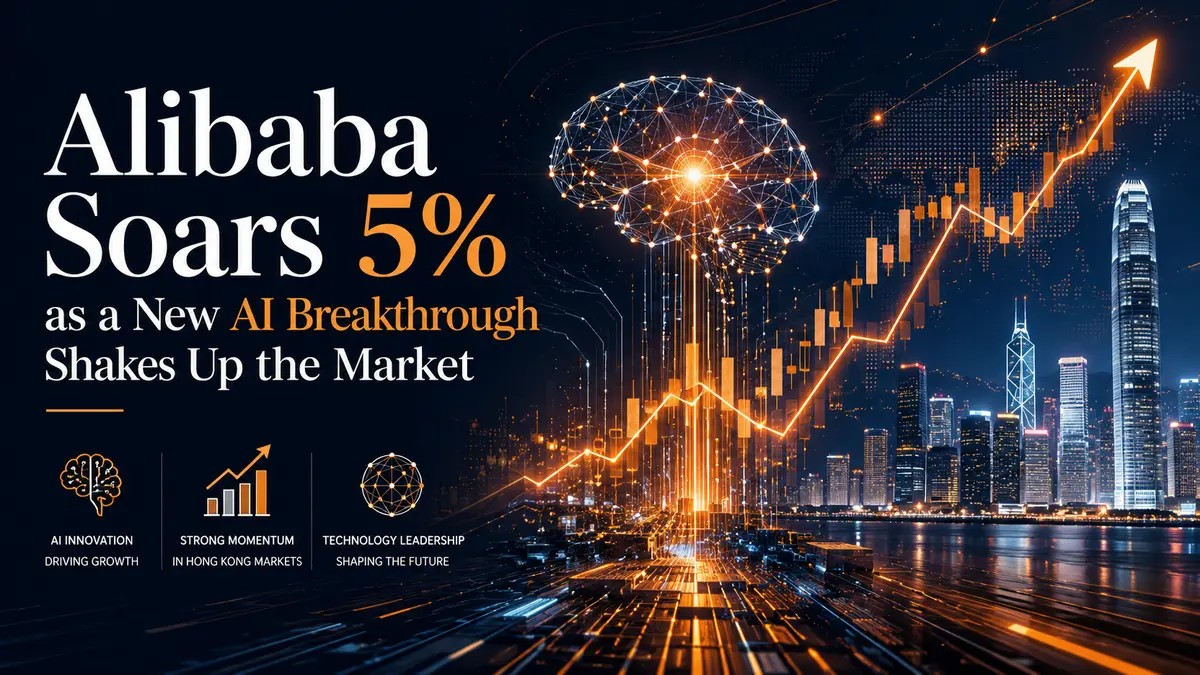
Alibaba Soars 5% as a New AI Breakthrough Shakes Up the Market

Monday’s Surge: Shares of the Chinese Giant Move Higher

The first day of the week proved triumphant for BABA ... Alibaba. The company’s shares on the Hong Kong Stock Exchange surged 5.2% to HKDUSD ... HK$118.40. The rally was not simply the result of favorable market conditions—it was driven by a specific technological breakthrough that investors immediately recognized.

On Saturday, Alibaba released a preview version of its new artificial intelligence model, Qwen3.8 Max. This is not just another routine update—it is a bold bid for leadership in the global AI race. The model contains 2.4 trillion parameters, placing it among the most powerful AI systems in the world. Alibaba claims that it is surpassed only by Anthropic’s latest flagship product, which would represent a major technological achievement.

However, what truly ignited the market was Alibaba’s promise to release the model’s weights in the near future. This is far more than a technical detail. It is a strategic move that could fundamentally strengthen Alibaba’s position in the AI industry.

Open models attract developer communities, accelerate innovation, and help create entire ecosystems around a product. The more developers who adopt Qwen, the stronger Alibaba’s competitive position is likely to become.

Qwen3.8 Max: What Kind of Beast Is It?

A model with 2.4 trillion parameters is not impressive merely because of the size of the number. It suggests that the model can process enormous volumes of data, understand complex contexts, and generate more accurate responses. Generally, the more parameters a model has, the more powerful it can be—although it also becomes more difficult and expensive to train.

Alibaba appears to have found a balance between power and efficiency. The company has not disclosed all the technical details, but it describes Qwen3.8 Max as one of the world’s most powerful AI models, reportedly ranking behind only...


Continue reading...
0
0

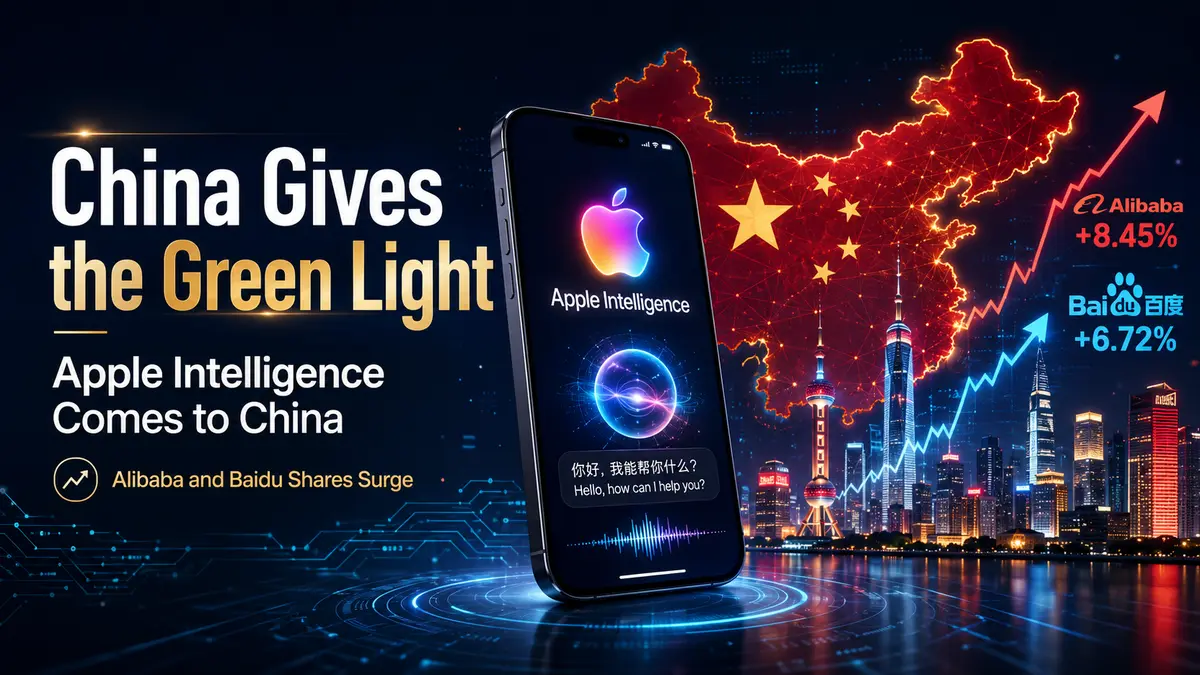
China Gives the Green Light: Apple Intelligence Is Finally Coming to the Chinese Market

China Gives the Green Light: Apple Intelligence Is Finally Coming to the Chinese Market

Thursday Morning: Alibaba and Baidu Shares Surge on the News

Thursday began on a celebratory note for China’s technology sector. Shares of Alibaba Group BABA ... traded in Hong Kong jumped nearly 5% by the middle of the trading session, while Baidu BAIDF ... gained around 4%. The reason for this widespread optimism is simple: Apple AAPL ... has finally received the long-awaited approval from Chinese regulators to launch its artificial intelligence services in the country.

The market had been waiting for this development for months, if not longer. Apple Intelligence, the company’s flagship AI platform, is already available in the United States and several other countries but has remained unavailable in China. The delay was not caused by technical difficulties but by Beijing’s strict regulatory requirements.

Chinese law requires all generative AI services to undergo mandatory registration and review before they can be offered to the general public. For Apple, this barrier proved more difficult to overcome than it was for many other companies because the Cupertino-based technology giant wanted to use its own models and proprietary approach. However, China’s main internet regulator withheld its approval for an extended period.

Now, according to information reported by the media, Apple appears to have made concessions that satisfied all parties. AI features on iPhones in China will not operate solely using Apple’s proprietary technology. Instead, they will rely on Chinese AI models—not just one, but two—from Alibaba and Baidu.

Alibaba’s Qwen and Baidu’s Technology: The Two Pillars of Apple Intelligence in China

According to Reuters sources familiar with the matter, Apple Intelligence in China will have a two-layer architecture. Its foundation will be Alibaba’s Qwen large language model, which is considered one of the most powerful and advanced AI models currently available in China.

Alibaba has officially confirmed its involvement, stating that Qwen will...

Continue reading...
0
0
Big Pip

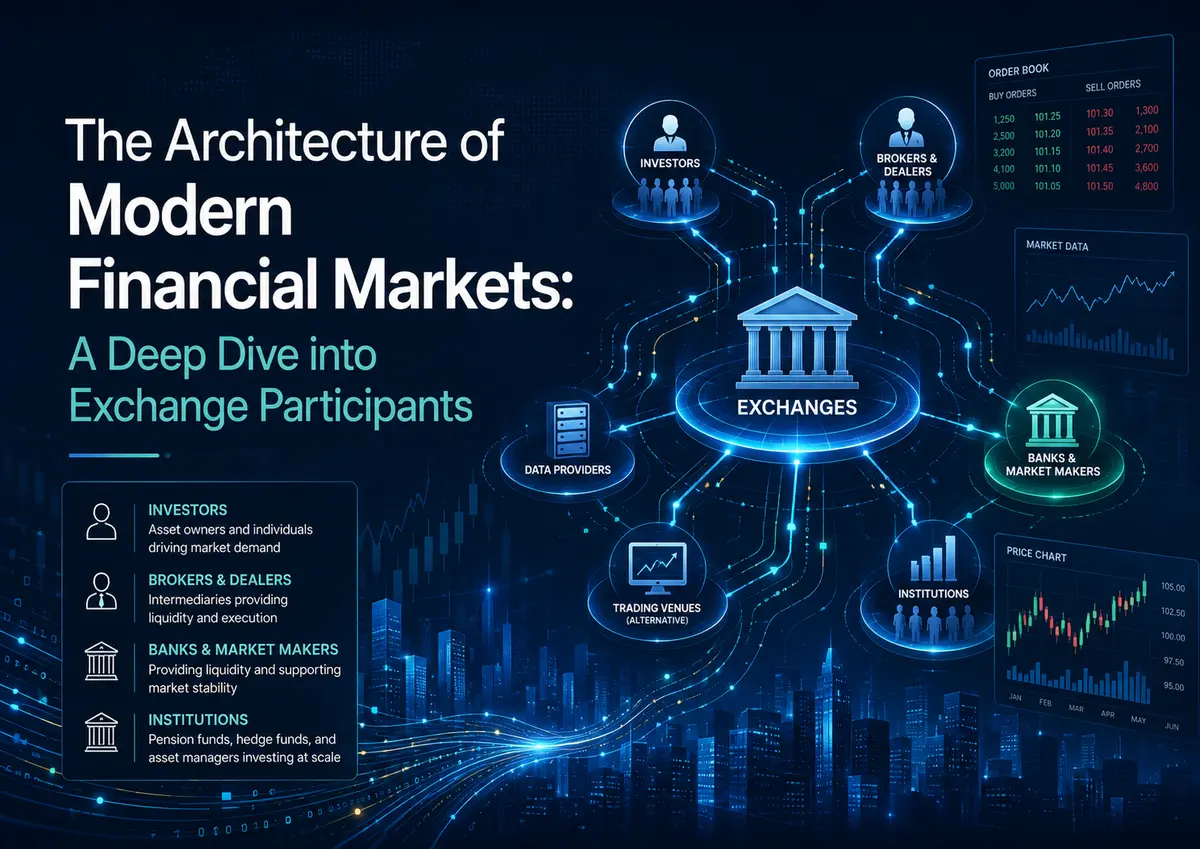
The Architecture of Modern Financial Markets: A Deep Dive into Exchange Participants

The Architecture of Modern Financial Markets: A Deep Dive into Exchange Participants

In its simplest terms, a financial exchange is not just a digital platform or a physical building in New York, London, or Tokyo. It is a highly regulated, living ecosystem where trillions of dollars change hands daily. For this ecosystem to function seamlessly, several distinct groups of participants must interact with one another.

Each player — from the individual trading on their smartphone to massive sovereign wealth funds — has a unique role, risk tolerance, and objective.

Understanding who these participants are and how they collaborate is the first step to understanding how the global economy allocates resources and prices risk.

1. Investors: The Providers of Capital

At the very heart of any exchange are the investors. These are the individuals and entities who supply the capital that fuels global business. Their primary objective is simple: to preserve and grow their wealth over time. However, their strategies, timelines, and scale vary drastically.

Retail Investors: The Democratization of Finance

Retail investors are individual, everyday people investing their personal savings. In the past, high brokerage fees and complex systems kept retail investors on the sidelines of global markets. Today, the rise of digital trading platforms like Robinhood in the US, eToro in Europe, and Tiger Brokers in Asia has democratized access to the markets.

Retail investors often focus on long-term wealth accumulation — such as saving for retirement or a child's education — though a subset engages in active daily trading. They typically invest in familiar global brands like AAPL ... , MSFT ... , or TSLA ... , and use user-friendly instruments like fractional shares (buying a portion of a high-priced stock).

Institutional Investors: The Market Heavyweights

Institutional investors are the massive organizations that pool money from millions of people to invest on a grand scale. Because of the sheer volume of capital they...

Continue reading...
0
0
Navigation menu
instaforex banner