

Who is a Shareholder: Fundamentals of Corporate Ownership in the Global Economy
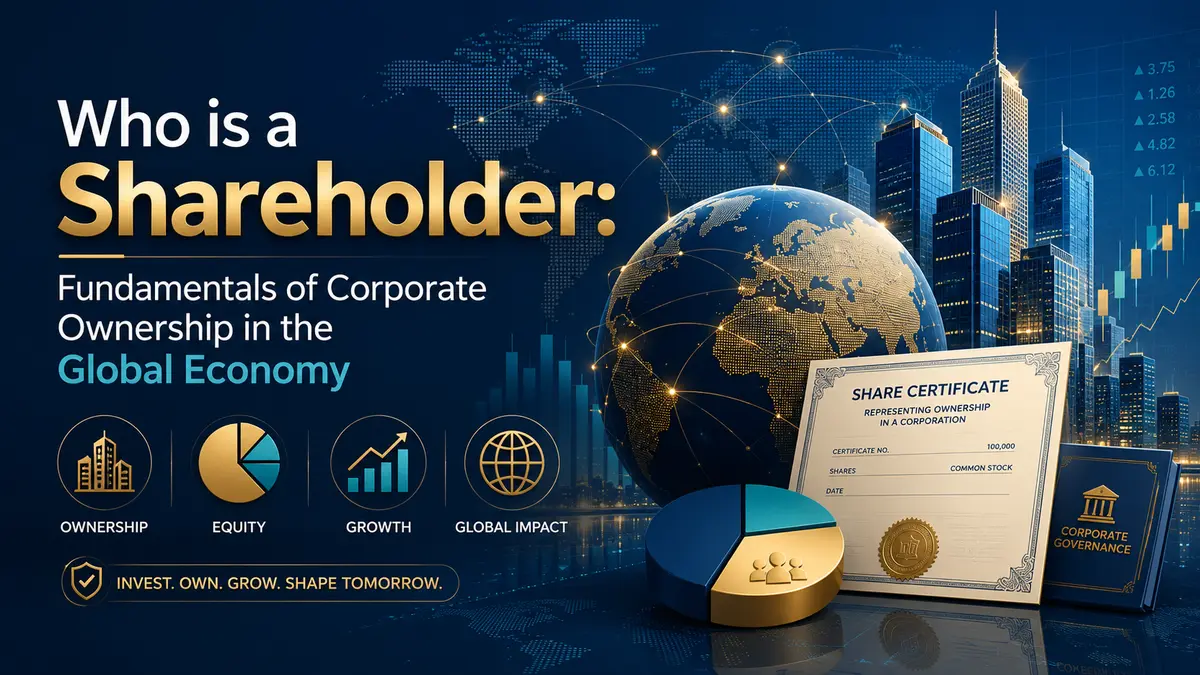
When you purchase a stock in a company — whether it is a single share of a tech giant like Apple AAPL ... or a massive block of a consumer staple like Nestlé NSRGF ... — you are doing something much deeper than placing a financial bet. You are legally step-typing into the role of a co-owner.
A shareholder (often referred to as a stockholder) is an individual, corporation, or institution that legally owns at least one share of a company’s capital stock.
Collectively, shareholders are the bedrock of the modern capitalist economy. They provide the equity capital that businesses need to innovate, scale, and navigate global markets, and in return, they receive a claim on the company’s future prosperity.
Understanding the delicate balance of power, rights, and duties that define a shareholder is key to understanding how global corporations are governed and how wealth is generated on the world stage.
1. Shares: The Mechanics of Fractional Ownership
To fully appreciate what a shareholder is, we must first look at the financial instrument that binds them to the corporation: the share.
What Do Shares Actually Represent?
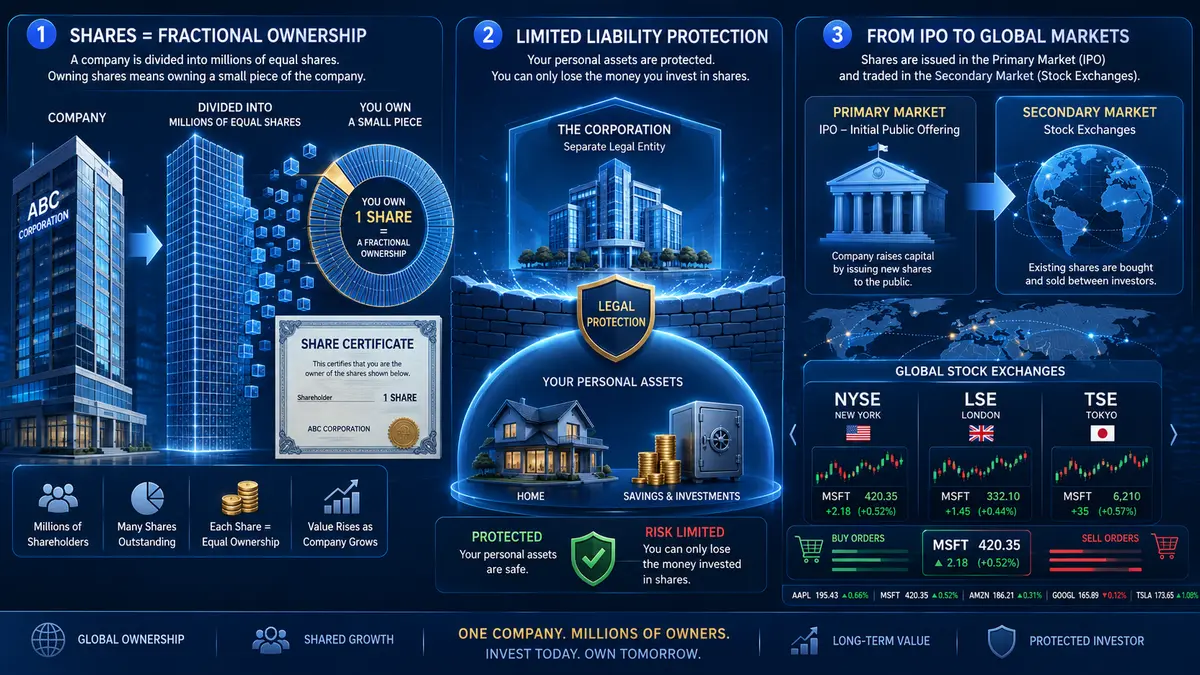
A share is a financial security that represents a fraction of ownership in a corporation. When a business incorporates, its total value is partitioned into millions — or sometimes billions — of tiny, equal pieces.
For instance, a company like Microsoft MSFT ... has billions of outstanding shares traded on the Nasdaq. When an investor buys Microsoft shares, they do not own the actual physical desks, servers, or patents of the company directly. Instead, they own a slice of the legal corporation itself, which in turn owns those assets.
This distinction is crucial because of limited liability — one of the most revolutionary concepts in economic history.
What is Limited Liability? If a public corporation goes bankrupt or faces a multi-billion-dollar lawsuit, the shareholders are not personally responsible for the company’s debts. The maximum amount a shareholder can lose is strictly limited to the money they spent to purchase their shares. Your personal assets (such as your home or savings) remain completely safe.
How Shares are Acquired in the Global Market
The journey of a share typically begins in the primary market through an Initial Public Offering (IPO). This is when a private company decides to go public to raise massive amounts of expansion capital. A classic global example is the historic IPO of Saudi Aramco in 2019, which raised $25.6 billion by selling shares to global institutional and retail investors.
Once a company is public, its shares trade on the secondary market. This includes major international stock exchanges such as the New York Stock Exchange (NYSE), the London Stock Exchange (LSE), and the Tokyo Stock Exchange (TSE).
On these exchanges, shares change hands between buyers and sellers in real-time, with prices fluctuating based on supply, demand, corporate earnings, and global macroeconomic trends.
2. The Spectrum of Shareholders: From Retail to Institutional
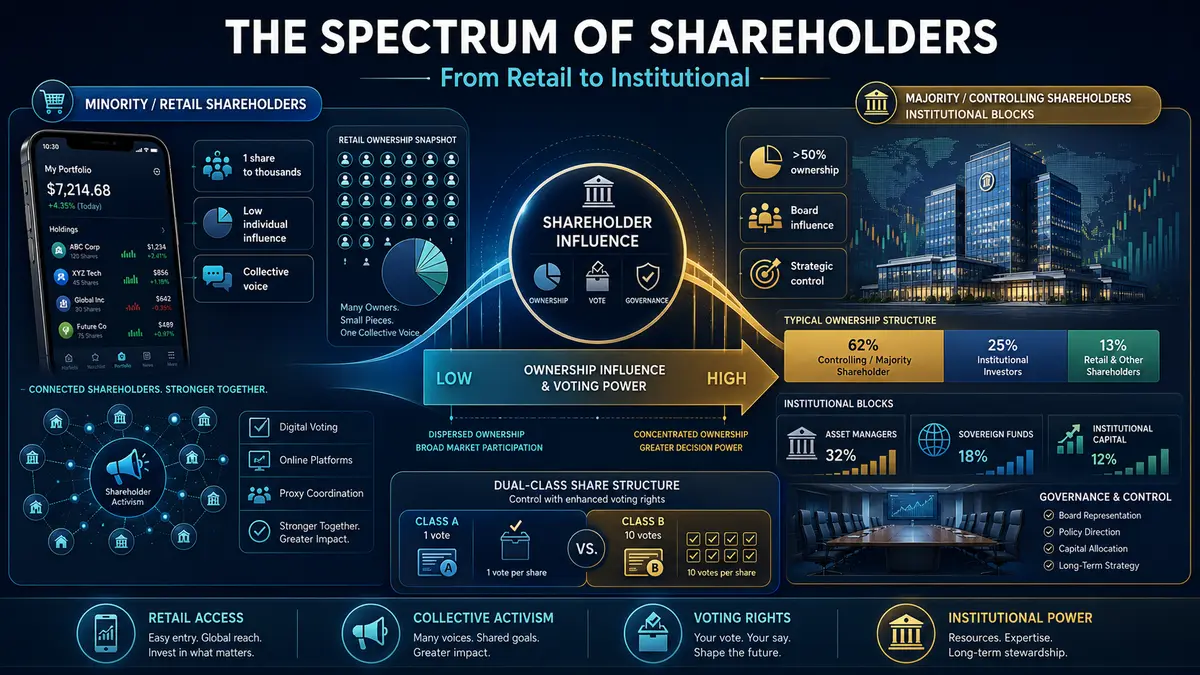
The influence a shareholder wields over a company’s direction is directly proportional to the number of shares they control. In the global market, we can categorize shareholders into two primary groups.
Minority (Retail) Shareholders
Minority shareholders are typically individual, everyday investors trading through personal brokerage accounts. They might own anywhere from one share to a few thousand shares. Individually, a retail shareholder has virtually zero influence over the day-to-day decisions or executive appointments of a massive multinational corporation.
However, the collective voice of retail shareholders can be incredibly powerful. In recent years, global financial markets have witnessed the rise of retail shareholder activism, where smaller investors unite via online platforms to influence corporate policies, vote on environmental initiatives, or drive market momentum.
Majority and Controlling Shareholders
A majority shareholder is an individual or entity that owns more than 50% of a company’s outstanding shares. In many cases, especially within major global technology companies, founders or early-stage venture capital firms retain a controlling interest.
-
Dual-Class Share Structures: To prevent hostile takeovers and maintain creative control, many modern global firms use a dual-class share system. For example, at Meta Platforms (parent company of Facebook META ... ), Mark Zuckerberg owns Class B shares which carry ten votes per share, whereas public Class A shares carry only one vote per share. This structure ensures that Zuckerberg remains the controlling shareholder with absolute voting power, despite not owning a majority of the economic value of the company.
-
Institutional Blocks: Often, the largest shareholders are not individuals but massive institutions like BlackRock BLK ... , Vanguard VPCCX ... , or sovereign wealth funds. These entities manage trillions of dollars and hold significant portions of almost every major public company, allowing them to engage directly with corporate boards to push for strategic changes.
3. The Corporate Governance Framework: Ownership vs. Control
A common point of confusion is how a company is actually run. While shareholders are the technical owners of a corporation, they do not run its daily operations. This separation of ownership and control is managed through a system called Corporate Governance.
To solve the “Principal-Agent Problem” — where the owners (principals) must trust managers (agents) to run the business honestly — the corporate hierarchy is structured as follows:
Shareholders (Own the Company)> Board of Directors (Govern & Supervise) > Executive Management (Run Daily Operations)The Annual General Meeting (AGM)
The primary venue where shareholders exercise their ownership rights is the Annual General Meeting (AGM). Once a year, public companies are legally required to host this gathering.
A famous global example is the Berkshire Hathaway AGM BRK.NE ... held annually in Omaha, Nebraska. Often called the “Woodstock for Capitalists,” it draws tens of thousands of shareholders from across the globe. At the AGM, shareholders vote on critical issues such as electing members of the Board of Directors, approving executive compensation plans, and greenlighting major structural changes like mergers or acquisitions.
4. The Legal Rights of a Shareholder
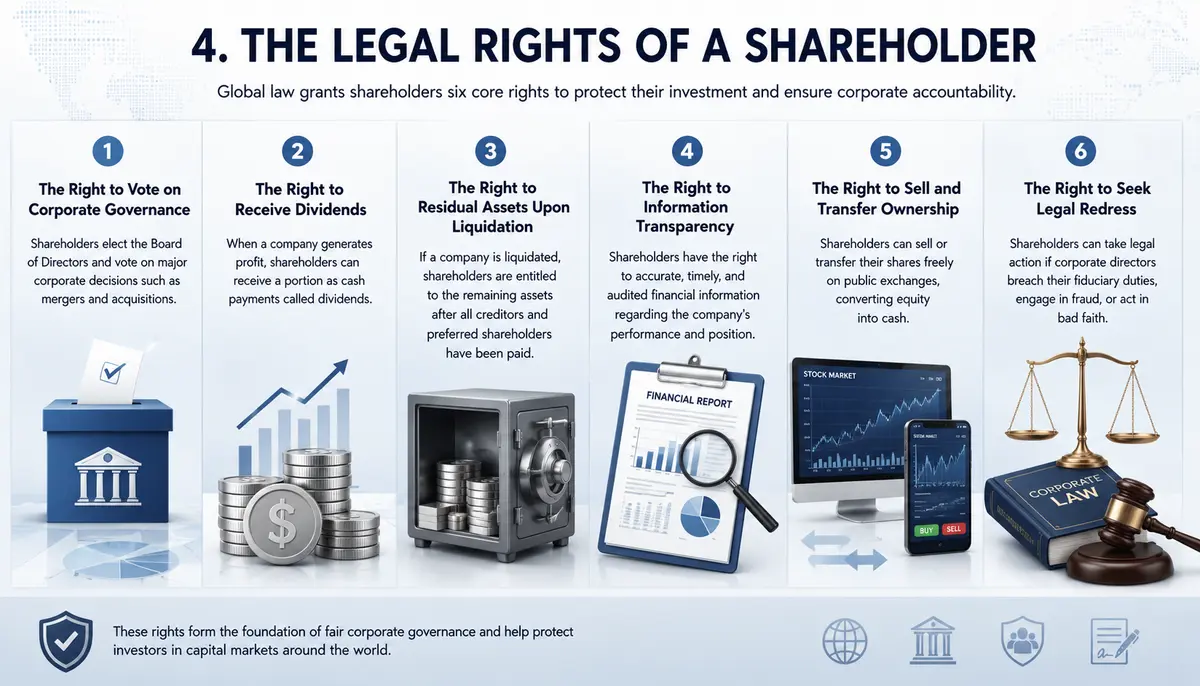
To prevent corporate managers or majority owners from abusing their power, global financial systems grant shareholders a core set of legal rights. While laws vary slightly between jurisdictions (such as Delaware corporate law in the US or the Companies Act in the UK), these six fundamental rights are globally recognized:
1. The Right to Vote on Corporate Governance
Typically, the standard rule of corporate equity is “one share, one vote.” Shareholders use their voting power to elect the Board of Directors, who in turn hire the CEO. They also vote on major corporate transformations, such as whether a company should merge with a competitor.
2. The Right to Receive Dividends
When a company generates a profit, the Board of Directors can choose to either reinvest those earnings back into the business or distribute a portion of them to shareholders as cash payments, known as dividends. Global dividend legends like Coca-Cola CCEP.L ... or Johnson & Johnson JNJ ... have consistently paid out and increased their dividends for decades, providing a steady stream of passive income to their shareholders.
3. The Right to Residual Assets Upon Liquidation
If a company goes bankrupt and is forced to dissolve, its physical and financial assets are sold off. Shareholders have a right to a share of these remaining funds. However, they are at the very bottom of the priority ladder. Secured creditors, bondholders, and preferred shareholders are paid first. Common shareholders only receive what is left over, which is often nothing.
4. The Right to Information Transparency
Shareholders have a legal right to inspect the financial health of the company. Regulators like the Securities and Exchange Commission (SEC) in the US or the Financial Conduct Authority (FCA) in the UK force companies to publish highly detailed, audited quarterly and annual financial reports (such as the Form 10-K).
5. The Right to Sell and Transfer Ownership
Unless bound by specific lock-up agreements (common immediately after an IPO), shareholders have the absolute right to sell their shares to anyone else at any time on public stock exchanges, allowing them to quickly convert their paper equity into hard cash.
6. The Right to Seek Legal Redress
If corporate directors or executives act in bad faith, engage in fraud, or breach their fiduciary duties, shareholders have the right to take legal action. They can file “shareholder derivative lawsuits” to sue corporate officers on behalf of the corporation to recover financial damages.
5. The Legal and Ethical Obligations of a Shareholder
While being a shareholder comes with lucrative perks, it also carries a set of distinct legal and ethical responsibilities designed to keep the financial system fair and stable.
1. Adherence to Securities Laws and Corporate Bylaws
Shareholders must play by the rules. They are obligated to comply with the country’s financial laws, tax regulations, and the company’s internal articles of association. This includes accurately reporting capital gains and dividend income to tax authorities.
2. Responsible Voting
While voting is a right, casting votes blindly or destructively can harm a company’s employees, customers, and long-term value. Institutional shareholders are increasingly expected to practice “active stewardship” — voting responsibly on complex issues like environmental sustainability, fair labor standards, and executive pay.
3. Maintaining Corporate Confidentiality
In private companies or during sensitive corporate negotiations, shareholders may be privy to non-public financial projections, product designs, or strategic plans. They are legally bound by non-disclosure agreements (NDAs) to keep this proprietary information strictly confidential.
4. Financial Settlement of Share Purchases
When an investor buys shares, they are legally obligated to settle the trade by paying the agreed-upon price within the market’s standard settlement window (usually two business days, known as T+2). In margin accounts, shareholders must immediately meet “margin calls” if the value of their portfolio dips below a certain threshold.
5. Absolute Prohibition of Market Manipulation
Shareholders are strictly forbidden from using inside information to trade stocks before that information is made public. Engaging in insider trading or participating in market manipulation schemes (like “pump-and-dump” operations) is a federal crime across all major global markets.
6. Alignment with Corporate Well-Being
While shareholders have the right to criticize a company’s leadership, they have a general duty not to engage in malicious actions that actively sabotage the corporation’s brand, operations, or intellectual property, as doing so directly damages the value of the enterprise they partially own.
6. Shareholder vs. Investor: Resolving the Confusion
Though the terms “shareholder” and “investor” are frequently used interchangeably in financial journalism, they are not identical.
The Investor: A Broad Umbrella
An investor is any individual or entity that deploys capital with the expectation of a financial return. This is a massive umbrella term. If you buy gold, purchase a rental property, acquire government bonds, or trade commodities like oil, you are an investor — but you are not a shareholder. You do not own a corporate entity; you simply own an asset or a debt contract.
The Shareholder: A Specialized Equity Owner
A shareholder is a specific subcategory of investor. A shareholder is strictly an equity investor who has chosen to buy ownership stakes in a corporate business.
The primary difference lies in the nature of the relationship with the company:
-
Bondholders (Creditors): If you buy a corporate bond from Apple, you are an investor. You have loaned Apple money. They must pay you a fixed interest rate, but you do not own a single piece of the company, and you have zero voting rights at their AGM.
-
Shareholders (Owners): If you buy a share of Apple, you are an owner. You are not guaranteed any payout, but you have voting rights and unlimited upside potential if the company’s value sky-rockets.
Ultimately, shareholding is the mechanism that bridges the gap between individual savers and massive corporate enterprises, driving the engine of global wealth creation and corporate accountability.









Comments
No comments yet. Be the first to share your thoughts!
Authentication Required
You must be logged in to post a comment.