

The Global Brokerage Landscape: A Comprehensive Guide to Market Intermediaries
Introduction to Brokerage Services
Defining the Modern Broker
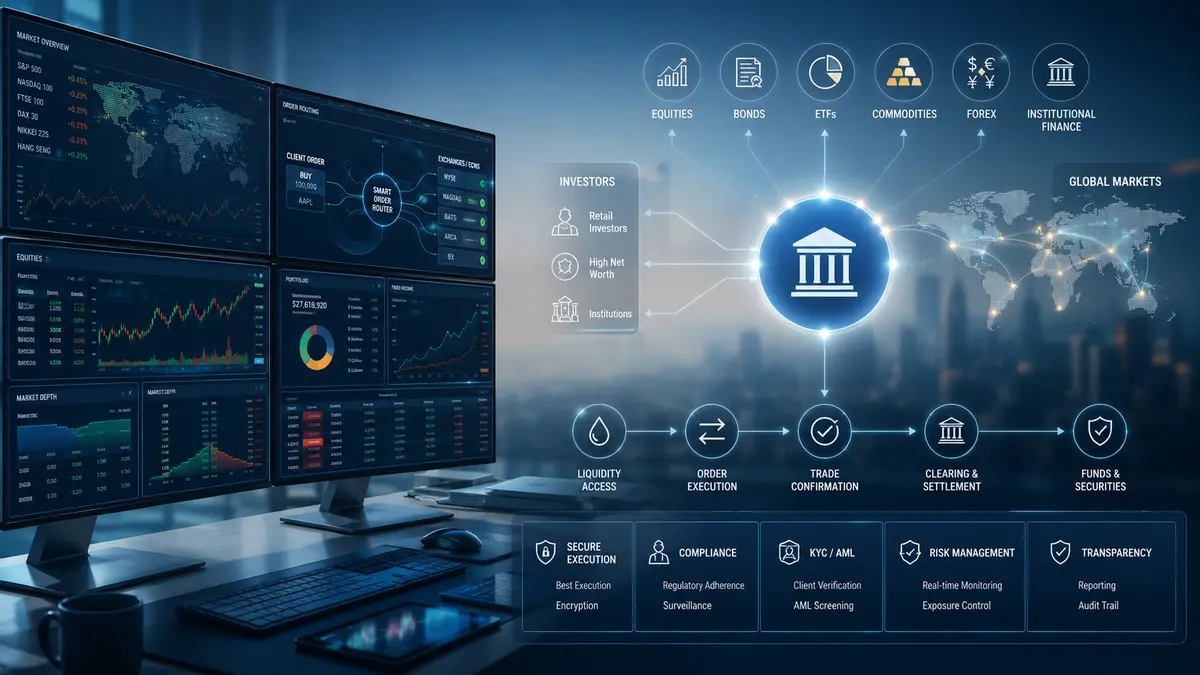
In the contemporary global financial ecosystem, a broker serves as an indispensable intermediary, executing transactions and providing critical infrastructure for clients across diverse asset classes. Historically operating on physical trading floors with chaotic hand signals, the modern broker has evolved into a highly sophisticated technological enterprise. Today’s brokerage firms leverage high-frequency data feeds, complex algorithmic routing networks, and intuitive user interfaces to bridge the gap between individual or institutional investors and centralized marketplaces. Whether operating as an independent digital entity or as a specialized division within an international banking conglomerate, the fundamental mandate of a broker remains unchanged: to facilitate the efficient transfer of assets, risk, and capital under strict regulatory compliance.
The Importance of Intermediaries in Global Finance
Market intermediaries are foundational to the liquidity and efficiency of international capital markets. Without brokers, the search costs for finding a counterparty to buy or sell a specific asset would be prohibitively high, stalling economic activity. By pooling thousands of orders, brokers create deep reservoirs of liquidity, which in turn narrows bid-ask spreads and minimizes transaction costs for all market participants. Furthermore, brokers assume significant operational and counterparty risks, ensuring that transactions clear and settle smoothly according to standardized global protocols. In an interconnected global economy, they act as the gatekeepers of financial integrity, enforcing strict Anti-Money Laundering (AML) and Know Your Customer (KYC) regulations to prevent illicit capital flows and maintain systemic stability.
Stock and Exchange Brokers (Equity and Commodity Intermediaries)
Core Functions and Order Execution
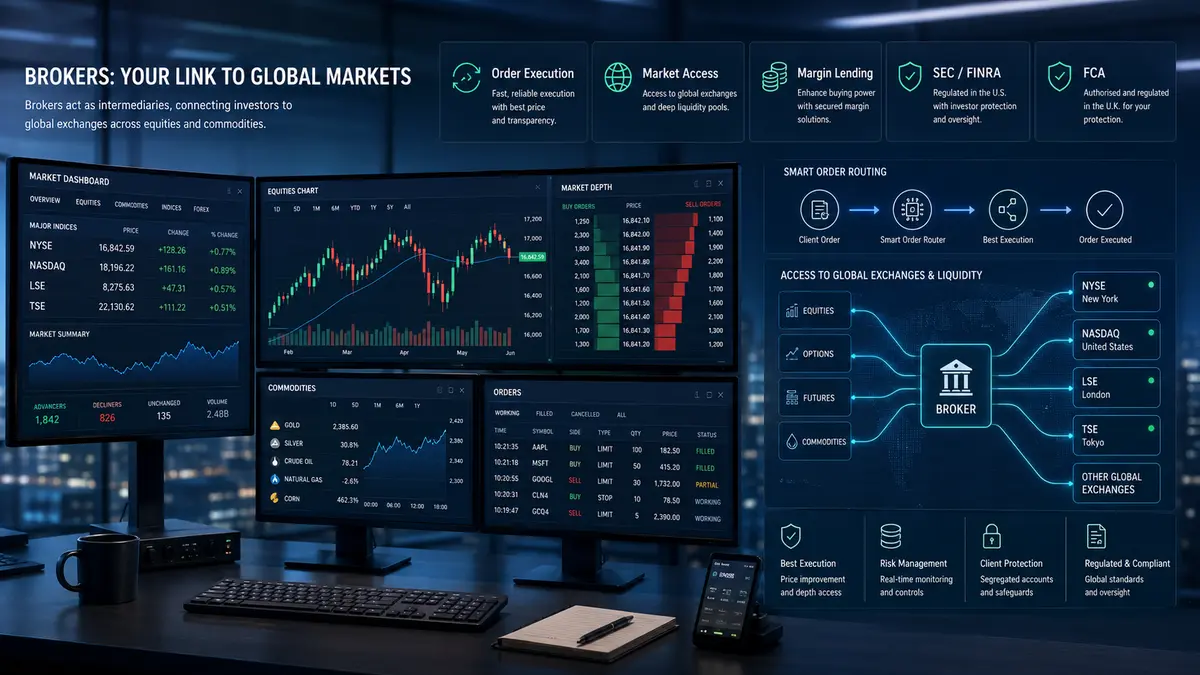
Stock and exchange brokers operate directly within organized public exchanges such as the New York Stock Exchange NYSX ... , NASDAQ, the London Stock Exchange LSEGY ... , and the Tokyo Stock Exchange (TSE). Their primary duty is the precise, rapid execution of client orders — ranging from simple market orders to complex conditional stop-limit strategies. When an investor initiates a trade, the broker utilizes smart order routing (SOR) technology to scan multiple execution venues instantly, seeking the best available price and execution speed. Beyond simple execution, exchange brokers provide essential margin lending facilities, allowing traders to leverage their capital positions under strictly monitored regulatory thresholds.
Market Access and Regulatory Oversight
Operating on public exchanges requires stringent licensing, substantial capital reserves, and continuous regulatory oversight. In the United States, exchange brokers must be registered with the Securities and Exchange Commission (SEC) and maintain active membership in the Financial Industry Regulatory Authority (FINRA). In the United Kingdom, the Financial Conduct Authority (FCA) enforces parallel protocols. These regulatory frameworks are designed to protect retail investors from fraudulent schemes, ensure corporate capital adequacy so that brokers can withstand systemic shocks, and guarantee that client funds are strictly segregated from the broker’s operational capital in ring-fenced bank accounts.
Global Market Leaders and Industry Trends
The global stock brokerage sector has undergone massive consolidation and democratization over the past decade. Industry pioneers like Charles Schwab and Fidelity Investments transitioned traditional wealth management into digital powerhouses, managing trillions of dollars in client assets. Concurrently, disruptive digital-native platforms like Interactive Brokers and Robinhood revolutionized the market by introducing commission-free trading and fractional share investing. This paradigm shift forced legacy institutions worldwide to re-evaluate their fee structures, shifting their business models toward premium value-add services, high-tier subscription models, and alternative revenue streams such as payment for order flow (PFOF).
Investment Brokers and Wealth Managers
Comprehensive Portfolio Management
Unlike pure transaction-oriented execution brokers, investment brokers and wealth managers provide a holistic suite of fiduciary and advisory services. These financial professionals focus on long-term wealth preservation, capital growth, and strategic asset allocation. They work intimately with high-net-worth individuals (HNWIs), family offices, and institutional endowments to craft bespoke investment policy statements. By assessing a client’s specific risk tolerance, time horizon, and liquidity needs, investment brokers construct diversified portfolios across global equities, fixed-income instruments, real estate investment trusts (REITs), and alternative assets like private equity or commodities.
Research, Analytics, and Educational Ecosystems
A primary differentiator for top-tier investment brokers is the depth of their proprietary institutional research. Firms invest millions of dollars annually in macroeconomic analysis, corporate equity research, and sector trend forecasting.
Clients receive comprehensive analyst reports, risk-modeling metrics, and predictive asset-allocation models. Additionally, these brokers maintain extensive educational ecosystems, hosting international webinars, market symposiums, and interactive financial planning simulators to ensure their clients possess the financial literacy required to navigate complex macroeconomic cycles, such as inflationary periods or shifting central bank interest rates.
Global Industry Leaders and Fiduciary Standards
The global investment brokerage landscape is anchored by massive asset management and wealth groups, including VPCCX ... , BDSAX ... , and Morgan Stanley Wealth Management. These entities operate under a strict fiduciary standard in many jurisdictions, legally binding them to act solely in the best financial interest of their clients. This contrast with the suitability standard used by execution-only brokers has reshaped global regulations, pushing the international wealth management industry toward complete transparency regarding management fees, trailing commissions, and potential conflicts of interest.

Forex Brokers (Foreign Exchange Market Intermediaries)
The Mechanisms of the Currency Market
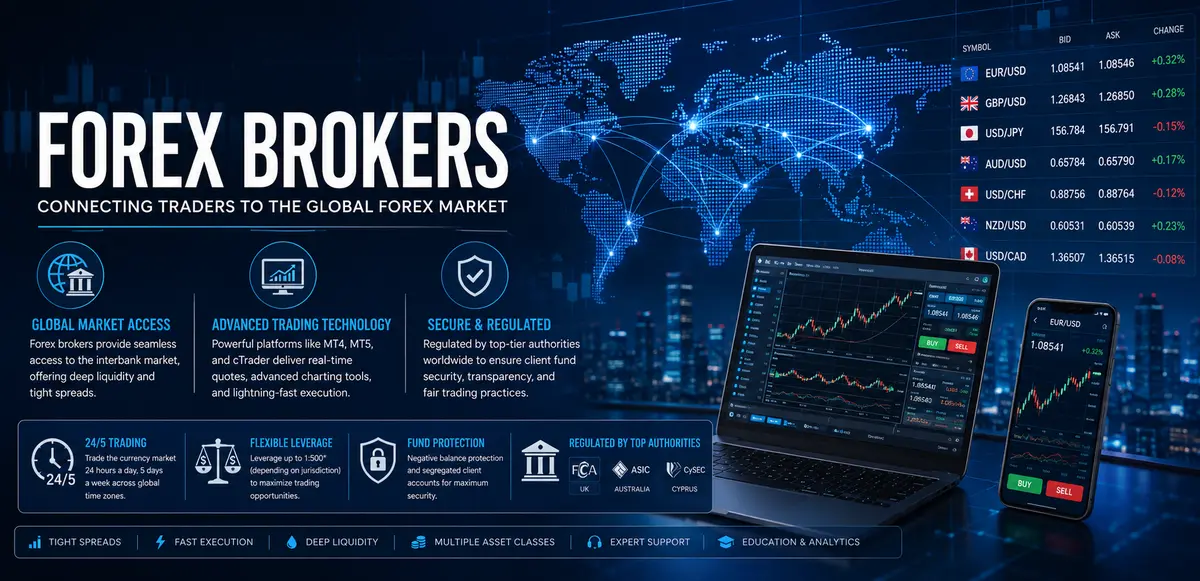
Forex brokers specialize in providing access to the foreign exchange market — the largest, most liquid financial market in the world, with a daily trading volume exceeding $7 trillion. Operating 24 hours a day, five days a week, the forex market is entirely decentralized and over-the-counter (OTC). Forex brokers act as intermediaries between retail traders and the global interbank network, which consists of top-tier investment banks like Citibank, JPMorgan Chase, and Deutsche Bank. Because currency movements are typically measured in minuscule fractions called pips, forex brokers offer extensive leverage (sometimes up to 1:30 or 1:500 depending on jurisdiction), allowing traders to control large positions with minimal capital outlays, though this significantly intensifies risk profiles.
Technological Infrastructure and Execution Models
The technological backbone of a forex broker is paramount to its survival and performance. They offer highly advanced electronic trading platforms, most notably MetaTrader 4 (MT4), MetaTrader 5 (MT5), cTrader, or highly customized proprietary web applications. Forex brokers generally utilize two main business models: Electronic Communication Networks (ECN)/Straight-Through Processing (STP), where client trades are routed directly to external liquidity providers; and Market Making (Dealing Desk), where the broker acts as the direct counterparty to the client’s trade. ECN brokers profit by charging a transparent commission per trade plus a tight market spread, whereas market makers generate revenue from the bid-ask spread itself.
Global Regulatory Jurisdictions
Due to the high risks associated with leveraged currency trading, forex brokers face rigorous oversight from international tier-one regulators. Jurisdictions include the Australian Securities and Investments Commission (ASIC), the UK’s FCA, and the Cyprus Securities and Exchange Commission (CySEC). These bodies enforce strict leverage caps, mandate negative balance protection to prevent retail clients from losing more than their initial deposit, and require brokers to participate in investor compensation funds to protect against insolvency. Prominent global examples in this sector include IG Group, Saxo Bank, and Pepperstone.
Commercial Real Estate Brokers
Corporate Real Estate Operations
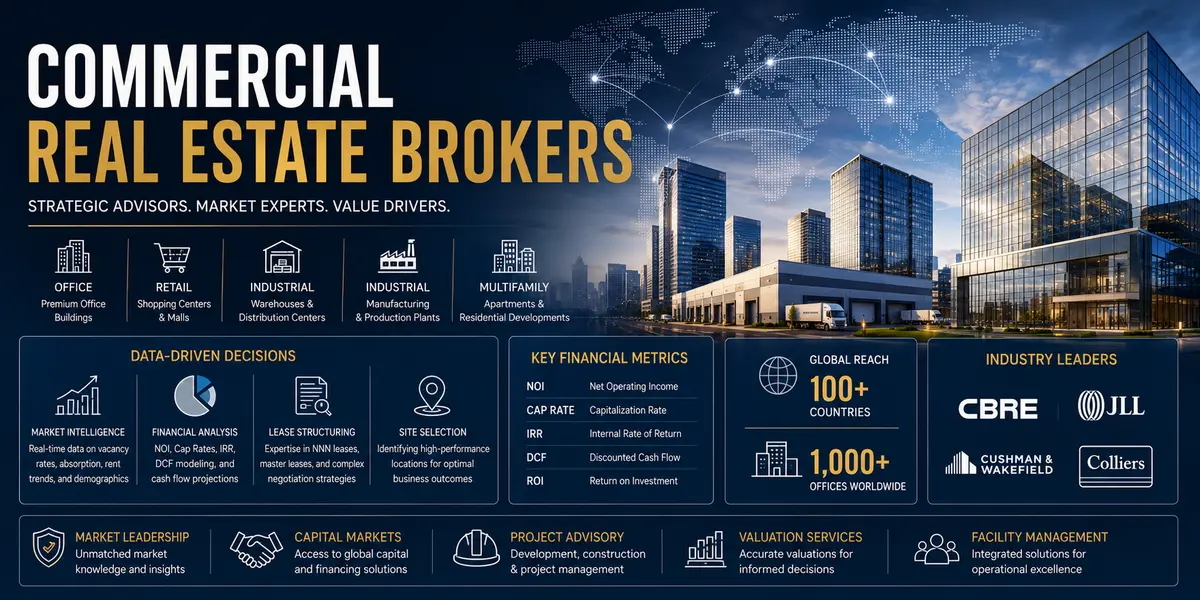
Commercial real estate (CRE) brokers specialize exclusively in facilitating transactions involving business-oriented properties, including premium office towers, retail complexes, logistical warehouses, industrial manufacturing plants, and large-scale multi-family residential developments. Unlike residential agents, commercial brokers operate in a highly quantitative environment where properties are evaluated primarily as yield-generating financial assets. Their clients are typically institutional investors, real estate corporations, sovereign wealth funds, and multinational tenants seeking to optimize their corporate real estate footprints across global logistics centers and urban hubs.
Negotiation Strategies and Financial Analytics
The toolkit of a successful commercial broker is heavily reliant on advanced corporate finance metrics. They must be experts in calculating Net Operating Income (NOI), Capitalization Rates (Cap Rates), Internal Rate of Return (IRR), and performing complex Discounted Cash Flow (DCF) analyses. CRE brokers assist clients in navigating intricate triple-net (NNN) leases, master lease agreements, and complex regional zoning and environmental regulations. They conduct extensive market intelligence studies, tracking vacancy rates, absorption statistics, and demographic shifts to advise corporations on optimal location acquisitions and asset dispositions.
Global Corporate Giants
The global commercial brokerage sector is dominated by a select group of publicly traded Fortune 500 multinational corporations. Companies such as CBRE Group, Jones Lang LaSalle (JLL), Cushman & Wakefield, and Colliers International operate across hundreds of offices globally. These corporate giants do not merely broker sales; they offer unified corporate services, including facility management, project development advisory, capital markets financing, and global valuation services, making them vital partners to multinational corporations worldwide.
Residential Real Estate Brokers
Navigating the Global Housing Market
Residential real estate brokers act as the vital link between private individuals looking to buy, sell, or lease residential properties, such as single-family homes, condominiums, townhouses, and luxury estates. While residential real estate is inherently local, the modern residential brokerage industry is driven by massive global franchise networks and cross-border capital flows. Brokers assist sellers by establishing competitive market pricing based on comparative market analyses (CMA), staging properties for maximum appeal, and marketing listings across global digital syndication networks. For buyers, brokers act as trusted advisors, identifying properties that align with lifestyle needs, school districts, and personal financial constraints.
Transaction Execution and Client Representation
The residential real estate transaction process is notoriously complex, involving extensive legal paperwork, title searches, property inspections, and mortgage underwriting coordination. Residential brokers guide clients through this maze, acting as primary negotiators to secure favorable terms. They manage the relationship between escrow companies, attorneys, appraisers, and home inspectors. In many advanced markets, agents specialize as either “listing agents” (representing the seller’s interests) or “buyer’s agents” (protecting the buyer), ensuring clear ethical boundaries and dedicated advocacy throughout the transaction lifecycle.
Prominent Global Franchise Networks
The residential sector features legendary global brands that operate extensive franchising models across dozens of countries. Brands like RE/MAX, Century 21, and Coldwell Banker possess massive global footprints, allowing an agent in New York or London to seamlessly refer a client to an agent in Dubai or Tokyo. In the ultra-high-net-worth segment, luxury boutique brokerages such as Sotheby’s International Realty and Christie’s International Real Estate leverage prestige brand equity to market multi-million-dollar estates to an affluent, globalized clientele.

Strategic Guidelines for Selecting a Global Broker
Regulatory Compliance and Financial Safety Net
When entering any financial market, the selection of an appropriate broker is a critical decision that directly impacts capital security and overall investment success. The absolute baseline criterion must be regulatory compliance. Investors should verify that the chosen broker is regulated by a reputable, top-tier financial authority (such as the SEC, FCA, or ASIC). Furthermore, it is vital to understand what asset protection schemes are in place. For example, in the US, the Securities Investor Protection Corporation (SIPC) protects client accounts up to $500,000 in the event of a broker’s bankruptcy, while the Financial Services Compensation Scheme (FSCS) in the UK provides similar safeguards up to £85,000.
Technology, Transparency, and Cost Alignment
Beyond security, a broker must align with the investor’s specific operational needs and technological preferences. Active day traders require low-latency platforms, robust charting suites, and direct market access with competitive spread pricing.
Long-term investors may prioritize a vast selection of low-cost exchange-traded funds (ETFs), automatic dividend reinvestment programs (DRIP), and robust retirement planning tools. Fee transparency is non-negotiable; investors must thoroughly audit the broker’s fee schedule for hidden costs, such as inactivity fees, withdrawal charges, account maintenance fees, and currency conversion spreads. Ultimately, the ideal broker balances absolute regulatory safety with an optimized fee structure and technological tools tailored to the client’s long-term financial objectives.




Comments
No comments yet. Be the first to share your thoughts!
Authentication Required
You must be logged in to post a comment.