

Gold Pauses at $4,313: Iran Peace Deal and Central Banks Keep the Market in a Tight Grip
Tuesday: A Breather After the Rally
On Monday, gold put on quite a show. It surged more than 2% after news broke of a preliminary agreement between the United States and Iran. The metal, which had been under pressure for weeks, finally caught a breath. Investors who had been selling in panic just a week earlier suddenly rushed back into the market. The reasons were clear: cheaper oil, a more dovish Federal Reserve, and a weaker U.S. dollar. The same chain of factors that had weighed on gold during the conflict was now working in its favor.
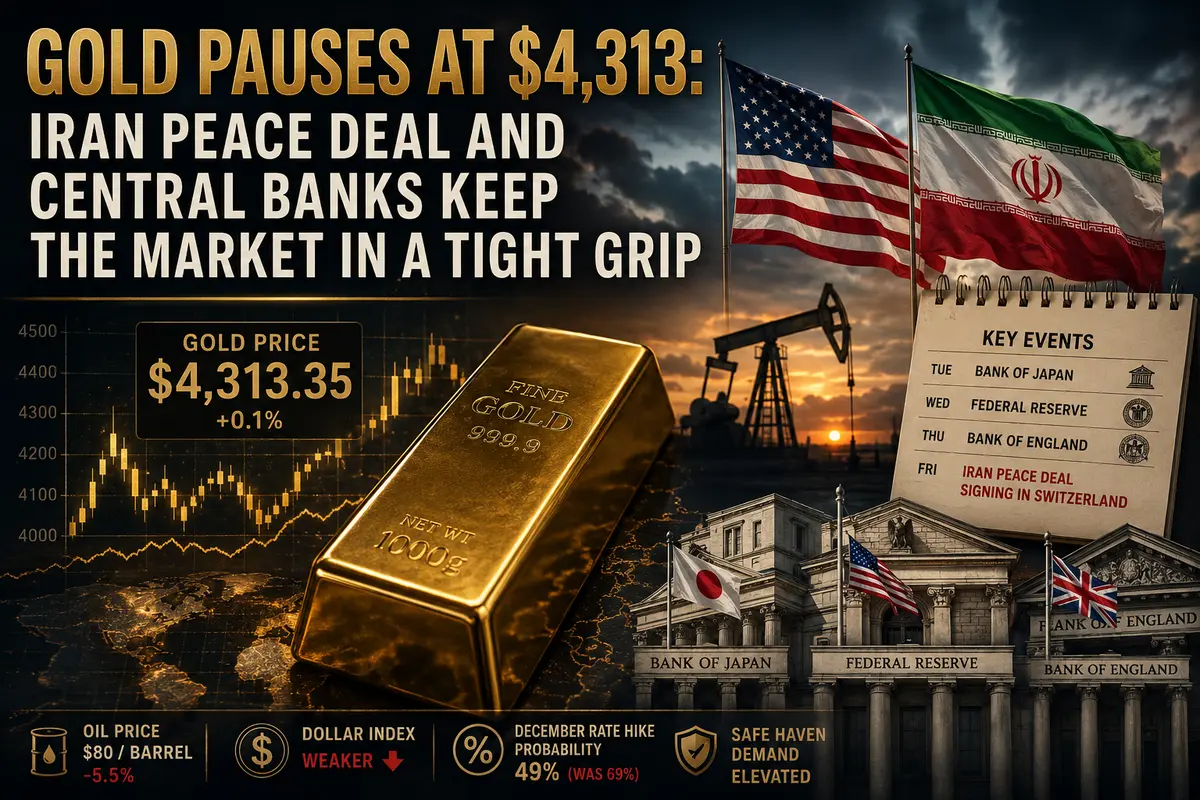
But on Tuesday, gold calmed down. Spot prices edged up just 0.1% to $4,313.35 per ounce, while futures slipped 0.4% to $4,333.90. There was no euphoria—just cautious, almost hesitant movement.
Why? Because the market realized that peace has not yet been officially secured. The formal signing ceremony in Switzerland is scheduled for Friday. Between now and then, anything can happen. Iranian hardliners, Israeli hawks, or American lawmakers could still attempt to derail the deal. If that happens, hopes for lower oil prices and a more accommodative Fed could quickly evaporate—and gold could fall along with them.
Adding to the uncertainty is a packed week for central banks. Today, the Bank of Japan is expected to raise rates to their highest level in 31 years. Tomorrow, the Federal Reserve will meet, and its guidance will shape the future direction of the dollar. The Bank of England is also expected to leave rates unchanged.
Traders are reluctant to take large positions ahead of so many potentially market-moving events. They are waiting. And gold is waiting with them.
Iran Peace Deal: Temporary Boost or Sustainable Trend?
Gold jumped 2% on Monday because markets interpreted the peace news as a significant step toward easing inflation pressures. Oil prices fell 5.5% to around $80 per barrel. Inflation expectations declined. The dollar weakened. Gold finally began catching up on gains it had failed to make during months of geopolitical turmoil.
By Tuesday, however, traders were asking tougher questions.
What if the agreement is never signed?
What if negotiations collapse?
What if Iran demands unacceptable terms?
What if Israel launches a strike before the ceremony?
Markets dislike uncertainty. They prefer clarity. Until that clarity arrives, gold may struggle to advance. In fact, it could retreat if signs emerge that the peace process is stalling.
On the other hand, if the agreement is successfully signed, it could become a powerful bullish catalyst for gold. Cheaper oil means lower inflation. Lower inflation means a more dovish Federal Reserve. A dovish Fed means a weaker dollar. And a weaker dollar generally supports higher gold prices.
The chain reaction is straightforward. The only question is whether it will continue.
The Federal Reserve: The Week’s Main Event
If the Iran deal is a short-term factor, Fed policy is a long-term one. What Kevin Warsh says tomorrow could influence gold’s trajectory for months.
Markets overwhelmingly expect the Fed to leave interest rates unchanged. That part is predictable. What remains unpredictable is Warsh’s tone.
According to CME FedWatch data, markets currently assign a 49% probability to a rate hike in December, down from 69% a week ago. The sharp decline followed softer-than-expected inflation data and the news of progress toward peace with Iran.
If Warsh delivers a dovish message—suggesting inflation is cooling and the Fed can afford to pause—the dollar may weaken and gold could rally, potentially toward $4,400 and beyond.
If he strikes a hawkish tone—emphasizing persistent inflation risks and a willingness to tighten further—the dollar could strengthen and gold might retreat toward $4,200 or even $4,100.
Warsh remains an enigmatic figure. He was considered hawkish in the past, but his stance in his current role may differ. No one knows exactly what he will say. That uncertainty continues to weigh on gold.
Bank of Japan: A Rate Hike Without Impact
On Tuesday morning, the Bank of Japan raised rates to 1.0%, the highest level in 31 years. The move was widely anticipated, which is why the yen barely reacted.
For gold, the significance is indirect. Higher Japanese rates could strengthen the yen and weaken the dollar, which would generally be supportive for gold.
But the yen failed to rally, remaining near 160.23 per dollar. Markets had already priced in the rate increase. What investors now want are signals about future hikes. If the Bank of Japan indicates that further tightening is likely, the yen could strengthen. If not, it may remain weak.
For now, the yen remains subdued, making the development largely neutral for gold.
The Bank of England and Other Central Banks
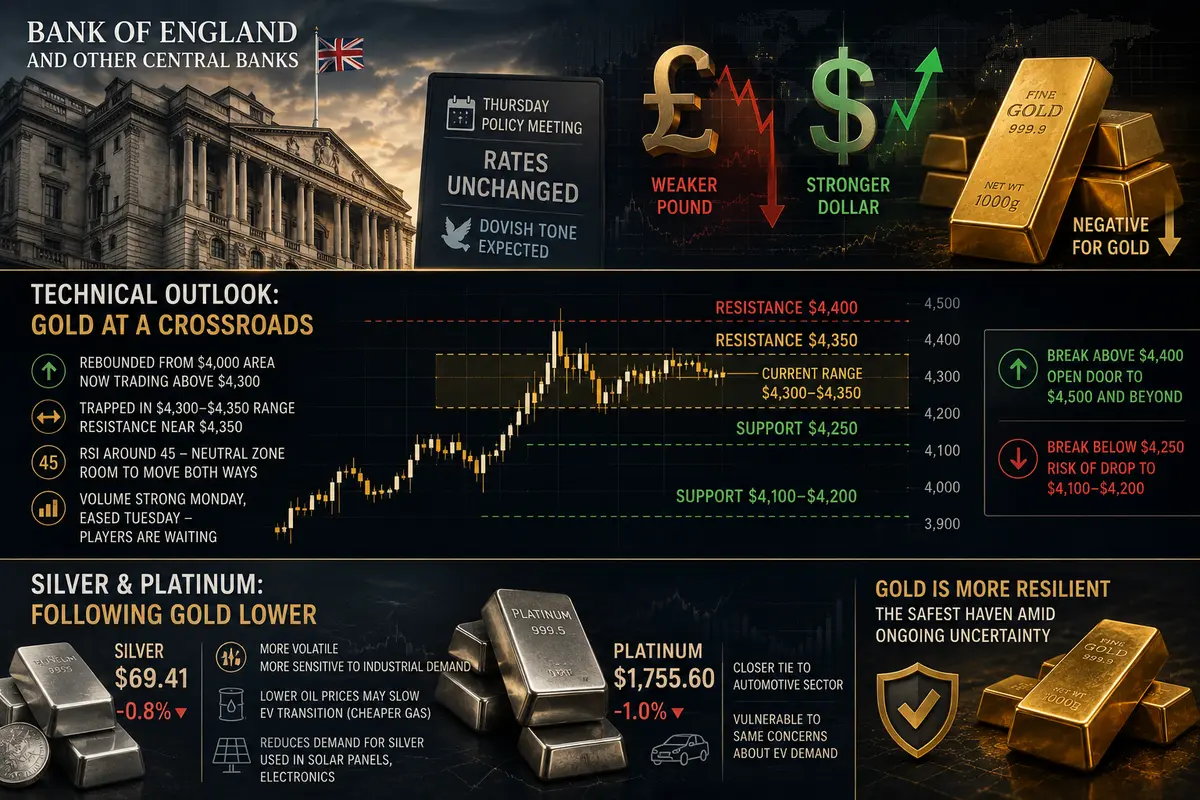
The Bank of England meets on Thursday and is expected to leave rates unchanged. The reason is simple: the UK economy remains fragile. GDP contracted by 0.1% in April, and inflation continues to moderate. The Bank is likely to maintain a dovish tone.
That could weaken the pound and strengthen the dollar, which would generally be negative for gold.
Still, the Bank of England’s influence on gold is secondary. The Fed remains the primary driver.
Technical Outlook: Gold at a Crossroads
Technically, gold is sitting in a zone of uncertainty.
On one hand, it has rebounded strongly from the $4,000 area and is now trading comfortably above $4,300. That is a constructive signal.
On the other hand, it remains trapped in the $4,300–$4,350 range and has been unable to break through resistance near $4,350.
The Relative Strength Index (RSI) on daily charts stands around 45, a neutral reading that suggests neither overbought nor oversold conditions. There is room for movement in either direction.
Trading volumes were strong on Monday but eased on Tuesday. This suggests that major players have already established positions and are now waiting for fresh catalysts.
The next major resistance level is $4,400. A breakout above that level could open the door to $4,500 and beyond.
Key support lies near $4,250. A break below that level could trigger a move back toward the $4,100–$4,200 range.
Silver and Platinum: Following Gold Lower
Silver fell 0.8% on Tuesday to $69.41 per ounce, a larger decline than gold.
Why? Because silver is more volatile and more sensitive to industrial demand. Lower oil prices resulting from a potential Iran peace deal could slow the transition toward electric vehicles by making gasoline relatively cheaper. That, in turn, could reduce demand for silver, which is widely used in solar panels and electronics.
Platinum dropped 1% to $1,755.60 per ounce. Platinum is even more closely tied to the automotive sector, making it vulnerable to similar concerns.
As a result, gold appears more resilient than other precious metals. Investors continue to view it as the safest haven amid ongoing uncertainty.
Outlook: Three Scenarios for Gold
Scenario 1: Bullish
The Iran deal is signed, oil continues to decline, the Fed adopts a dovish tone, and the dollar weakens.
Gold rises to $4,400–$4,450 this week and potentially reaches $4,500–$4,600 in the coming months.
Scenario 2: Bearish
The Iran deal collapses, oil prices rebound, the Fed sounds hawkish, and the dollar strengthens.
Gold falls to $4,200–$4,250 this week and potentially revisits $4,000–$4,100 in the weeks ahead.
Scenario 3: Neutral
The agreement is signed, but implementation takes time. The Fed maintains a balanced tone. The dollar remains stable.
Gold trades sideways between $4,300 and $4,400 without establishing a clear trend.
Based on the current mix of factors, the neutral scenario appears the most likely in the immediate term. There is simply too much uncertainty for a decisive move in either direction.
However, after the Fed meeting and the expected signing ceremony on Friday, markets may finally receive the clarity they need.
Bottom Line: Gold Is Waiting for a Signal
Gold has stalled near $4,313 after Monday’s rally. Investors are focused on two key events: Friday’s expected Iran peace signing and Wednesday’s Federal Reserve meeting.
The Bank of Japan raised rates to their highest level in 31 years, but the muted reaction in the yen provided little support for gold.
Silver and platinum have fallen more sharply, reflecting concerns about industrial demand.
From a technical perspective, gold remains in a neutral zone, with support near $4,250 and resistance around $4,400.
The key variable remains Kevin Warsh’s message at the Fed meeting. A dovish tone could push gold higher. A hawkish stance could send it lower.
For now, however, the market is quiet—a heavy, tense silence. The kind of silence that can feel more unsettling than any noise. Because in silence, all anyone can do is wait. And waiting is often the hardest part of trading. And of life. Especially when billions of dollars are at stake—and when the world is once again balancing between hope for peace and fear of conflict.
No one knows what comes next.
Everyone is waiting.
And gold is waiting with them.

Comments
No comments yet. Be the first to share your thoughts!
Authentication Required
You must be logged in to post a comment.