Bar Pipa
We pay for a post of 10$

US Dollar Index

Yen Plunges Past 163 While the Won Holds Firm: Asia’s Currency Drama Amid Oil and War

Yen Plunges Past 163 While the Won Holds Firm: Asia’s Currency Drama Amid Oil and War

A Nightmare for the Yen: Why 163 Is More Than Just a Number

When the Japanese yen broke through the 163-per-dollar mark on 22.07.2026 Wednesday, a chill swept through financial markets. This is not merely another psychological threshold—it is a return to an era when most of today’s traders had not even begun their careers. It was 1986: Ronald Reagan was in the White House, Mikhail Gorbachev was only beginning to make global headlines, and the yen was already struggling under pressure from the dollar. Today, history is repeating itself, but against a new and far more alarming backdrop.

The drop beyond 163 is not simply a step downward but a leap into the abyss—one that many experts had predicted but continued to hope could be avoided. What is driving this grim currency carousel? The answer may seem obvious, but it consists of several layers, each heavier than the last.

First and foremost, US Treasury bonds are back in fashion. Their yields are rising rapidly, attracting investors from around the world who are seeking assets that are both safe and profitable. Supported by these higher yields, the dollar looks like a fortress compared with the fragile Japanese currency. However, the US economy is not the only force taking center stage.

Oil is the second—and perhaps the main—character in this story. Prices for black gold are surging amid the geopolitical nightmare unfolding in the Middle East. Japan, which imports virtually all of its oil, is being hit from both sides: expensive energy is damaging its trade balance and weakening the national currency, while investors’ flight toward safe havens such as US government debt is adding even more pressure.

Investors now resemble poker players who can see their opponents’ cards but have no idea what the next deal will bring. They are...


Continue reading...
0
0

WTI Crude Oil Declines: Technical Correction or Trend Reversal?

WTI Crude Oil Declines: Technical Correction or Trend Reversal?

Tuesday in the Commodity Market: A Modest Decline After a Strong Rally

Tuesday 21.07.2026 brought a pause to the oil market. September WTI ... crude oil futures on the New York Mercantile Exchange fell by 0.23% to $82.29 per barrel. The decline may appear insignificant, but it comes after several days of steady growth, during which oil reached new highs and broke through psychologically important levels. The market has taken a breather, and the main question now is whether this is a temporary correction or the beginning of a trend reversal.

There are reasons for caution. The conflict in the Middle East continues to escalate, which is still providing support for oil prices. However, after oil surged following reports of strikes against Iran and disruptions to shipping through the Strait of Hormuz, many traders decided to take profits. This is normal market behavior: a correction usually follows a strong rally, especially when there are no new catalysts to sustain the upward momentum.

The current technical picture supports this view. Support is located at $77.93, while resistance stands at $84.59. The current price of $82.29 is closer to the upper boundary of this range but has not yet reached it. This means the market still has room to move in either direction, although sellers are currently slightly more active than buyers.

Interestingly, WTI is declining against the backdrop of a stronger US dollar. The US Dollar Index rose by 0.03% to 100.81. Although this is a small move, it is symbolically important and places additional pressure on oil prices. The dollar and oil traditionally have an inverse correlation, meaning that even minor changes in the value of the US currency can affect commodity markets.

Brent Falls More Sharply as the Spread Widens

While WTI declined, September BZUSD ... crude oil futures fell by...

Continue reading...
0
0

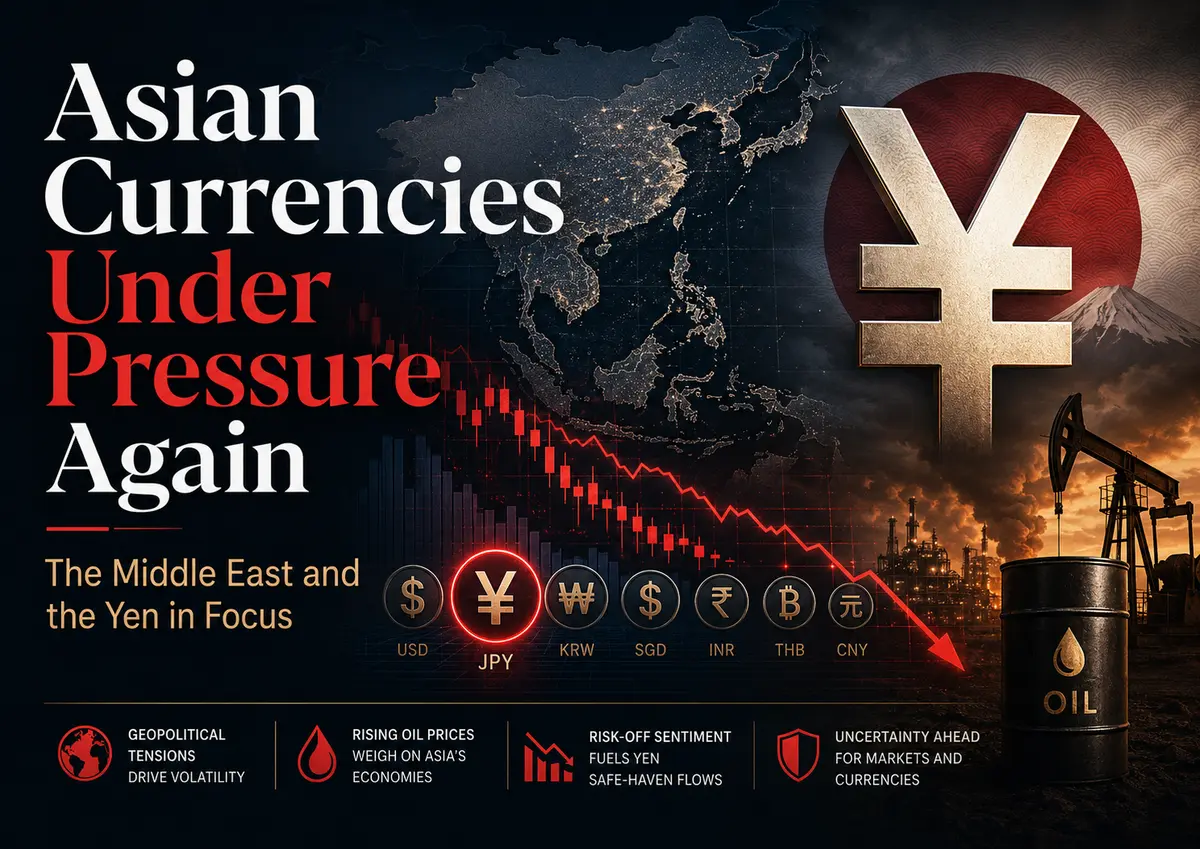
Asian Currencies Under Pressure Again: The Middle East and the Yen in Focus

Asian Currencies Under Pressure Again: The Middle East and the Yen in Focus

Friday Morning: Asia Holds Its Breath

Friday began across Asian currency markets with a sense of uneasy calm. Most regional currencies remained confined to narrow trading ranges, seemingly waiting for developments unfolding thousands of kilometres away. The Middle East once again became the main source of market-moving news, and its influence outweighed even the much-anticipated weakening of the US dollar.

The US Dollar Index, which fell to one-month lows this week following softer inflation data, edged up by 0.1% to 100.79 on Friday morning. The move may appear insignificant, but it was enough to encourage caution among Asian currencies. The dollar continues to benefit from its safe-haven status, and whenever geopolitical tensions intensify, investors begin turning back toward the US currency despite its fundamental weaknesses.

The situation in the Middle East is indeed becoming increasingly tense. The United States and Iran continue to exchange strikes, while yesterday’s reports of renewed military action confirmed that neither side appears ready to de-escalate the conflict. Oil prices remain close to one-month highs, automatically triggering a chain of rising inflation expectations. More expensive oil means higher energy costs, higher consumer prices and, ultimately, tighter monetary policy. For Asian economies, most of which are net energy importers, this represents a double blow.

The Yen: Near a 40-Year Low and Hoping for a Miracle

The Japanese yen remains the central currency drama of the year. The USDJPY ... pair is once again trading near 162.4, only a few tenths below the 40-year low of 162.84 reached earlier this month. The yen has not been this weak since the Japanese economy was operating under entirely different conditions.

The reasons behind the decline are well known and no longer surprise market participants. The enormous interest-rate gap between the United States and Japan continues to work against the yen. While...

Continue reading...
0
0

Gold Under Pressure: How the Oil Shock and Inflation Fears Are Sinking the Precious Metal

Gold Under Pressure: How the Oil Shock and Inflation Fears Are Sinking the Precious Metal

Introduction: Monday’s Sell-Off

Monday morning brought an unpleasant surprise for gold investors. Precious metal prices continued to decline, and the drop was substantial. XAU/USD fell by 1.5% to $4,057 per ounce, while gold futures lost 1.17%, slipping to $4,065. Silver and platinum suffered even heavier losses: silver plunged by nearly 3%, while platinum fell by 1.6%.

What happened? Why is gold, traditionally considered a safe-haven asset, falling at a time when geopolitical tensions are reaching their peak? As is often the case, the answer lies in a complex combination of factors, with rising oil prices and inflation expectations outweighing demand for safety.

The resumption of hostilities between the United States and Iran, the threat of the Strait of Hormuz being closed, and the surge in oil prices above $78 per barrel have created a perfect storm for the gold market. Investors are not so much afraid of the war itself as they are of its consequences: accelerating inflation and, as a result, tighter monetary policy from the Federal Reserve. For gold, which generates no income, higher interest rates can be a fatal blow.

Geopolitical Shock: Iran, the United States, and the Strait of Hormuz

Escalation of the Conflict: From Words to Action

The weekend marked the point at which diplomatic efforts finally reached a dead end. The United States launched another round of strikes against Iranian targets following an attack on a Cyprus-flagged cargo vessel in the Strait of Hormuz. Tehran responded swiftly by announcing the closure of the key shipping route until further notice.

Although US officials disputed the announcement and emphasized that the waterway remained open under the protection of the US armed forces, markets had already begun pricing in the worst-case scenario. Shipping activity in the region declined sharply, and even if the strait technically remains open,...

Continue reading...
0
0
Navigation menu
instaforex banner