

Gold Breaks Down: $4,200 Is History as Iran and the Fed Keep Pressure on the Market
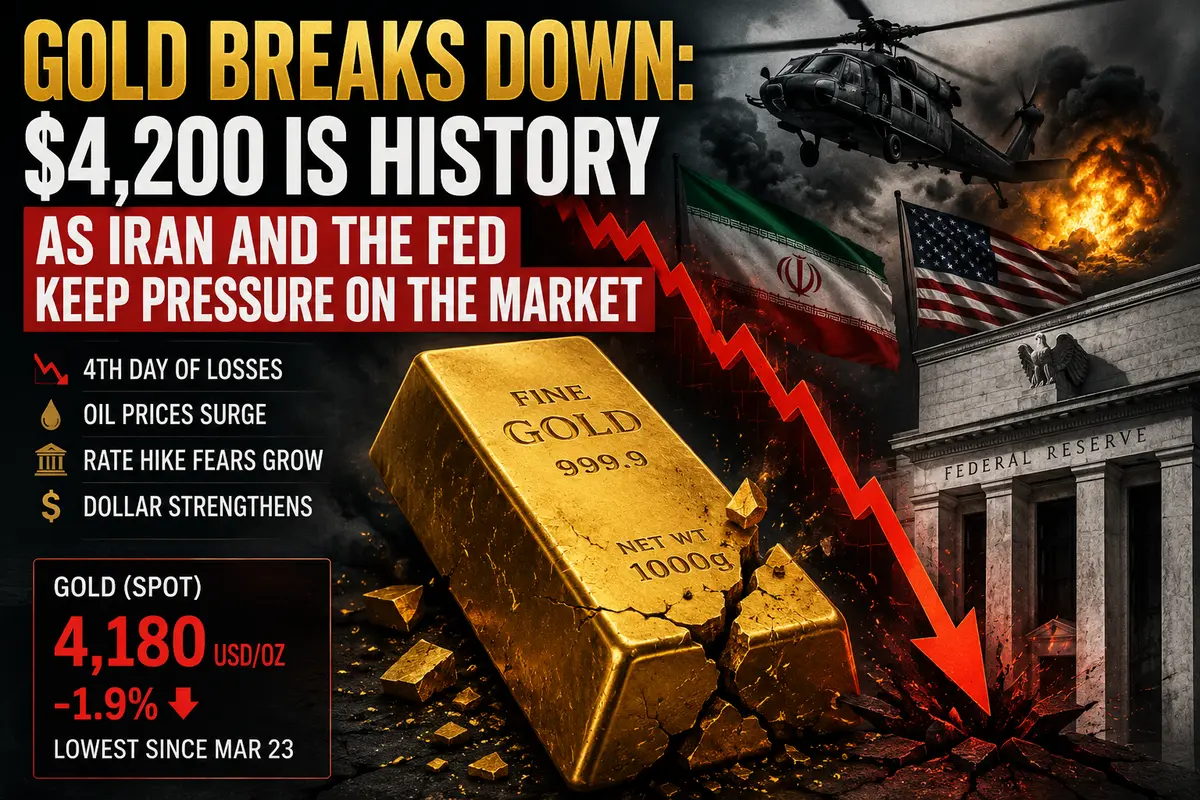
The fourth day of pain: not even a helicopter incident could save the yellow metal
Wednesday morning. You open the gold chart and can hardly believe what you see. Spot gold is trading at $4,180 per ounce, down 1.9% overnight. Four consecutive trading sessions in the red. Four. The last time that happened was last year, when the Federal Reserve was just beginning its aggressive rate-hiking cycle.
Gold has broken below the psychological $4,200 level and never looked back. It keeps falling, and nobody knows where the bottom is. U.S. gold futures are at $4,204.75, also down 1.9%, their lowest level since March 23. Three months ago, the world looked very different: the Middle East ceasefire was still holding, U.S. inflation was easing, and the Fed was signaling rate cuts. Those promises have now all but disappeared.
What Happened?
The same story that has plagued gold for weeks continues. The dollar is strong. Interest rates remain high. Inflation refuses to retreat. And the Middle East—which would normally support gold prices—has instead become another source of pressure.
Now a new and dangerous twist has emerged. On Tuesday, Washington reportedly launched fresh strikes against Iranian targets following the downing of a U.S. military helicopter near the Strait of Hormuz.
Think about what that means. The United States and Iran are no longer exchanging blows through intermediaries or proxy forces in Lebanon or Yemen. These are direct strikes. A helicopter has been shot down. Airstrikes are underway. The Strait of Hormuz—the artery through which roughly one-fifth of the world’s oil flows—is increasingly becoming a conflict zone.
And do you know how gold is reacting?
It’s falling.
Not rising—falling.
Because markets are looking three steps ahead. Strikes on Iran lead to higher oil prices (which rose another 1% on Wednesday), which fuels inflation, which reduces the chances of Fed rate cuts and may even increase the likelihood of another hike in December. That strengthens the dollar—and sends gold lower.
Gold used to be a hedge against war.
Now war is hurting gold.
Absurd, perhaps—but that’s the reality of today’s market.
New U.S. Strikes on Iran: Why Markets Are Concerned
Let’s take a closer look.
Earlier this week, reports focused on a ceasefire between Israel and Iran, declarations of “complete victory,” and hopes that stability was returning to the region. At the time, those headlines appeared credible.
But the ceasefire proved even more fragile than many skeptics expected.
According to unofficial reports, a U.S. military helicopter conducting reconnaissance near the Strait of Hormuz was shot down by Iranian air defenses. Washington responded quickly. Strikes targeting missile sites, ammunition depots, and command centers reportedly followed within hours.
U.S. officials described the action as a “proportional response.” Iran vowed to “respond to the response.”
And once again, markets are confronting the possibility of a broader regional conflict—one that could disrupt shipping through the Strait of Hormuz, send oil prices soaring, and potentially push the global economy toward recession.
In the old market environment, this would have been extremely bullish for gold.
Not anymore.
Because inflation fueled by expensive oil is exactly what the Fed fears most. And what hurts the Fed’s inflation fight ultimately hurts gold.
Markets are no longer focused on the conflict itself. They are focused on the monetary-policy consequences.
Brent crude has already climbed above $95 per barrel, while WTI has moved above $92. The $100 mark is now within reach. If oil crosses that threshold, inflation expectations could surge, giving the Fed a powerful argument for maintaining or even tightening policy further.
Inflation Data: The Calm Before the Storm
All eyes are on Wednesday’s U.S. Consumer Price Index (CPI) report for May.
This may be the most important economic release of the month—and perhaps of the year.
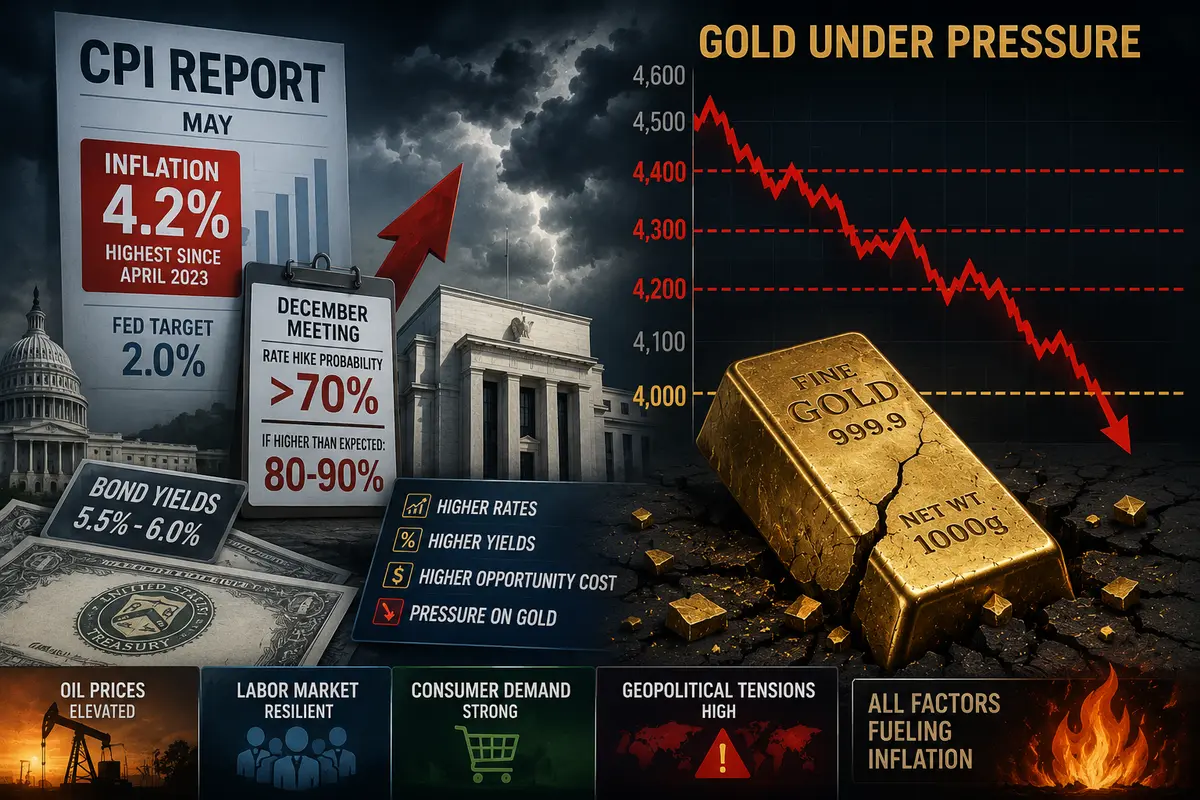
Economists expect annual inflation to rise to around 4.2%, which would mark the highest reading since April 2023. The Fed’s target remains 2%, meaning inflation would still be more than double the desired level.
Markets are already pricing in a greater than 70% probability of a rate hike at the December meeting.
If inflation comes in above expectations, those odds could climb toward 80–90%.
A significantly stronger reading might even lead some traders to price in a September hike.
For gold, that would be a major setback.
Higher interest rates generally push Treasury yields higher, increasing the opportunity cost of holding gold. Why own a metal that generates no income when relatively low-risk U.S. government bonds offer yields of 5.5–6%?
On Thursday, investors will also receive Producer Price Index (PPI) data. While important, CPI remains the main event.
A softer-than-expected inflation print could give gold a chance to rebound.
But most analysts are not expecting good news.
Oil prices are elevated. The labor market remains resilient. Consumer demand is still strong. And geopolitical tensions continue to add fuel to the inflation fire.
Technical Picture: Support Levels Keep Breaking
Technical analysts are increasingly frustrated.
Gold has sliced through one support level after another:
-
$4,400
-
$4,300
-
$4,200
Each time, investors hoped a bottom had formed.
Each time, the market proved otherwise.
The next major psychological level is $4,000 per ounce—just 4.5% below current prices.
At the current pace, that level could be tested as early as next week.
The Relative Strength Index (RSI) has fallen into oversold territory near 25, which would normally suggest a reversal is near.
But in the current environment, fundamentals are overwhelming technical indicators.
The dollar is strong.
Bond yields are high.
Inflation expectations are rising.
Geopolitical risks remain elevated.
Everything is working against gold—even factors that historically supported it.
Major banks have started lowering their gold forecasts. Just a month ago, many analysts were calling for $5,000 gold by year-end. Now some are discussing targets closer to $4,000 or even $3,800.
The bearish trend is so powerful that few investors want to stand in front of it.
Silver and Platinum: Even More Pain
If gold is struggling, other precious metals are doing even worse.
Silver fell 1% to $64.70 per ounce. Over the past two weeks, however, it has lost more than 10%.
Unlike gold, silver depends heavily on industrial demand. Fears of a global slowdown are weighing on that demand, while high interest rates are simultaneously hurting investment demand.
A double blow.
Platinum suffered even more, dropping 3% to $1,678.60 per ounce.
Platinum was already under pressure from the transition toward electric vehicles, which require fewer platinum-based catalytic converters. Now macroeconomic concerns are adding a third source of pressure.
Investors are pulling money from the entire precious-metals complex.
In a world where bond yields are near multi-year highs, non-yielding assets have become less attractive.
Even palladium, once a favorite among speculators, is trading near its lows.
The entire precious-metals sector is firmly in a bear market.
And there is little sign that it is ending anytime soon.
The Dollar: Strong, but Not Invincible
The U.S. Dollar Index (DXY) gained another 0.1% during Wednesday’s Asian session and remains near the two-month high of 100.21 reached earlier this week.
Analysts identify 99.80 as a key support level. If DXY remains above 100, it could signal further dollar strength.
There is, however, a counterargument.
Morgan Stanley recently forecast a weaker dollar in the second half of the year, citing narrowing interest-rate differentials between the United States and other major economies.
For now, markets are unconvinced.
Strong employment data and rising oil prices continue to support the greenback.
But a surprisingly soft inflation report could quickly shift sentiment.
At present, the dollar remains the preferred safe haven in a world facing Middle East tensions, slowing European growth, and uneven economic momentum in China.
Money is flowing into dollars.
Gold is paying the price.
What to Expect from the Fed
The next key date is June 16–17, when the Federal Reserve holds its next monetary-policy meeting.
Most economists expect rates to remain unchanged.
But the market cares less about what the Fed does and more about what it says.
If inflation remains elevated and geopolitical risks persist, Chair Jerome Powell and his colleagues may adopt a more hawkish tone.
They could emphasize their willingness to raise rates again if necessary—or outline specific conditions that would justify further tightening.
For gold, that would be another negative development.
A hawkish Fed typically means a stronger dollar, higher yields, and lower gold prices.
A softer inflation report, on the other hand, could allow policymakers to maintain a more dovish stance, giving gold an opportunity to recover.
Yet most analysts are not counting on that outcome.
Long-Term Perspective: Does Gold Still Have a Role?
Long-term investors may view the current selloff differently.
Gold is trading near an 11-week low, and many of the negative factors are already reflected in the price.
The key question is how much further the decline can go.
Historically, gold performs best when real interest rates are low or negative.
Today, U.S. real rates remain positive—around 1.5–2%. That is not disastrous for gold, but it is hardly supportive.
If inflation stays elevated and the Fed is forced to keep rates high, real rates could rise toward 2.5–3%.
That scenario would be painful for gold and could potentially push prices toward $3,500 or even $3,000.
If inflation begins to cool, however—perhaps due to stabilizing oil prices—the Fed could eventually gain room to cut rates.
Real yields would fall, and gold could recover rapidly toward $4,500–$5,000.
Everything comes back to oil.
And oil comes back to the Middle East.
As long as conflict keeps energy prices elevated, gold may continue to struggle.
Bottom Line
Gold has broken below $4,200 and continues to slide, marking its fourth consecutive losing session.
The main drivers are:
-
A stronger U.S. dollar
-
Expectations of further Fed tightening
-
Rising oil prices
-
Escalating tensions involving Iran and the United States
Markets are pricing in a greater than 70% chance of a December rate hike.
Treasury yields remain near multi-month highs.
The opportunity cost of holding gold continues to rise.
Investors are now waiting for U.S. inflation data. A stronger-than-expected reading could push gold toward $4,100 or even $4,000. A weaker reading could trigger a rebound, although its sustainability would remain uncertain.
Silver and platinum are under even greater pressure.
The dollar remains the dominant safe-haven asset despite forecasts of eventual weakness later this year.
Next week’s Fed meeting could determine the next major move.
For now, investors are fleeing gold—not because they have lost faith in the metal, but because the world has changed.
In today’s market, war no longer automatically supports gold. Higher interest rates make bonds more attractive. And the dollar remains king.
Gold has recovered from every major crisis over the past 5,000 years.
It may recover again.
The only question is when.
A month from now?
A year from now?
No one knows.
For now, the bottom has yet to be found—and each new day seems to bring another low.

Comments
No comments yet. Be the first to share your thoughts!
Comments only for logged-in users.