

Gold at a Crossroads: An Iran Ceasefire Beckons, but Inflation Keeps a Tight Grip
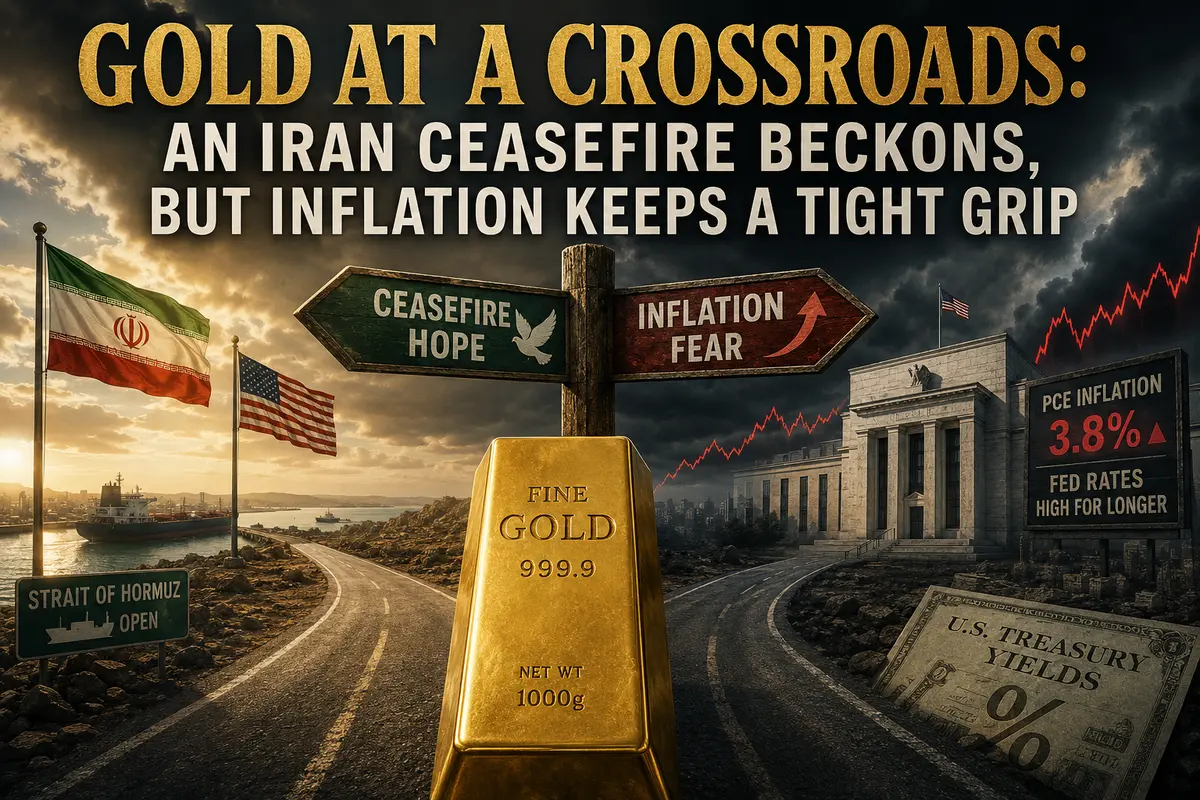
Friday’s gold market was defined by painful uncertainty. Spot gold held steady at $4,495.90 per ounce, virtually unchanged, while futures edged slightly lower to $4,526. Beneath this calm surface lies a market being pulled in opposite directions. On one side is hope for peace, which pushed prices higher on Thursday. On the other is persistent inflation, preventing gold from gaining real momentum. Caught between these forces, the yellow metal remains stuck, unable to choose a clear direction.
Ceasefire on the Table: What Changed Overnight
The main development driving markets on Thursday and continuing to influence sentiment on Friday is reports that the United States and Iran are close to extending a ceasefire agreement. According to sources, the preliminary arrangement includes a 60-day truce and, critically, the reopening of the Strait of Hormuz to maritime traffic.
This is precisely the breakthrough markets have been waiting for over the past several months. Since the conflict began, the closure of the Strait of Hormuz has been a major source of oil market disruption, inflationary pressure, and monetary policy concerns. Now, with renewed hopes that the waterway could reopen, markets reacted immediately.
Gold initially fell to a two-month low on Thursday as investors feared that de-escalation would reduce demand for safe-haven assets. However, as the implications of the news became clearer, the metal reversed course and finished the day up 0.8%. This turnaround is key to understanding how the market currently operates.
Investors realized that a ceasefire would mean not only a reduction in geopolitical risk premiums but also lower oil prices. Lower oil prices would ease inflationary pressures. Lower inflation would reduce the need for the Federal Reserve to raise interest rates. And a pause in rate hikes is exactly what gold needs.
However, the agreement is not yet final. It still requires approval from President Trump and confirmation from Iran. This is where the biggest risk lies. Trump has previously spoken of progress only to authorize new military actions later, while Iran has repeatedly denied reports of agreements. Markets remember these reversals and remain reluctant to fully price in peace. That caution explains Friday’s subdued trading. Few investors are willing to make large bets until the ceasefire becomes reality rather than just a headline.
The Inflation Monster: PCE Challenges Optimism
Even if a ceasefire is achieved, gold faces a problem that no agreement alone can solve: inflation.
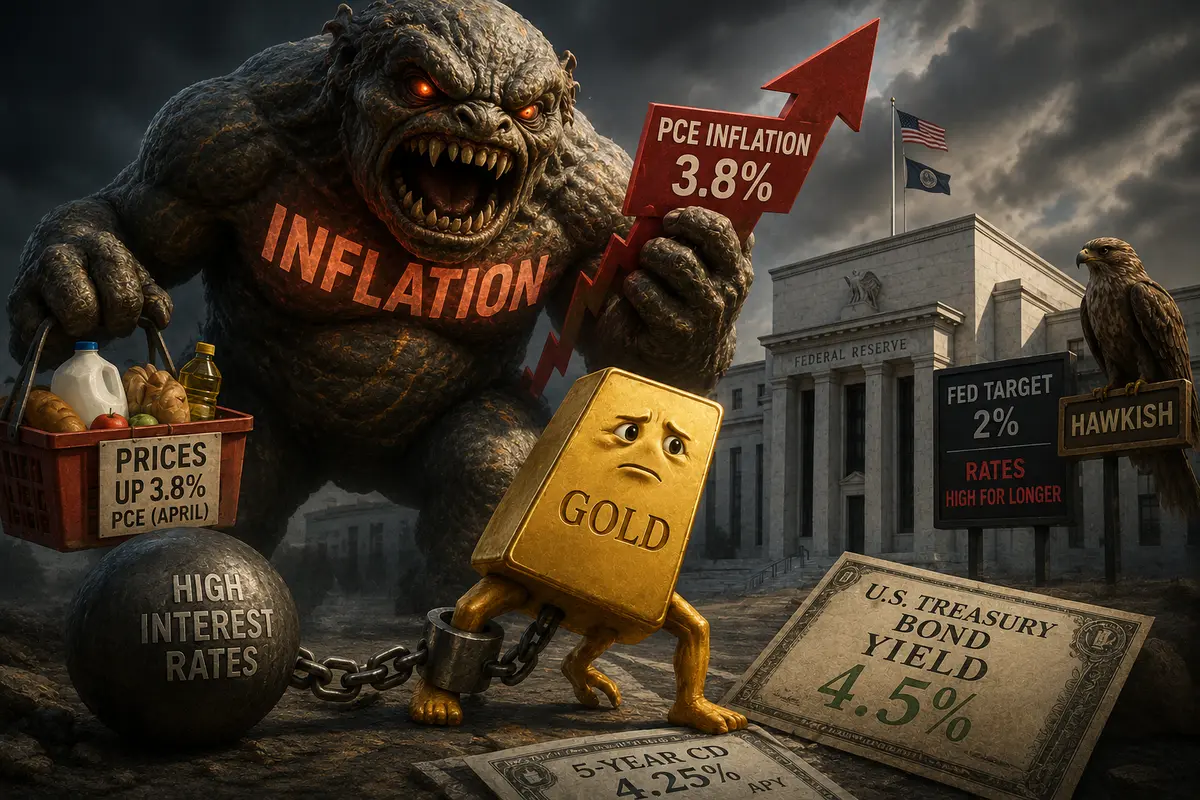
On Thursday, the April Personal Consumption Expenditures (PCE) Price Index—the Federal Reserve’s preferred inflation gauge—was released, and the figures were alarming. Annual PCE inflation rose 3.8%, marking the fastest pace in roughly three years.
A reading of 3.8% is well above the Fed’s 2% target. It signals that inflation is not merely elevated—it is accelerating. Even if oil prices begin to decline as a result of a ceasefire, the impact will not be immediate. Inflation is inherently lagged. The April data reflect the oil shock that began in February and March. Even if the Strait of Hormuz reopens tomorrow, consumer prices are likely to remain elevated for several more months.
For gold, this means the threat of high interest rates remains very much alive. Faced with accelerating inflation, the Federal Reserve is likely to keep rates elevated and could even raise them further. This is the single most significant headwind for gold.
Gold generates no yield. When interest rates are high, holding gold becomes more expensive from an opportunity-cost perspective. Money tied up in bullion could instead earn interest in deposits or government bonds. This mechanism acts like a weight attached to gold’s legs. As long as inflation remains elevated and the Fed maintains a hawkish stance, that weight will continue to limit gold’s upside potential.
Treasury Yields: Gold’s Silent Enemy
The PCE data briefly pushed U.S. Treasury yields lower, but yields soon rebounded to multi-month highs.
This is gold’s silent enemy.
High yields make bonds an attractive alternative to precious metals. Why hold gold, which pays no income, when investors can buy 10-year Treasuries and receive a guaranteed return?
Yields remain elevated because markets believe the Federal Reserve will not rush to ease monetary policy. Even if a ceasefire with Iran materializes and oil prices fall, inflation is still expected to remain above target, forcing the central bank to maintain a restrictive stance.
This significantly limits gold’s upside. The metal may receive short-term boosts from geopolitical developments, but as long as yields stay high, a sustained rally remains unlikely.
Silver and Platinum: Living in Gold’s Shadow
Other precious metals moved lower on Friday.
Silver fell 0.2% to $75.52 per ounce, while platinum declined 0.4% to $1,915.
Both metals face many of the same challenges as gold, but with additional burdens.
Silver has a dual identity as both a safe-haven asset and an industrial metal. As a defensive asset, it suffers from high interest rates. As an industrial commodity, it suffers from uncertainty created by a prolonged conflict. Even hopes for a ceasefire cannot fully offset this double blow.
Platinum is even more dependent on industrial demand, particularly from the automotive sector. Automakers dealing with expensive energy costs and supply-chain disruptions have reduced purchasing activity. Even if peace with Iran is achieved, a recovery in demand will take time. Until then, platinum is likely to remain under pressure.
A Week That Resolved Nothing
By the end of the week, gold prices were virtually unchanged.
This is remarkable considering everything that happened. Strikes on Iran, retaliatory attacks, inflation data, and ceasefire reports—any one of these events would normally be enough to move gold by dozens of dollars. Instead, the forces largely offset one another.
Hope for peace pushed gold higher. Inflation data pushed it lower. Geopolitical fears and monetary-policy concerns battled each other to a draw.
For traders, this has been frustrating. The market is offering few clear signals. Gold remains trapped in a range and unable to break free.
A decisive move higher would likely require a powerful positive catalyst—such as a formally signed ceasefire and a sustained decline in oil prices. A breakdown lower would require a negative shock—failed negotiations, renewed escalation, or further inflation acceleration.
Until one of those scenarios materializes, gold is likely to continue drifting within its current range, torn between hopes for peace and fears of higher interest rates.
Friday provided no answers. It merely reinforced what the market already knew: gold is sitting at a point of maximum uncertainty. A ceasefire with Iran appears on the horizon, but has not yet been secured. Inflation remains high, though it may have peaked. Treasury yields remain elevated, though they could decline.
Amid this mix of conflicting signals, gold has come to a standstill, waiting for the fog to clear. Until it does, the yellow metal will remain at a crossroads.

Comments
No comments yet. Be the first to share your thoughts!
Authentication Required
You must be logged in to post a comment.