

Gold continues its ascent: fifth day of gains on the wave of peace with Iran and Fed expectations
Wednesday — a day when the yellow metal refuses to give up
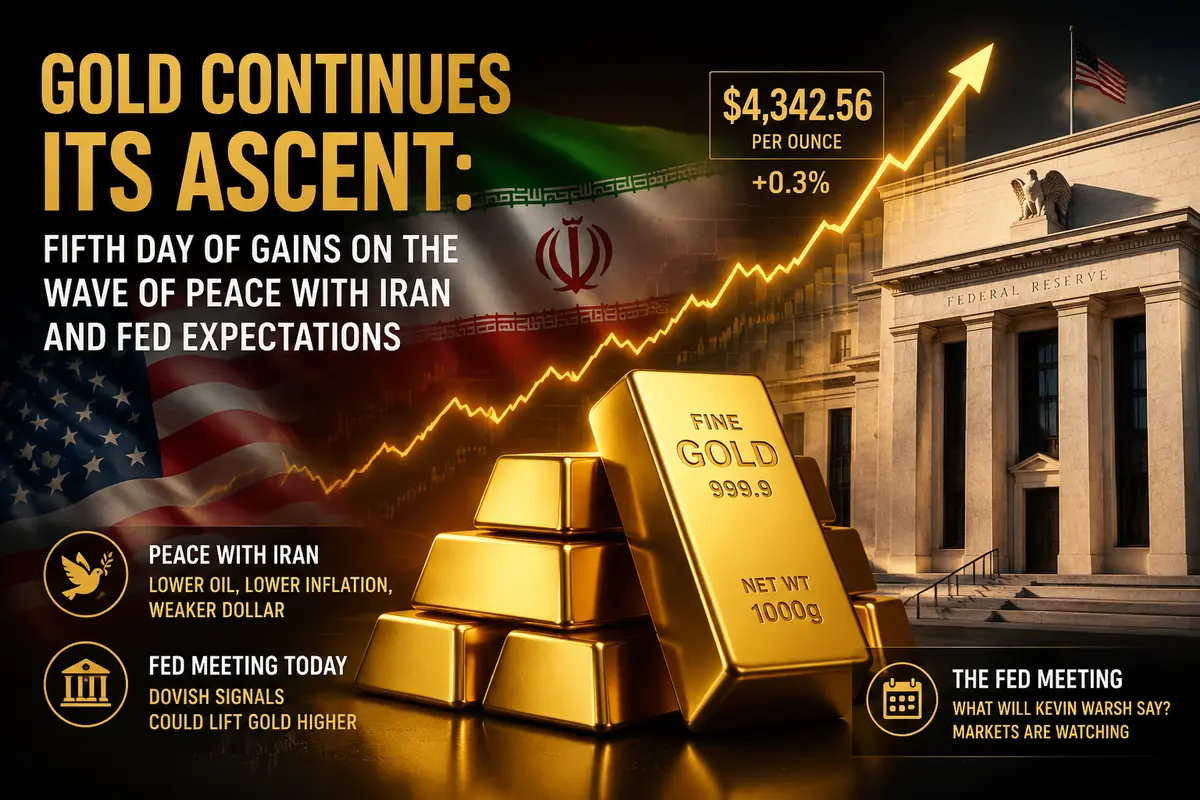
Wednesday in the gold market began with the continuation of the rally — the fifth consecutive session. The spot price rose by 0.3% to $4,342.56 per ounce. Futures gained 0.3% to $4,368.40. It may seem minor, but this is the fifth straight day of gains. After four weeks of continuous decline, when gold was balancing near the $4,000 level, this looks like a real comeback.
What is driving gold higher? Two things. First — the peace agreement between the United States and Iran. Second — expectations around the Federal Reserve meeting.
Peace with Iran continues to influence markets. Oil has fallen, inflation expectations have eased, and the dollar has weakened. A weaker dollar is a classic driver of gold growth. Investors who were panic-selling gold a week ago are now returning, buying the metal as a hedge against uncertainty.
But the main factor is the Fed. Today’s Federal Reserve meeting, led by new Chairman Kevin Warsh, is a major test. It is his first serious challenge in the role. The future of the dollar — and therefore gold — depends on his words.
Investors are waiting for “dovish” signals. They hope Warsh will confirm the Fed’s willingness to ease policy if inflation continues to decline. If that happens, the dollar will fall and gold will surge.
But there is also risk. If Warsh turns out “hawkish,” the dollar could strengthen and gold may reverse downward.
For now — five days of gains. And that is already a trend.
Let’s break down what is behind this rally, what to expect from the Fed, and how long gold’s rise can continue.
Iran peace: why it is good for gold
On Monday, we wrote that peace with Iran triggered a sharp drop in oil and weakened the dollar. This gave gold an upward impulse.
On Tuesday and Wednesday, that momentum continued. Details of the agreement are becoming clearer. Iran is granted the right to resume oil exports. It agrees not to develop nuclear weapons and freezes its nuclear program for 60 days.
This reduces geopolitical risks related to a possible blockade of the Strait of Hormuz. Investors are less afraid of war and more willing to take risk. But for gold, this is a paradox: gold usually rises on fear. Now it is rising on peace.
Why? Because peace with Iran has led to lower oil prices. Lower oil prices reduce inflation expectations. The Fed may become more accommodative. The dollar weakens. And a weaker dollar means higher gold prices.
The chain is long but logical:
Peace → cheaper oil → lower inflation → dovish Fed → weaker dollar → higher gold
This is exactly the mechanism driving gold over the past five days.
The Fed: the main risk and main hope
The Federal Reserve meeting is a potential game-changer. Rates are expected to remain unchanged — that is predictable. What is not predictable is Kevin Warsh’s tone.
Warsh has a “hawkish” reputation. He served on the Fed Board of Governors during the 2008 financial crisis and is known for his strict stance on inflation.
But in his new role, he may soften his tone. He must balance inflation control with economic growth. Too hawkish — and he risks recession. Too dovish — and inflation could become entrenched.
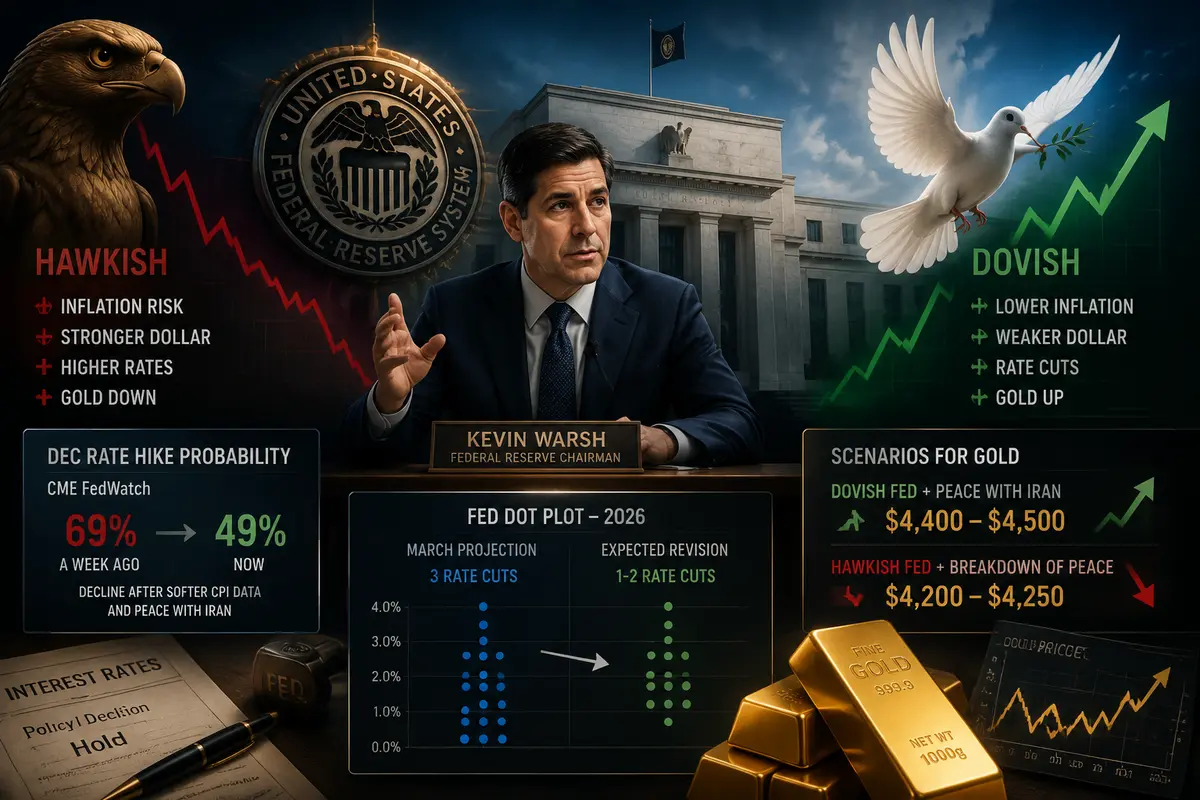
Markets currently price in a 49% probability of a rate hike in December (CME FedWatch data). A week ago, it was 69%. The decline followed softer CPI inflation data and news of peace with Iran.
Investors want to hear that the Fed is ready to cut rates if inflation continues to fall. If Warsh says this, the dollar will drop and gold will rise. If he is cautious or hawkish, the dollar will strengthen and gold may fall.
Also important are economic projections (the “dot plot”). In March, the Fed projected three rate cuts in 2026. Now those projections are likely to be revised downward. One cut or none would be a hawkish signal. Two or three cuts would be dovish.
For gold, the ideal scenario is a dovish Fed combined with continued peace with Iran. In that case, gold could reach $4,400–$4,500.
A negative scenario — hawkish Fed and breakdown of peace talks — could push gold down to $4,200–$4,250.
Technical analysis: gold is rising
Technically, gold looks much stronger than a week ago. Five consecutive days of gains is a powerful signal. Gold has broken resistance at $4,300 and is now testing $4,350.
The next resistance level is $4,400. If gold breaks above it, the path opens toward $4,500 and higher. Support is at $4,250. If it falls below that, a return to $4,200 is possible.
The Relative Strength Index (RSI) is at 55 — neutral territory but trending upward. Neither overbought nor oversold. There is room for further gains.
Trading volumes have increased in recent days, suggesting that large players are returning to the gold market.
Structural demand: central banks are buying gold
Beyond speculative factors, there is also fundamental support. According to a recent World Gold Council survey, 45% of reserve managers at central banks expect to increase their gold holdings over the next year.
This is a key signal. Central banks buy gold to diversify reserves and protect against geopolitical risk. Their trust in the dollar is declining, especially amid sanctions and global conflicts.
Central bank demand supports gold prices in the long term. Even when speculators sell, central banks buy.
In addition, demand from investors in China and India is rising. China’s economy is recovering, and gold remains a traditional store of value. India, where gold is culturally significant, remains a major consumer.
What about silver and platinum
Silver and platinum also rose on Wednesday. Silver gained 0.6% to $70.47 per ounce. Platinum rose 0.4% to $1,815.72.
Silver is often called gold’s “poor cousin.” It is more volatile and more sensitive to industrial demand. Lower oil prices and peace with Iran support industrial activity, which is positive for silver.
Platinum depends heavily on the auto industry. Despite the transition to electric vehicles, demand for platinum in catalytic converters for traditional cars remains significant. Lower oil prices may slow EV adoption — paradoxically positive for platinum demand.
Forecast: three scenarios for gold
Scenario 1 — Bullish:
Peace with Iran holds, oil continues to fall, the Fed turns dovish, the dollar weakens. Gold rises to $4,400–$4,450 this week and $4,500–$4,600 in coming months.
Scenario 2 — Bearish:
Peace breaks down, oil rises again, the Fed turns hawkish, the dollar strengthens. Gold falls to $4,250–$4,300 this week and $4,100–$4,200 in the coming weeks.
Scenario 3 — Neutral:
Peace holds but implementation slows. The Fed remains neutral. The dollar stabilizes. Gold trades in a $4,300–$4,400 range without a clear trend.
Personally, weighing all factors, I lean toward the first scenario. There are too many positive drivers for gold: reduced inflation risk from Iran peace, a likely cautious Fed, and continued central bank buying.
But risks remain. If Warsh turns hawkish, everything could change.
Conclusion: gold continues its ascent
Gold is rising for the fifth consecutive session. The drivers are the peace agreement between the US and Iran, which reduced inflation expectations and weakened the dollar, and anticipation of the Federal Reserve meeting.
Technically, gold has broken resistance at $4,300 and is moving toward $4,400. Support stands at $4,250.
Central banks continue to buy gold, supporting demand.
Silver and platinum are also rising, though more slowly.
The key event of the day is the Fed meeting. Kevin Warsh’s tone will determine gold’s direction for weeks ahead.
If the Fed is dovish, gold could rise to $4,400–$4,450. If hawkish, it could fall to $4,250–$4,300.
For now — five days of gains. And this is no longer just a rebound, but a sustained trend. Gold is back. After long weeks of decline, fear, and uncertainty, it is finding its way again — toward light, toward growth, toward $4,400. And perhaps even higher. Time will tell.

Comments
No comments yet. Be the first to share your thoughts!
Authentication Required
You must be logged in to post a comment.