

Bitcoin Crawls Back from the Brink: $61,000 After a Week from Hell
Friday’s Nightmare: When $60,000 Stopped Being Support
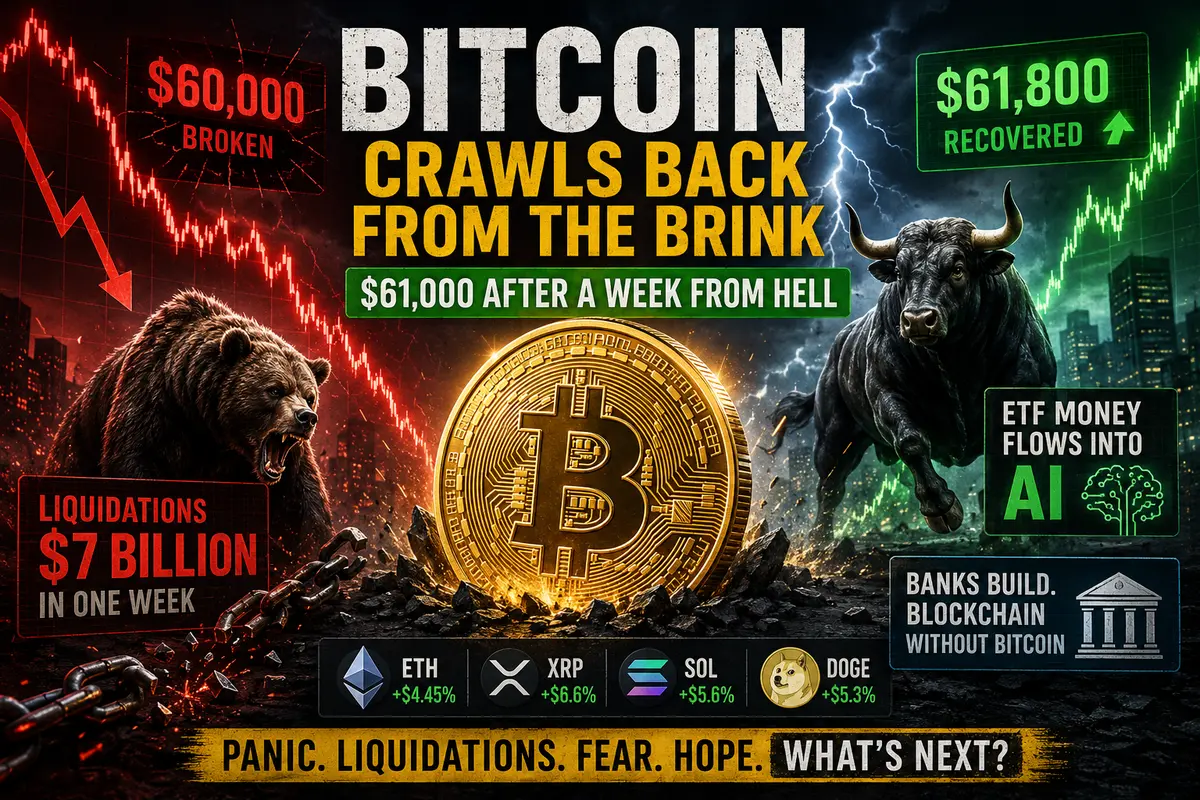
On Sunday morning, the crypto community finally exhaled. Not loudly, not joyfully—the kind of exhale that comes after narrowly surviving a disaster. Bitcoin climbed back above $61,000, gaining 1.7% in just a few hours. On a normal day, that wouldn’t even make headlines. But this was no normal week. It was the most brutal week since the collapse of FTX and the imprisonment of Sam Bankman-Fried.
Let’s start with the numbers to grasp the scale of the damage. Bitcoin lost more than 17% over the week. Ethereum fell around 20%. The entire crypto market shed roughly $390 billion in market capitalization. Three hundred ninety billion dollars—more than the GDP of New Zealand or Portugal—vanished in just five days.
Friday was the real horror show. Bitcoin briefly dropped below $60,000. This wasn’t just another price level; it was a psychological wall. When Bitcoin broke above it, everyone was shouting, “To the moon! $100,000 next!” When it fell below, panic took over. If $60,000 couldn’t hold, where was the bottom? $50,000? $45,000? Nobody knew. Nobody wanted to find out. Everyone simply sold.
And now, on Sunday, traders stare at the chart in disbelief. Bitcoin is back around $61,800. It should be a reason to celebrate. Yet the optimism feels nervous, cautious. What if another crash comes tomorrow? What if this is just a dead-cat bounce?
Strategy Sold Bitcoin. Is That a Sign?
Do you know what triggered the panic for many investors? Not macroeconomic news, not Federal Reserve comments, not even the stock market decline. It was news from a company called Strategy.
Formerly known as MicroStrategy, the company rebranded after Bitcoin effectively became its sole reason for existence.
Strategy spent decades building business intelligence software. Then founder Michael Saylor discovered Bitcoin and became obsessed. The company began buying billions of dollars worth of BTC, taking loans against its holdings, issuing bonds—doing everything possible to acquire more Bitcoin.
Today, when investors look at Strategy’s financial statements, they barely care about its software business. What matters is the Bitcoin treasury: over 200,000 BTC, roughly 1% of Bitcoin’s total supply.
Then came Friday.
Strategy sold Bitcoin for the first time since 2022.
Only 32 BTC, worth around $2.5 million—a rounding error compared to its total holdings. But the fact that it sold at all mattered. If even Strategy, a company that has preached eternal faith in Bitcoin and called it “digital gold,” is selling, maybe something is wrong.
The market reacted immediately. Many institutional investors view Strategy as a sentiment indicator. As long as Saylor is buying, everything is fine. If he starts selling, it’s time to run.
Saylor later explained that the sale was purely technical and related to corporate requirements, insisting the company’s strategy remains unchanged. But the word “sale” had already entered the market narrative. There was no taking it back.
Leveraged traders began getting wiped out one after another like bowling pins.
$7 Billion in Liquidations: How Leverage Gets Destroyed
This is where the real bloodbath happened.
According to CoinGlass data cited by CoinDesk, nearly $7 billion worth of positions were liquidated during the week. Of that amount, $5.7 billion came from long positions—bets on rising prices.
For those unfamiliar with liquidations, here’s how it works.
Imagine you have $1,000 and open a 10x leveraged position. You’re effectively trading with $10,000. If the market moves in your favor, your gains are magnified. If it moves against you, your losses are magnified too.
Once losses approach your collateral, the exchange forcibly closes your position. That’s called liquidation.
During panic selloffs, liquidations become self-reinforcing. One trader gets liquidated, pushing the price lower. That triggers another liquidation, pushing it even lower. Then another. And another.
The result is a cascade.
You look at the chart and wonder why Bitcoin just fell 5% in ten minutes despite no obvious news. The answer is liquidation-driven selling feeding on itself.
The $5.7 billion liquidated from long positions means that investors who believed in continued upside lost $5.7 billion. Gone. Vaporized.
Some lost savings. Some lost borrowed money. Some lost funds loaded onto credit cards.
The crypto winter that many thought was over suddenly felt very real again.
And perhaps the harshest reality: those losses aren’t coming back. The money simply transferred to traders who were shorting the market. They made fortunes while everyone else watched their portfolios burn.
ETF Money Is Flowing Into AI
Liquidations weren’t the only problem.
Another, more subtle force is weighing on crypto: capital outflows from spot Bitcoin ETFs.
Not because investors suddenly hate crypto, but because they’ve found something they find even more exciting.
Artificial Intelligence.
Every major institutional investor, pension fund, and family office is now thinking less about Bitcoin and more about NVIDIA, Microsoft, OpenAI (once it eventually goes public), and venture funds backing AI startups.
And honestly, the logic is understandable.
Bitcoin has existed for fifteen years. It’s no longer mysterious.
AI is the new frontier.
It’s the story behind eye-popping returns—just look at NVIDIA’s stock performance. It’s the topic dominating conferences from Davos to Singapore.
Investors who once insisted Bitcoin was the ultimate inflation hedge are now selling crypto exposure and buying semiconductor stocks instead. The potential returns appear higher, regulatory risks seem lower, and the business models are easier to understand.
As money leaves spot Bitcoin ETFs—the primary driver behind the rally in late 2024 and early 2025—it creates constant downward pressure.
Not dramatic pressure like liquidations.
Just steady pressure.
Like water slowly eroding stone.
A little selling every day.
A little lower every day.
Eventually, the stone cracks.
The Federal Reserve Ruined the Party Again
Of course, we can’t forget the classic villain in every market story: the U.S. jobs report.
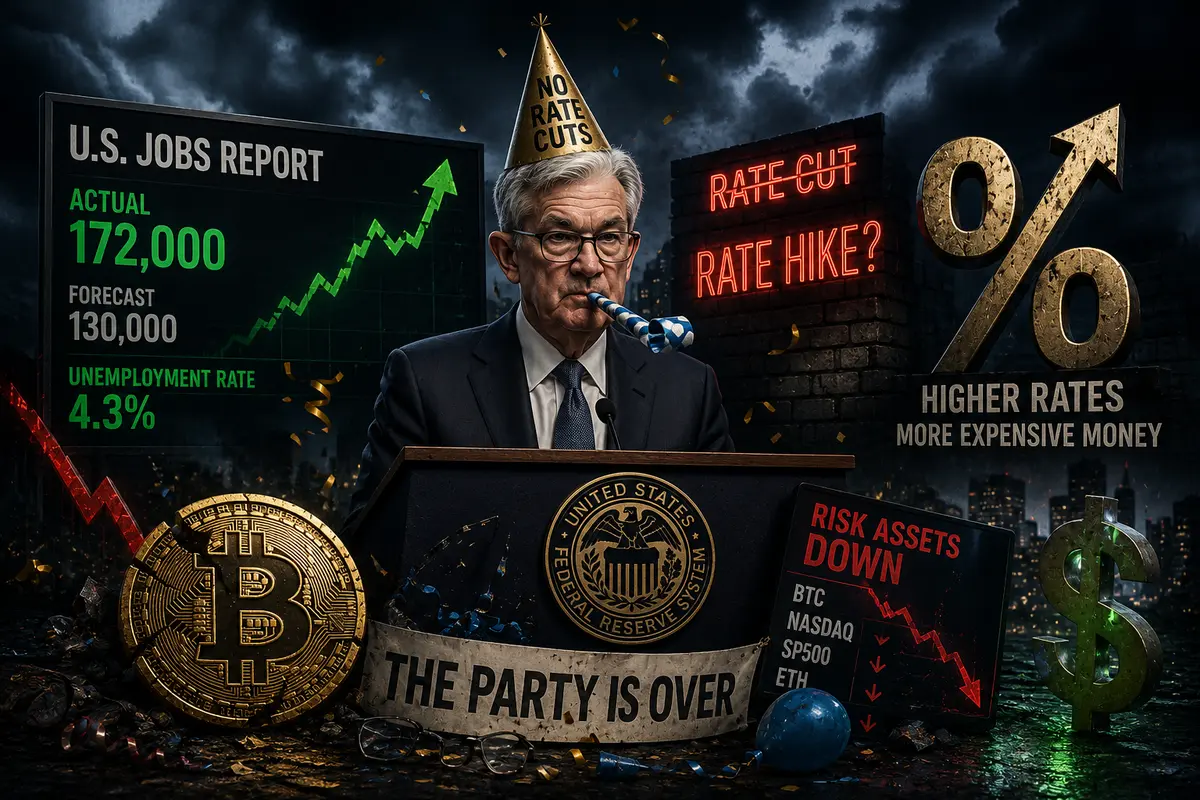
The U.S. economy added 172,000 jobs. Economists expected 130,000.
That’s a huge surprise.
Unemployment remained at 4.3%, stronger than expected.
What does that mean for crypto?
The same thing it means for every risk asset.
The Federal Reserve has less reason to cut interest rates.
In fact, some traders are now pricing in the possibility of another rate hike later in the year.
Higher rates mean more expensive money.
And expensive money is bad for speculative assets that generate no cash flow, dividends, or coupon payments.
In other words, it’s particularly bad for Bitcoin.
Treasury yields rose. The dollar strengthened. Traders betting on monetary easing closed their positions because their thesis no longer worked.
There’s another irony here.
Bitcoin has long been marketed as “digital gold,” a safe-haven asset that should thrive during uncertainty.
Yet when geopolitical tensions rise and interest rates climb, Bitcoin often behaves more like a high-risk technology stock than a store of value.
Friday’s market reaction reinforced that reality.
Banks Love Blockchain, But Not Bitcoin
There is one bright spot in this otherwise gloomy story.
While speculators lose billions, major banks are quietly building the next generation of financial infrastructure using blockchain technology.
JPMorgan Chase, Bank of America, Citigroup, and other banking giants have announced plans to launch a shared tokenized-deposit network by 2027.
It sounds boring.
It isn’t.
Today, transferring money between banks can take days, involve multiple intermediaries, and often works only during business hours.
Tokenized deposits could enable near-instant, 24/7 settlement with fewer intermediaries.
Banks are essentially taking the technology behind Bitcoin and applying it to traditional finance.
But notice something important:
They don’t need Bitcoin itself.
They want blockchain as a distributed ledger.
They’ll use their own tokens, their own networks, and their own rules.
For the crypto community, that’s both encouraging and unsettling.
Encouraging because the technology is being validated.
Unsettling because adoption may happen without Bitcoin, Ethereum, or decentralization playing a central role.
Ancient Wallets Wake Up: A Message From 2011
Now for a crypto mystery that has captivated the community.
Several Bitcoin wallets created in 2011 suddenly became active after more than a decade of silence.
These wallets contained coins that had not moved since Bitcoin traded for less than a dollar.
Imagine someone buying Bitcoin in 2011, forgetting about it, losing access to it—or perhaps even passing away.
Then suddenly, movement.
Maybe someone found an old hard drive.
Maybe someone remembered a password.
Or perhaps someone cracked the wallet.
One wallet reportedly contained more than 1,000 BTC.
At current prices, that’s over $60 million.
The market reacted nervously because every awakened wallet raises the same question:
Will the owner sell?
If yes, that’s additional supply hitting the market.
If not, it’s simply a fascinating story.
So far, no major selling has occurred.
But the event reminded investors that an estimated 2–4 million Bitcoin—roughly 10–20% of total supply—has remained dormant for over five years.
Some of those coins are likely lost forever.
Others may still be waiting.
Altcoins Flash Green Amid the Red
Sunday’s rebound wasn’t limited to Bitcoin.
Ethereum jumped 4.45% to around $1,640.
Yet it still remained down 17.5% for the week.
The bounce is real, but it doesn’t erase the damage.
XRP gained 6.6% to roughly $1.16, though it was still down 13% over the week.
Solana and Cardano rose 5–6%.
Dogecoin, Elon Musk’s favorite meme coin, gained 5.3%.
Meanwhile, the $TRUMP memecoin barely moved at all—a strange display of stability for an asset known for wild swings.
Overall, the altcoin market suggests crypto is still alive.
Not everyone has left.
Some investors believe the selloff was excessive.
Some think $60,000 is the bottom.
Others are averaging down and accumulating.
And some are still hoping for an “altseason,” where capital rotates from Bitcoin into smaller tokens and drives explosive gains.
But one question hangs over the market:
Will there even be an altseason this cycle?
Or will institutional money that entered through ETFs remain focused exclusively on Bitcoin because of liquidity and regulatory clarity?
What Happens Next? Three Bitcoin Scenarios
So where do we go from here?
Bearish Scenario
Bitcoin fails to hold above $60,000.
The Fed stays hawkish.
Investors continue shifting capital into AI.
Liquidations continue.
Bitcoin falls to $55,000 and eventually $50,000.
In this scenario, crypto winter lasts through the end of 2026 or longer.
Many projects fail.
High-cost miners shut down operations.
Hash rate declines.
The pain continues.
Base Case
Bitcoin consolidates between $58,000 and $65,000 through the summer.
Large players accumulate.
Retail investors panic and sell.
If the Fed hints at easing later in the year, another rally emerges.
Not to $100,000.
More likely toward $75,000–$80,000.
Not a triumph, but not a disaster either.
Bullish Scenario
A banking crisis or major geopolitical shock drives investors back into Bitcoin as a safe-haven asset.
Inflation accelerates.
The Fed is forced to cut rates despite a strong labor market.
Bitcoin reclaims $70,000 and pushes toward new all-time highs.
The problem?
This scenario requires something bad to happen in the real world.
That’s not exactly comforting.
Personally, I lean toward the middle scenario.
Too many factors are working against a rapid recovery: high rates, capital flows into AI, and ongoing regulatory uncertainty.
At the same time, I don’t expect a total collapse. Too many large institutions have already entered the market to let it fade into irrelevance.
The Moral: Crypto Is Still Not for the Faint of Heart
This week delivered a lesson the market teaches every year—and one investors keep ignoring.
Cryptocurrency is not for the faint-hearted.
Seven billion dollars in liquidations is not a joke.
Those were real losses suffered by real people who simply wanted to make some money.
Yes, Bitcoin recovered above $61,000.
Yes, altcoins are flashing green.
But nobody can guarantee there won’t be another crash tomorrow.
Nobody knows whether Strategy will sell more coins.
Nobody knows what Jerome Powell will say next week.
So if you’re reading this and wondering whether it’s time to buy Bitcoin at the bottom, remember one thing:
We only recognize the bottom in hindsight.
When prices are collapsing, it feels like the world is ending.
Buying at that moment is terrifying.
And yet, historically, that has often been when the best opportunities emerged.
Bitcoin survived the Mt. Gox collapse.
It survived China’s crackdowns.
It survived FTX.
It will likely survive this selloff too.
The real question isn’t survival.
The real question is the price you pay to enter—and the nerves you manage to keep intact along the way.
From the looks of it, a good buying opportunity may be approaching.
A bad one was Friday.
What Monday brings, however, remains anyone’s guess.

Comments
No comments yet. Be the first to share your thoughts!
Authentication Required
You must be logged in to post a comment.