

Bitcoin Tries to Catch Its Breath After a Hellish Week: $63,000 and Fragile Hope
Monday: A Hint of Green Through the Red Haze
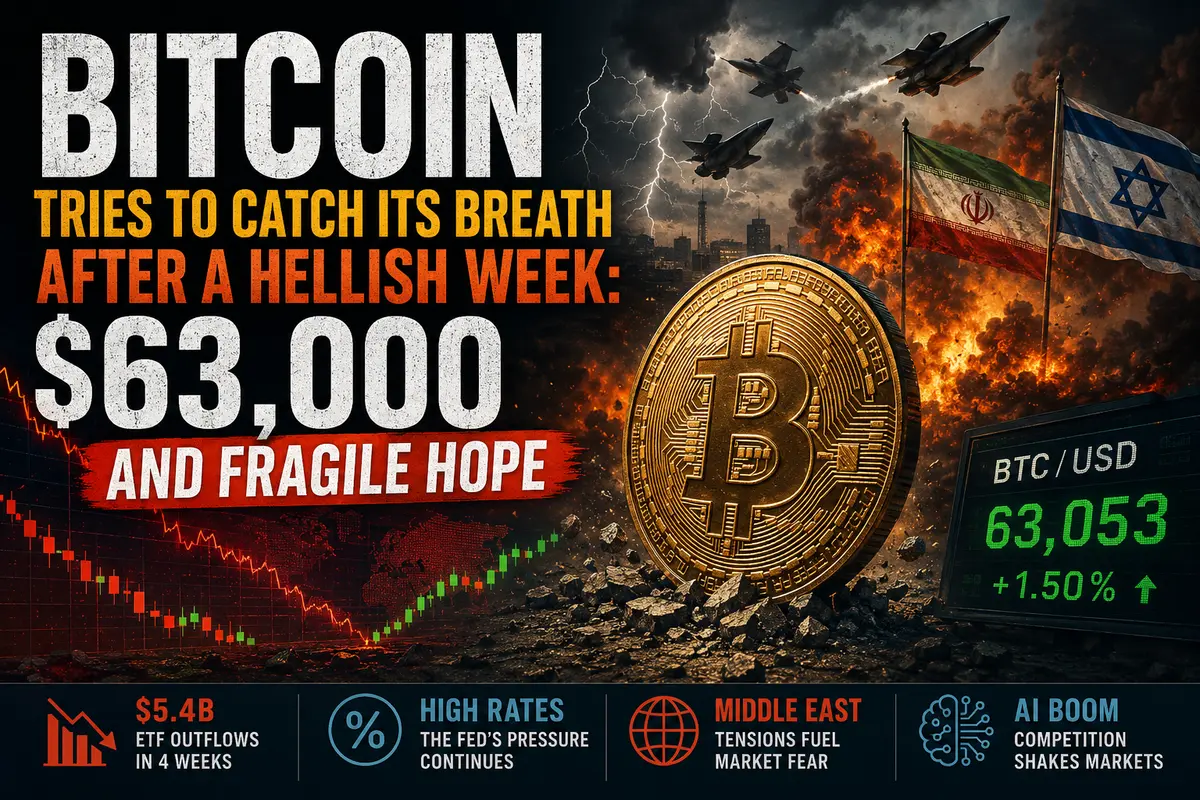
After seven days of nonstop nightmare, after the cryptocurrency market lost nearly $400 billion in market capitalization, after $7 billion in liquidations and panic not seen since the collapse of FTX, Monday finally arrived. It did not bring relief, but at least it offered a brief pause.
Bitcoin rose by 1.5%, reaching $63,053.
Sounds insignificant? Perhaps. After an 18% decline in a single week, one and a half percent is just a drop in the ocean. But in the crypto world, where fortunes are made and lost in a matter of hours, any green candle feels like a gift from fate.
Yet the optimism is cautious, tinged with anxiety about both the past and the future. The fundamental problems that triggered the selloff have not disappeared. Institutional investors continue pulling money out of spot Bitcoin ETFs. The conflict between Iran and Israel has not been resolved—it has merely frozen under a fragile ceasefire that could collapse at any moment. And the Federal Reserve continues to rattle markets with the prospect of persistently high interest rates.
Still, Bitcoin is up 1.5%.
The cryptocurrency managed to hold above the psychologically important $60,000 level, which it briefly fell below on Friday. Altcoins are showing signs of life as well: Ether gained 3.4%, while Solana and XRP each rose 1.3%. Even memecoins, which typically suffer the most during panic-driven selloffs, posted modest gains.
The market is trying to find a bottom.
The only question is whether it has actually found one—or whether this is simply another pause on the way down.
Institutional Exodus: $5.4 Billion Gone in Four Weeks
The biggest story of the past month is not missiles in the Middle East or even Federal Reserve policy.
The biggest story is spot Bitcoin ETFs.
The very funds that once seemed like the crypto market’s salvation—attracting tens of billions of dollars from conservative institutional investors—have now become channels for capital outflows.
The numbers are alarming.
Last week alone, U.S. spot Bitcoin ETFs recorded $1.72 billion in net outflows, the largest weekly withdrawal since April 2025. It was also the fourth consecutive week of negative flows.
Over those four weeks, investors pulled a staggering $5.4 billion from Bitcoin ETFs.
Five and a half billion dollars in a month.
That is an enormous amount of money.
That is confidence slipping through the market’s fingers.
Who is selling?
Pension funds, hedge funds, family offices, and corporate treasuries—the same institutions that eagerly embraced Bitcoin through regulated investment vehicles a year ago.
Why are they selling?
The reasons are familiar: fears of persistent inflation, elevated interest rates, capital rotation into AI-related stocks, and geopolitical uncertainty.
But there is also a more specific explanation.
Many institutional investors viewed Bitcoin as a bet on Federal Reserve rate cuts. The logic was simple: lower rates would weaken the dollar and boost alternative assets such as Bitcoin.
But rates have not fallen.
In fact, markets are now increasingly pricing in the possibility of another rate hike by December.
That trade has failed.
Institutions are taking losses and heading for the exits.
The largest weekly outflow came from Grayscale’s GBTC, which has been bleeding assets for months due to its relatively high fees. Yet even market leaders such as BlackRock’s IBIT and Fidelity’s FBTC posted negative flows.
Everyone is selling.
Nobody wants to hold Bitcoin amid this level of uncertainty.
Artificial Intelligence: Friend or Foe?
Another major theme is competition from artificial intelligence.
Throughout 2025 and into early 2026, investors increasingly shifted capital from cryptocurrencies into AI-related stocks. NVIDIA surged severalfold. Microsoft, Google, and Amazon reported record revenues from AI-driven cloud services. Startups such as OpenAI, Anthropic, and Moonshot AI raised billions at valuations reaching tens of billions of dollars.
Against that backdrop, crypto looked underwhelming.
Yes, Bitcoin reached new all-time highs around $70,000–$75,000, but much of the move felt driven by momentum rather than genuine enthusiasm.
The analogy is simple: when a shiny new toy appears, the old toys gather dust on the shelf.
But something interesting happened on Friday and Monday.
AI stocks suddenly came under pressure.
NVIDIA dropped sharply. Broadcom, AMD, and Intel also moved lower. The trigger was a disappointing forecast from Broadcom, which caused investors to question whether the AI boom could continue indefinitely.
That gave Bitcoin a small boost.
Some of the capital that had flowed into AI began trickling back into crypto—not because crypto suddenly became more attractive, but because AI stopped looking like a guaranteed winner.
The paradox is clear:
Bitcoin benefits when a competing sector weakens.
But that is hardly reassuring. If the AI bubble truly bursts, it could drag down the entire universe of risk assets—including cryptocurrencies.
The connections are invisible but real: the same investors, the same appetite for risk, and the same macroeconomic forces.
The Middle East: Missiles, Oil, and Risk Aversion
On Sunday evening, just as crypto traders prepared for a new week, the Middle East once again reminded markets how quickly tensions can escalate.
Iran and Israel exchanged airstrikes.
Iran launched missiles toward northern Israel. Israel struck targets in Beirut’s suburbs that it claimed were linked to Iranian operations.
Donald Trump, who had recently called for restraint and spoken about the possibility of a diplomatic agreement with Tehran, found himself in an uncomfortable position.
His appeals went unheard.
The conflict continued.
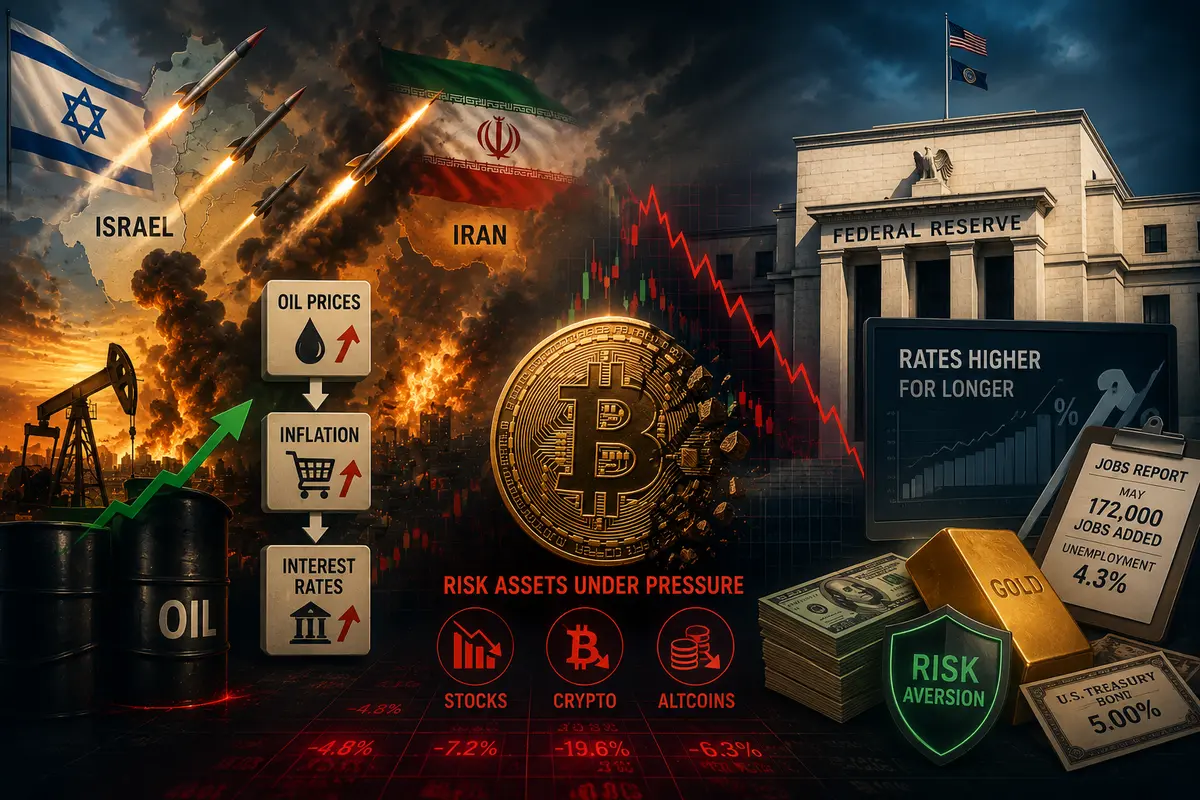
For crypto markets, this is bad news—not because cryptocurrencies are directly affected by missile strikes, but because escalation in the Middle East tends to push oil prices higher.
Higher oil prices fuel inflation.
Higher inflation encourages higher interest rates.
And higher interest rates are poison for speculative assets, including Bitcoin.
War also fuels risk aversion.
When investors panic, they sell anything perceived as risky and seek refuge in dollars, gold, and government bonds.
Cryptocurrencies, being among the riskiest assets available, are often hit first.
Even as Bitcoin edged higher on Monday, traders remained glued to headlines from Tehran and Tel Aviv.
A new attack could send prices plunging.
A durable ceasefire could spark a relief rally.
The Federal Reserve: Crypto’s Greatest Enemy
If the Middle East represents a short-term risk that can change overnight, Federal Reserve policy is the long-term force shaping markets for years.
And for cryptocurrencies, the picture remains troubling.
Friday’s U.S. labor market report showed that the economy added 172,000 jobs in May, far exceeding expectations. Unemployment remained steady at 4.3%.
It was a strong report.
It suggested that the U.S. economy continues to expand despite elevated borrowing costs.
For the Federal Reserve, that means there is less urgency to cut rates.
Indeed, markets are increasingly pricing in the possibility of a rate hike at the December meeting.
For Bitcoin, higher rates are a serious problem.
Bitcoin generates no yield.
When rates are low, investors are more willing to chase speculative returns. When rates are high, many prefer the certainty of bond income.
Why hold an asset that can lose 20% in a week when you can buy U.S. Treasuries yielding around 5% and sleep peacefully at night?
This is the fundamental reason behind the capital outflows from crypto.
Until the Federal Reserve signals a meaningful policy shift, pressure on Bitcoin is likely to persist.
Altcoins: Pale Shadows of Bitcoin
Altcoins followed Bitcoin higher on Monday, but the move felt hesitant and fragile.
Ether rose 3.4% to $1,666, though it remains nearly 20% lower than a week ago.
XRP and Solana gained around 1.3%.
Cardano and BNB added roughly 0.5–1%.
Dogecoin climbed 0.8%, while the TRUMP token gained 2%.
There was no euphoria.
No bullish frenzy.
Just a cautious recovery after panic selling.
Ethereum’s situation is particularly notable.
Despite last year’s network upgrades, which were expected to improve scalability and lower transaction fees, the anticipated rally never materialized.
Ether continues to trade roughly 40% below its all-time highs.
Competition from Solana, BNB, and other so-called “Ethereum killers,” combined with broader risk aversion, has limited its upside.
XRP, despite securing regulatory clarity in the United States after its legal victory against the SEC, has also struggled to capitalize on the development.
Altcoins typically suffer more than Bitcoin during market panics because they are less liquid and more speculative.
When investors flee risk, they sell altcoins first.
When confidence returns, Bitcoin is usually the first asset they buy back.
What Do the Technical Indicators Say?
For those who trust charts more than headlines, the technical picture remains mixed.
On the positive side, Bitcoin successfully defended the $60,000 level.
This is both a psychological and technical support zone.
Had it broken decisively below that level, the next likely targets would have been $55,000—or even $50,000.
For now, that scenario has been avoided.
On the negative side, Bitcoin remains below its 200-day moving average, currently near $65,000.
That is a bearish signal.
Until the price climbs back above that level, it is premature to declare a trend reversal.
The Relative Strength Index (RSI) on daily charts is hovering around 30, indicating oversold conditions.
That suggests the possibility of a short-term rebound—which is precisely what Monday’s move may represent.
Trading volumes have also cooled following Friday’s panic-driven liquidation event.
That is normal.
Markets need time to recover after a shock.
Overall, the technical picture suggests that the broader bearish trend remains intact, though a short-term recovery rally remains possible.
Its strength will depend heavily on incoming news.
Outlook: What Happens to Bitcoin This Week?
The next few days will be driven by several key catalysts.
First: developments in the Middle East.
If the ceasefire holds and no new attacks occur, markets may calm down and Bitcoin could recover toward the $65,000–$66,000 range.
If hostilities escalate, another sharp selloff is possible.
Second: U.S. inflation data due on Wednesday.
A hotter-than-expected reading would reinforce the case for higher rates and likely pressure Bitcoin.
A softer reading could revive hopes of monetary easing and support crypto prices.
Third: ETF flows.
If institutional investors continue withdrawing money, selling pressure will remain.
If outflows slow—or reverse into inflows—that would be a bullish signal.
Analysts surveyed by major crypto media outlets currently expect Bitcoin to finish the week somewhere between $60,000 and $68,000.
A wide range that reflects the extraordinary uncertainty facing markets today.
Personally, considering all the factors, I expect Bitcoin to spend the week fluctuating between $60,000 and $65,000, repeatedly testing both ends of the range.
Too much negative news has accumulated for a rapid recovery.
But too many investors are waiting for a rebound for the market to simply collapse without resistance.
Is This a Good Time to Buy?
This is the question every reader asks while watching Bitcoin’s price:
Should I buy or not?
The answer depends on your investment horizon and risk tolerance.
If you are a short-term trader, this may not be the ideal environment.
Volatility remains extremely high, and there are too many unpredictable variables.
You can make a fortune—or lose one—in a single day.
If you are a long-term investor, current levels may prove attractive.
Yes, Bitcoin has fallen 18% in a week.
But it still trades roughly three times higher than it did two years ago.
Its long-term trend remains upward.
And institutional adoption, while slowing, has not disappeared.
There is, however, one major caveat.
If the Federal Reserve raises rates again in December and the Middle East conflict escalates into a broader war, Bitcoin could fall significantly below current levels—perhaps toward $50,000 or even lower.
Buying now means accepting that risk.
The classic dollar-cost averaging strategy—buying gradually during significant pullbacks—appears sensible.
It avoids the impossible task of calling the exact bottom while ensuring you are not left behind if the market turns higher.
Conclusion: A Fragile Balance
Monday was a day of breathing room for the crypto market.
Not a victory.
Not a trend reversal.
Just a pause.
Bitcoin gained 1.5%, altcoins rose 1–3%, but everyone understands how fragile the situation remains.
There are simply too many unresolved problems: institutional outflows, persistent inflation, high interest rates, Middle Eastern tensions, and concerns about an overheated AI sector.
Any one of these issues could trigger another selloff.
Yet there are reasons for optimism as well.
Bitcoin held above $60,000.
Long-term believers did not panic and liquidate their positions.
Large holders—the so-called whales—continue accumulating at these levels.
And the long-term trend remains upward.
For now, the market is waiting.
Waiting for Wednesday’s inflation report.
Waiting for news from the Middle East.
Waiting for Federal Reserve decisions.
Waiting for Trump’s next statement.
Everyone is watching.
And nobody knows what tomorrow will bring.
But if you are reading this article and considering an entry into cryptocurrency, remember the golden rule:
Never invest more than you can afford to lose.
Because in the world of Bitcoin, you can lose everything.
In a single night.
With no right of appeal.

Comments
No comments yet. Be the first to share your thoughts!
Comments only for logged-in users.